• Following Us

  • Categories

  • Check out the Archives


  • Awards & Nominations

Non-Review Review: Suicide Squad

Suicide Squad is a mess.

Like many contemporary blockbusters, it is overplotted and convoluted. For a film with a (relatively) straightforward story and an impressively large ensemble, Suicide Squad twists and turns in a way that makes it impossible to pin down. The film never seems entirely sure when enough is enough, and always seems ready to pile more on top. The film is never entirely sure what the audience should know at a given moment, particularly compared to the characters. Character development is secondary to a series of quick gags and cheap one-liners.

Whacky.

Whacky.

At the same time, there is a certain charm to the film, once it gets past the clunky exposition or the twisty plot or the inevitable myriad of complications that serve to eat up screentime. The core concept of a team of supervillains enlisted to deal with a national crisis is a great story hook, and Suicide Squad featured a collection of intriguing characters brought to life by a fairly great cast. Suicide Squad works best when it lets those characters cut loose, when it cedes the screen to Margot Robbie or Will Smith. There is an energy and verve to it that is contagious.

That energy does not make up for the movie’s shortcomings, but couple with David Ayer’s sense of momentum, it helps to keep the train from coming off the rails for most of the movie’s two-hour runtime.

'Sup Squad?

‘Sup Squad?

Continue reading

Non-Review Review: The Shallows

The Shallows has a pretty great high concept that it stretches just far enough that it begins to creak, but not so far that it snaps back in the audience’s face.

The Shallows is very much a pulpy creature feature horror film, with a healthy dash of tourist anxieties thrown in for good measure. It is a film about a young surfer who finds herself stranded on a rock about two hundred metres from shore as she is menaced by a really determined shark. It is very much a high-tension high-stakes survival thriller, one that lends itself to pithy summaries like Jaws meets Phone Booth or Buried, where the part of Iraq is played by a menacing computer-generated shark.”

Still waters...

Still waters…

It is an absurd set up to sustain across a ninety-minute runtime, and it is to the credit of The Shallows that the movie realises this. The Shallows never resists the absurdity of its premise. It never hesitates or second-guesses itself. The film moves incredibly quickly, recognising that any moment where the tension slips is a moment at which the audience might begin question the underlying assumptions that hold the film together. Like its animal antagonist, The Shallows understands that it needs to keep moving forward if it is to survive.

The result is a survival horror movie less interested in subverting or deconstructing classic genre tropes than it is revelling in the pulpy possibilities of a story like this. The Shallows is much stronger for that.

Oh buoy...

Oh buoy…

Continue reading

Non-Review Review: Ghostbusters (2016)

It is very strange to think of Ghostbusters as a film.

For the past year or so, the word has existed as part of a storm ravaging the pop cultural landscape. It became the source of heightened controversy, its own front in the pop culture wars that had already consumed video gaming and the Hugos. To venture an opinion on the film was to wade into that storm, to chase the tornado and to find your opinion subject to all manner of criticism and second-guessing. If you were interested in the film, you were a raving feminist crushing the hopes and dreams of a generation. If you were sceptical, you were a misogynist.

Rocked and loaded.

Rocked and loaded.

With that in mind, it is strange to think of Ghostbusters as actually existing as a film that can actually be watched in a cinema. The film has been the source of so much discussion and debate – so much thought and energy – that it somehow feels “bigger” than two-hour long supernatural action comedy directed by Paul Feig and starring a great cast. Trying to separate the film from that larger discussion feels like a Herculean task of itself, one compounded by the fact that it is neither terrible nor brilliant.

Being sensational or being awful would make the matter a bit easier, because it would tie neatly into one of the two narratives swirling around the film’s production. Instead, it is merely very good. It is an enjoyable supernatural action comedy with a great cast that is always fun to watch, even if it isn’t perfect. In the end, it is just a film. A very good, very enjoyable, slightly flawed film.

Stream of thought...

Stream of thought…

Continue reading

Non-Review Review: The Legend of Tarzan

The Legend of Tarzan is a dysfunctional film.

It is an interesting film in many ways, eschewing a lot of the conventional choices when it comes to adapting the Lord of the Jungle for the silver screen. There are a lot of reasons why this adaptation might want to steer clear of familiar trappings like the origin story or opt for an unconventional starting point, and the result is one of the most intriguing of the year’s big blockbusters. The Legend of Tarzan never follows the path of least resistance, and the resulting film is more fascinating for that.

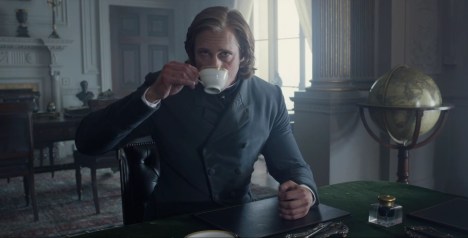
"Anyone for tea?"

“Anyone for tea?”

It is also a lot less satisfying. Tarzan is an archetypal character. Many of the character’s trappings linger in popular memory. Even people who have never seen a Tarzan film will recognise the character’s battle cry. The loincloth is just as iconic as Superman’s red underwear. There are certain expectations in a Tarzan adaptation. Defying many of those choices is a bold storytelling decision, but that decision creates an absence at the heart of the film. Director David Yates and star Alexander Skarsgård never manage to fill that void.

The result is a film that is fun to puzzle out, but not entirely engaging on its own terms. Characters repeatedly acknowledge “the Legend of Tarzan”, whether sketched on posters or memorialised in song. However, the film spends so much of its first half picking apart the legend that it struggles to put it back together at the climax.

Note: there is more colour in this frame than in the entire film.

Note: there is more colour in this frame than in the entire film.

Continue reading

Non-Review Review: Absolutely Fabulous – The Movie

Absolutely Fabulous: The Movie is that it feels very much like an extended special of the classic British sit-com. Sure, the film has an expanded budget that allows for some suitably glitzy location work. Of course, the film is stuffed to the gills with even more celebrity cameos than you could shake a stick at. However, there is very much a sense that Absolutely Fabulous has not been radically transformed in the transition from goggle box to silver screen. This is very much in the spirit and style of the source material.

That is perhaps both the best and worst thing that could be said about Absolutely Fabulous: The Movie.

Saundering off...

Saundering off…

Continue reading

Non-Review Review: The Neon Demon

Is it possible for a film set in the world of high fashion to be too superficial?

That is very much the crux around which Neon Demon pivots. Nicolas Winding Refn is a glorious stylish director with a strong visual sense and a provocative attitude. Thematically, his films tend to touch upon broad ideas like the correlation that exists between masculine identity and violence. It is familiar ground for anybody who has ever watched a film, followed a television show, read a book or even browsed a newspaper. Refn doesn’t necessarily do anything novel or compelling when it comes to his subject matter.

A cut throat industry...

A cut throat industry…

Instead, Refn offers a striking aesthetic that is lush and overwhelming. It is too much to suggest that Refn’s films would work just as well (or even better) with the volume turned down low. After all, Cliff Martinez’s scores are a key part of the appeal of Drive and Only God Forgives. More than that, the blunt metaphorical “nobody in the history of the world has ever talked like this” dialogue is very much part of the appeal. Characters in Neon Demon converse around one another, talking in abstracts and affectations. It is a pure pulpy delight.

At the same time, Neon Demon brushes up against its own limitations. When Refn draws on archetypal female characters, he seems to fall back on shallow sexist caricatures. “Are you food or are you sex?” one character asks young model Jesse early in the film. The movie suggests its own alternative (and sadly all too conventional) dichotomy. Refn’s female characters are reductive and crudely formed; just like his male characters. However, the reduction of the female characters in Neon Demon is much more problematic than that of his male characters.

This business can murder.

This business can murder.

Continue reading

Non-Review Review: Elvis and Nixon

Elvis and Nixon is a larger than life account of a larger than life meeting between two unlikely legendary figures.

Much has been made of the fact that neither Kevin Spacey nor Michael Shannon bear much resemblance to Richard Milhous Nixon or Elvis Aaron Presley. In fact, the film even makes a point of mentioning it. After a weird encounter at the White House gate, one security guard concedes of Elvis, “He’s taller than I thought.” Of course he is; Michael Shannon is noticeably (about ten centimetres) taller than his character. Indeed, the lack of physical resemblance between the actors and the subjects seems to be the point.

"Yeah, I suppose he KINDA looks like he from an angle."

“Yeah, I suppose he KINDA looks like he from an angle.”

After all, many of the best cinematic Nixons look rather unlike the nation’s thirty-seventh president. Anthony Hopkins and Frank Langella picked up Oscar nominations despite the fact that there was no risk of confusion. The same is true of Dan Hedaya, even if he never picked up an Oscar nomination. Both Richard Nixon and Elvis Presley exist as larger-than-life figures in the American popular consciousness more than distinct individuals; both are recognisable archetypes who seem to speak to the nation’s cultural memory more than its specific history.

Elvis and Nixon realises and embraces this. The film is gleefully and archly ahistorical, to the point that this becomes the point. It is not so much that the line between reality and fiction blurs for director Liza Johnson, it’s that the boundary never existed in the first place. There is no record of what actually happened during the thirty minute conversation, but that’s probably for the best. Nothing could be quite as fun as the mismatched odd couple comedy of Elvis and Nixon.

Photo finish...

Photo finish…

Continue reading

Non-Review Review: The Conjuring 2

The Conjuring 2 is effectively a tentpole horror.

It is very much a horror film, with James Wan demonstrating all the skill and technique that he had honed over years working in the genre. There some wonderful slow pans and creepy camera movements that emphasise negative space, some very effective use of timing and mounting dread, and a palpable sense of menace. There are jump scares and slow scares, and enough false alarms to keep the audience on the edge of their seats. The Conjuring 2 is in many ways an old-school archetypal horror film.

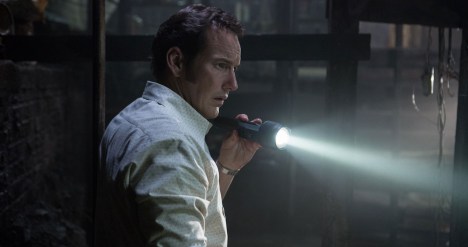
He ain't afraid of no ghost...

He ain’t afraid of no ghost…

However, there is something interesting happening in the background. The Conjuring 2 might have all the basic ingredients of a horror movie, but they are assembled in the style of a tentpole blockbuster. To be fair, the big summer release date is a bit of a clue, as is the climax that features a sweeping race-against-time as the heroes try to desperately make it back from the train station. Indeed, The Conjuring already launched something of a shared horror universe with the spin-off Annabelle.

In some respects, The Conjuring 2 feels like something of a mash-up, reflecting contemporary pop culture’s fascination with mashing existing concepts together to form intriguing cocktails. What is really surprising about the film is how well it works.

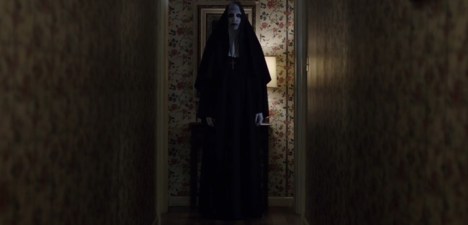
"I'm sorry, you wouldn't happen to be able to direct me to the Marilyn Manson concert, would you?"

“I’m sorry, you wouldn’t happen to be able to direct me to the Marilyn Manson concert, would you?”

Continue reading

Non-Review Review: The Nice Guys

The Nice Guys is a superb piece of work, a retro seventies buddy action comedy with charm to spare.

The Nice Guys is dripping with period detail. The opening tracking shot swoops behind the iconic “Hollywood” sign, still trapped in a state of decay. The characters wear brightly coloured suits. The soundtrack is populated by recognisable disco and funk songs. There are repeated references to President Richard Nixon. Characters smoke like troopers and drive around in open-top convertibles while somehow managing an unhealthy combination of sideburns, stubble and moustaches. In short, the film is set in the seventies, and the audience won’t forget it.

Cigarette-Smoking Man.

Cigarette-Smoking Man.

However, The Nice Guys has a much deeper retro charm. It harks back to the sort of buddy action films that have become a rarity these days, the story of two lovable klutzes who wander into a life-or-death mystery that gradually unravels over the course of two hours. The stakes are charmingly low-key; there is no city destroyed, no threat on a planetary scale. The characters are broadly drawn archetypes, but neither have be chosen or fated. There are at most a couple of lives resting on their shoulders, their own included.

The Nice Guy harks back to a very nineties buddy action comedy aesthetic, demonstrating a nostalgia that is more than skin deep, but which is nonetheless endearing.

Board to death.

Board to death.

Continue reading

Non-Review Review: Money Monster

Money Monster works better as a heightened thriller than as righteous social commentary.

There is a lot to recommend Money Monster, beginning with the basic premise. Lee Gates is the fast-talking abrasive host of a hyper-masculine financial television show, who finds one Friday afternoon broadcast hijacked by a disgruntled investor who followed his advice. Tensions quickly escalate, as Gates finds himself trying to stay alive while also unravelling a thread of conspiracy and deceit that seems to tie the financial markets together. Gates and his assailant find themselves part of an unlikely team-up to blow this corruption wide open.

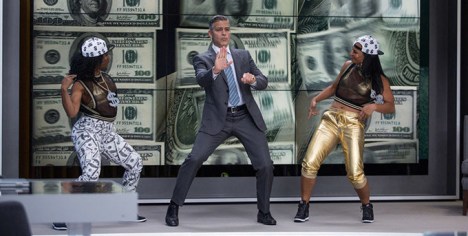
Money talks. It can also dance.

Money talks.
It can also dance.

Money Monster hinges on the combination of Jodie Foster’s direction and the cast’s charm. George Clooney remains one of the most charismatic performers on the planet, and there is a reason that Julia Roberts was one of the most successful lead actors of the nineties. While Clooney and Roberts add star power to the film, Foster benefits from casting Jack O’Connell as the irate-investor-turned-would-be-suicide-bomber. While performers like Dominic West and Giancarlo Esposito are horribly underused, they do add gravity to the film.

Jodie Foster is smart enough to keep the film moving. Even as a high-concept thriller, Money Monster is absurd. The characters frequently act irrationally. The plot never feels like an organic series of rippling consequences, with the author’s hand consistently visible. It is a movie that hinges on contrivance, with Foster working very hard to prevent the audience from catching their breath long enough to question the logic of what is unfolding on-screen. In some respects then, it has more in common with the world of high finance than it would care to admit.

Taking stock.

Taking stock.

Continue reading