• Following Us

  • Categories

  • Check out the Archives


  • Awards & Nominations

Non-Review Review: IT

IT works best as a fusion of weird fiction with a classic coming of age story.

IT is arguably one of Stephen King’s most iconic and influential works. Pennywise the Dancing Clown is perhaps King’s most instantly recognisable creation. King’s work seems to recognise this. The monster clown haunts his fiction, making various appearances in other works, suggesting that the creature is an infection spreading across the author’s vast tableau. There are lots of reasons for IT‘s success and status, but a lot of it comes down to the fact that IT is an encapsulation of many of King’s pet themes and plays to many of King’s strengths.
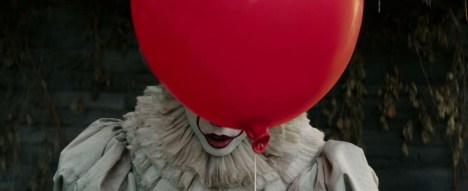
Bill Skarsgård used his other 98 red balloons on Atomic Blonde.

Director Andrés Muschietti seems to understand this. In fact, IT serves as a smorgasbord of cinematic King adaptations, drawing upon and even quoting from various other successful adaptations of the author’s work. Most notably, IT owes a surprisingly large debt to Stand By Me. The decision to exorcise the “present day” sequences of the novel from this film, leaving them to a potential sequel, means that IT is even more overtly and consciously a coming of age narrative.

However, IT is very much a coming of age horror story, a grotesque and unsettling expression of the nightmares lurking just behind familiar childish fears.

There’s something in water.

Continue reading

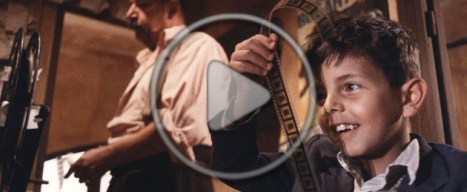
42. Cinema Paradiso (#55)

Hosted by Andrew Quinn and Darren Mooney, The 250 is a fortnightly trip through some of the best (and worst) movies ever made, as voted for by Internet Movie Database Users. New episodes are released every second Saturday at 6pm GMT, with the occasional bonus episode between them.

This time, Giuseppe Tornatore’s Cinema Paradiso.

Successful film director Salvatore Di Vita receives word the projectionist at the Cinema Paradiso has died. This news prompts Salvatore to embark on a literal and metaphorical journey back to the small village in which he grew up, exploring memories of his childhood and of the magical days spent in the cinema that served as the lynchpin of his idyllic community.

At time of recording, it was ranked the 55th best movie of all time on the Internet Movie Database.

Continue reading

Non-Review Review: The Black Prince

The Black Prince is a well-intentioned misfire.

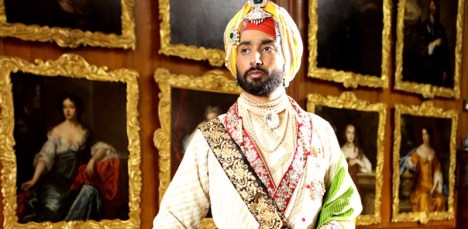
Written and directed by Kavi Raz, The Black Prince is a historical epic attempting to explore the life and times of the Maharaja Duleep Singh, who was abducted from India and taken to the United Kingdom where he became Queen Victoria’s “black prince.” The movie is undoubtedly ambitious and a labour of love for Kavi Raz, who is clearly working within any number of severe budget and production restraints. The best thing about The Black Prince might just be its canny use of existing locations that create a fascinating period atmosphere that recalls a vintage BBC drama.

However, the problems with The Black Prince are more fundamental than any issue with budget or ambition. Raz clearly has an abiding sympathy for and interest in the Maharaja Duleep Singh, but the film suffers from a reluctance to take a step back from its subject. Instead of tightening its focus on one aspect of the character’s life, or one key decision, the film attempts to condense the character’s entire history down to a two-hour movie. The result is a movie where a lot of things happen, but none of those things feel grounded in anything particularly important.

The Black Prince is a movie that suffers from its desire to be all things to all audiences, trying to pivot between genres in the spaces between scenes, reducing its central characters to vehicles for plot-driven or historical exposition, and changing its core premise so frequently that it feels like the cliffnotes of a much stronger film.


Continue reading

Non-Review Review: Wind River

Taylor Sheridan’s loose “Frontier trilogy” imagines the frontier as the site of America’s original sin.

Like Sicario and Hell or High WaterWind River is set in what might be considered a modern-day equivalent of the “wild west.” It is a harsh and brutal world, one in which people fight a losing battle to make sense of that violence. Sicario imagined the frontier as Mexico, a tale of lawless retribution set against the backdrop of the already-lost War on Drugs. Hell or High Water imagined that frontier in Texas, a modern tale of bank robberies and land grabs. Wind River pushes that frontier to vast frozen surroundings of Wyoming, putting Native Americans in focus.

In the wild white yonder…

As the trilogy has moved North, it has also shifted tones. Sicario was confused and angry, struggling to explain the horrors that were unfolding. Hell or High Water blended that anger with a sense of wistful nostalgia, reflecting on the tragic irony of manifest destiny eroded by late capitalism. Wind River is just profoundly sad, a meditation on loss that seems more exhausted than angry. It is a tale about those people left behind on what remains of the frontier, about violence that is too easily overlooked and ignored. There is no rage here, no passion. There is just fatigue.

Wind River is a western set in the forgotten part of the west. It is a western set in the snow, on a Native American reservation. It is the story of a frontier that is too readily forgotten.

In cold blood.

Continue reading

Non-Review Review: Annabelle – Creation

The issue with Annabelle: Creation is not one of skill or technique. Annabelle: Creation is a very well-crafted and well-constructed horror film. The issue is that Annabelle: Creation never quite figures out what kind of horror film it wants to be.

Annabelle: Creation struggles with tone. The movie bounces between extremes. At some points, it feels like it wants to be a genuinely dark and unsettling study of trauma and exploitation, a harrowing horror movie metaphor for some of the worst terrors that could be inflicted upon its young cast in their remote location. At other points, it is a much more conventional action horror movie, combining the blockbuster thrills approach of The Conjuring with the almost playful concept-driven self-aware scares of Lights Out.

Eye, Creepy Demonic Doll.

The movie often feels caught between these two approaches, repeatedly suggesting something much darker nestled at the core of what is a fairly solid and fairly recognisable horror template. There are moments when Annabelle: Creation is skin-crawlingly effective, and there are moments when the film cleverly punctuates its scares with awkward-laugh-out-loud moments of stress relief. In isolation, David Sandberg balances both approaches quite well.

The problem comes in trying to blend them together.

“Give me a moment, I’ve got to put my face on.”

Continue reading

Non-Review Review: Detroit

Detroit is a powerful and visceral piece of cinema, one that loses its way in a muddled second act.

The Hurt Locker and Zero Dark Thirty cemented Kathryn Bigalow’s talent for conveying a sense of chaos and disorganisation on film. It can be very difficult to capture the messiness of real life in the movies, given how cluttered narratives can become distracting or disorienting. It takes a very real talent to guide the audience through this carnage in a way that captures the organic ambiguities of the story while ensuring that nobody is lost or distracted. Bigalow has a very rare talent for that.

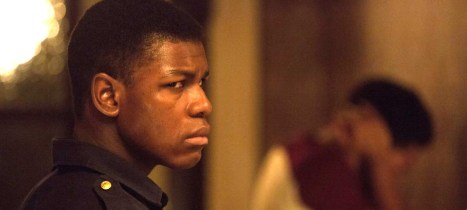
Insecurity guard.

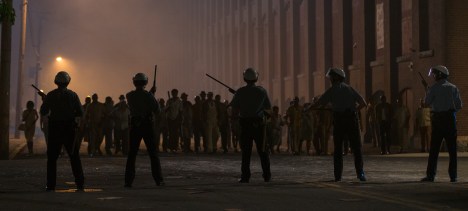
Unsurprisingly, Detroit works best in its opening and closing acts, when the narrative pulls back to the real-life story covering the Detroit Riots in late July 1967. The film’s opening and closing beats have the feel of a weird docudrama, with Bigalow using handheld cameras and tight focus in a way that allows her to blend footage of the cast with archive material. Characters are identified by legends down the bottom of the screen, while the audience is frequently put in the position of confused spectators in a way that captures the mere anarchy loosed upon the city.

However, Detroit fumbles a little bit in its second act. For the middle of the film, Detroit narrows its focus significantly. Instead of providing socio-economic and political context for the entire riots, or dealing with the aftermath of horrific events, Detroit transforms into a story about a bunch of characters locked in a confined space together. As the film’s closing text admits, these sequences are much less verifiable than the snapshots populating the opening and closing acts, much less a matter of public record.

Big Mackie.

The second act of Detroit is a more conventional fictional narrative. While the movie is never less than interesting and clever, that organic sensibility is lost. During the first and third acts, the focus is on the broader story of the larger community, so it does not matter that many of these characters feel like archetypes and ciphers. When Detroit zooms in on the characters, they seem drawn too crudely to support the scrutiny. Detroit works a lot better as an epic social study, and less well as a claustrophobic character study.

Bigalow struggles to get the balance right, resulting in a film that is certainly ambitious and worthy, but also more uneven than her recent output. Detroit is too confident and too professional to be deemed a failure, but its second act is too shallow to be a success either.

I predict a riot.

Continue reading

Non-Review Review: Dunkirk

Dunkirk is compelling in its contradictions.

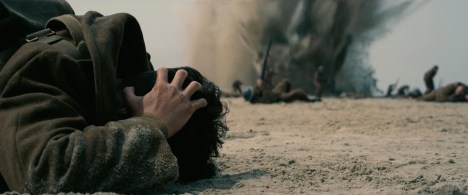
Dunkirk concerns a pyrrhic victory, a defeat which became a source of national pride. Dunkirk is at once a story rooted in a very particular event and a mythic narrative populated by archetypal characters. Dunkirk follows three parallel stories as they move towards a singular inevitable climax, although those narratives are allowed to move at their own pace towards those epic events and even overshoot one another. Dunkirk is at once chaotic and disjointed, and yet moving with a very clear sense of purpose and direction.

Directed by Christopher Nolan, it is too much to describe Dunkirk as a “puzzle box” narrative. It always very clear to the audience exactly what is going on, and the movie’s mysteries and revelations tend to be smaller and intimate rather than broad and sweeping. Nevertheless, it is a movie consciously unstuck in time, recalling Nolan’s long-standing fascination with shifting his narrative backwards and forwards along a timeline. (Insomnia, The Dark Knight and The Dark Knight Rises stand out as Nolan’s most linear films.)

Dunkirk is a war epic in the broadest possible sense, its narrative bouncing between three separate timelines covering the retreat from the eponymous port. However, there is also a faint sense that Dunkirk itself is unstuck in time. As much as the film is rooted in the reality of the 1940 evacuation of Dunkirk, it speaks to something much bigger and more sweeping. There is a vagueness to Dunkirk which suggests that the film might well speak to realities beyond its specific setting.

Continue reading

Non-Review Review: The Big Sick

What is most striking about The Big Sick is the sense of authenticity, and not in the most obvious way.

The Big Sick was written by the husband and wife team of Kumail Nanjiani and Emily Gordon, loosely inspired by their own romance. Nanjiani plays a fictionalised version of himself, a stand-up comedian working in Chicago dealing with the weight of his parents’ expectations. Zoe Kazan plays a slightly more fictionalised version of Gordon, swapping out the surname Gordon for Gardner. The broad strokes of the story conform to how Nanjiani and Gordon came to meet and fall in love, and some of the barriers that arose between them. So The Big Sick is authentic in a very literal way.

However, The Big Sick is most striking in its small moments. While the movie is obviously built around the narrative arc of this true-to-life relationship, it perfectly captures all the weird little moments that define people. Nanjiani is a comedian by profession and Gordon is a psychologist, and there is a sense that both are keen observers of human nature. There are a lot of little touches in the film that resonate, that add a sense of convincing realism and gravity to a story that is dealing some very weighty material. (After all, the title of the film kind of hints at the stakes.)

The Big Sick is an astoundingly beautiful piece of work.

Full disclosure: Kumail Nanjiani is a very nice person. I don’t know him personally, but he very kindly agreed to write the intro to my upcoming book Opening the X-Files: A Critical History of the Original Series. Which I believe was in the middle of the production of this film, so I greatly appreciate that.

Continue reading

35. Baby Driver – This Just In (#127)

Andrew Quinn and Darren Mooney host This Just In, a subset of the fortnightly The 250 podcast looking at notable new arrivals on the list of the 250 best movies of all-time as voted for by Internet Movie Database Users.

This time, Edgar Wright’s Baby Driver.

Continue reading

Non-Review Review: The House

The House comes from the writing duo Brendan O’Brien and Andrew Jay Cohen, representing Cohen’s directorial debut.

O’Brien and Cohen are perhaps best known for their work on Neighbours and Neighbours II: Sorority Rising, two of the more successful “overgrown manchildren” movies of the past few years. (They also worked on the somewhat underrated Mike and Dave Need Wedding Dates.) While these sorts of movies about grown-ups behaving badly are a dime-a-dozen in the modern comedy landscape, Neighbours and Neighbours II were elevated by a number of factors: attention to their female leads, very canny casting, clever shifts in the film’s moral weight at key moments.

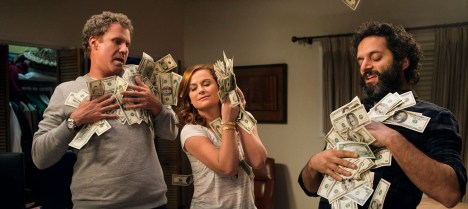
They are so money.

The House is perhaps a more modest proposal than Neighbours and Neighbours II. It is certainly a lot more straightforward in its plotting and character arcs, a simplicity reflected in the relatively abridged run-time of eighty-eight minutes. (To be fair, both Neighbours and Neighbours II kept their runtime just over the hour-and-a-half mark, which seems about right for a broad comedy.) However, it shares one key strength. It is a movie that very skilfully captures the feeling of a mid-life crisis, and the yearn to return to into a belated adolescence.

The House is a little uneven in places, prone to the structural problems that haunt a lot of contemporary blockbuster comedy from the jokey asides that jar with the narrative to the oh-so-tidy resolution, but it has a solid core. It is a movie that understands the middle-class middle-aged urge to break bad in the most banal of fashions, just a hint of sadness lurking beneath its more absurd twists. The House doesn’t always win, and maybe it hedges just a little too much, but it knows the game that it is playing.

A dicey proposition.

Continue reading