• Following Us

  • Categories

  • Check out the Archives


  • Awards & Nominations

New Escapist Column! Twenty Years Later, “Battle Royale” Still Stands Apart…

I published a new In the Frame piece at The Escapist this evening. Because Battle Royale is twenty years old this month, it seemed like a good opportunity to take a look back at the iconic Japanese film.

In the years since the release of Battle Royale, there has been an explosion of dystopian young adult fiction based around similar premises: the idea of children forced to kill other children to survive. There are plenty of examples of this subgenre, most notably The Hunger Games, Divergent and The Maze Runner. However, Battle Royale has aged better than these other films for two core reasons. First of all, it acknowledges the horror of its premise, rather than sanitising it. Second of all, it understands that this social decay is perhaps more mundane than sensationalist.

You can read the piece here, or click the picture below.

“He’s Smart, You’re Dumb!” The Cynical Idiocy of “The Wolf of Wall Street”…

The podcast that I co-host, The 250, just finished a season of coverage of director Martin Scorsese. The weekend before last, we discussed Scorsese’s The Wolf of Wall Street. It’s a fun, broad discussion that digs into the movie in a lot of depth. However, watching the film and talking about the film got me thinking about the film’s portrayal of Jordan Belfort.

Martin Scorsese was seventy-one years old when The Wolf of Wall Street was released, and had a filmography that stretched across six decades.

As such, it is heartening that Scorsese had a film like The Wolf of Wall Street in him. The film runs three hours, but moves with an impressive and exhausting energy. Critic Robbie Collin described The Wolf of Wall Street as “a picture that would have exhausted a director half his age.” Indeed, it seems fair to say that the film exhausted quite a few of its audience. The Wolf of Wall Street was the highest-grossing movie of Scorsese’s career, but there is some evidence it was divisive with audiences – earning a controversial “C” CinemaScore.

Indeed, the film earned no shortage of outrage. Scorsese himself was reportedly accosted at a screening for the Academy of Motion Picture Arts and Sciences by veterans chanting “shame on you!” The film’s portrayal of greed and excess prompted something of a moral panic. There legitimate concerns raised about where the money to fund the movie came from. There was also the reasonable observation that Scorsese had constructed The Wolf of Wall Street in such a way as to obscure the victims of Jordan Belfort.

Of course, this is something Scorsese’s films have always done, and a way in which they have consistently made the audience uncomfortable by effective immersing them in a world governed by characters who are hostile and dangerous. Taxi Driver seldom allowed itself to step outside Travis Bickle’s head, with the audience forced to confront “god’s loneliest man.” Raging Bull refused to pathologise or explain Jake LaMotta, declining to reduce his psychology to trite cause and effect. Henry Hill took centre stage in Goodfellas, but the film itself suggested he was not to be trusted.

Scorsese’s output is often framed in religious terms, and there is a strong spirituality that runs through his work. It is obviously most apparent in films like The Last Temptation of Christ, Kundun or Silence, but it is a constant throw line – even where religious authority is defined by its absence, with Casino feeling like a story about what happens when man believes that God is not watching. However, Scorsese’s films also trade in doubt, challenging the audience with the fear that there may be no external arbitrator to balance the scales.

The Wolf of Wall Street offers little in the way of emotional catharsis, little by way of reassurance that people like Belfort will be punished for their crimes or that the victims will be compensated. After all, even by 2013, it was obvious that nobody actually responsible for the financial crisis would be held to account. Scorsese stated in interviews that the anger that The Wolf of Wall Street generated was part of the film’s point. “It should touch a nerve!” he insisted in interviews around the film’s release, explaining why he declined to offer a more moralistic movie.

Of course, like Taxi Driver and Raging Bull and Goodfellas before it, The Wolf of Wall Street does condemn its subjects. Of course there are plenty of reports of stockbrokers on Wall Street loving the movie, just as many gangsters loved The Godfather. However, it seems highly unlikely that any reasonable person leaving The Wolf of Wall Street could feel any sympathy or warmth for Jordan Belfort, or that anybody paying attention to the film could imagine that his lifestyle would lead to anything other than disaster and betrayal, even if he avoided jail or bankruptcy.

More than that, The Wolf of Wall Street is notable for its refusal to glamourise Belfort himself. The film consistently portrays its subject as a moron defined only by his ravenous id, all impulse and no control. Indeed, some of that Scorsese spirituality shines through. Belfort often seems less than human, incapable of the reasoning, self-control and empathy that elevates a human being. Indeed, to frame the portrayal in Catholic terms, the elements that suggest the existence of a soul. The Wolf of Wall Street is about an animal more than a man.

Continue reading

Non-Review Review: Let Him Go

Any plot summary of Let Him Go inevitably does the film a disservice.

After all, the basic narrative of Let Him Go invites comparisons to the “da’ction” genre that was popularised by Taken. (In fact, Honest Thief is in cinemas at the moment, proving that even the pandemic cannot kill the Liam Neeson midlife action film.) At its core, Let Him Go is a story about an older couple who embark on a journey to rescue their lost daughter-in-law and their grandson from an increasingly ominous set of circumstances. It becomes obvious as the film progresses that George and Margaret are mounting a rescue mission in hostile territory.

Peak Da’ction? (Or “Dad-ction”, for our American readers?)

In reality, Thomas Bezucha’s film is a much more meditative and contemplative affair than that description suggests. Let Him Go offers a quiet and introspective character study of an elderly couple venturing through the wilds of the American heartland, navigating their shared grief offer the loss of their son in a freak accident as much as their anxieties around the possible fate of their grandson. Much of Let Him Go consists of George and Margaret trying to navigate a strange world, but also one another.

The results are compelling. Let Him Go features flashes of violence and brutality, but it works best as something of a mood piece. It’s a melancholy reflection on a warped and hostile landscape, playing as an update on the classic western template for the modern era.

Bucking the trend.

Continue reading

Non-Review Review: Stardust (2020)

Stardust is not just a terrible movie, it often feels like a very direct insult to its subject.

To some extent, Stardust was inevitable. The commercial and awards success of Bohemian Rhapsody had cemented the musical biopic as an organic extension of the jukebox music genre that had enjoyed popular success with Mamma Mia and Mamma Mia: Here We Go Again. Given that the logical extension had been to move from a Freddie-Mercury-centric biopic to an Elton-John-centric biopic with Rocketman, it seemed that iconic British musical artists from the seventies were ripe for this sort of treatment.

“But the film is a saddening bore.
For she’s lived it ten times or more.
She could spit in the eyes of fools.
As they ask her to focus on…”

David Bowie loomed large in that line-up, so a Bowie biopic seemed the next logical step. Of course, there are two fundamental problems with Stardust. The first is one of genre. Whether fairly or not, the musical biopic has a certain structure and rhythm to it. This was the case with the early iterations of the genre like Ray and Walk the Line, and it was spoofed mercilessly with Walk Hard. That formula is evident in Bohemian Rhapsody and Rocketman, unironically reiterated. That formula has its uses, but David Bowie was an artist who defied those sorts of tropes and beats.

However, the second fundamental issue with Stardust is particular to the movie. A large part of the appeal of musical biopics is the soundtrack, with the plot often feeling like a set of hooks on which the movie might hang iconic and beloved songs. The soundtrack album is a huge part of the commercial appeal of these projects. Rocketman arguably pushed this idea to its extreme by embracing the cinematic language of the musical, but it was there in Walk the Line and Bohemian Rhapsody.

“Time takes a cigarette, puts it in your mouth.
You pull on your finger, then another finger, then cigarette.
The wall-to-wall is calling, it lingers, then you forget.”

With that in mind, it is notable that Stardust is effectively a jukebox musical biography without any jukebox music. The Bowie estate declined to license Bowie’s music for the film, which should have been enough to stop the project dead or at least require a major rethink of the approach to it. Without a killer Bowie soundtrack, trying to emulate Bohemian Rhapsody and Rocketman would be a fool’s errand. There is probably a way to tell the story of David Bowie’s life without including his music, but a formulaic musical biopic is not it.

One almost has to admire the stubbornness in committing to a format almost wholly reliant on a soundtrack that is legally unavailable to the film in question. Almost.

“Making love with his ego,
Ziggy sucked up into his mind,
Like a leper messiah.”

Continue reading

Non-Review Review: Songbird

Perhaps the most surprising thing about Songbird is how tame and lifeless it is.

The trailer arrived in a multimedia firestorm, positioning the movie as a piece of “pandemic-xploitation”, set against the backdrop of a hypothetical future where the current global pandemic had raged for four years. In this climate, public health officials have begun abusing their power, the black market thrives, the government has set up ominous and secretive “Q-zones” to house those affected. “Once you go to the Q-zone, you don’t ever really leave,” an influencer remarks early in the film. The United States operates under “marshal law”, as virus has “mutated” to attack the brain.

Sick privilege, bro.

All of this sounds very crass and very charged, something similar to what happened with the release of The Hunt earlier in the year. Songbird and The Hunt are movies that position themselves as genre pieces with biting resonance to a highly charged and combustible situation. However, like The HuntSongbird is ultimately something of a damp squib. It makes grand gestures towards the current moment, importing all manner of iconography and language associated with the pandemic to give it a patina of relevance, but ultimately ties it to a fairly conventional story.

This is perhaps the biggest difference between something like The Hunt and something like Songbird. The Hunt was ultimately a standard genre movie that disguised itself as something more relevant, but it was reasonably well constructed. In contrast, Songbird is an absurdly slipshod production. The film often feels like it was cobbled together over a weekend to ensure that it would be released at a point where it was still relevant and timely. The result is a shoddily made and vapid piece of work, that somehow feels even more vulgar than a full-throated exploitation film might.

Cooking up a Stormare…

Continue reading

Non-Review Review: The Prom

The Prom arrives on Netflix as part of director Ryan Murphy’s deal with the streaming service, similar to the adaptation of The Boys in the Band.

On one level, The Prom is perfectly suited to Murphy’s aesthetic as a director. It is an adaptation of a Broadway musical about Broadway musicals, one that collides with a stereotypical depiction of the American heartland in a way that invites a heightened and almost caricatured version of both. The Prom is a larger than life production, and feels very much of a piece with Murphy’s output as writer, director and producer – from American Horror Story to Ratchet to Glee. There is no sense that any approach to The Prom could ever be “too much”, and so it’s a good fit for Murphy.

Making a whole production of it.

At the same time, The Prom ultimately feels rather empty. Murphy is very good at offering stylised hyperreal worlds, but The Prom feels like a hollow confection. This problem is compounded by a tonal issue; the movie is never entirely sure how cynical or how earnest it wants to be, and so is frequently caught halfway between extremes. The Prom never seems entirely sure whether it’s a brutal parody of feel-good nonsense or a triumphant example of escapist entertainment, so it never works in either register.

This is a shame, given the talent involved in the production and the occasional momentum that the film manages to build through its high-energy song-and-dance numbers and its game cast. Sadly, though, it never manages to hit the high notes that it needs to.

It’s a bit Broad(way)…

Continue reading

“Saint Rose” is in Irish Cinemas This Weekend!

Obviously release schedules have been a bit of mess this year with the pandemic on-going. As a result, international release dates are staggered. Irish cinemas are reopening for the first time in months, and Saint Maud is now screening.

Rose Glass’ blackly comic horror film is one of my favourite films of the year to date, and so is deserving of a shoutout. You can read the original review from the Dublin International Film Festival here, or you can pick the picture below.

Non-Review Review: Wolfwalkers

Wolfwalkers is a stunningly beautiful piece of animation.

Of course, that almost goes without saying. Cartoon Saloon remain one of the most consistent animation houses in the world today, steadily building a reputation among animation aficionados that might invite comparisons to other artisanal studios like Ghibli or even Pixar; their previous three feature films all received Oscar nominations, and Wolfwalkers itself seems sure to earn its place among this year’s nominees.

Packed full of excitement.

Still, there’s an admirable ambition to Wolfwalkers, a sense that the studio is not merely resting on its laurels and is instead pushing itself forward. Wolfwalkers is perhaps the most technically accomplished animation that Cartoon Saloon have produced to date, applying all of the studio’s key strengths and throwing some playful experimental elements into the mix. Wolfwalkers retains the stylised Celtic aesthetic that informed both The Secret of Kells and Song of the Sea, but also throws in elements with a more international flavour. The results are breathtaking.

While the film suffers slightly in narrative terms, particularly in contrast to the studio’s work on The Breadwinner, it is a consistently and breathtakingly beautiful work.

Continue reading

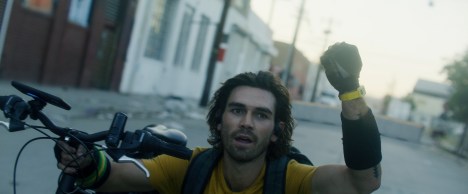
Non-Review Review: Mosul

Mosul is a frustratingly generic war movie, particularly given its potential as an exploration of Iraq in the wake of the American withdrawal.

Mosul is produced by Joe and Anthony Russo, best known as the directors of Avengers: Infinity War and Avengers: Endgame. The pair have leveraged the success of their work with Marvel to produce the work of other filmmakers, including past collaborators. 21 Bridges was a star vehicle for Black Panther leading actor Chadwick Boseman. Extraction starred Thor actor Chris Hemsworth and was directed by stuntman Sam Hargrave who had been Chris Evans’ stunt double on Captain America: The Winter Soldier.

Iraqqing up an impressive reputation.

Mosul marks the directorial debut of veteran writer Mathew Michael Carnahan, who collaborated with Adam Mervis on the screenplay for 21 Bridges. Indeed, the Middle Eastern War on Terror framing of Mosul feels like an organic extension of Carnahan’s interests as a writer; his first two screenplay credits were for The Kingdom and Lions for Lambs, both released in 2007. As such, tasking Carnahan with making a boots-on-the-ground war film about the chaos in Iraq following the end of American involvement seems like a perfectly logical choice.

To his credit Carnahan understands the language and the logic of war movies. With its emphasis on handheld footage, Mosul occasionally feels like a spiritual companion to something like Blackhawk Down. With its recurring fascination with the absurdity and insanity of the horror of these sorts of conflicts, Mosul plays an extension of the core themes of Apocalypse Now. Indeed, Carnahan cycles through the conventional tropes and clichés of war movies with thrilling abandon, ensuring a propulsive sense of momentum and movement through the film.

“Mosul, Mo’ Problems.”

At the same time, Mosul feels a little too generic and too conventional. There are only a handful of sequences in the movie that feel like they relate specifically to this context, to the particulars of the war being waged in Iraq against Daesh. Too often, the film feels like it could be any war in any place at any time. It doesn’t help that Mosul positions itself more as an action movie and thriller than as a drama or study. Indeed, there are moments when Mosul feels just a little exploitative, as if attempting to extract pulpy thrills from a crisis that is still unfolding.

That said, Mosul hits most of its marks with enough skill and efficiency that none of these problems ever reach critical mass. Mosul bounces quickly from each set-up to the next, never allowing its audience or its characters the space to dwell on the familiarity of its set-up and execution. Mosul is a tightly constructed war thriller, even if it never fulfills its potential.

Commanding presence.

Continue reading

Non-Review Review: Another Round

Another Round marks another successful collaboration for director Thomas Vinterberg and actor Mads Mikkelsen.

Another Round is an exploration of alcoholism, filtered through the lens of midlife crisis. Prompted by a conversation over dinner, four teachers decide to embark on a pseudo-scientific study to test the hypothesis that the human body and mind function optimally with a blood alcohol concentration of 0.5%. This experiment naturally has a variety of unintended consequences for the middle aged men as they attempt to navigate the world of new possibilities that they create for themselves.

Drinking it all in…

Another Round works in large part because of the chemistry of its four leads: Mikkelsen, Thomas Bo Larsen, Lars Ranthe and Magnus Millang. It helps that Vinterberg is also careful to avoid tipping Another Round into stern-faced moralising about the dangers of alcohol. Although the movie’s trajectory is quite obvious from the moment that the four men seize on their plans, Another Round is refreshingly honest about the nature of the four men’s relationship to alcohol. The film understands the pull of alcohol to men in that situation.

Still, Another Round suffers slightly from feeling overly familiar. Its plot and character arcs are straightforward, and the film occasionally tips into outright melodrama in its final act. Still, there’s a lot to recommend Another Round, even if the taste isn’t quite as exotic as it might suggest.

Relighting his fire.

Continue reading