• Following Us

  • Categories

  • Check out the Archives


  • Awards & Nominations

Millennium – Kingdom Come (Review)

This February and March, we’re taking a trip back in time to review the fourth season of The X-Files and the first season of Millennium.

Kingdom Come is a horrible misjudged episode of Millennium, and the show’s first truly spectacular misfire.

Kingdom Come was notably the first episode to air out of production order. It had been produced as the fourth episode following The Pilot, between Dead Letters and The Judge. However, the episode was broadcast as the sixth episode of the television season, after 5-2-2-6-6-6 and before Blood Relatives. The official reason given for this delay was the death of Cardinal Joseph Bernardin in mid-November 1996, following a long and public battle with cancer. It was suggested that an episode about a serial killer targeting religious figures would have been in poor taste at the time.
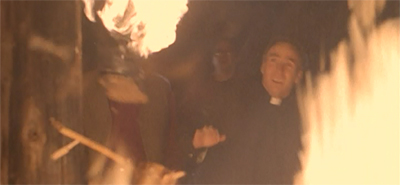
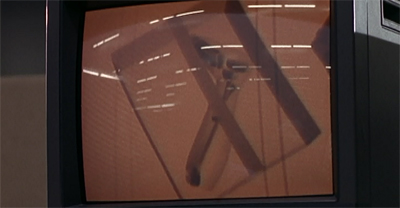
A light in the darkness...

A light in the darkness…

Still, whatever the official reason given, it cannot help but feel like the production staff were hoping to bury a stinker a little deeper into the season. Kingdom Come is an episode that does not work on any number of levels, offering a rather patronising and condescending view of religious faith as explained through stilted exposition and trite cliché. The show’s observations about faith and hope feel more like sentiments from Hallmark greeting cards than observations on the human condition.

The result is an episode that embodies the worst traits of Millennium, feeling just as crass and sensationalist as it does hollow and superficial.
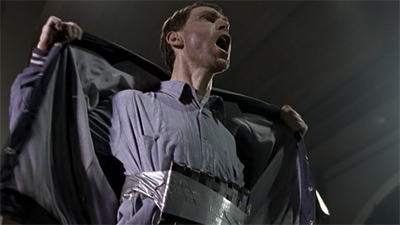
The episode really bombed...

The episode really bombed…

Continue reading

Millennium – 5-2-2-6-6-6 (Review)

This February and March, we’re taking a trip back in time to review the fourth season of The X-Files and the first season of Millennium.

It is interesting to compare and contrast the scripts that Morgan and Wong wrote for the fourth season of The X-Files with the scripts that they wrote for the first season of Millennium. The duo were writing for both shows at the same time – with episodes frequently airing within a week of each other. Morgan tended to focus more on the four X-Files scripts, while Wong worked primarily on the three Millennium episodes. While the seven scripts are all fascinating in their own way, there is a marked difference in how the duo approach the two shows.

Their four episodes of The X-Files are very bold and experimental – they look and feel utterly unlike anything that the show has done; before or after. These four scripts seem to needle at the show, pushing it further. Home seems designed to see how much unpleasantness the writers can get on to Fox prime time in the nineties. The Field Where I Died is a thoughtful and melancholy romance with no companion in the X-Files canon. Musings of a Cigarette-Smoking Man parodies the show’s central conspiracy. Never Again makes the Mulder/Scully dynamic toxic.

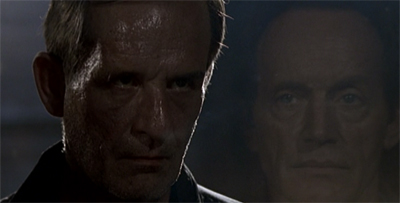
Having a blast...

Having a blast…

That makes a great deal of sense. After all, The X-Files was in its fourth season. It was approaching that impressive “one hundredth episode” landmark, the number of episodes necessary before the show would be secure in syndication. (At least in the television landscape of the nineties.) Although less than half-way through its eventual nine-season run, The X-Files was an old dog by this stage of its life cycle. As such, it made a great deal of sense for Morgan and Wong – two writers who had been there at the beginning – to shake things up.

In contrast, the three scripts that Morgan and Wong wrote for the first season of Millennium are a bit more conservative in scope and tone. They are fascinating pieces of television that help to establish the mood of the show, but they are not as experimental of the work that Morgan and Wong were doing on The X-Files. Again, this makes a great deal of sense. Millennium was still a very young show. It was still defining its own identity, figuring out what it wanted and needed to be. Morgan and Wong’s three scripts are essential in that development.

Taking a page from the Group...

Taking a page from the Group…

Continue reading

Millennium – The Judge (Review)

This February and March, we’re taking a trip back in time to review the fourth season of The X-Files and the first season of Millennium.

The Judge feels very much like an episode that might have worked better later in the first season of Millennium. It deals with pretty big ideas and themes at the heart of the show, but in ways that feel almost clumsy and haphazard. Millennium is still a show that is finding its way, and The Judge pokes and prods at ideas close to the heart of the series as a whole. The episode feels rather clumsy, as though the show hasn’t reached a point where it really has a handle on itself, let alone the sorts of hefty existential questions suggested by The Judge.

At its core, The Judge is fascinated with issues of moral authority and justice – in particular, it asks questions about whether such authority can exist outside (or even inside) the mechanism of the state. Given that Millennium is the story about a man working with a private group to the potential collapse of civil order on the eve of the millennium, The Judge feels like it would be the perfect opportunity to broach questions about the Millennium Group and the work that they do. After all, the Millennium Group and the supporting cast have been haunting the narrative since The Pilot.

Judge not...

Judge not…

While these tough questions hover at the very edge of the episode, it never seems like The Judge addresses them. Then again, The Judge is the fourth episode of the first season of a new show. Millennium is still young. The Judge is written by Ted Mann; it is the first episode of Millennium that is not written by a veteran of The X-Files, by somebody who isn’t Chris Carter or hasn’t experience working within Chris Carter’s world. It is, perhaps, too much to expect it to have a handle on all of that. And The Judge deserves a great deal of credit for marking out areas that the show may want to explore as it grows and develops.

At the same time, while it has some interesting big ideas and a great cast, The Judge feels little clumsy and awkward in its execution. It avoids a lot of the interesting implications of what it says, and it features a rather convenient and contrived final act that seems to exist solely so Frank Black can move on to doing other stuff in the next installment. The Judge is a misfire, but it is an intriguing and interesting misfire. It is precisely the sort of episode that you might expect at this stage in the season.

You've got male (body parts)!

You’ve got male (body parts)!

Continue reading

Millennium – Dead Letters (Review)

This February and March, we’re taking a trip back in time to review the fourth season of The X-Files and the first season of Millennium.

Dead Letters is the first Millennium episode credited to writers James Wong and Glen Morgan, and to director Thomas J. Wright. These are three creative forces that would come to be massively influential in the development of the show.

As with Gehenna, the obvious point of comparison in this early stage of development is with The X-Files. Chris Carter wrote the first two episodes of both shows, outlining the core themes and larger direction. However, the crucial third episode was handed to the team of James Wong and Glen Morgan. They would be the first writers other than Carter to write for Fox Mulder, Dana Scully and Frank Black. They were tasked with demonstrating that these concepts could work in the hands of writers other than Chris Carter.

A hair's breadth away from insanity...

A hair’s breadth away from insanity…

The first script that Wong and Morgan wrote for The X-Files was Squeeze. It was the show’s first stand-alone monster-of-the-week episode, and effectively codified a very flexible subgenre of The X-Files, while also creating a very popular and iconic monster. Dead Letters does something vaguely similar for Millennium, even if it is not quite as effective. Free from a lot of the millennial anxieties that drove The Pilot and Gehenna, Dead Letters offers an example of a fairly pure-blooded “serial-killer-of-the-week” story.

For better or for worse, Dead Letters sets the tone for the rest of the show’s first season.

Bits and pieces...

Bits and pieces…

Continue reading

Millennium – Gehenna (Review)

This February and March, we’re taking a trip back in time to review the fourth season of The X-Files and the first season of Millennium.

Written by Chris Carter and directed by David Nutter, Gehenna feels very much like a continuation of The Pilot.

More to the point, it feels like a restatement of many of the key themes of The Pilot, an attempt to reinforce many of the core ideas in that first episode, and hint at something larger. In many ways, it is about ensuring that Millennium retains its identity as it transitions from a pilot that had a relatively relaxed schedule and high budget into a weekly (well, eight-day) production schedule. Gehenna is about Carter and Nutter proving that Millennium can do what it wants and needs to do week-in and week-out, while also indicating towards larger threads.

Touching (or, at least, seeing) evil...

Touching (or, at least, seeing) evil…

This isn’t a bad way to approach the first regular episode of a television series. Indeed, Carter had done something similar with The Pilot and Deep Throat on The X-Files, structuring the episodes as a one-two punch of reinforced themes and world-building. Gehenna is very much about convincing the audience that The Pilot was not just a flash in the pan, and that the series has a long clear arc ahead of it. Much like Deep Throat really sketched the outline of the alien conspiracy only hinted at in The Pilot, Gehenna features more than a few nods towards a larger evil at work in Frank’s world.

There are points where Gehenna feels a little bit too forced, and a little bit too eager to restate and repeat the themes and ideas of The Pilot. However, it is an interesting episode that does hint towards the show’s future in a number of interesting ways.

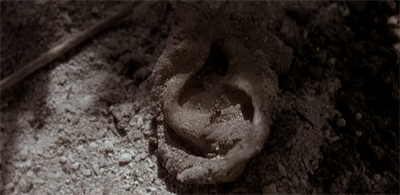
Ear today...

Ear today…

Continue reading

The X-Files – Unruhe (Review)

This February and March, we’re taking a trip back in time to review the fourth season of The X-Files and the first season of Millennium.

Unruhe was the first episode of The X-Files to air on Sunday nights.

The show had vacated its traditional Friday evening slot to make room for Millennium. It had been moved to Sunday evenings. Although the production team were initially quite cautious about the move, it would ultimately pay dividends for the show. The show had already become a mainstream hit, but the Sunday night slot would help to push it into the stratosphere. Airing alongside Fox’s other long-running success story, The Simpsons, the show would secure its highest ratings ever less than six months after moving into its new slot.

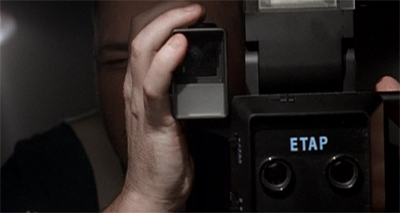
Photo copy?

Photo copy?

Of course, this also draws attention to another interesting facet of Unruhe. This was the first episode of The X-Files to air after Millennium hit the air. Unruhe aired two days after the pilot. The impact of Millennium has already been keenly felt on the fourth season of The X-Files in a number of ways; deadline and production issues hindered Herrenvolk, while James Wong and Glen Morgan had been drafted back to The X-Files to help shore up the fourth season. However, Unruhe seems to directly (and perhaps pointedly) acknowledge Chris Carter’s younger series.

Unruhe is an episode that would probably have been quite at home on Millennium. It is an episode that could easily have been re-worked or re-tooled for Carter’s new show – with only a few minor changes. With its serial offender, fascination with forensic psychology, and its grim reflection on mankind’s capacity for evil, it feels like an story that could comfortably have been told using Frank Black. While it serves to welcome Millennium to the genre neighbourhood, it also seems to suggest that Millennium might be a little redundant.

A walk among the tombstones...

A walk among the tombstones…

Continue reading

Millennium – Pilot (Review)

This February and March, we’re taking a trip back in time to review the fourth season of The X-Files and the first season of Millennium.

You think you’re protecting me but you make it worse, Frank. You can’t shut the world out for me. You can’t ask me to pretend that I don’t know what you do.

Everyone pretends. We all make believe. These men I help catch – make us.

We’re raising a daughter, Frank. The real world starts to seep in. You can’t stop it.

I want you to make believe that I can.

Fade to Black...

Fade to Black…

Continue reading

Space: Above and Beyond – Dear Earth (Review)

This November (and a little of December), we’re taking a trip back in time to review the third season of The X-Files and the first (and only) season of Space: Above and Beyond.

In many respects, Dear Earth serves as a mirror to Toy Soldiers.

Both stories are based around familiar wartime story beats. Both are very sentimental hours of television. Both are firmly anchored in the idea that Space: Above and Beyond is largely about reworking the narratives of the Second World War for a futuristic outer space setting. There is a lot of overlap between Dear Earth and Toy Soldiers, with the episodes feeling like two peas in a pod. They both appeal to the same aspects of Space: Above and Beyond.

You've got mail...

You’ve got mail…

However, Dear Earth works a lot better than Toy Soldiers did. It is dealing with a similar collection of iconic imagery and ideas associated with the Second World War, touching on many of the same themes and ideas; it is just that the execution is considerably stronger. Dear Earth is a show that not only has a lot more charm than Toy Soldiers did, but a lot more humanity. It is an episode that does a lot to remind viewers why they have come to care for the show’s ensemble.

Dear Earth is a very well-made piece of television.

Astro-turf...

Astro-turf…

Continue reading

The X-Files – Revelations (Review)

This November (and a little of December), we’re taking a trip back in time to review the third season of The X-Files and the first (and only) season of Space: Above and Beyond.

Religion, eh?

In the mid-nineties, religion was a very difficult subject to navigate on network television. The so-called “culture wars” were in full swing at the middle of the decade, with religious values serving as a particularly brutal battleground. Religion is a very thorny and contentious subject. As recently as 2012, more than 40% of polled Americans stated they would not vote for an atheist candidate in a presidential election. Pete Stark would admit to being an atheist in 2007, becoming the first self-identified atheist in the United States Congress.

Mulder's got a taste for adventure...

Mulder’s got a taste for adventure…

As a result, it is very difficult to have a meaningful and thoughtful conversation about it. “There’s a man that I work with – a friend – and usually I’m able to discuss these things with him… but not this,” Scully confesses at the end of the episode. While undoubtedly a comment on Mulder’s stubborn refusal to engage with Scully on the topic, it also feels like a commentary on the awkwardness of any public discussion about religious beliefs or values, which was prone to become highly charged and contentious.

The conventional wisdom was that you didn’t talk about religion at the dinner table. It wasn’t much easier on television. This puts Revelations in a very awkward position.

A bloody business...

A bloody business…

Continue reading

Space: Above and Beyond – Ray Butts (Review)

This November (and a little of December), we’re taking a trip back in time to review the third season of The X-Files and the first (and only) season of Space: Above and Beyond.

Ray Butts is a collection of familiar war movie clichés.

Space: Above and Beyond is effectively a gigantic Second World War movie in space, and Ray Butts allows creators Glen Morgan and James Wong to roll two of the most instantly recognisable war movie archetypes into a single character. The eponymous officer is at once a soldier traumatised by his past experiences and a tough new commander for a young unit. He is a source of friction on the show, kept ambiguous and mysterious for most of the episode’s runtime.

We salute you...

We salute you…

Ray Butts piles on the questions. The show doesn’t reveal his orders for quite a while, asking the audience to decide whether they trust the orders – let alone the man assigned to carry them out. The show also plays up questions around Butts himself; is Butts a man trying work through his own issues in his own way, or simply a risk-taking and borderline incompetent commanding officer? Ray Butts doesn’t have too many surprises, but it works because Morgan and Wong know how to structure an episode of television.

After the misfiring ambition of The Dark Side of the Sun, it feels almost like Ray Butts puts Morgan and Wong back in their element.

Don't shoot the chef!

Don’t shoot the chef!

Continue reading