• Following Us

  • Categories

  • Check out the Archives


  • Awards & Nominations

Millennium – Covenant (Review)

This February and March, we’re taking a trip back in time to review the fourth season of The X-Files and the first season of Millennium.

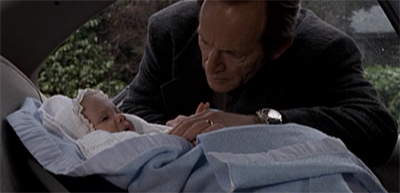
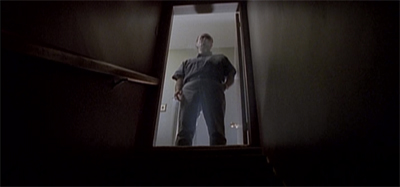
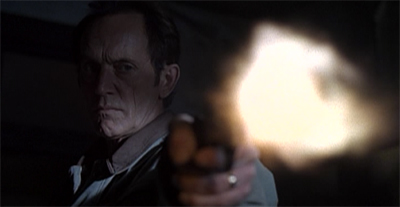
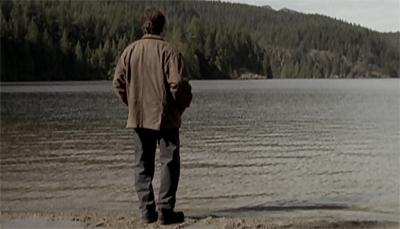
Apparently, the original cut of Covenant ran over an hour and twenty minutes. This is not unusual in network television. Glen Morgan and James Wong faced similar problems when producing The Field Where I Died. However, while cutting The Field Where I Died down to forty-five minutes left something of a jumble, Covenant feels much stronger for the rather ruthless editing done to fit the episode into the broadcast slot. In many ways, Covenant feels quite minimalist – an episode that says the bare minimum, but conveys everything that needs to be conveyed.

Covenant is an episode that could easily seem exploitative. After all, there are points where Millennium feels like it is wallowing in human anguish and suffering. A story concerning the brutal murder of a nuclear family (including three children and a pregnant wife) is something that needs to be approached with care and delicacy. The original script for Covenant is perhaps overwritten, trying to draw too many parallels to Frank’s own family; these associations are best left unsaid.
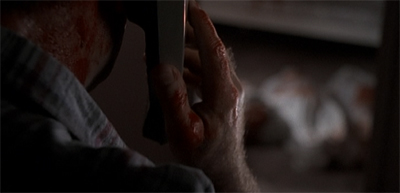
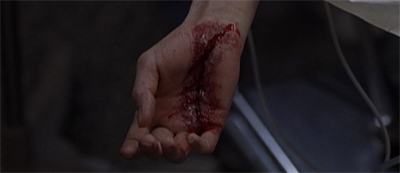
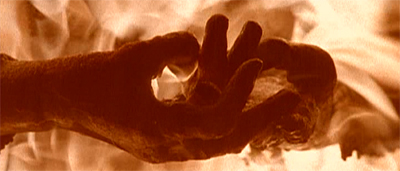
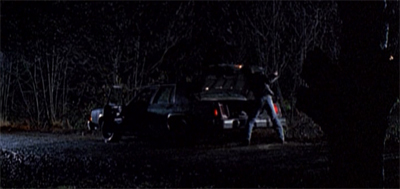
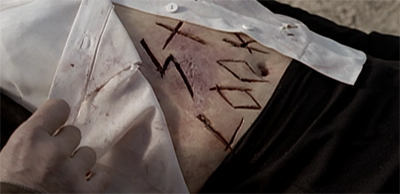
Bloody handiwork...

Bloody handiwork…

In many ways, Millennium could be described as a “horror” show, and Covenant hones on some of the same fears that the first season has targeted repeatedly. Millennium is a show that is keen to assure viewers that their family members are not safe in their own homes and communities. However, there is a deftness and a tactfulness on display here that elevates Covenant above many of the similar stories in this début season. Covenant is all the more unsettling for its restraint and its control.

Covenant continues a strong late-season streak for Millennium, demonstrating the versatility and the nuance possible within the framework that the show has established. Covenant is a triumph for all involved.
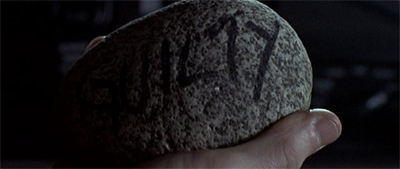
Solid as a rock...

Solid as a rock…

Continue reading

Millennium – Sacrament (Review)

This February and March, we’re taking a trip back in time to review the fourth season of The X-Files and the first season of Millennium.

If Force Majeure and The Thin White Line seem to call forwards towards the weird and eccentric second season, Sacrament is a bit more modest. In many ways, Sacrament seems to foreshadow the last stretch of episodes in the first season. The forces of evil seem to encircle the Black family, creeping closer and closer to the big yellow house and everything it represents. For the first time, Sacrament explicitly puts Frank’s family at the heart of a case; this time focusing on the kidnapping of his sister-in-law from her child’s christening.

In many respects, this points towards the direction the show will take in its final stretch of episodes. Lamentation and Powers, Principalities, Thrones and Dominions will see the forces of evil explicitly violate the Black residence, insidiously eroding the idealised life that Frank has tried to build for his family in their new Seattle home. The cliffhanger at the end of Paper Dove pushes the concept to its logical conclusion, as a secret that Frank has tried to keep from his family finally comes home to roost.

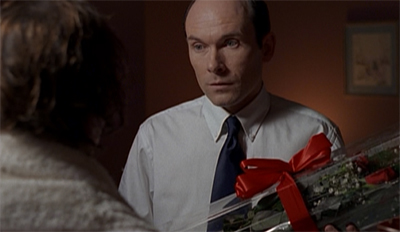
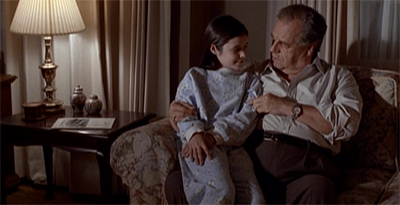
Worst. Uncle. Ever.

Worst. Uncle. Ever.

As with WeedsSacrament demonstrates that writer Frank Spotnitz has an uncanny understanding of how Chris Carter built Millennium. It is an episode that is soaked through with the core themes of the series; it is a story about good and evil, and how evil taints everything that it touches. As with a lot of Millennium, Sacrament is not subtle; the moment that Tom Black is identified as the brother of our protagonist, it is inevitable that the forces of evil will come barrelling down upon him.

Nevertheless, Sacrament demonstrates a clear understanding of what it wants to be, and is a pretty effective snapshot of Millennium at this moment in time. The first season of Millennium is often overlooked and overshadowed amid the controversies surrounding the second or third seasons, but Sacrament stands as a great example of what the first season was trying to do.

Our father...

Our father…

Continue reading

Millennium – The Thin White Line (Review)

This February and March, we’re taking a trip back in time to review the fourth season of The X-Files and the first season of Millennium.

The Thin White Line is the final script from James Wong and Glen Morgan for this season of Millennium, following closely after Never Again, their final script (ever) for The X-Files.

Indeed, there is considerable overlap between the two stories – at least thematically. Both are episodes about destructive cycles. In Never Again, Scully faces the very real possibility that she is now trapped with Mulder; that her life outside the X-files is over. In The Thin White Line, Frank Black contemplates the idea that people are trapped in perpetual cycles of violence and abuse; that the world resembles the ouroboros featured so prominently in the opening credits, a snake constantly eating its own tail.

Frank discharge...

Frank discharge…

Never Again is relentlessly cynical. The closing image suggests that nothing will change, that something is broken than cannot be fixed. Important statements hang in the air, unresolved. The Thin White Line is perhaps slightly optimistic. Both Frank Black and Bob Bletcher try in their own way to end cycles of violence and recrimination. While Bob Bletcher responds with brutal cynicism and more violence, Frank Black responds with compassion and humanity. There is a sense of cynicism to The Thin White Line, but there is also some hope.

The Thin White Line is a stand out piece of work, a fantastic illustration of what Millennium can do when it sets its mind to it. Like Force Majeure before it, The Thin White Line suggests that Millennium has very clearly and definitely figured out its own voice. It is no wonder that both episodes come from future showrunners.

Cutting retort...

Cutting retort…

Continue reading

Millennium – Force Majeure (Review)

This February and March, we’re taking a trip back in time to review the fourth season of The X-Files and the first season of Millennium.

Papa?

It’s begun.

Fire and ice.

Fire and ice.

Continue reading

Millennium – Loin Like a Hunting Flame (Review)

This February and March, we’re taking a trip back in time to review the fourth season of The X-Files and the first season of Millennium.

Loin Like a Hunting Flame represents the peak of a particular type of Millennium story.

It is an episode towards which the season seems to have been building. It is an episode that rather explicitly and candidly ties together two of the show’s favourite subjects: sex and violence, in harmony together. Loin Like a Hunting Flame is something of a stalking horse for the rest of the season; it is the first season episode that most obviously embodies the excesses of any show like Millennium. Fetishised violence has been baked into Millennium since The Pilot opened with a stripper dancing in her own blood; here, it reaches a logical end point.

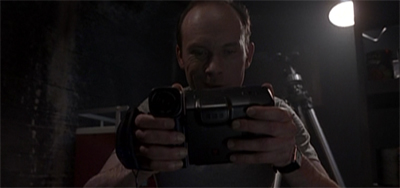
Candid camera!

Candid camera!

Loin Like a Hunting Flame is an episode that is guilty of just about any criticism that might be thrown at it. It is gratuitous; it is sensationalist; it is excessive. It tries to have things both ways, titillating the viewer with glimpse of “exotic” sexual liberation while warning them that those sexually liberated individuals will be punished for their perceived transgressions. Yes, Loin Like a Hunting Flame tries to say something a bit more nuance, but it flails around for most of its forty-five minute runtime like a dying fish.

In many respects, this could be treated as a catharsis for the series. After this point, Millennium turns a corner. The rest of the first season is a lot more ambitious in tone and scope. As much as Loin Like a Hunting Flame closes off a particularly evolutionary line of Millennium, Force Majeure and The Thin White Line push forwards towards a more adventurous show. Loin Like a Hunting Flame just has to work these issues out, once and for all, to their logical (and unsatisfying) conclusion.

Wholesome family fun...

Wholesome family fun…

Continue reading

Millennium – Weeds (Review)

This February and March, we’re taking a trip back in time to review the fourth season of The X-Files and the first season of Millennium.

Weeds concludes the loose “suburban trilogy” running through the first season of Millennium. In fact, Weeds was filmed directly after Wide Open, but was pushed back in the broadcast schedule so as to air after The Wild and the Innocent. While this change in broadcast and production order is nowhere near as confusing as the scheduling hijinx happening with The X-Files at the same time, it does give an indication that the production team recognised the potential similarities between Weeds and Wide Open.

Both episodes are about the violation of a supposedly “safe” space, bypassing and subverting all the potential security put in place to keep the home secure. In Wide Open, the killer visits open houses and hides in wardrobes until the family go to sleep that night; in doing so, he avoids setting off any alarms. In Weeds, a secure and gated community discovers that they cannot keep their children safe; someone within the community is preying on the residents’ children. As with The Well-Worn Lock, there is a sense that families are not safe, even when they think that they are.

Community watch...

Community watch…

As with Wide Open, Weeds feels just a little bit sensationalist. It is the kind of episode that attracts criticisms about gratuitous violence or exploitation. Millennium was never quite as excessive or as sadomasochistic as its critics would suggest, but there are definite tendencies towards those extremes on display at certain points in the run. While Millennium is very clearly driven by a core moral philosophy, it can occasionally seem a little too comfortable with its brutality or depravity.

Indeed, Weeds hits on quite a few of the stock fears that run through the first season of Millennium: children are victimised by a person in a position of trust and authority; there is biblical quotation; there is sadistic (and disturbing) torture filmed in a heavily stylised manner. There is something almost cynical and calculated about how Weeds hits these familiar buttons; these impulses towards excess haunt the first season of Millennium, and are building to something of a catharsis in Loin Like a Hunting Flame.

There will be blood...

There will be blood…

Continue reading

Millennium – The Wild and the Innocent (Review)

This February and March, we’re taking a trip back in time to review the fourth season of The X-Files and the first season of Millennium.

The Wild and the Innocent is an ambitious piece of television.

It is not a piece of television that works as well as it might, the execution of the central ideas leaving a little to be desired, but it is an episode that commits whole heartedly to something unique. In I Want to Believe, Robert Shearman refers to The Wild and the Innocent as “a plot more suited to Cormac McCarthy than Chris Carter.” He’s not wrong. The Wild and the Innocent is a story about cycles of violence and abuse in the American south, a grim road movie with some very harsh conclusions about the way that the world works.

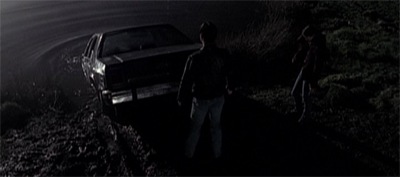
That sinking feeling...

That sinking feeling…

It still fits within the milieu of Millennium. After all the classic “serial killer road movie” is still a serial killer story, and Millennium has already carved out that niche for itself. However, the image of Frank Black and Peter Watts following a trail of bodies from Missouri down through Arkansas suggests a different show than the one that has been airing since The Pilot. In many respects – with its heavy philosophical voice-over, its country-tinged soundtrack, its fixation on the outlaw couple – The Wild and the Innocent feels almost like some old American folk tale.

There’s something decidedly old-fashioned here, with the episode playing more like a western than a police procedural. In the documentary Order in Chaos, Carter described Frank Black as character from a story “like Shane, like any cowboy, any good movie, Western movie.” As such, he fits in quite comfortably with this new type of story.

Road warrior...

Road warrior…

Continue reading

Millennium – Wide Open (Review)

This February and March, we’re taking a trip back in time to review the fourth season of The X-Files and the first season of Millennium.

The middle stretch of the first season of Millennium is preoccupied with suburban horror.

In The Well-Worn Lock, Wide Open and Weeds, Millennium presents the audience with threats to supposedly “safe” suburban families. In each case, the threat is shown not to come from outside these homes, but is instead nestled snugly inside. In The Well-Worn Lock, Joe Bangs is a respected family patriarch and a monster. In Weeds, Edward Petey is both an active member of his gated community and a predator. Wide Open is perhaps a little more sensationalist, featuring a serial killer who sneaks into houses that are on display, hiding inside until after dark, and then brutally murdering any adults in the home.

Home (in)security...

Home (in)security…

There is an intriguing thematic continuity here between what might loosely be termed “the suburban trilogy.” Indeed, Weeds was shuffled around in the broadcast order so it would not air directly after Wide Open, perhaps because of this similarity. This thematic continuity is quite striking, like the presence of Scully proxies and surrogates in the stretch of the second season of The X-Files running from One Breath to Irresistible or the subtle fixation on “cancer” from the end of the third season into the fourth season of The X-Files.

Like The Well-Worn Lock before it and Weeds after it, Wide Open is not particularly elegant in its meditations about suburbia under siege. The story is a bit clunky, prone to the same trashy exploitative excess that can be found in some of the weaker moments of the first season. Nevertheless, Wide Open largely works – it manages to tap into a fairly universal fear in a decidedly unsettling manner, inviting the audience to wonder whether there may actually be monster lurking in their own closets or under their own beds.

Standing guard against the world...

Standing guard against the world…

Continue reading

Millennium – The Well-Worn Lock (Review)

This February and March, we’re taking a trip back in time to review the fourth season of The X-Files and the first season of Millennium.

The Well-Worn Lock is trying to say something important.

As easy as it is to mock Chris Carter for being a little heavy-handed in his writing, he tends to wear his heart on his sleeve. There is an honesty and an earnestness to his writing that is quite endearing – a sense that he has some things that he wants to say, and that he will say them. The Well-Worn Lock is a tough and grueling episode, with some pretty harrowing things to say. It confronts the types of issues that are often overlooked or ignored, because they are so uncomfortable to examine head-on. There is a lot to admire here.

Happy families...

Happy families…

However, The Well-Worn Lock is also clumsy and ham-fisted. It is so committed to saying what it wants to say that it occasionally gets caught up in itself. It has been argued that Carter constructed Millennium as a vehicle to examine the nature of evil in the modern world, and there are points where the series feels more like a pulpet that a television show. The Well-Worn Lock is an episode about an insidious and oft-ignored evil, but there are points where it has the depth and complexity of a life-action cartoon.

The problem is not that the episode’s antagonist is a monster – after all, it is hard to describe anybody who commits this sort of abuse as anything but a “monster” – but that he seems a grotesquely exaggerated and one-dimensional caricature. Tackling a subject that requires considerable tact and grace, The Well-Worn Lock often has the emotional nuance of a sledgehammer.

The world according to Catherine Black...

The world according to Catherine Black…

Continue reading

Millennium – Blood Relatives (Review)

This February and March, we’re taking a trip back in time to review the fourth season of The X-Files and the first season of Millennium.

Blood Relatives is the best episode of Millennium to air within the first half of the first season. It is an episode that seems to recognise the potential of a show like Millennium to be more than just a formulaic procedural, acknowledging that the show needs to find its own unique narratives in the same way that The X-Files did during its first season. Blood Relatives adheres rather loosely to the serial-killer-of-the-week format, but is rather more interested in the stories of the characters around the murders than in the murders themselves.

Blood Relatives is also notable as the first Millennium script written by Chip Johannessen. Johannessen would go on to become one of the defining voices of the show’s run, writing some of the best episodes of the first two seasons and steering the show through its troubled two years. Johannessen was good to Millennium, and Millennium was good to Johannessen. It transitioned the writer from shows like Married… With Children, Beverly Hills 90210 and The Monroes towards 24, Dexter and Homeland.

Not cut out for all this...

Not cut out for all this…

As with his next script, Force Majeure, Johannesson hones in quite beautifully on the potential of Millennium. Blood Relatives is an episode of television that is almost perfectly tailored for Millennium. While it retains the elements of a procedural, it is hard to image the episode working on something like Law & Order or CSI, more rigidly-structured television shows with clearer boundaries. Indeed, it seems like Johannessen recognised Millennium as a show spun out of Irresistible, and chose to play Blood Relatives on the same sort of themes about loss and dysfunction.

Blood Relatives is a superbly constructed piece of television, one that marks Johannessen as a talent to watch going forward.

Wading in...

Wading in…

Continue reading