• Following Us

  • Categories

  • Check out the Archives


  • Awards & Nominations

Marvel 1602 (Review)

After spending the tail end of last year looking at the tangled inter-continuity crossovers at Marvel, I thought I’d spend January looking at some of the looser “out of continuity” tales at the major companies.

Although DC invented the term “elseworlds” to describe alternative continuities featuring familiar characters in unfamiliar settings, it was really Marvel who ran with it. Even discounting the Ultimate line, Marvel has produced any number of alternative continuity worlds within the past decade or so – not stories or chapters, but worlds. Tales spin-off in so many different directions that these stories become viable alternative versions of the Marvel Universe, just with a variation upon a theme. Marvel Noir offers us the Marvel Universe as seen through a smokey glass-half-empty lens, with tales of Daredevil, X-Men and Spider-Man changed to fit in this strange new setting. Writer Neil Gaiman, however, crafted an especially interesting alternative to mainstream Marvel with 1602. It pretty much does exactly what it says on the tin, transposing the modern day Marvel Universe to 1602.

Take these broken wings...

Continue reading

Thor 101: A Beginner’s Guide to Marvel’s Thor…

Another year, another slew of massive comic book adaptations. While most people are familiar with Batman or Superman, I think that we’re moving away from the more popular comic book properties being adapted for the big screen. Last month I wrote a brief introduction to the Green Lantern mythos, as Martin Campbell’s blockbuster approaches. The response was good enough that I thought I might take a look at Marvel comics’ upcoming blockbuster Thor, directed by Kenneth Branagh. Anyway, here’s the trailer.

Continue reading

Marvel Crossover Continuity

In August, I decided it would be… interesting to take a look at the event-driven storylines that Marvel was producing between 2005 and 2010. So, for sixteen weeks (and more, if you consider the occasional bonus back-up feature), I reviewed one of the many “events” Marvel produced during the period. I’ve grouped the particular strands of continuity together below for easy of browsing (also providing the original date of publication). I hoped that exploring this particular aspect of the medium might grant me some insight into why big events like this continually upset on-going stories being told by writers in individual characters’ books. It was an interesting experiment, even if I doubt I’ll be engaging with the core of the Marvel Universe so thoroughly any time soon.

Note: It is incomplete. I had planned to follow The Avengers through to Siege, but it looks like my reviewing schedule caught up with them – for the same reason I haven’t got around to The Thanos Imperitive yet. I will return to this thread in the future.

Avengers-Based Continuity
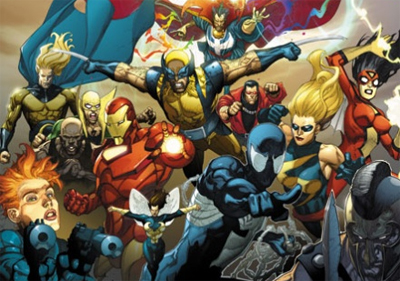
It was a good decade for The Avengers as a franchise, with Marvel consciously pushing the franchise to the forefront – not just in comics but in other media as well. If the nineties and early naughties belonged to the X-Men (with X-Men: The Animated Series on the airwaves, Bryan Singer’s X-Men in cinemas and crossovers like Age of Apocalypse in comic books), this was very clear attempt to take that back. Brian Michael Bendis was tasked with turning the Avengers into Marvel’s prime franchise and succeeded – most of the “big” comic book events of the decade revolved around them. That said it was certainly a controversial restructuring of the book, with a line-up crafted to feature more popular characters like Spider-Man and Wolverine instead of more obscure characters like Quicksilver or the Scarlet Witch.

The Avengers branched out into other media too. Iron Man demonstrated that Marvel’s “big three” could hold viewer interest in cinemas, and promised a series of crossovers on the big screen that would see The Avengers assemble under the direction of Joss Whedon. As a brand, Marvel made sure these characters were everywhere.

The stories featuring these characters over the decade form something of a larger meta-story which seems to reflect on the superhero genre as a whole. Although Bendis’ New Avengers opens with a supervillain breakout, the characters spent more time fighting each other than bad guys (Civil War, World War Hulk). When they did fight bad guys, they were more often than not corrupted mirrors of themselves, be it the Skrulls who had managed to so perfectly imitate heroes despite being villains (Secret Invasion) or government-sanctioned psychotic “Dark Avengers” (Siege). It was a story about how difficult it was to be a hero in the last few years – in the wake of the “dark age” of comic books – and a deconstruction of the effectiveness of a group of individuals like this to actually make a difference. You could even argue that this was a grim reflection of real world political and social uncertainty – particularly mistrust of authority (it’s telling how much time these heroes spend going “rogue”). Of course, this is open to interpretation, and many fans were less than pleased with the execution of this particular tale.

“Cosmic Marvel” Continuity

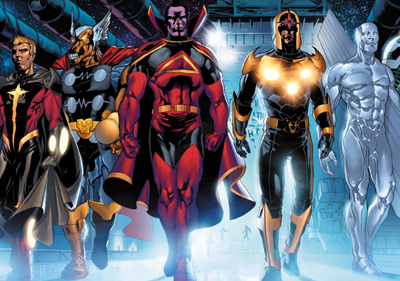
Marvel’s Cosmic Universe got a much-needed revitalisation this decade, offering perhaps a better-plotted and more straightforward avenue for Marvel’s crossover events. Although Jim Shooter had done great work with many of these characters in the nineties (with Infinity Gauntlet and so forth), they had mostly remained in relative obscurity before the relaunch.

The distinguishing aspect of these stories is the way that they are structured. Rather than a big event coinciding with countless tie-ins across countless books, most of these stories would open with a single prologue issue which would branch into a handful of miniseries running for a set number of issues, before dovetailing into a main series. This meant that every issue remotely connected with a series could be collected in a hardcover. Admittedly the titles become more entangled in continuity as they went on (with War of Kings tying in directly to Ed Brubaker’s The Rise & Fall of the Shi’ar Empire story arc in Uncanny X-Men), but by and large these series served to avoid pointless tie-ins and an exceptionally convoluted continuity (everything you needed was included in the books themselves).

They’re the best crossovers that you weren’t reading.

X-Men Continuity

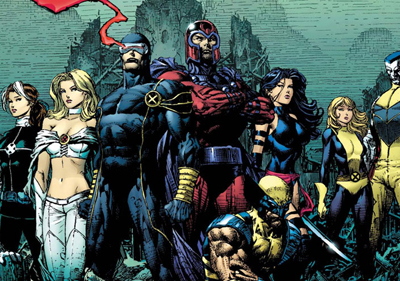
The last decade has been an interesting one for the X-Men, as both the books and the characters have found themselves looking for purpose. Grant Morrison’s New X-Men posited a world where mutants would be the dominant species with a few generations and proposed to move the “mutants as oppressed minority” metaphor firmly into the twenty-first century, where the worries weren’t (at least for the most part) about government-sponsored genocide or legal rights, but cultural and social questions about the way that mutants and humanity live together. This was clearly a step too far, as Marvel decided to essentially wipe out the mutant population, feeling there were too many mutants in the Marvel Universe. This was done with three words from a psychotic Scarlet Witch rather than a more subtle approach (like simply reducing the number of mutants featured in various books).

Suddenly the X-Men found themselves facing extinction, and this became a driving narrative force for the book. It was as if the line was actively rebelling against the editorial mandate forced upon them. Instead of granting narrative clarity, the edict had instead complicated things. It also forced the X-Men away from their widely-loved position as a civil rights metaphor and towards a more straight forward “find the cure” narrative. It also served to isolate the franchise from the rest of the Marvel Universe (except for Wolverine, of course, who is everywhere) – the X-Men were always busy doing their thing and trying not to die out rather than assisting with Civil War or Secret Invasion. The solution to this narrative thread is entirely predictable, but it does offer a clear structure to the X-Men stories from the period.

It’s interesting to note that while all the major Avengers titles from this period (New/Mighty/Dark Avengers) have been consistantly collected, the X-Men books have not been. Ed Brubaker’s run is quite difficult to collect in one consistent format, as is Matt Fraction’s – and both are writing for what should be “the flagship book” of the X-Men publishing line, Uncanny X-Men. This makes it considerably harder to follow than the Avengers franchise, for example.

Realm of Kings (Review/Retrospective)

This is the fifteenth in a series of comic book reviews that will look at the direction of Marvel’s shared universe (particularly their “Avengers” franchise) over the past five or so years, as they’ve been attempting to position the property at the heart of their fictional universe. With The Avengers planned for a cinematic release in 2012, I thought I’d bring myself up to speed by taking a look at Marvel’s tangled web of continuity.

Realm of Kings is a strange little chapter in the cosmic saga that Dan Abnett and Andy Lanning have been drafting. It seems to exist not really as a story in its own terms (although it does contain some interesting narratives) but rather as a bridge between War of Kings and The Thanos Imperative. It’s essentially the story of an attempt to find stability in a radically warped universe, one turned upside down by recent events. It feels somewhat smaller in scope than the other events that the pair have produced, not that there’s anything wrong with that. In fact, it’s nice to see a series exploring the consequences and aftermath of what has occurred, rather than simply pushing on right into the next big thing. While Realm of Kings does focus on “the Fault” opened at the climax of War of Kings that will become a galactic threat in The Thanos Imperative, the three miniseries are at their best when they explore the consequences of the political instability that the intergalactic war has produced.

That's gonna be Thor tomorrow...

Continue reading

Matt Fraction’s Run on Uncanny X-Men – Nation X (Review/Retrospective)

I am doing a weekly look at Marvel’s complicated crossover chronology, following various key crossovers to see if they might give me a better idea of what I’m missing by avoiding mainstream comic book continuity. While – with The Avengers due for release in 2012 – I am focusing on the stories told featuring those characters over the past five years, I also have time for the X-Men. While this isn’t strictly speaking a crossover, it is a series of issues which connect Utopia to Second Coming, so I figured it was worth a look.

Utopia ended with a heck of a plot twist. Cyclops decided that his merry band of mutants have had enough of being looked down upon in New York and , more recently, San Francisco, so he decides to build himself an island from the remains of Magneto’s “Asteroid M” just off the San Francisco Bay. Announcing the new nation of “Utopia”, he declares the island a haven for mutants. Nation X provides a hardcover collection of the issues from Matt Fraction’s Uncanny X-Men which bridge the gap between Utopia and Second Coming, as well as the four-issue Nation X anthology miniseries. And, while it’s a decidedly uneven reading experience, I have to admit that some of Fraction’s portrayal of the mutant team is a little bit interesting – even if most is slightly boring and deeply convoluted.

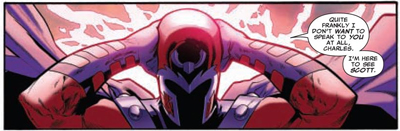
Magneto has a magnetic personality...

Note: This collection opens with Dark Reign tie-in X-Men: The List written by Matt Fraction and following an attempted assassination attempt on Namor by Norman Osborn. Accordingly, I think I should open this review with a link to Abhay’s quite excellent article on the issue, which – among some more serious points – suggests that Namor is starring in his own private version of You Don’t Mess With The Zohan. Seriously, check it out.

Continue reading

X-Men/Dark Avengers: Utopia (Review/Retrospective)

This is the fourteenth in a series of comic book reviews that will look at the direction of Marvel’s shared universe (and, in particular, their “Avengers” franchise) over the past five or so years, as they’ve been attempting to position the property at the heart of their fictional universe. With The Avengers planned for a cinematic release in 2012, I thought I’d bring myself up to speed by taking a look at Marvel’s tangled web of continuity. Get an overview of what I’m trying to take a look at here.

There’s an essay to be written about how Marvel has so carefully and meticulously replaced the X-Men with The Avengers as their biggest A-list franchise book (in fact, there’s a quite wonderful essay written here about that). During the nineties, the big event crossovers at Marvel seemed to exist at the leisure of their mutants – Age of Apocalypse and Onslaught being two of the more obvious examples. However, since House of M, the mutants have been consciously sidelined. They continue to have their own internal events and crossovers – Messiah Complex and Second Coming the most obvious examples – but they remain largely insular and detached from the regular goings on in the Marvel Universe. Except for Wolverine, because he’s everywhere.

Marvel announces Dark Avengers on Ice!

Continue reading

X-Men: Messiah War (Review/Retrospective)

This is the eleventh in a series of comic book reviews that will look at the direction of Marvel’s shared universe (particularly their “Avengers” franchise) over the past five or so years, as they’ve been attempting to position the property at the heart of their fictional universe. With The Avengers planned for a cinematic release in 2012, I thought I’d bring myself up to speed by taking a look at Marvel’s tangled web of continuity.

Messiah Complex is billed as the “second instalment” of the X-Men “Messiah Trilogy”, following on from Messiah Complex and leading into Second Coming. The arc essentially follows Hope, the first mutant baby born in the wake of the infamous House of M crossover and the quest by various factions to exploit her – will she be a salvation of Marvel’s erstwhile bunch of mutants, or their ultimate damnation? Messiah War essential combines the two on-going X-Men books launched in the wake of Messiah Complex, with Cable following Hope and the time-travelling X-Man as they flee those who wish the child harm and X-Force following Wolverine’s bunch of “black-ops” “darker and edgier” X-Men strike force. Of course, the only way it could get more nineties was if you threw in Deadpool, Apocalypse and Stryfe… oh, wait. They did.

Has the bar been raised?

Continue reading

Peter Milligan & Michael Allred’s Run on X-Force – Famous, Mutant & Mortal (Review/Retrospective)

For the past few months, I’ve been taking a look at Marvel’s sometimes convoluted crossover chronology as a sort of lead-in to The Avengers, arriving in cinemas in 2012. Later on today, I’ll be reviewing Messiah War, a crossover between two of the series relaunched in the wake of Messiah Complex so I thought I might take a look back at some of the series leading into it beforehand. However, the two series – Cable and X-Force both have roots in the “darker and edgier” period of X-Men history known as the nineties. Driven by Rob Liefeld, the two series became by-words for ridiculous violence, convoluted storytelling, shallow characters and lots of guns. Lots of guns.

That is not the version of X-Force I’m going to look at today.

British writer Peter Milligan apparently laughed pretty hard when he was asked to write X-Force. However, the early part of the naughties was a different time at Marvel. Perhaps the financial collapse of the company in the nineties had made the company bolder, more willing to take creative chances. Perhaps they figured that, with Grant Morrison working on New X-Men, there wasn’t anything that much more radical that Peter Milligan could do. Either way, the author was granted incredible creative control and the chance to do something truly different. He took advantage of it, and produced one of the most fascinating comic books of the past decade.

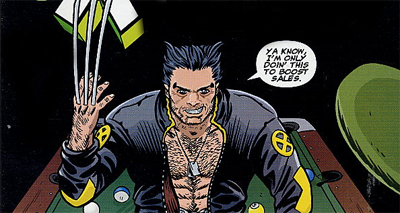
At least he’s honest about it…

Continue reading

Annihilation: Conquest (Review/Retrospective)

This is the tenth in a series of comic book reviews that will look at the direction of Marvel’s shared universe (particularly their “Avengers” franchise) over the past five or so years, as they’ve been attempting to position the property at the heart of their fictional universe. With The Avengers planned for a cinematic release in 2012, I thought I’d bring myself up to speed by taking a look at Marvel’s tangled web of continuity.

Perhaps it was the novelty of Marvel’s Annihilation crossover which lent the series its appeal. It took some of the more often overlooked space heroes of the Marvel Universe and tied them all together as part of a gripping narrative fighting against the extinction of life itself. It was loud and bright and colourful and frentic – it was perhaps the best crossover that Marvel have produced in the past five years or so. So I was very much anticipating the sequel, Annihilation: Conquest – hoping that it could be another breath of fresh air in this long trek through Marvel’s shared universe. Unfortunately, it seemed that a lot of energy of the original was gone – the series couldn’t help but feel somewhat anti-climactic.

Feel the Wraith...

Continue reading

Nova: Annihilation (Hardcover) (Review/Retrospective)

I’m currently taking a look at the modern history of the Marvel Universe. I kinda figured that I should go through at least one cycle of big continuity-heavy events to at least engage with this style of storytelling, so I can get a feel for it. Although I’m focusing on The Avengers (what with the movie and all), I’m also checking out cosmic Marvel and the X-Men at the same time. My review of the big intergalactic crossover Annihilation: Conquest is going out today, so this is a bit of a sidenote on that. Nova was the first relaunched on-going “cosmic” Marvel series, launched in the wake of Annihilation, so I thought I’d follow the first year of the book. 

I have to confess that I quite enjoyed Marvel’s attempt to reinvigorate their line of cosmic comic books with the gigantic crossover event Annihilation. And it apparently did quite well, spawning a series of associated crossovers in the years that followed, as well as an on-going series following the character perhaps most greatly affected by the events of the miniseries. Although the character has had his own series in the past (no fewer than three times) and featured in a few high-profile teambooks, it’s good to see Nova returned to prominance, particularly written by two authors who clearly know and cherish him.

Iron Man expects Richard to show some Initiative...

Continue reading