• Following Us

  • Categories

  • Check out the Archives


  • Awards & Nominations

Star Trek: Deep Space Nine – Season 6 (Review)

The sixth season of Star Trek: Deep Space Nine seems to brush up against the limits of what the show could do.

To be fair, Deep Space Nine spent most of its fourth and fifth seasons smashing through the arbitrary boundaries imposed upon what a Star Trek show could and could not do. Overseen by executive producer Ira Steven Behr, the writing staff very consciously and very vigourously pushed past the limitations imposed by the so-called “Roddenberry Box” and the style of television overseen by franchise leader Rick Berman. The storytelling became more complex, serialisation crept in, the music became more noticeable, conflict became more evident.

This all built to a climax in the second half of the fifth season, a series of interlinked stories that stretched from In Purgatory’s Shadow and By Inferno’s Light through to Call to Arms. Diplomatic tensions rose, character arcs became clear. Then, at the very end of the season, the unthinkable happened. The Federation went to war with the Dominion. More than that, the Federation started a war with Dominion. It was a bold creative choice, one that chipped away at so many of the assumptions underlying the utopian future of Star Trek.

The sixth season faces a number of serious problems. Most obviously, the fourth and fifth seasons had pushed so far that there was only so much ground left to cover. The sixth season explored that ground thoroughly. There is an argument to be made that the arc that opens with Call to Arms and continues through the first six episodes of the sixth season ranks as the single most ambitious stretch of the Rick Berman era. Episodes like Far Beyond the Stars, Inquisition and In the Pale Moonlight pushed the franchise well outside its comfort zone.

At the same time, there was a clear sense that the production team was butting up against the limits of the form, that they had pushed Deep Space Nine almost as far as it was possible to push a nineties Star Trek show, and so the season lacked the same sense of forward momentum as the fourth and fifth seasons had. Many creative decisions in the sixth season feel like the result of creative compromise, whether the sense that the writers had told all the big stories that they wanted to tell or because they had to bow in some way to the conventions of television storytelling.

The result is a frustrating season of television. The sixth season of Deep Space Nine features some of the best Star Trek episodes in the fifty-year history of the franchise. However, it also contains a lot of thwarted ambitions. For every barrier that the sixth season smashes through, it brushes up against another. It is a reminder of just how far Deep Space Nine had pushed the franchise during its run. In some ways, it felt like the sixth season of Deep Space Nine was not so much brushing up against the limits of Star Trek as against the limits of nineties television.

Continue reading

Star Trek: Deep Space Nine – Soldiers of the Empire (Review)

Soldiers of the Empire is a very effective illustration of just how far Star Trek: Deep Space Nine was willing to push the Star Trek franchise.

It is an episode that unfolds primarily on a Klingon Bird of Prey. This is nothing new. After all, Star Trek: The Next Generation produced A Matter of Honour in its second season, assigning Riker to serve on a Klingon ship as part of an exchange programme. However, that episode was told primary from a human perspective, the story centring on Riker adjusting and adapting to an alien culture before saving the day. When Worf joined the Klingon fleet in Redemption, Part II, the story kept cutting back to life on the Enterprise in his absence.

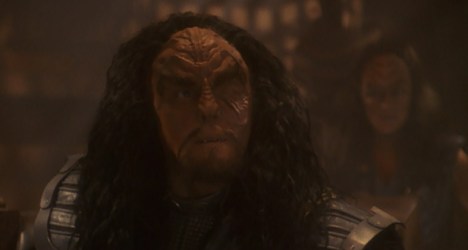
"Mahk-cha!"

“Mahk-cha!”

In contrast, Soldiers of the Empire is primarily focused upon the Klingon cast and the Klingon crew. Worf and Dax join the IKS Rotarran to support General Martok in his first command since escaping the Dominion prison camp at the end of By Inferno’s Light, but they are very much bystanders. Although Worf and Dax provide vital narrative functions in introducing the audience to Klingon customs and cultures, the narrative arc of the show belongs to Martok and the crew of the Rotarran. This is not a story about Worf and Dax, this is a story about Martok.

The result is an episode that really pushes the limits of the storytelling possibilities on Deep Space Nine, a reminder that the production team remain as ambitious as ever in the show’s fifth season. Soldiers of the Empire suffers from a few minor plotting issues, but it is exciting and compelling in a way that captures the very best of Deep Space Nine.

A sharp stabbing pain.

A sharp stabbing pain.

Continue reading

Star Trek: Deep Space Nine – By Inferno’s Light (Review)

In Purgatory’s Shadow and By Inferno’s Light represent a fantastic accomplishment for Star Trek: Deep Space Nine.

The two-parter demonstrates the care and skill that went into characterisation on the show. The later Star Trek series often struggled to define their core ensembles as effectively as this series defined its secondary players. Star Trek: Voyager often reduced its characters to cogs within a plot-driven machine, capable of whatever a given plot required from them at a given moment. The same was true of Star Trek: Enterprise, which spent most of its first two years slotting cookie-cutter characters into very conventional narratives.

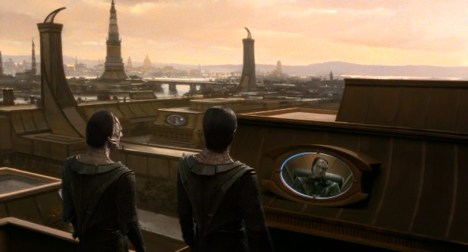
"I, for one, welcome our new Dominion overlords."

“I, for one, welcome our new Dominion overlords.”

In contrast to Voyager and Enterprise, the bulk of plotting on Deep Space Nine seemed to flow from the characters themselves rather than forcing the characters to conform to the demands of the plot. All the big storytelling decisions on Deep Space Nine are rooted in the agency of the characters in question, to the point that the fate of the entire Alpha Quadrant seems to hinge upon the fragility of Gul Dukat’s ego. It is a very clever (and very ahead of its time) approach to plotting a science-fiction series, just one reason that Deep Space Nine has aged so well.

As a result, In Purgatory’s Shadow and By Inferno’s Light are both rooted in what the audience already knows about the characters populating Deep Space Nine. All the decisions that are taken feel very much in character, and in keeping with what the audience knows about these individuals. This only serves to make it all the more impressive that the two-parter so radically revises the show’s status quo.

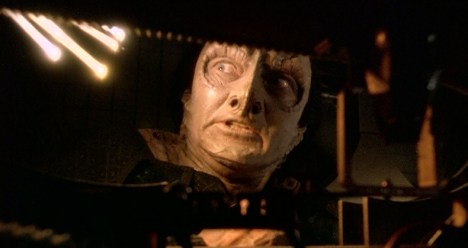
Leave a light on.

Leave a light on.

Continue reading

Star Trek: Deep Space Nine – In Purgatory’s Shadow (Review)

In Purgatory’s Shadow and By Inferno’s Light represent a fantastic accomplishment for Star Trek: Deep Space Nine.

In keeping with the television of the time, the first Star Trek show had been firmly episodic, to the point that there are arguments about the order in which episodes happened. Even in the context of the early nineties, Star Trek: The Next Generation tended to shy away from making dramatic decisions with huge consequences. The Klingon Civil War is resolved in Redemption, Part I and Redemption, Part II. The failed Romulan invasion of Vulcan in Unification, Part I and Unification, Part II is never mentioned again.

"Mister Worf, we really shouldn't have mounted this mission during Sweeps."

“Mister Worf, we really shouldn’t have mounted this mission during Sweeps.”

Deep Space Nine grew increasingly adventurous over the course of its run. The series had flirted with up-ending the status quo before, from the introduction of the Defiant and the Founders in The Search, Part I and The Search, Part II through to the dismantling of the Khitomer Accords in The Way of the Warrior. While those decisions had very long-term consequences for the show, their impact was not as dramatic and immediate as that seen here. Even the defeat of the Cardassians and Romulans in Improbable Cause and The Die is Cast took time to ripple down.

In contrast, In Purgatory’s Shadow and By Inferno’s Light change a lot of what the audience think they know about Deep Space Nine. The fifth season pivots on this two-parter, which serves to enable just about every major dramatic development between this point and the end of the series. This only serves to make it all the more impressive that the two-parter is so firmly rooted in its characters and characterisation.

Gripping drama.

Gripping drama.

Continue reading

Star Trek – Day of the Dove (Review)

This July and August, we’re celebrating the release of Star Trek Beyond by taking a look back at the third season of the original Star Trek. Check back every Monday, Wednesday and Friday for the latest update.

It is striking how iconic and influential the third season of Star Trek is.

The third season is often written off, by both fans of the show and members of the production team. There are any number of reasons for this; a slashed budget, an exodus of talent, a new producer, conflicts behind the scenes. There is also the simple fact that the third season is wildly more variable than either the first or second seasons of the series, with its most consistent string of episodes being the three episodes from Is There in Truth No Beauty? to The Tholian Web.

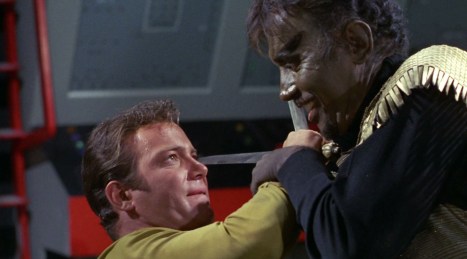
Crossed swords.

Crossed swords.

However, in spite of that, there is a sense that a lot of what modern fans consider to be Star Trek is rooted in this dysfunctional assemblage of episodes. This applies to all sorts of things. The third season offers more than its fair share of continuity minutiae, from the first appearance of a Klingon ship and the first space battle in Elaan of Troyius to the first appearance of the IDIC in Is There in Truth No Beauty? to the memorable appearance of the Tholians in The Tholian Web. However, the season’s legacy is more than just one of continuity.

It occasionally seems like the franchise’s philosophy is truly galvinising over the third season, that Star Trek is coming close to explicitly embracing a utopian humanist philosophy. With The Empath, the show laid out a template for the “humans are special” stories that would dominate the early years of Star Trek: The Next Generation, a much more effective (and less condescending and patronising) celebration of humanity’s potential than later episodes like Lonely Among Us, The Last Outpost and The Neutral Zone.

Into darkness.

Into darkness.

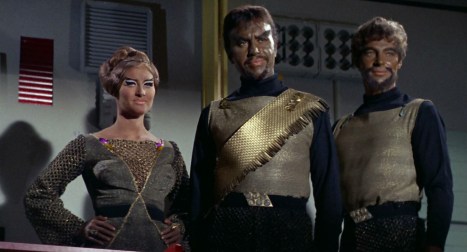
Day of the Dove is an episode that is singularly influential in terms of the future of the franchise, both in terms of continuity detail and in terms of its core themes. Most superficially, Day of the Dove offers the first real suggestion that the Klingons might be anything more than vaguely Asian antagonists, suggesting a culture that makes sense internally and allowing them an agency earlier stories lacked. Kang is in many ways the first true Klingon, who would fit comfortably with the spin-offs’ interpretations of the Klingons.

The episode’s influence runs deeper than that. Like The Empath before it, there is a clear sense that Day of the Dove has embraced the idea of the twenty-third century as a utopia in which mankind has transcended all of their hate and violence. Star Trek is presented as something approaching a paradise.

Don't blame me. I voted for Kodos.

Don’t blame me. I voted for Kodos.

Continue reading

Star Trek: Deep Space Nine – Broken Link (Review)

This February and March (and a little bit of April), we’re taking a look at the 1995 to 1996 season of Star Trek, including Star Trek: Deep Space Nine and Star Trek: Voyager. Check back daily for the latest review.

What is perhaps most surprising about Broken Link is how quiet and subdued it all it.

The fourth season began with a bang, with the dissolution of the alliance between the Klingons and the Federation that had been established in Heart of Glory and dramatised in Star Trek VI: The Undiscovered Country. In fact, The Way of the Warrior featured the largest and most impressive combat sequence in the history of the Star Trek franchise to that point. Even allowing for The Sacrifice of Angels and What You Leave Behind, the fourth season premiere still ranks as one of the most elaborate set pieces in the franchise’s history.

Pray... for... Odo...

Pray… for… Odo…

Broken Link consciously circles back to that. It features the first reappearance of Robert O’Reilly as Gowron since The Way of the Warrior. The episode makes it clear that the problems depicted in The Way of the Warrior are only worsening. There is no small suggestion that Gowron is hoping to turn the cold war between the Federation and the Klingon Empire into a shooting war. Broken Link is very much a show about taking the status quo that was established in The Way of the Warrior and ramping it up.

However, what is most striking about Broken Link is the manner in which it escalates the situation. Not a single weapon is discharged in Broken Link, which is the last season finalé of Star Trek: Deep Space Nine not to feature a combat sequence of some description. The actual plot of the episode is remarkably straightforward and linear, keenly focused on a single member of the ensemble rather while relegating politics into the background. Even in terms of the scripting of the episode, care is taken to slow the pace down and allow character-driven dialogue scenes.

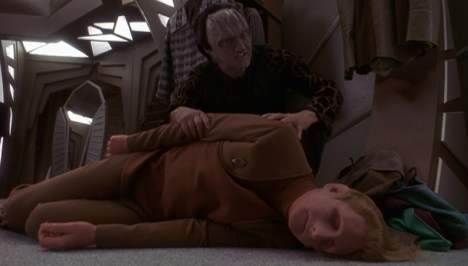
Oh no, Odo!

Oh no, Odo!

The result is a strangely intimate season finalé, one free of the bombast that comes with the season-bridging two-parters favoured by Star Trek: The Next Generation and Star Trek: Voyager. It is interesting to compare Broken Link to something like Basics, Part I, if only because the latter would never make room for Jadzia joking about being surrounded by “naked men” or Garak playing “Star Trek Cluedo” with Odo in sickbay. In fact, Broken Link is even relatively quiet by the standards of Deep Space Nine, lacking the galactic status quo shift of The Jem’Hadar or A Call to Arms.

As with a lot of the fourth season, there is a sense that the production team have made a point to learn from the third season: to improve upon what works and to fix what doesn’t. The Adversary was something of a happy accident at the end of the third season, a script thrown together at short notice when Paramount vetoed a season-ending cliffhanger that would be loosely adapted for Homefront and Paradise Lost. The slow character-centric tension of The Adversary was never intended to close the third season, but Broken Link realises that such an approach worked well.

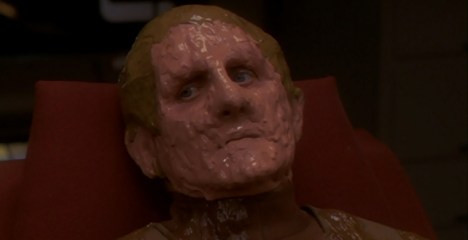
"Melting! Melting! Oh, what a world!"

“Melting! Melting! Oh, what a world!”

The result is an episode that feels incredibly comfortable in its own skin. Deep Space Nine is well aware of what it is, regardless of the direction and input that the studio offered the production team at the start of the fourth season. In fact, despite its somewhat relaxed pace and the space that it affords its character interactions, Broken Link is remarkably focused on what it wants to do. The closing line of the episode (and the season) is clever, consciously tying back the bold new direction of The Way of the Warrior back into the series’ own larger endgame.

In hindsight, Broken Link is something of a misleading title. Instead, it ties everything together.

Only a stone's throw away...

Only a stone’s throw away…

Continue reading

Star Trek: Deep Space Nine – Rules of Engagement (Review)

This February and March, we’re taking a look at the 1995 to 1996 season of Star Trek, including Star Trek: Deep Space Nine and Star Trek: Voyager. Check back daily Tuesday through Friday for the latest review.

Rules of Engagement is that old Star Trek standard: the trial episode.

The franchise has never really had a lot of luck with the format over the years. The Menagerie, Part I and The Menagerie, Part II were primarily of interest for the way that they repurposed The Cage and offered viewers a glimpse of an alternate kind of Star Trek. Later in that same first season, Court Martial was a disjointed and uneven (and even illogical) story. Later series did not fare much better; neither A Matter of Perspective nor Dax nor Ex Post Facto could be considered highlights of their seasons or their shows or the wider franchise.

Worf really doesn't understand the proper way to lodge an objection...

Worf really doesn’t understand the proper way to lodge an objection…

However, The Measure of a Man remains the exception that proves the rule. Not only a strong episode of itself, it stands as one of the best episodes in the history of the franchise. More than that, it represented a turning point in the history of Star Trek: The Next Generation; it is perfectly reasonable to point to The Measure of a Man as the moment that The Next Generation finally delivered on its potential after almost two seasons of struggling to find a unique voice. It seems entirely possible that the franchise has been chasing that high ever since.

Unfortunately, Rules of Engagement is an example of the rule rather than the exception. It is a misguided and clumsy episode that has a number of interesting ideas that fail to coalesce into a satisfying whole.

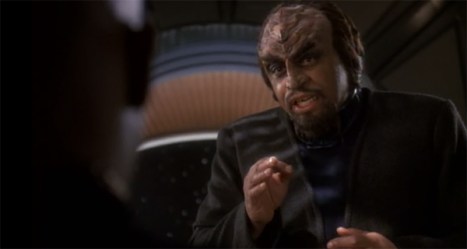
Klingon lawyered up... Kl'awyered up, if you will.

Klingon lawyered up…
Kl’awyered up, if you will.

Continue reading

Star Trek: Voyager – Dreadnought (Review)

This February and March, we’re taking a look at the 1995 to 1996 season of Star Trek, including Star Trek: Deep Space Nine and Star Trek: Voyager. Check back daily Tuesday through Friday for the latest review.

Dreadnought is arguably a much better version of Prototype.

Both are essentially horror stories about B’Elanna Torres essentially creating a new mechanical life form, making a decision that has unforeseeable consequences. There is an element of reproductive horror to all this, reinforced by the clever decision to have B’Elanna literally give the eponymous warhead her own voice and watch it engage in a course that is quite literally self-destructive. It is perhaps the quintessential reproductive horror story, the fear that we might create something that will supplant us; that our children become the worst reflections of ourselves.

Engine of mass destruction...

Engine of mass destruction…

It is interesting that Dreadnought followed Meld so closely; both are essentially stories about how Star Trek: Voyager (and its characters) cannot cleanly escape their past, as much as the show might push it (and them) towards a generic Star Trek template. The middle of the second season sees an emphasis on the idea that Voyager is composed of two radically different crews – that Starfleet and the Maquis are not as integrated as shows like Parallax or Learning Curve might suggest.

Alliances, Meld and Dreadnought all build on the idea of underlying tensions that were mostly glossed over during the first season. Of course, this creates a weird dissonance, as Voyager seems to actually be moving backwards rather than forwards – attempting a half-hearted do-over of some of its earliest miscalculations.

Engineering a solution...

Engineering a solution…

Continue reading

Star Trek: Deep Space Nine – Sons of Mogh (Review)

This February and March, we’re taking a look at the 1995 to 1996 season of Star Trek, including Star Trek: Deep Space Nine and Star Trek: Voyager. Check back daily Tuesday through Friday for the latest review.

Moving Worf over from Star Trek: The Next Generation to Star Trek: Deep Space Nine could be seen as a cynical move.

In fact, it was a bit of a cynical move, a rare example of executive meddling in the basic plot of Deep Space Nine. Although there is some disagreement as to precisely how much give and take was involved in the decision-making process by the production team and the studio, it was clear that the writing staff had not originally envisaged Worf joining the show and that the addition of Michael Dorn to the show’s cast was an attempt to shore up the show’s ratings and profile. These are the realities of network television production.

As the world Kurns...

As the world Kurns…

At the same time, moving Worf over to Deep Space Nine from The Next Generation afforded the production team unique opportunities and storytelling possibilities. With Star Trek: Voyager unfolding in the distant Delta Quadrant, Deep Space Nine had been largely free to reinvent and rework the franchise’s status quo for its own purpose. Deep Space Nine was allowed to play with toys that would have been off limits while The Next Generation was on the air; war with the Klingons, Federation civil war, Dominion invasion.

However, actually transitioning a character from The Next Generation to Deep Space Nine allowed the production team even more freedom and even greater contrast. Although very clearly the same character, Worf changes between The Next Generation and Deep Space Nine. There is a sense that Deep Space Nine is a lot more willing to carry certain aspects of the character to their logical conclusion, in a way that was simply not feasible on The Next Generation. This is clear in Sons of Mogh, when Worf attempts to murder his own brother.

Flirty!

Flirty!

Continue reading

Star Trek: Deep Space Nine – The Sword of Kahless (Review)

This February and March, we’re taking a look at the 1995 to 1996 season of Star Trek, including Star Trek: Deep Space Nine and Star Trek: Voyager. Check back daily Tuesday through Friday for the latest review.

The Sword of Kahless is the first episode of Star Trek: Deep Space Nine to focus primarily on Worf.

The character arrived on the show (and the station) in The Way of the Warrior, but his development since then had largely been confined to secondary plots. In Hippocratic Oath and Starship Down, Worf learned that life on Deep Space Nine would not be the same as life on the Enterprise. However, he had not really been the centre of any given episode before this point. (Even in The Way of the Warrior, Worf’s arrival and crisis of conscience was just one facet of a larger political situation.)

Sword of destiny...

Sword of destiny…

This is quite remarkable, and a result of a number of unique factors. Most obviously, Worf was not just any new cast member. Worf was a character who had arrived over from Star Trek: The Next Generation, and so was something of a known quantity to fans. There was less of a need to establish who Worf was, because most fans already knew. More than that, a lot of the early fourth season episodes had been in development before Michael Dorn had been confirmed to be joining the ensemble. As such, they tended to focus on other characters.

Nevertheless, it is remarkable that the fourth season is almost one-third of the way through its run before the production team devoted an episode to the newest member of the cast. It is a testament to the production team that the show had the confidence and restraint to adopt such an approach to such an obviously popular character. More than that, The Sword of Kahless is undoubtedly a Worf-centric episode, but it is a Worf-centric episode that makes it quite clear that Worf is a Deep Space Nine character now.

"Thank you, sir. May I have another?"

“Thank you, sir. May I have another?”

Continue reading