












Detroit is a powerful and visceral piece of cinema, one that loses its way in a muddled second act.
The Hurt Locker and Zero Dark Thirty cemented Kathryn Bigalow’s talent for conveying a sense of chaos and disorganisation on film. It can be very difficult to capture the messiness of real life in the movies, given how cluttered narratives can become distracting or disorienting. It takes a very real talent to guide the audience through this carnage in a way that captures the organic ambiguities of the story while ensuring that nobody is lost or distracted. Bigalow has a very rare talent for that.
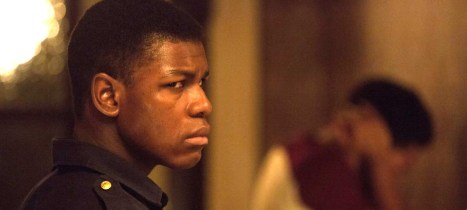
Insecurity guard.
Unsurprisingly, Detroit works best in its opening and closing acts, when the narrative pulls back to the real-life story covering the Detroit Riots in late July 1967. The film’s opening and closing beats have the feel of a weird docudrama, with Bigalow using handheld cameras and tight focus in a way that allows her to blend footage of the cast with archive material. Characters are identified by legends down the bottom of the screen, while the audience is frequently put in the position of confused spectators in a way that captures the mere anarchy loosed upon the city.
However, Detroit fumbles a little bit in its second act. For the middle of the film, Detroit narrows its focus significantly. Instead of providing socio-economic and political context for the entire riots, or dealing with the aftermath of horrific events, Detroit transforms into a story about a bunch of characters locked in a confined space together. As the film’s closing text admits, these sequences are much less verifiable than the snapshots populating the opening and closing acts, much less a matter of public record.

Big Mackie.
The second act of Detroit is a more conventional fictional narrative. While the movie is never less than interesting and clever, that organic sensibility is lost. During the first and third acts, the focus is on the broader story of the larger community, so it does not matter that many of these characters feel like archetypes and ciphers. When Detroit zooms in on the characters, they seem drawn too crudely to support the scrutiny. Detroit works a lot better as an epic social study, and less well as a claustrophobic character study.
Bigalow struggles to get the balance right, resulting in a film that is certainly ambitious and worthy, but also more uneven than her recent output. Detroit is too confident and too professional to be deemed a failure, but its second act is too shallow to be a success either.
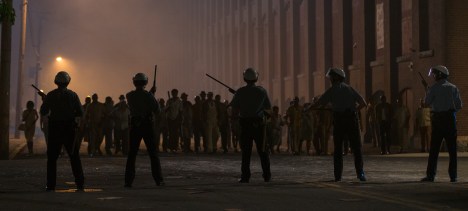
I predict a riot.
Filed under: Non-Review Reviews | Tagged: Detroit, film, kathryn bigalow, Movie, non-review review, review | Leave a comment »







 the m0vie blog