• Following Us

  • Categories

  • Check out the Archives


  • Awards & Nominations

Jessica Jones – AKA The Sandwich Saved Me (Review)

It could be argued that Jessica Jones is at its strongest when it embraces its status as an anti-superhero story.

The weakest points in the first season come when Jessica Jones embraces its superhero elements too readily, like when AKA Crush Syndrome or AKA It’s Called Whiskey fixated upon the idea of Kilgrave’s “weakness” as if Jessica is going to pull a glowing purple rock out of her pocket that will solve everything or when AKA 99 Friends made a point to tie the show into the events of The Avengers. This is not a show that lends itself to those sorts of superhero conventions.

jessicajones-thesandwichsavedme20a

Instead, Jessica Jones works best when it ignores many of the more common tropes of the genre. Kilgrave is particularly creepy for the fact that he doesn’t want to rule the world or destroy New York. Jessica Jones and Luke Cage are more interesting for the fact that they cannot be reduced to a series of cause-and-effect chain of consequence. These are real and messy lives that just happen to exist in a world full of giant green rage monsters and Norse deities. The juxtaposition is part of the appeal.

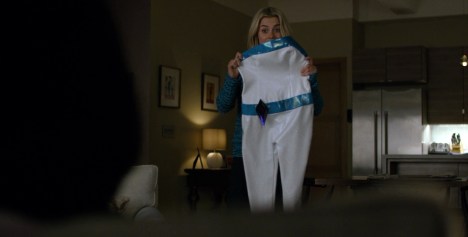
In that respect, AKA The Sandwich Saved Me plays as something of a gleefully subversive origin story. It exists primarily as a negative space, a story that rejects enough of the preconceived notions of superhero tales that it fosters a compelling dissonance.
jessicajones-thesandwichsavedme24a

Continue reading

Jessica Jones – AKA 99 Friends (Review)

Jessica Jones has always been more interested in the style and aesthetic of noir than in its storytelling.

The show’s visual aesthetic and stylistic sensibilities hark to noir. Jessica Jones is a cynical hard-drinking private investigator, who routinely works cases involving cheating spouses. She narrates her harsh reflections of life as she studies the world through the lens of a camera. Meanwhile, sad saxophones play in the background of lonely establishing shots of New York as the city that never sleeps, while our hero works alone late into the night seemingly accomplishing nothing. That is to say nothing of the actual opening sequence, with its impressionistic flair.

jessicajones-99friends11a

While Jessica Jones borrows a lot of the stock archetypes and set-ups associated with noir, its storytelling is more of a hybrid between conventional superhero drama and feminist psychological thriller. The problem is that Jessica Jones never actually feels comfortable with its main character’s profession. Despite the fact that Jessica Jones is a licensed private detective, the eponymous character spends precious little time actually detecting stuff. Jessica’s investigations are generally in pursuit of Kilgrave, with her profession treated as a background detail.

AKA 99 Friends demonstrates how uncomfortable Jessica Jones is with this aspect of its title character. Over the course of the show’s thirteen-episode run, AKA 99 Friends is the closest that the show comes to offering a straightforward “case of the week” episode. Unfortunately, it is pretty terrible.

jessicajones-99friendsa

Continue reading

Jessica Jones – AKA It’s Called Whiskey (Review)

Although Jessica Jones is the central character of Jessica Jones, the show does a pretty great job of building its ensemble.

The characters who exist in orbit of the title character all feel surprisingly well-formed and nuanced, three-dimensional and grounded. Although Jessica Jones is not always plotted in the most organic or logical way, it goes to great efforts to add layers to its characters. Over the course of the thirteen-episode season, even minor players like Malcolm or Simpson are revealed to be much more than their initial appearances would suggest. (Although this turns out to be a mixed blessing in the case of Simpson.)

jessicajones-itscalledwhiskey28a

If Jessica Jones has a weaker sense of structure than Daredevil, it has a stronger sense of its own ensemble. This is obvious from the outset. Rather than incorporating the show’s awkward mandatory comic relief into the primary cast as Daredevil did with Foggy, Jessica Jones relegates Robyn and Ruben to recurring status. As AKA Take a Bloody Number demonstrates, this doesn’t prevent every possible awkward tonal mismatch between comic relief and tragic drama; however, it does allow the rest of the cast room to breathe.

AKA It’s Called Whiskey is largely about building up the characters around Jessica, without sacrificing her role in the larger narrative.

jessicajones-itscalledwhiskey14a Continue reading

Jessica Jones – AKA Crush Syndrome (Review)

The biggest problems with the first season of Jessica Jones are structural in nature.

Writing a season of television is tough. It is particularly tough when the season is heavily serialised, requiring the production team to break the story down into a distinct number of easily digestible chunks. It is especially tough when the season is going to be released all at once for public consumption, allowing the audience to watch as many episodes as they want as frequently as they want. Is a thirteen-episode drama released all at once effectively just a twelve-hour movie with conveniently timed bathroom breaks? Or is it the same as any other drama?

jessicajones-akacrushsyndromea

Jessica Jones struggles with this. It begins struggling with it quite early and continues struggling with it until the final couple of episodes. There is a sense that the production team are not entirely sure what the ideal mode of consumption is for Jessica Jones. Is the show supposed to gulped down in three or four marathon sessions, or is it meant to be savoured over a longer period of time? Do the episodes need to stand on their own or should they flow together? Do the team have to worry about repeating certain story beats (“capture and escape”) too close together?

Jessica Jones never quite answers this. The show has a strong enough cast of actors playing an interesting enough selection of characters that it is easy enough to forgive these problems. The world feels well-formed and the immediate story beats are generally interesting enough that the show never drags or feels repetitive. However, it does occasionally wander down certain storytelling dead ends. AKA Crush Syndrome and AKA It’s Called Whiskey take the show down its first such narrative cul de sac.

jessicajones-akacrushsyndrome20a

Continue reading

Netflix and Marvel’s Jessica Jones (Review)

Jessica Jones is a bold and ambitious piece of work.

In many ways, it takes what worked about Daredevil, and improves upon a lot of it. It offers a grounded take on the shared Marvel universe, one even further disconnected from the world of The Avengers. It offers a likable cast of actors playing a bunch of nuanced and well-developed characters, avoiding some of the stock comic relief that bogged down Daredevil at certain points in the series. It is smart and provocative in a way that many of Marvel’s more mainstream offerings are not, taking advantage of the relatively smaller platform to tell a more niche story.

jessicajones-sinbin28a

There are issues, of course. The biggest problem with Jessica Jones is that the series feels about four episodes too long for the format that it has adopted. While each of the episodes work as a distinct unit of story, Jessica Jones is much more of a single story than Daredevil was. The problem is that the story occasionally feels like it goes through narrative loops and down narrative cul de sacs to stretch out to the thirteen-episode order. While the more episodic structure of the first half of Daredevil was not ideal, it allowed for a smoother twelve-hour storytelling experience.

Still, this is a rather small problem. The world and characters of Jessica Jones are interesting enough to sustain interest even when it feels like the plot is stalling. Jessica Jones is clever, exciting and engaging.

jessicajones-ladiesnight7

Continue reading

Jessica Jones – AKA Ladies’ Night (Review)

“New York may be the city that never sleeps, but it sure does sleep around,” explains grizzled private detective Jessica Jones, the first line of Jessica Jones.

The line establishes two key themes going forward, running through the first season of the show. The more subtle theme is that of New York itself. Like Daredevil before it, Jessica Jones is rooted in a particular vision of New York; in its imagery and iconography. While Daredevil was arguably rooted in a version of Hell’s Kitchen that no longer existed, Jessica Jones seems at least a little more modern and more relevant. In AKA Ladies’ Night, and across the season, street names serve as an emotional anchor to the eponymous private eye. They are real and tangible places.

jessicajones-ladiesnight7

The second theme is more immediately pronounced. Jessica Jones might just be the most sex-positive aspect of the shared Marvel Universe. Although the usual limitations on nudity are in effect, Jessica Jones seems far more comfortable with human sexuality and sexual dynamics than any of the studio’s earlier output. AKA Ladies’ Night sets the tone for the season, opening with an awkward sequence of quick and grotty sex in (and around) a parked car. The show starts as it means to go on, embracing sex as a part of the human condition.

AKA Ladies’ Night does an effective job of setting the tone for what will follow. It is an effective introduction to the world of Jessica Jones.

jessicajones-ladiesnight12 Continue reading

Secret War (Review/Retrospective)

April (and a little bit of May) are “Avengers month” at the m0vie blog. In anticipation of Joss Whedon’s superhero epic, we’ll have a variety of articles and reviews published looking at various aspects of “Earth’s Mightiest Heroes.” Yesterday and today we’re taking a look at the two Brian Michael Bendis events that kick-started the writer’s work on the franchise.

In many ways, Secret War feels like a companion piece to DC’s Identity Crisis crossover. Both miniseries essentially deconstructed the relatively simplistic nature of those superhero universes – daring to question what might happen if you approached these plot devices with a bit more cynicism. Bendis’ Secret War miniseries not only sets up the status quo and suggests the themes he would develop over the course of his New Avengers run, it also darkens the entire tone of the shared Marvel Universe. You can almost plot a straight line between Secret War and Siege, considering it one gigantic and messy saga adopting a cynical approach to the mechanics of this fictional world.

The war at home…

Continue reading