• Following Us

  • Categories

  • Check out the Archives


  • Awards & Nominations

Star Trek: Voyager – Resolutions (Review)

This February and March (and a little bit of April), we’re taking a look at the 1995 to 1996 season of Star Trek, including Star Trek: Deep Space Nine and Star Trek: Voyager. Check back daily for the latest review.

So, shipping.

Times change surprisingly quickly. It is fair to say that Star Trek: Voyager emerged in a different world than the original Star Trek. However, it also emerged in a different world than Star Trek: The Next Generation. In a way, the show had acknowledged as much through its experiments with serialisation earlier in the second season. Michael Piller was trying to keep the franchise at the bleeding edge of contemporary television, realising that the medium was not the same as it had been when Jean-Luc Picard emerged at the end of the Reagan era.

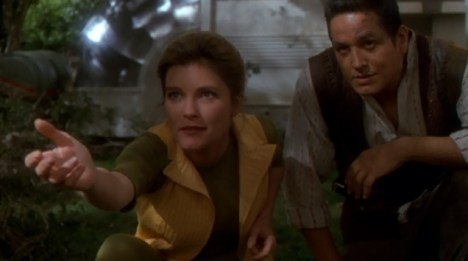
Reach out...

Reach out…

Resolutions nods towards a different type of change in the way that television storytelling worked, particularly conversations about television storytelling. Although it could be argued that Star Trek helped to popularise the notion of romantically (or sexually) pairing off television characters through the practice of “slashing” Kirk and Spock, the notion of “shipping” had begun to enter the mainstream during the mid-nineties. The raw sexual chemistry between David Duchovny and Gillian Anderson on The X-Files played no small part.

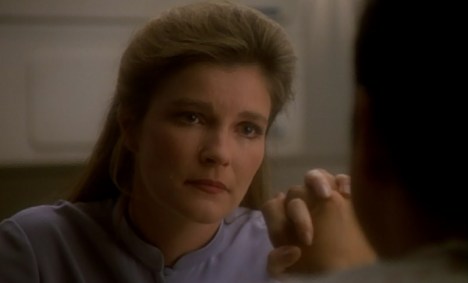
Resolutions is essentially about “shipping” Janeway and Chakotay.

... and touch somebody.

… and touch somebody.

Continue reading

Star Trek: Voyager – Alliances (Review)

This September and October, we’re taking a look at the 1995 to 1996 season of Star Trek, including Star Trek: Deep Space Nine and Star Trek: Voyager. Check back daily for the latest review.

One of the more persistent and convincing criticisms of Star Trek: Voyager is the idea that it was very narrative conservative; that the show got comfortable playing out the familiar formula that had been established by Star Trek: The Next Generation, and so never attempted to innovate or experiment in the way that Star Trek: Deep Space Nine (or eventually Star Trek: Enterprise) did. This is a perfectly valid criticism of the show as a whole, but it does ignore some of the weird tensions that played out across the first two seasons.

It is fair to say that Voyager never truly experimented. However, there are several moments in the first two seasons where it looks like the show was considering doing something unique or unprecedented. The show walked up to the edge, looking up and down; it never quite made the leap, but it seemed to weigh the possibility of jumping headlong into uncharted territory. However, it ultimately only dipped its toes in the water before getting cold feet and returning to the comfort of the familiar.

"Everyone liked Godfather III, right?"

“Everyone liked Godfather III, right?”

The sad truth about the second season of Voyager is that the show made a number of attempts to do something different or unique, only to botch each and every one of those attempts so completely that the production team learned not to even try. The second season’s more adventurous creative decisions all ended in humiliation and farce, explaining why the show desperately sought the warm blanket of a familiar format and an established template. After all, it was the more conventional episodes of the second season that had been (relatively) well received.

The second season of Voyager turned the process of trying something moderately ambitious and failing spectacularly into something of an artform. Of course, given the simmering tensions behind the scenes, it often seemed like the show wanted to fail. Michael Piller desperately wanted to do new things, only to meet resistance from his fellow producers and writing staff. Writers like Kenneth Biller would publicly criticise assignments they had been handed, offering a sense of just how much faith the staff had in these ideas.

"You wouldn't like me when I'm angry..."

“You wouldn’t like me when I’m angry…”

Alliances marks perhaps the most ambitious element (and most spectacular failure) of the second season of Voyager. It is the centrepiece of Michael Piller’s attempts to develop the Kazon into a credible (and convincing) alien threat, while also setting up a recurring arc that will allow Piller to push Tom Paris into the role of “lovable rogue” of which Piller was so fond. These were elements that excited Piller a great deal, but left most of the rest of the production team relatively cold.

So there is a great deal of irony in the fact that Alliances is ultimately written by Jeri Taylor, who was increasingly at loggerheads with Piller over the direction of Voyager. In light of that context, it makes sense that Alliances is an episode that aggressively critiques its own existence. Janeway spends most of the episode frustrated at the fact that the story is happening at all, and Alliances builds towards a climax that seems designed to convince the viewer that this whole idea is misconceived on just about every possible level.

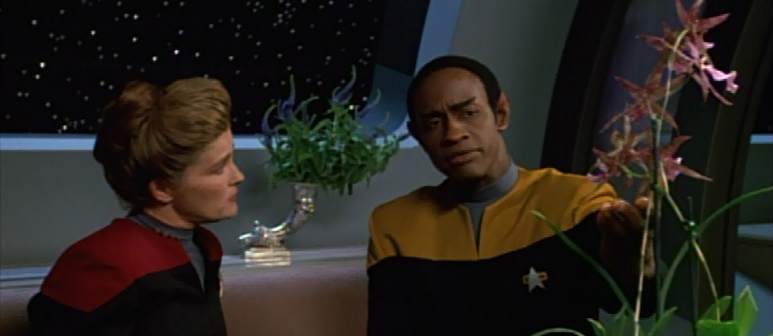
Blooming disaster...

Blooming disaster…

Continue reading

Star Trek: Voyager – Persistence of Vision (Review)

This February and March, we’re taking a look at the 1995 to 1996 season of Star Trek, including Star Trek: Deep Space Nine and Star Trek: Voyager. Check back daily Tuesday through Friday for the latest review.

In some respects, the second season of Star Trek: Voyager can be seen as a conflict over the future of the show.

On the one hand, Michael Piller had returned to the franchise following the failure of the television show Legend. With Ira Steven Behr overseeing Star Trek: Deep Space Nine, Piller returned to focus his attention on the second season of the younger Star Trek show. After all, the second season was a disorganised mess, with the production team struggling to get the necessary scripts together on time. Having a safe pair of hands on board to help guide the show might come in handy.

"It's a bridge AND a tanning salon, simultaneously..."

“It’s a bridge AND a tanning salon, simultaneously…”

On the other hand, Jeri Taylor had been around the show since Caretaker. She had taken over the reins after Piller’s departure and had supervised the tail end of the first season. Taylor had arrived on the Star Trek franchise just a year after Piller, and had been a vital part giving Star Trek: The Next Generation its unique voice and mood. Over the course of the second season, it became increasingly clear that Michael Piller and Jeri Taylor had very different visions for the future of Star Trek: Voyager, and those visions were coming into conflict.

History ultimately vindicated Jeri Taylor. The second season of Voyager was the last television season of Star Trek to be directly overseen by Piller, while Jeri Taylor become the guiding light of the third and fourth seasons of the show. Whatever problems might exist with those two seasons television, they are at least more stable and consistent than the first and second years of the show. It is, of course, arguable that Piller never got his own change to exercise his own vision of the show unimpeded – and so that is not a fair measure.

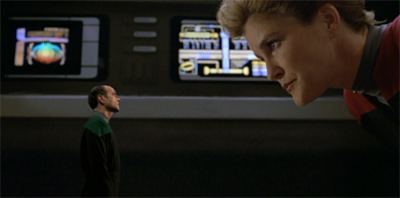
Cutting the Doctor down to size...

Cutting the Doctor down to size…

In a way, the conflict between Piller and Taylor’s versions of Voyager is quite clearly typified in this early run of episodes. The show had breezed through the four episodes left over from the first season production block, and desperately needed ideas to keep afloat. The senior producers rolled up their sleeves and got involved. Piller was largely responsible for Parturition and Tattoo, while Taylor oversaw Persistence of Vision. None of these episodes are perfect, but it is quite clear that Taylor is increasingly the show’s safest bet going forward.

Persistence of Vision is a very flawed episode of television, playing to some of Taylor’s more uncomfortable recurring motifs. However, it is much more interested in actually moving Voyager along than either of Piller’s contributions.

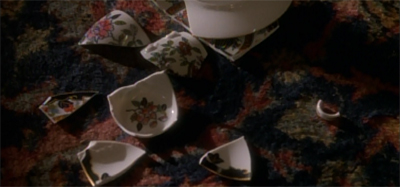
"The teacup that I shattered did come together."

“The teacup that I shattered did come together.”

Continue reading

Star Trek: Voyager – Twisted (Review)

This September and October, we’re taking a look at the jam-packed 1994 to 1995 season of Star Trek, including Star Trek: Deep Space Nine and Star Trek: Voyager. Check back daily for the latest review.

It’s easy to see why the decision was made to bury Twisted as deep into the second season of Star Trek: Voyager as possible. The third of four episodes carried over from the end of the show’s first production year, it was the sixth episode of the show’s second broadcast season. Not only did it air behind the last episode produced as part of that first year, it also aired behind the first two episodes produced during the second season.

To be fair, Twisted isn’t a bad episode. It has a whole host of problems, but the most fundamental issue with Twisted is that it is incredibly dull. It’s the most pointless sort of story imaginable, where a bunch of weird stuff happens to our characters and there’s no way to save the day so they just sit around and wait patiently until it stops. While the script to Twisted is comprised of irritating moments, they don’t add up to anything substantial.

Twisted is very much the equivalent of forty-five minutes of Star Trek themed dead air.

"Why, hello there..."

“Why, hello there…”

Continue reading

Star Trek: Voyager – The 37’s (Review)

This September and October, we’re taking a look at the jam-packed 1994 to 1995 season of Star Trek, including Star Trek: Deep Space Nine and Star Trek: Voyager. Check back daily for the latest review.

The 37’s did not close out the first broadcast season of Star Trek: Voyager, as the producers had intended. The last episode produced in the first season run, it was held back in the schedule into the second season – a decision made by UPN to allow Voyager to get an early start the following autumn. Still, the decision to reposition The 37‘s as the premiere of the broadcast season is quite telling.

Airing ahead of the three episodes produced before it, and ahead of any episodes produced specifically for the second season, there’s a sense that the production team intend The 37’s to be an important episode. After all, the season premiere is just as important as the season finalé in the basic structure of a broadcast season. The finalé serves as a capstone for what has come before, while (hopefully) indicating what might follow. The premiere is a way of setting up what is yet to come.

We have lift-off...

We have lift-off…

So the positioning on The 37’s is interesting, because it indicates just how much the production team had invested in the episode. This is a big episode of Voyager, this is an important episode of Star Trek. As such, it makes for a completely unsatisfying experience. The 37’s isn’t a bad episode by any measure – it has a few interesting ideas and a few memorable elements – but it’s not ambitious. It doesn’t radically change Voyager, but it also doesn’t distil it. It doesn’t offer the sense of purpose lacking for morst of the first season.

The 37’s just sort of is. It’s an episode that would be functional shuffled into the middle of a season – a few episodes earlier or later than broadcast. However, it simply doesn’t work when scheduled into a high-profile slot, particular when it has been moved so consciously and so purposefully.

A second pilot?

A second pilot?

Continue reading

Star Trek: Voyager – Prime Factors (Review)

This September and October, we’re taking a look at the jam-packed 1994 to 1995 season of Star Trek, including Star Trek: Deep Space Nine and Star Trek: Voyager. Check back daily for the latest review.

Prime Factors has some great ideas, but blunders awkwardly in the execution. In that respect, it genuinely feels like a first season episode of a new show in the same way that The Cloud did – there’s a sense that the series is trying to expand its own comfort zone in a way that offers potential for future storytelling opportunities. Prime Factors might make a few pretty serious missteps along the way, and often seems a little too timid to commit to its bolder ideas directly, but at least it feels more ambitious than Time and Again or Ex Post Facto.

Make way for Janeway...

Make way for Janeway…

Continue reading

Star Trek: Voyager – The Cloud (Review)

This September and October, we’re taking a look at the jam-packed 1994 to 1995 season of Star Trek, including Star Trek: Deep Space Nine and Star Trek: Voyager. Check back daily for the latest review.

The Cloud feels more like a first season episode than Time and Again and Phage did. Star Trek: Voyager has ploughed fairly effectively into its first season, primarily by treating it as the eighth season of Star Trek: The Next Generation. However, the first season has been falling into a regular pattern so fast that pausing for forty-five minutes to do some awkward and ill-defined character work doesn’t feel like a bad idea.

The Cloud is an awkwardly constructed piece of television that feels like it’s interested in building up this ensemble. As such, the pacing suffers, and the episode makes a number of awkward mistakes along the way, but it still feels like it is at least trying to do something worthwhile.

Shaking things up around here...

Shaking things up around here…

Continue reading

Star Trek: Voyager – Time and Again (Review)

This September and October, we’re taking a look at the jam-packed 1994 to 1995 season of Star Trek, including Star Trek: Deep Space Nine and Star Trek: Voyager. Check back daily for the latest review.

It’s really remarkable the sense of self that Star Trek: Voyager had three issues into its run. It took Star Trek: The Next Generation two years to figure out what it wanted to be. Star Trek: Deep Space Nine only really settled down in its fourth season. Star Trek: Enterprise reinvented itself twice before it was cancelled. On the other hand, Voyager just seemed so aware of what it was and what it was going to be within only a few episodes.

Sure, there would be a few changes made in the years ahead. The Borg would appear in the third season; Seven of Nine would join the cast in the fourth. Janeway’s fickleness has yet to be firmly established; the Doctor hasn’t come to the fore. And, yet, three episodes in, it is quite possible to look at Star Trek: Voyager and get a sense of what the next seven years will be like. The shape of things to come.

Time and Again is a time travel story, but it’s also the first time that Voyager pulls a full-on end-of-episode reset. It will not be the last.

Guest starring: anomaly of the week!

Guest starring: anomaly of the week!

Continue reading