• Following Us

  • Categories

  • Check out the Archives


  • Awards & Nominations

Star Trek: Voyager – Displaced (Review)

The Star Trek franchise has a reputation for being liberal and open-minded.

After all, the franchise is very much rooted in an extension of Kennedy-era liberalism, with the “final frontier” very much an extension of Kennedy’s “new frontier.” It is a franchise that is supposed to celebrate “new lifeforms and new civilisations” that it meets on “strange new worlds”, embracing the alien and celebrating diversity. The franchise is rooted in a utopian version of the future that has been portrayed as at least mostly socialist dating back to Star Trek: The Motion Picture at the latest.
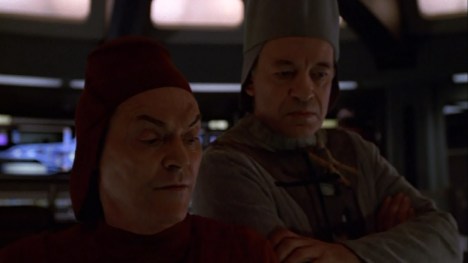
The end is Nyrian.

The end is Nyrian.

However, there are also points at which Star Trek could be considered to be reactionary and conservative. The original Star Trek was nowhere near as progressive on matters of race and gender as many would claim. The first two seasons of Star Trek: Enterprise frequently played as endorsements of politics of the Bush era and the fear of the unknown. The third season of Star Trek: Voyager has been particularly conservative in its outlook; consider the treatment of sex in Blood Fever or Darkling, of the traditional family in Real Life, of globalisation in Unity.

Displaced is perhaps the most striking example, an episode that is essentially a forty-five minute treatise on the risk posed by immigration.
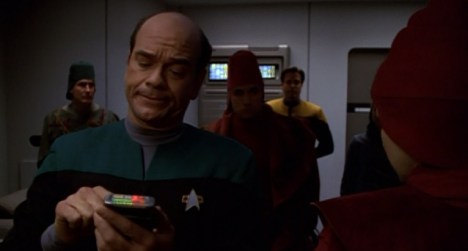
Damn space immigrants, clogging up our space hospitals.

Damn space immigrants, clogging up our space hospitals.

Continue reading

The X-Files – Providence (Review)

This December, we’re taking a trip back in time to review the ninth season of The X-Files.

It is frequently argued that 9/11 killed The X-Files.

There are two sides to this argument. The most defensible side suggests that audiences simply lost all appetite for conspiracy and paranoia when confronted with an atrocity on that scale; that viewers wanted to be comforted and reassured about authority in the wake of the attacks. This argument is perhaps supported by the significant drop in viewers between Existence and Nothing Important Happened Today I, suggesting that the audience simply wasn’t interested in finding out what the ninth season had to offer – regardless of quality.

Oh your gods...

Oh your gods…

The other side of the argument suggests that the production team themselves were ill-equipped to deal with post-9/11 reality. The X-Files was a show rooted in the cultural context of the nineties, and had just been asked to adjust to a seismic shift. The world had changed dramatically over the course of a few hours on a morning in Autumn. The eighth season had seen the show drift away from government conspiracies and towards a more conventional alien invasion narrative, one that could play as a reactionary fantasy of the War on Terror.

The ninth season aired in the immediate aftermath of 9/11. The season was actually in production when the attacks took place, with the team halting work on Dæmonicus as the reports came in. While the ninth season does not necessarily have a coherent and rational response to those events, it is clear that the production team want to say something. Much of the ninth season mythology seems to struggle with what it wants to say and how best to say it.

Fire and brimstone...

Fire and brimstone…

Continue reading

The X-Files – Vienen (Review)

This October/November, we’re taking a trip back in time to review the eighth season of The X-Files and the first (and only) season of The Lone Gunmen.

It feels strange to see the black oil after such a long time.

Technically, the last time that the black oil was brought up was in Two Fathers and One Son, where it was retroactively confirmed to be the “Purity” alluded to in The Erlenmeyer Flask. However, the last time it was an active plot element was really The X-Files: Fight the Future. After that, it lost amid plot developments involving gestating aliens and faceless rebels. So, in a way, putting the black oil at the centre of Vienen feels just a little surreal against the backdrop of “super soldiers” and other more immediate concerns.

Explosive action!

Explosive action!

Vienen feels very old-fashioned. Even the structure of the episode harks back to the first season mythology episodes, when the show was allowed to use aliens and conspiracies without the burden of tying them to a larger narrative. It features the black oil, but Vienen feels closer to Fallen Angel or E.B.E. than Tunguska or Terma. Trying to tie it into the larger plot of the mythology is an exercise in futility, but that is not the point here. Vienen is no more or less a mythology episode than Empedocles, despite its inclusion in the “mythology” DVD collections.

It is an excuse to bring back an iconic baddie for one last run-around with Mulder, continuing the orderly transition of power from the what the show was to what it might be in the future.

You should really use a dipstick for that...

You should really use a dipstick for that…

Continue reading

Star Trek: Enterprise – The Catwalk (Review)

Next year, Star Trek is fifty years old. We have some special stuff planned for that, but – in the meantime – we’re reviewing all of Star Trek: Enterprise this year as something of a prequel to that anniversary. This April, we’re doing the second season. Check back daily for the latest review.

The Catwalk is a solid, if unexceptional, piece of Star Trek.

Given the problems that the second season of Star Trek: Enterprise has been having to date, it feels like a breath of fresh air. As with a lot of the episodes around it, The Catwalk feels a little familiar. There are refugees with a secret; an alien take-over of the ship; a clever bluff to reclaim the ship from a position of weakness. If we are looking at The Catwalk in the “… by way of …” formula that seems to apply to most of this stretch of the second season, The Catwalk is “Starship Mine by way of Basics.”

"Right, right! Goddammit, Trip, now we'll never get the high score!"

“Right, right! Goddammit, Trip, now we’ll never get the high score!”

However, The Catwalk feels a lot more functional than many of the earlier episodes in the season. A large part of that is down to the way that writers Mike Sussman and Phylis Strong play to their strengths. The inevitable alien hijacking and threat is relegated to the background; The Catwalk is almost half over by the time that anything actually happens. While the episode’s pacing is a little uneven, it does allow Sussman and Strong a bit of room to explore the characters, building up the sense that the crew is something of a family unit.

While The Catwalk isn’t innovative or particularly adventurous, it works quite well. The idea of pushing the whole crew into a confined space and having them weather the storm together feels like it captures a lot of the pioneering sense of adventure that the show has allowed to fade over the second season.

Don't forget to turn out the light...

Don’t forget to turn out the light…

Continue reading

The X-Files – El Mundo Gira (Review)

This February and March, we’re taking a trip back in time to review the fourth season of The X-Files and the first season of Millennium.

The X-Files is a show that sometimes has difficulties when it comes to portraying minorities.

There are lots of episodes that offer insightful and thoughtful explorations of isolated subcultures, without veering into offensive stereotypes or awkward cliché. Fresh Bones and Hell Money are two examples of the kinds of stories that do offer those sorts of interesting and respectful depictions of minorities. In contrast, the show can sometimes seem a little close-minded and xenophobic. Excelsis Dei, Teso Dos Bichos and Teliko are episodes with somewhat questionable depictions of other cultures.

Illegal aliens.

Illegal aliens.

Writer John Shiban likes his horror tropes. He adores the classic horror movie trappings, and revels in a very old-school approach to scary stories. Unfortunately, the horror genre has an unfortunate history of exploitation and racism when it comes to the portrayal of “the other.” The easiest way to make something scary and unknown is to make it foreign, suggesting that the outside world is filled with horrors and monstrosities. Shiban would hit on this trashy exploitation vibe repeatedly during his tenure on The X-Files.

El Mundo Gira is very much a companion piece to Shiban’s other stories about foreign monsters – the indigenous cat-people of Teso Dos Bichos and the butt-dwelling Indian fakir of Badlaa. It is a not a story set in the world of Mexican-American immigrants; it is a story set in a clumsy stereotypical depiction of the world of Mexican-American immigrants, as channelled through unfortunate racial stereotypes.

Green haze...

Green haze…

Continue reading

The X-Files – Teliko (Review)

This February and March, we’re taking a trip back in time to review the fourth season of The X-Files and the first season of Millennium.

The very premise of Teliko is something that should probably have big flashing warning lights around it.

Teliko is an episode about an immigrant from Burkina Faso who celebrates his arrival by murdering within the African-American community. As such, it is the kind of story that the production team has to be very careful in handling. It could easily become a horrendously xenophobic anti-immigration story, a warning about the dangers of opening the borders to foreigners from cultures that are different to our own. And that is even before the episode decides to have the monstrous murderers turn his African-American victims white.

Top drawer...

Top drawer…

Writer Howard Gordon has navigated this sort of minefield before. Fresh Bones was a voodoo story set within a Haitian refugee camp. As such, it came with many of the same sorts of latent issues. It would be very easy to put a foot wrong, to turn the story into a collection of unpleasant and reactionary stereotypes that painted the foreign as inherently and undeniably horrific. Gordon’s script for Fresh Bones cleverly side-stepped a lot of these problems, becoming one of the strongest scripts of the second season.

While Teliko makes a conscious effort to avoid these potential hurdles, it isn’t quite as quick on its feet.

It's okay. Everybody gets a little airsick.

It’s okay. Everybody gets a little airsick.

Continue reading

The X-Files – Hell Money (Review)

This November (and a little of December), we’re taking a trip back in time to review the third season of The X-Files and the first (and only) season of Space: Above and Beyond.

Hell Money is an oft-overlooked episode of The X-Files.

The positioning in the third season probably doesn’t help. It comes directly after Teso Dos Bichos, probably the season’s weakest episode. It is also positioned in the gap between Pusher and Jose Chung’s “From Outer Space”, two broadly-loved episodes that serve as pitch-perfect examples of The X-Files both on- and off-format. In contrast, Hell Money is something a little stranger. It is not as conventional as Pusher, nor as radical as Jose Chung’s “From Outer Space.”

Seeing is believing...

Seeing is believing…

Instead, Hell Money is an episode of The X-Files that loosely fits the show’s format. Mulder and Scully investigate a bunch of macabre murders where sinister forces are at work. However, in keeping with the broad themes of the third season, the evil in Hell Money takes a particularly banal form. There are no monsters here; at least, not any supernatural monsters. The only ghosts that haunt the narrative are metaphorical. There is a culture alien to our leads, but one a bit more grounded than extraterrestrials.

Hell Money is a clever and thoughtful piece of television that feels subtly and harrowingly subversive.

The writing is on the wall...

The writing is on the wall…

Continue reading

Alien Nation: What the Aborted Superman Returns Opening Sequence Tells Us About Bryan Singer’s Man of Steel…

I’ve already talked a great deal about Superman Returns and why the movie doesn’t really work as a Superman story, but I was still fascinated to get a glimpse at the aborted $10m dollar opening sequence that never made it to the final cut, but only wormed its way onto the internet today. The clip is well-made and there’s no doubt that it was abandoned fairly late in the process, almost ready to fit in Bryan Singer’s epic story about the Man of Steel. It’s fascinating what the clip tells about how Singer sees his protagonist, and how the clip bolsters his own take, while demonstrating some of the more fundamental flaws with his vision.

Continue reading

Does Machete Matter?

I imagine that Robert Rodriguez was bracing himself for controversy over his new film Machete. Given the uproar that the use of foul language in Kick-Ass caused, I think it’s safe to say that Rodriguez’s retro “mexploitation” film was just asking for trouble when it came out. I anticipated a lot of politically correct discussions about the film’s premise, and potentially some discussions of negative stereotypes it might evoke. However, I certainly could not have suspected that it would provoke some sort of “race war”.

Knife to see you...

Continue reading