• Following Us

  • Categories

  • Check out the Archives


  • Awards & Nominations

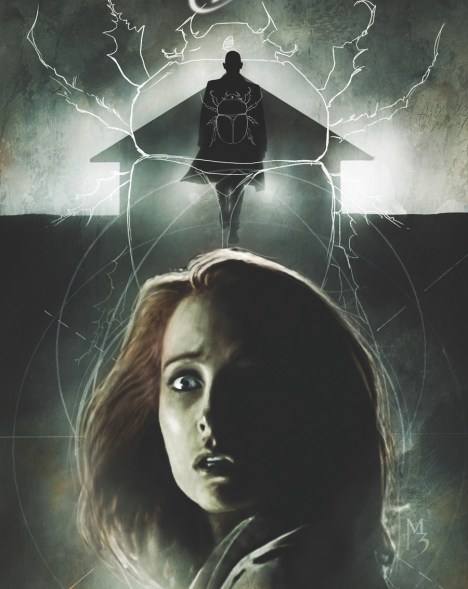
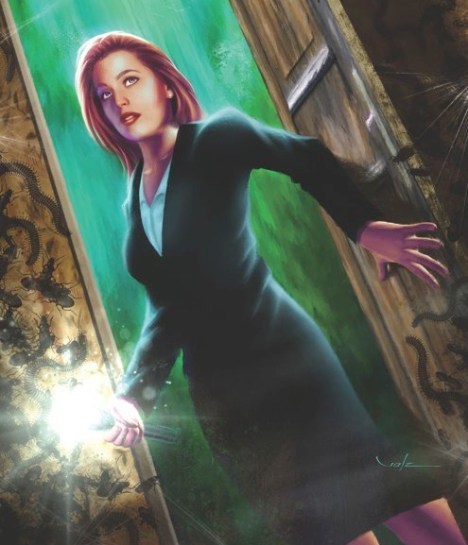
The X-Files: Season 10 (IDW) #9 – Chitter (Review)

This June, we’re going to be taking a look at the current run of The X-Files, beginning with the IDW comic book revival and perhaps taking some detours along the way. Check back daily for the latest review.

Chitter is an interesting single-issue story.

In many ways, Chitter feels very much like a throwback. It is a “monster of the week” story, the first such story to be written by Joe Harris focusing on an original creation. In fact, Harris acknowledged as much on his blog, remarking, “It’s my first, original ‘Monster of the Month’ (a term I’m taking sole credit for) story and it’s utterly disgusting, I’m sorry.” Although the plot includes a few nods towards the overarching themes of The X-Files: Season 10, the story stands almost completely alone. It would be possible to skip the issue entirely without missing much of importance.

Bugging out...

Bugging out…

This is very much an oddity in terms of The X-Files: Season 10, a monthly comic book series that has been very focused on the mythology and continuity of The X-Files. The first eight issues of the series were given over to threads dangling from the original show, whether the continuation of the mythology in Believers or the fate of the Fluke Man in Hosts or the origin of Mister X in Being for the Benefit of Mister X. This is the first time that the comic book has told a story that feels self-contained and truly standalone.

There is something very refreshing in that, with Harris constructing a story that feels very much in keeping with the tone and mood of The X-Files without relying on specific details. In many ways, it feels more like a classic episode than any of the previous issues. More than that, it actually feels very much like one of the early X-Files comics written for Topps by writers like Stefan Petrucha or John Rozum. It is a very strong piece of work.

Crawl good...

Crawl good…

Continue reading

Non-Review Review: 10 Cloverfield Lane

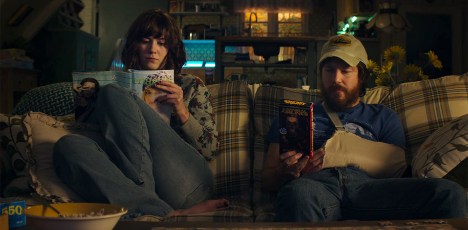
10 Cloverfield Lane is a beautiful piece of speculative paranoid horror.

The plot follows Michelle, a young woman who is involved in a car crash. She wakes up to find herself in a strange concrete bunker, under the care of the mysterious (and more-than-slightly sinister) Howard. As she comes to her senses, Howard advises her that something horrible has happened; the world has ended outside and they are sealed safely inside an air-tight self-sustaining bunker. However, Michelle has a healthy degree of skepticism about Howard’s claims, wondering what exactly is going on and just how trustworthy Howard actually is.

At home at the end of the world. Maybe.

At home at the end of the world.
Maybe.

To reveal any more would be to spoil the film. 10 Cloverfield Lane is very much a “mystery box” production, in keeping with various other JJ Abrams projects from Cloverfield to Super 8 to Star Trek Into Darkness. Although Abrams is not directing, 10 Cloverfield Lane retains a lot of the director’s aesthetic. It is a film that is designed to be seen with the bare minimum of information, to the point where the unveiling of the movie’s title came surprisingly late in the release process.

However, writers Drew Goddard and Daniel Casey (working from a story by Matthew Stuecken and Josh Campbell) and director Dan Trachtenberg use that mystery box structure in a manner distinct from Abrams’ blockbuster sensibilities. 10 Cloverfield Lane plays like a feature-length high-budget episode of The Twilight Zone, a story that looks and sounds great but would (mostly) lend itself to a stage play adaptation. 10 Cloverfield Lane feels very much like a classic high-concept science-fiction horror, in the best possible way.

Music to his ears...

Music to his ears…

Continue reading

Star Trek: Voyager – Meld (Review)

This September and October, we’re taking a look at the 1995 to 1996 season of Star Trek, including Star Trek: Deep Space Nine and Star Trek: Voyager. Check back daily for the latest review.

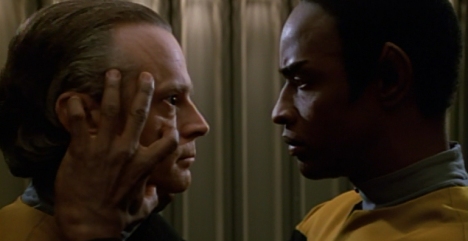
Meld is a masterpiece. It is the best episode of Star Trek: Voyager to date. There is perhaps a reasonable argument to be made that it is one of the best episodes that the series ever produced. It is, in many respects, one of the strongest and most compelling exploration of themes that have been bubbling around in the background since Caretaker, offering a more thoughtful and insightful exploration of the nineties culture of fear and anxiety than anything involving the Kazon. It is certainly the best use of Tuvok that the show managed in its seven year run.

Meld is an episode about violence, in its many forms. It is a story about the horrors and arbitrariness of unprovoked violence, but also about the cycles of violence that such actions can create. In many respects, Meld is a more scathing criticism of the death penalty than Repentance, the seventh season episode explicitly written as a death penalty allegory. Unlike many of the surrounding episodes, Meld actually manages to make good use of the show’s Delta Quadrant setting to heighten the dramatic stakes.
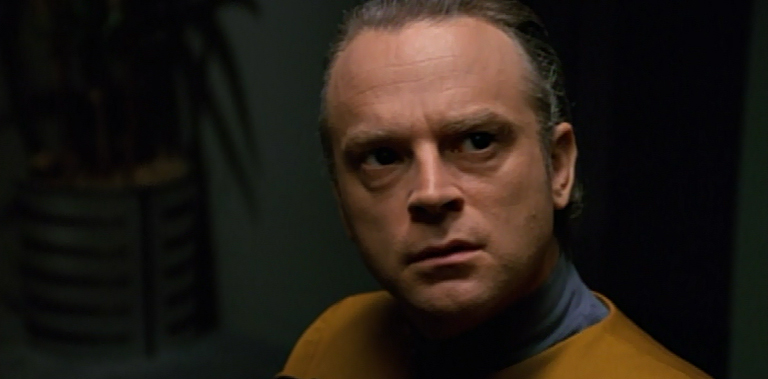
"Where's your head at?"

“Where’s your head at?”

In a way, Meld represents a collision of the franchise’s past and future. Meld may be the last truly great Star Trek script written by Michael Piller, the writer who helped to define the modern iteration of the franchise with his work on the third season of Star Trek: The Next Generation. At the same time, it is also Mike Sussman’s first story credit on the franchise; Sussman would go on to join the show’s writing staff in its final season and would be one of the few writers to serve a full four seasons on Star Trek: Enterprise.

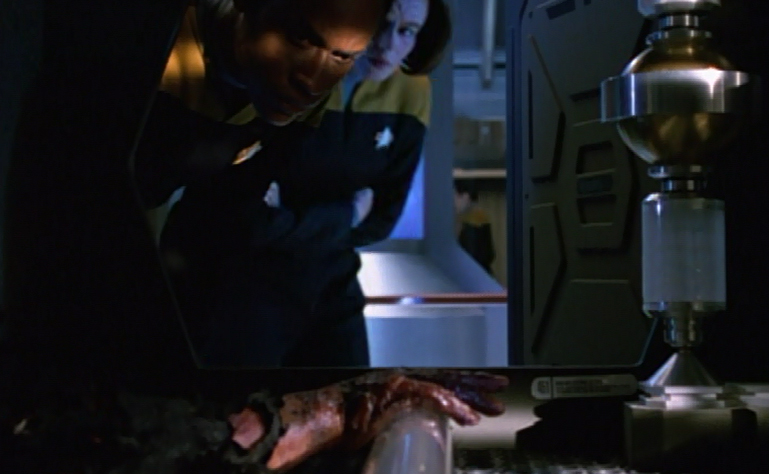
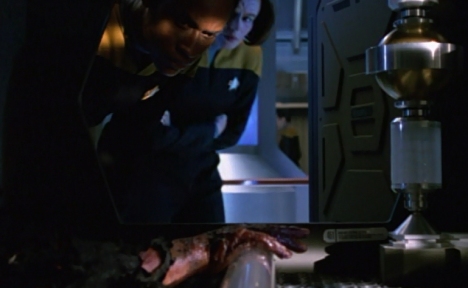
While the script for Meld is exceptionally well-written, the episode is elevated by a combination of factors. Cliff Bole does great work in bringing a very unconventional Star Trek episode to life. Meld could be seen as a continuation of the second season’s b-movie charms. Following on from the robot wars of Prototype and the body horror of Threshold, Meld plays like a Star Trek serial killer thriller. Bole’s directorial choices are consciously stylised, with delightful little touches like the band of light across Tuvok’s eyes when the body is discovered.
"Funny. I though Braga murdered Darwin last week."

“Funny. I thought Braga murdered Darwin last week.”

The episode also benefits from two mesmerising central performances from guest star Brad Dourif and Tim Russ. Russ was always one of the more under-utilised members of the Voyager ensemble, particularly when his “obligatory emotionally detached character” role was usurped by Seven of Nine in the fourth season. It is a shame, as Russ has a great deal of fun channeling Nimoy in his portrayal of the franchise’s first full-blooded Vulcan regular. Tuvok (and Russ) deserved more attention than the show afforded him.

That said, it is Brad Dourif who steals the show here. Lon Suder is one of the most fascinating guest characters in the history of the Star Trek franchise, and perhaps the only recurring character member of the Voyager crew who made any impression. A lot of that is down to the novelty of a fundamentally violent character in a Starfleet uniform, but Dourif is absolutely brilliant in the part. Dourif might just be the best guest star ever to appear in Voyager, and one of the franchise’s all-time greats.

Beta(zoid) male.

Beta(zoid) male.

However, perhaps the most striking aspect of Meld is the way that it feels very much of its time; it is an episode that firmly engages with a cultural context around Voyager. So much of Voyager seems lost in some sort of weird science-fiction neverland where the fifties and sixties never ended that a well-produced episode that feels of its time is a rarity. Meld is an episode that would feel strange ten years earlier or ten years later, but one which aligns perfectly with the wider context of 1996.

It is a overdue triumph from the Voyager team.

Smile!

Smile!

Continue reading

Star Trek: Voyager – Threshold (Review)

This February and March, we’re taking a look at the 1995 to 1996 season of Star Trek, including Star Trek: Deep Space Nine and Star Trek: Voyager. Check back daily Tuesday through Friday for the latest review.

Threshold is hated by fandom.

Veteran reviewer Jamahl Epsicokhan described it as “one of the all-time worst episodes of Star Trek ever filmed.” He is far from the only voice raised in protest. Winston O’Boogie remarked that, watching the episode, “you can’t help but think that something has gone terribly, terribly wrong with the world that allowed this to happen.” Assessing writer Brannon Braga’s contributions to the larger franchise, Jim Wright reflected, “Whatever else he may accomplish, he’s as forever shackled to Threshold as George Lucas to Jar-Jar.”

It's not even the worst episode of the season...

It’s not even the worst episode of the season…

Threshold is terrible. There is no way around that. It is a very stupid episode that is never entirely sure what it is trying to say from one moment to the next. More than that, positioning it as an important Tom Paris arc in the middle of the second season serves to sabotage the already confused character arc running between Alliances and Investigations. There is absolutely no context in which Threshold could be described as a “good” (or even “competent”) hour of television.

At the same time, it is not one of the worst episodes of the franchise ever produced; it is not even one of the worst episodes of the series. Surrounded by episodes like Tattoo or Alliances, the episode cannot even make a particularly confident claim to being the worst instalment of the season. None of this should be confused as an endorsement of Threshold. It is condemnation of everything that exists around Threshold.

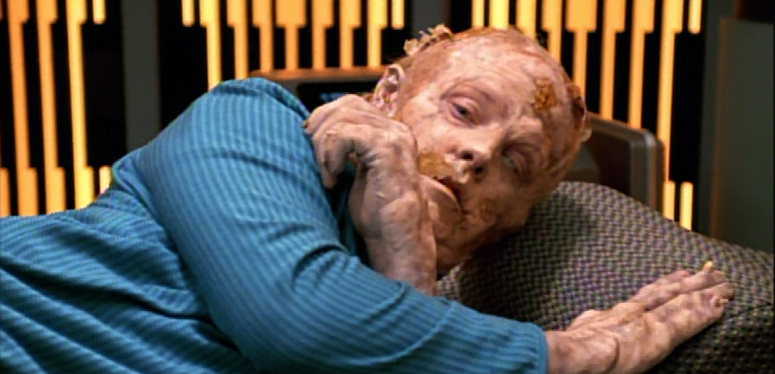
The great mutato!

The great mutato!

Continue reading

Night Stalker – What’s the Frequency, Kolchak? (Review)

This January, to prepare for the release of the new six-part season of The X-Files, we’re wrapping up our coverage of the show, particularly handling the various odds and ends between the show’s last episode and the launch of the revival.

What’s The Frequency, Kolchak? is the episode written by Vince Gilligan.

Gilligan remained one of Frank Spotnitz’s most keen collaborators in the years following the end of The X-Files. Gilligan had worked with Spotnitz as part of the writing staff on the short-lived Robbery Homicide Division before the pair moved on to Night Stalker. After ABC cancelled Night Stalker, the pair would collaborate on the television series A.M.P.E.D. for Spike, writing a pilot that would eventually air as a television movie when the network declined to pick it up for series.

"Wow, ABC really is a tough network to play with..."

“Wow, ABC really is a tough network to play with…”

Sadly, Night Stalker only lasted long enough for Gilligan to script a single episode of the show. Still, he fared better than fellow staffer Darin Morgan; Morgan’s script for The M-Word did not make it into production before the axe fell on the show. This is a shame; the materials available on the DVD that never made it to air on ABC suggest a show more comfortable with itself than the first six episodes would suggest. More than any other episode of the first season of Night Stalker, What’s the Frequency, Kolchak? speaks to the series’ potential.

It is just a shame that it arrives too late.

The monster at the end of the hall...

The monster at the end of the hall…

Continue reading

Night Stalker – Timeless (Review)

This January, to prepare for the release of the new six-part season of The X-Files, we’re wrapping up our coverage of the show, particularly handling the various odds and ends between the show’s last episode and the launch of the revival.

The unaired episodes of Night Stalker are fascinating glimpses into what the show might have been.

Into Night was the show’s original second episode, brutally shunted from its original position when ABC decided that they did not want a show focusing on monsters. The version of Into Night that appears on the DVD appears somewhat cobbled together, hastily editted in such a way as to make the show’s second episode sit as its eighth. The result feels like something of a rough cut, a glimpse at the pressures bearing down on the production team to meet various network demands.

It's dead at night in here...

It’s dead at night in here…

In contrast, Timeless and What’s the Frequency, Kolchak? feels like something completely different. These are episodes that were obviously produced while Night Stalker was still airing on ABC, but which did not complete production under the network’s supervision. While Timeless and What’s the Frequency, Kolchak? are ver clearly part of the same show, they feel tangibly different. The two episodes are more horrific, more confident, and less pandering than what came before.

In many respects, the two episodes suggest that Night Stalker benefits from not having to air on ABC.

My word!

My word!

Continue reading

Non-Review Review: The Revenant

The Revenant is a beautiful and visceral piece of work.

Sporting a troubled production history, The Revenant is surprisingly straightforward film. Based on the tale of famed fur trapper (and tall-tale-teller) Hugh Glass, The Revenant charts one man’s journey from near-death back to civilisation against the harsh and unforgiving American wilderness. The Revenant is essentially a journey in a straight line, as Glass struggles to find a way back to security and revenge himself upon his colleagues who left him for dead. The film’s biggest structural issues lie in a desire to distort or convolute that straight line.

therevenant6

However, the fairly linear and straightforward plot is really just a framework for director Alejandro G. Iñárritu and cinematographer Emmanuel Lubezki to present the audience with striking vistas and symbolism that ranges from blindingly obvious to wilfully obtuse. The film is absolutely stunning, capturing its tone perfectly and presenting any number of memorable images and moments. Even when the visual trips sideways or backwards feel indulgent or unnecessary, they are still beautiful.

The Revenant is perhaps a little too fixated on over-complicating what is a fairly straightforward narrative, with a script that can seem unexpectedly obtuse for what is basically a single long chase movie crossed with a classic “man against nature” survival film. Nevertheless, the result is a striking piece of work that is awe-inspiring in visual (and visceral) terms.

therevenant7 Continue reading

Jessica Jones – AKA It’s Called Whiskey (Review)

Although Jessica Jones is the central character of Jessica Jones, the show does a pretty great job of building its ensemble.

The characters who exist in orbit of the title character all feel surprisingly well-formed and nuanced, three-dimensional and grounded. Although Jessica Jones is not always plotted in the most organic or logical way, it goes to great efforts to add layers to its characters. Over the course of the thirteen-episode season, even minor players like Malcolm or Simpson are revealed to be much more than their initial appearances would suggest. (Although this turns out to be a mixed blessing in the case of Simpson.)

jessicajones-itscalledwhiskey28a

If Jessica Jones has a weaker sense of structure than Daredevil, it has a stronger sense of its own ensemble. This is obvious from the outset. Rather than incorporating the show’s awkward mandatory comic relief into the primary cast as Daredevil did with Foggy, Jessica Jones relegates Robyn and Ruben to recurring status. As AKA Take a Bloody Number demonstrates, this doesn’t prevent every possible awkward tonal mismatch between comic relief and tragic drama; however, it does allow the rest of the cast room to breathe.

AKA It’s Called Whiskey is largely about building up the characters around Jessica, without sacrificing her role in the larger narrative.

jessicajones-itscalledwhiskey14a Continue reading

The X-Files – Invocation (Review)

This October/November, we’re taking a trip back in time to review the eighth season of The X-Files and the first (and only) season of The Lone Gunmen.

There is something rather strange about how the first six episodes of the eighth season approach Doggett as a character.

Despite the fact that he is one of the two leads on The X-Files, the series takes its time in getting around to him. Robert Patrick is effectively stepping into the shows of David Duchovny, but the early stretches of the eighth season seem quite unsure what to make of Special Agent John Doggett. Robert Patrick might appear in the opening credits, but there is a sense that the writing staff are not yet entirely comfortable with the character. Perhaps worried about alienating fans still grieving for Mulder, the show keeps a respectful distance from Doggett.

Good grief.

Good grief.

Within and Without introduced Doggett as the agent in charge of the hunt for Mulder. While Scully and Skinner were looking at Mulder as a potential victim, they frequently found themselves competing with Doggett’s decisions to paint Mulder as a potential suspect. Doggett was introduced in a surprisingly abrasive manner, literally (and clumsily) attempting to undermine the relationship between Mulder and Scully – perhaps a literal expression of fannish anxiety about the show’s new lead.

This is not to suggest that the show has been hostile (or even disinterested) towards Doggett. Both Patience and Roadrunners emphasise that Scully needs to learn to trust Doggett and that he really does have her best interests at heart. However, the show tends to look at Doggett as an object of curiousity. In the first six episodes of the season, the show tends to view Doggett from an outside perspective. He might play an active role in the narrative, but he is not really a viewpoint character.

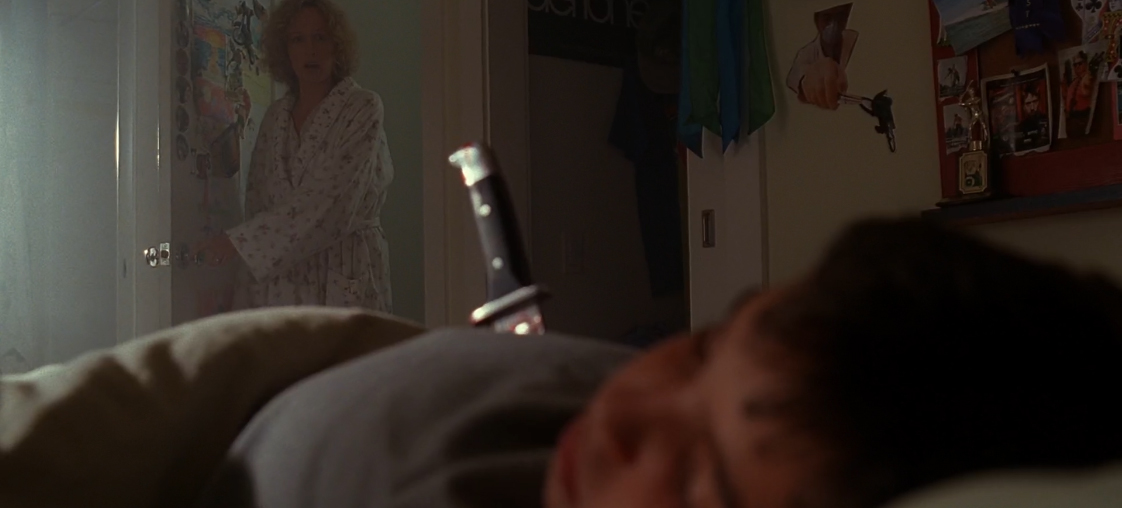
Knife to see you...

Knife to see you…

The show generally approaches Doggett through the character of Scully. (In Redrum, it is Martin Wells.) Leaning heavily on Scully makes sense; the audience trusts Scully, so if she can trust Doggett then maybe they can as well. More than that, it offers a nice twist on the dynamic during the first season of the show. In The Pilot, Scully was introduced as a viewpoint character into the bizarre world of Fox Mulder. Seven years later, the audience is so accustomed to that bizarre world that she is the viewpoint character into the grounded world of John Doggett.

This decision to treat Scully as the viewpoint character gives Invocation a surreal tone. In many ways, Invocation is the show’s first real Doggett-centric story; it is the first time that the character gets to drive the central narrative instead of running in parallel, it is the first time that the show hints at a personal back story for Doggett beyond “generic law enforcement and armed forces experience.” However, it is all filtered through the lens of Dana Scully. It emphasises the fact that Doggett is a mystery, which seems strange given how straight-laced he seems.

"Luke, I was your father."

“Luke, I was your father.”

Continue reading

The X-Files – Brand X (Review)

This September, we’re taking a trip back in time to review the seventh season of The X-Files and the first (and only) season of Harsh Realm.

Watching the seventh season of The X-Files only reinforces the sense that the production team got extremely lucky with the casting of David Duchovny and Gillian Anderson. The chemistry between the two actors has carried more than a few weak scripts across the seventh season. Lighter shows like Rush, The Goldberg Variation and The Amazing Maleeni were all able to coast off the charm of the pair. It doesn’t matter that the plot resolution in an exposition dump from Mulder when you end on Scully attempting a magic trick. However, this works both ways.

It the seventh season coasts of the charisma of David Duchovny and Gillian Anderson, this means that their inevitable absences are keenly felt. As The X-Files had become more popular, the demand upon Duchovny and Anderson had grown greater; most obviously, the show had dropped its production order from twenty-four to twenty-two episodes. Even allowing for that, the show could no longer make the same demands of Duchovny and Anderson that it had made in the first four seasons. Nor could they simply produce less television.

Smoke 'em if you got 'em...

Smoke ’em if you got ’em…

As a result, there are points in the show’s run when either (or both) David Duchovny and Gillian Anderson are unavailable. There are extended periods of the final two seasons that do not feature David Duchovny in any significant capacity. However, even within the seventh season, there are episodes where both leads are unable to fill the narrative space allocated to the lead characters. Gillian Anderson was largely absent from Chimera while working on all things; David Duchovny was largely absent from all things while working on Hollywood A.D.

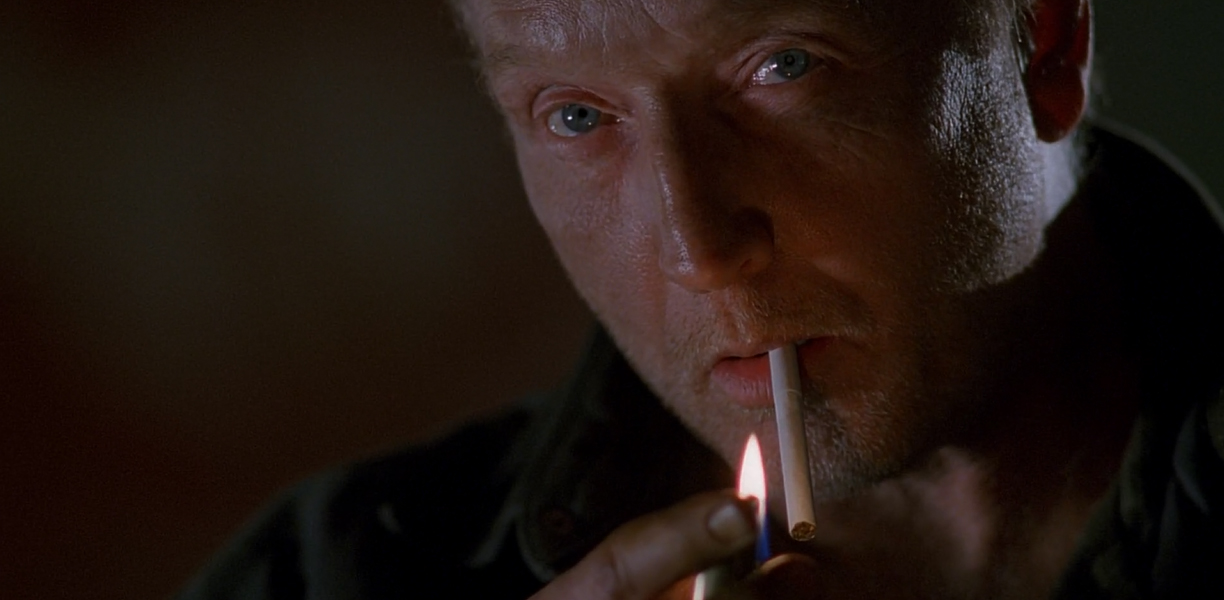
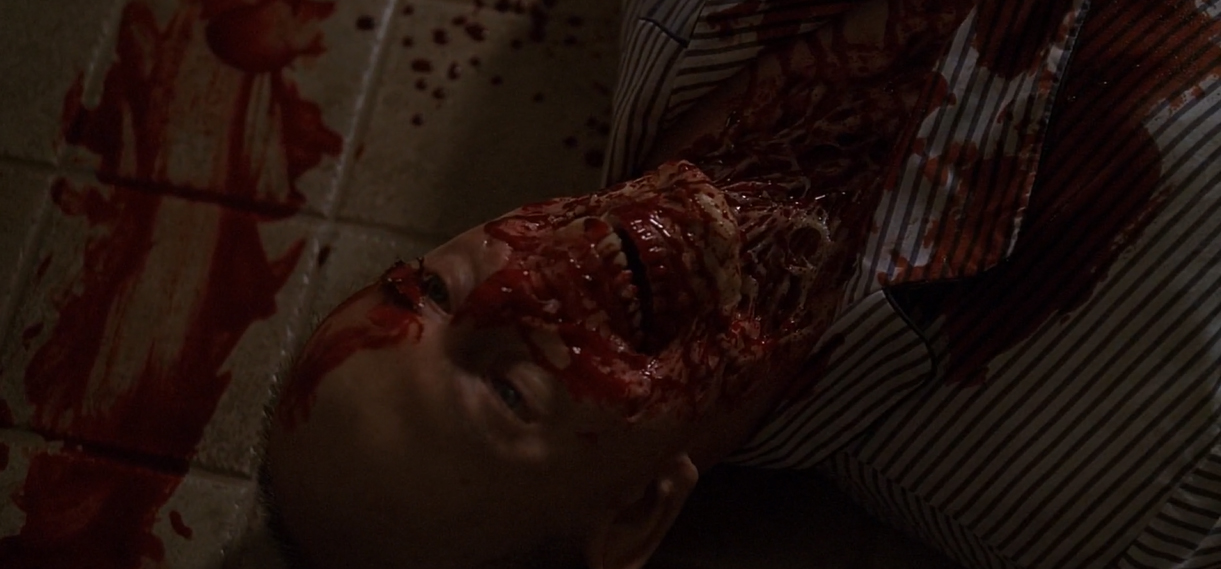
It is these absences which suggest an uncomfortable truth about The X-Files. The show might have its own chemical dependencies. In a metaphor stretched in an effort to tie it all back to Brand X, the audience might rely on Duchovny and Anderson as surely as a smoker relies on their quick nicotine fix. Any attempt to genetically reengineer the show to ensure a healthier and longer life could easily end up creating a monster.

Talk about a looming legal face-off...

Talk about a looming legal face-off…

Continue reading