• Following Us

  • Categories

  • Check out the Archives


  • Awards & Nominations

Non-Review Review: The Curse of La Llorona

The Curse of La Llorona is fairly solid as contemporary studio horrors go.

Although the arrival of Avengers: Endgame has a lot of attention focused on the largest and most successful shared cinematic universe of the twenty-first century, there is a lot to be said for the strange horror universe that has been built outwards from The Conjuring. Although this trend is most overt in The Conjuring 2, the rare horror movie to also feature a car chase sequence, there is something fascinating in how these films have transformed studio horror into a blockbuster concern.
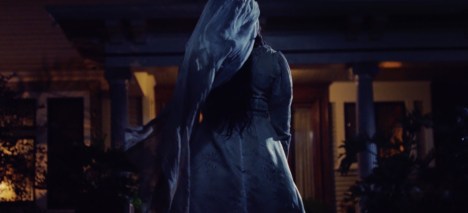
Mother have mercy.

There is a reason that these films are released during the summer months, as counter-intuitive as that might seem. Again, discussing The Curse of La Llorona in such terms might seem cynical, but it is genuinely striking. It takes a lot of work to satisfy the competing demands of the two genres; the shock of horror with the familiarity of blockbuster storytelling. The challenge with The Curse of La Llorona lies in offering audiences something that satisfies all their expectations of a film like this, while still offering a few shocks and starts along the way. It is a remarkable accomplishment.

The Curse of La Llorona strikes that balance relatively well. The film knows the formats and rhythms of a horror film, and director Michael Chaves knows both what the audience expects and how to work within that format to build a genuine and compelling sense of dread. The Curse of La Llorona is well-made, efficient, and delivers what the audience anticipates from a Conjuring spin-off. There’s something endearing in the reliability, in the care with which the film strikes these sorts of balances.
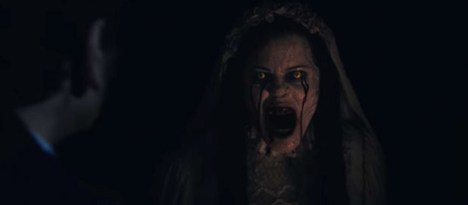
Scream queen.

Continue reading

Non-Review Review: Pet Sematary

The horror in Pet Sematary is primal and ancient, both literally and figuratively.

The tropes that power Pet Sematary were already familiar and old-fashioned by the time that Stephen King published the book more than a quarter of a century ago. Indeed, there are extended stretches of the novel when Pet Sematary feels like a game of Stephen-King-related mad-libs: a dash of paternal anxiety here, a sense of existential dread about the American wilderness there, a familiar older character to provide exposition thrown in, and a climax where everything gets very brutal very quickly.

“You just take a left at the Pet Seminary.”

Even beyond the sense of Pet Sematary as a collection of familiar Stephen King elements blended together, the novel riffed on familiar genre elements. There was more than a faint whiff of The Monkey’s Paw to the basic plot, the story of a seemingly wondrous device that could resurrect the dead only for the person responsible to realise that their beloved had come back “wrong” – or, as Jud helpfully summarises, that “sometimes dead is better.” (The novel alluded to this more directly with the story of Timmy Baterman, which is consigned to a newspaper clipping in this adaptation.)

Writer Jeff Buhler, along with directors Kevin Kölsch and Dennis Widmyer, clearly understand that appeal. The script for Pet Sematary makes a number of major alterations to the book’s plot, but most are logical and organic, rooted in the realities and necessities of cinematic storytelling more than the desire to change things for the sake of changing them. For the most part, Pet Sematary revels in the old-fashioned blend of Americana and horror that defines so much of King’s work, the mounting sense of dread and the decidedly pulpy sensibility.

The purr-fect villain.

Pet Sematary only really runs into trouble in its third act, and this is arguably a problem that is carried over from the source material despite the major branching choices that the script makes leading up to that point. The issues with the third act are not those of character or plot, but instead of tempo and genre. In a weird way, these third act issues make Pet Sematary feel like a spiritually faithful adaptation, carrying over something of the essence of the book, for better and for worse.

Pet Sematary is at is strongest when building mood and mounting dread, when offering its own shading on the familiar iconography of a haunted and untamed wilderness. Pet Sematary is at its weakest when it is forced to shape that dread into a more conventional horror movie climax.

Shades of grey.

Continue reading

Non-Review Review: Velvet Buzzsaw

Velvet Buzzsaw is a broad and blackly comic exploitation horror story.

Of course, Velvet Buzzsaw has all the trappings of a biting social satire about the shallowness of the art world, the kind of cartoonish takedown that has been a pop culture staple for decades, built on the acknowledgement that the world of commercial art is vapid and that the people who inhabit that world are delusional and self-centred. There’s certainly an elements of that to Velvet Buzzsaw, which populates its cast with the kinds of characters who might be ordered in a box set for that kind of film; the pretentious and insecure critic, the conniving climber, the manipulative dealer, the precious artist.

The art of horror.

However, Velvet Buzzsaw has nothing particularly new or interesting to say about these characters and this world. In fact, the opening half-hour or so that the film spends with these characters in this world is perhaps the weakest part of the film, often feeling like the television edit of a more pointed and acerbic film. There is a sense that writer and director Dan Gilroy understands this. At one point, early in the film, Rhodora Haze surveys a Miami art show with a potential client. “I get the joke,” she admits. “None of this new.” She may as well be talking about the stretch of the film in which she finds herself.

However, as with Nightcrawler, there is a sense that the social commentary is not the central appeal of Velvet Buzzsaw. Instead, again as with Nightcrawler, the appeal of Velvet Buzzsaw is the manner in which Gilroy appends what is a fairly straightforward criticism of hypercapitalism to the framework of a horror movie, to create a compelling and exciting aesthetic. Velvet Buzzsaw doesn’t work as an angry takedown of a world that has been well-explored across film and television, but it does work as a delightfully schlocky B-movie about (literally) killer art installations.

Painting the town red. And blue. And yellow.

Continue reading

My 12 for ’18: Quiet Please in “A Quiet Place”

It’s that time of year. I’ll counting down my top twelve films of the year daily on the blog between now and New Year. I’ll also be discussing my top ten on the Scannain podcast. This is number eleven.

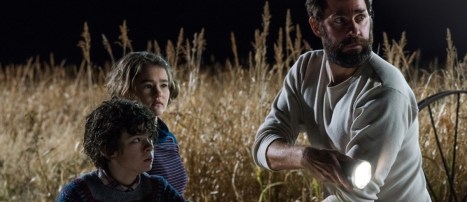
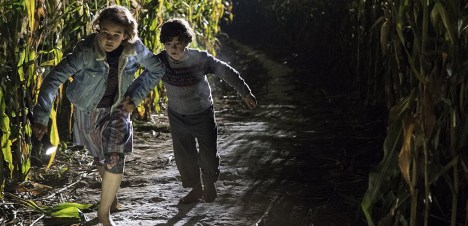
Much has been made of A Quiet Place as an old-fashioned horror throwback, and justifiably so.

There is a lot to like about A Quiet Place, especially for audiences who are maybe a little cynical about the modern cinematic landscape. It is an original property. It is not a sequel, reboot, prequel or remake. It is not even based on a book or a comic. It does not exist as part of a shared universe. It is not a story drowned out by the cacophony of end-of-the-world stakes. It is not a story that struggles under the weight on unnecessary exposition. It is a solid, mid-tier, old-fashioned horror film. It is the kind of respectable mainstream genre film that doesn’t really exist anymore.

However, there is something that separates A Quiet Place from the year’s other nostalgic prestige horror offerings like Hereditary. Hereditary was a film that largely succeeded as a nostalgic throwback to the classic horror films of the seventies, tapping into the same fears of familial dissolution as Don’t Look Now or The Exorcist. In contrast, A Quiet Place is a thoroughly modern film. It is a movie that very much reflects the modern world, although not necessarily in terms of theme or story. Indeed, trying to work out the politics of A Quiet Place is bound to be an exercise in frustration.

Instead, A Quiet Place is a modern film in the way that it engages overtly with and makes the characters complicit in the act of watching a horror movie. It is a horror film that is consciously designed in order to heighten and emphasise the manner in which people watch films.

Continue reading

108. Slender Man – This Just In (-#57)

Hosted by Andrew Quinn and Darren Mooney, This Just In is a subset of the fortnightly The 250 podcast, looking at notable new arrivals on the list of the 250 best(and the 100 worst) movies of all-time, as voted for by Internet Movie Database Users.

This time, Sylvain White’s Slender Man.

Continue reading

Non-Review Review: Bird Box

Bird Box is a fascinating contemporary horror movie.

The stock comparison will be to something like A Quiet Place, another contemporary horror movie that plays a fairly standard set-up with a high-concept twist. In A Quiet Place, the characters were stalked by monsters that could not hear them, and so they had to move without generating any sound. In Bird Box, the characters find themselves confronted by supernatural monsters that drive any person who looks at them completely insane, often to the point of self-destructive suicide.

Carry on regardless.

However, Bird Box feels decidedly more abstract than A Quiet Place, more lyrical and more metaphorical in its construction. It was often difficult to read a strong central allegory into A Quiet Place, to see it as anything more than a very effective old-fashioned horror film that very effectively literalised one of the central tensions for horror movie audiences; the desire to scream with the need to keep quiet. Bird Box does something similar, effectively creating a horror movie where even the characters themselves must close their eyes when the scary parts happen.

However, there is much more going on in Bird Box, perhaps even too much. The central premise of the horror movie lends itself to any number of varied (and possibly contradictory) readings about the insanity of the modern world and the need to protect the family from chaos that might at any moment encompass them. Bird Box is an ambitious and effective horror, one that applies a variety of tried-and-tested horror formulas to bracing social commentary.

Life is anything but a dream.

Continue reading

102. Silence of the Lambs (#23) – Halloween 2018

Hosted by Andrew Quinn and Darren Mooney, and this week with Doctor Bernice Murphy, The 250 is a (mostly) weekly trip through some of the best (and worst) movies ever made, as voted for by Internet Movie Database Users.

This time, a Halloween treat. Jonathan Demme’s The Silence of the Lambs.

At time of recording, it was ranked the 23rd best movie of all time on the Internet Movie Database.

Continue reading

Non-Review Review: Overlord

Overlord is a film that works a lot better in concept than in does in execution.

The idea of constructing a pulpy monster narrative around Nazi atrocities during the Second World War has a certain appeal to it. Not only does it evoke the sort of trashy fiction that that often existed at the margins of popular culture, but it also suggests the speculative lenses through which audiences process trauma, the way in which mass media filters horrors almost beyond human comprehension into something tangible and visceral, creating an uncanny and uncomfortable prism through which anxieties over these horrors might be channeled.

Russelling up some fun.

The horrors inflicted by the Nazis are almost impossible to fully comprehend; the systemic brutality inflicted upon those marginalised groups under their authority, the destruction that they wrought across Europe. These traumas linger in the popular memory. While the reality of those atrocities must never be forgotten or downplayed, there is something very powerful in the idea of translating that to the screen through the cinematic language of horror. Like Wolfenstein, Overlord seems to suggest an impressionistic portrait of the horrors of the period.

This approach is intriguing, and there are moments when Overlord works very well, when the film is creepy and unsettling in all the ways that it should be creepy and unsettling. However, the film suffers greatly when the script tries to impose a familiar framework on these horrors, when it runs through the checklist of storybeats expected for a major modern cinematic release. Put simply, Overlord works best when it aspires to be Captain America: The First Avenger, but as a horror film” and it works worst when it just tries to be Captain America: The First Avenger.

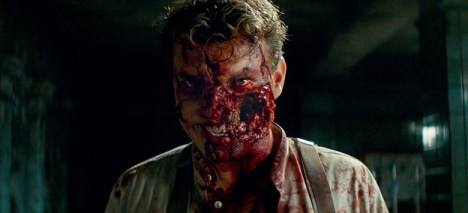
I want to take his face… off.

Continue reading

97. The Open House (-#58)

Hosted by Andrew Quinn and Darren Mooney, The Bottom 100 is a subset of the fortnightly The 250 podcast, a trip through some of the worst movies ever made, as voted for by Internet Movie Database Users. The Bottom 100 is a special series of episodes that will be randomly interspaced with regular releases, covering the way in which the Internet Movie Database recently renovated their list of the worst movies ever made to include more populist fare.

This time Matt Angel and Suzanne Coote’s The Open House.

Continue reading

Star Trek: Voyager – The Haunting of Deck Twelve (Review)

It seems strange that Neelix was not a larger part of Star Trek: Voyager.

To be fair, Neelix never disappeared into the ensemble to the same degree as characters like Chakotay, Kim and Tuvok. However, the series often struggled with how best to approach the character and how to make him work. It is notable that the production team went to the effort of writing Neelix off the show shortly before the seventh season finale, sending him to live with a colony of (very far from home) Talaxians in Homestead and consigning him to a cameo in Endgame. The character was often just there, his role hazy and undefined.

A Briefing With Death!
Errr, I mean, Neelix.

Of course, there were reasons for this. Neelix had been drafted on to the crew as an expert on the Delta Quadrant in Caretaker, and it made sense that this role would become increasingly redundant as time went on. By Fair Trade, Neelix was largely redundant, his knowledge exhausted. More than that, the early seasons of Voyager anchored Neelix’s character development to an abusive relationship with two-year-old. The toxicity of Neelix’s relationship with Kes in episodes like PhageTwisted and Parturition made it hard to invest in Neelix as a character worthy of attention or effort.

However, across the seven seasons of Voyager, there is a strange sense that Neelix is perhaps the single character most perfectly adapted to Voyager. He is the character who has developed in the direction that is perhaps most compatible with what Voyager has become, both in how it tells its stories and what it uses those stories to talk about. More than any other character on Voyager, Neelix is the character with the deepest roots in Delta Quadrant history and the character who is most firmly committed to oral traditions of storytelling, both recurring motifs within Voyager.

Smoke and mirrors.

Continue reading