• Following Us

  • Categories

  • Check out the Archives


  • Awards & Nominations

Star Trek: Voyager – Prey (Review)

Prey is a fantastic piece of television, and stands as one of the best standalone episodes of the fourth season of Star Trek: Voyager.

It is an episode built around a very simple premise, pitting two of Voyager‘s more memorable alien creations against one another and throwing a nice character arc into the midst of this epic conflict. Prey is an exciting thriller built around the established characteristics of both the Hirogen and Species 8472, using two very distinctive cultures to tell a compelling and engaging story with the regular cast thrown into the fray. “Lone Hirogen hunter pursues lost member of Species 8472” is a great hook for an episode.
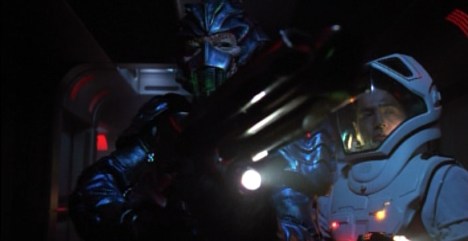
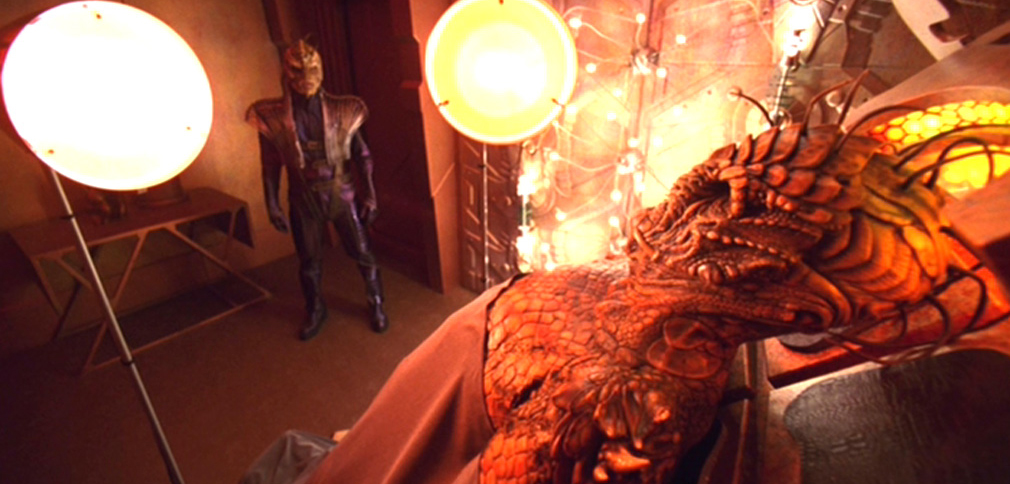
Here come the big guns.

However, Prey goes even further than that. The basic plot is intriguing on its own terms, but Prey cleverly grounds the story in what we know about these characters and their dynamic. As much as Voyager is caught in the crossfire of this horrific situation, the crew are also forced to make tough decisions. How will Janeway react to a wounded member of a hostile (and nigh-invulnerable) species? How will Seven of Nine respond when asked to save the life of a creature that participated in a brutal war with the Borg Collective?

This is intriguing stuff, largely anchored in what the audience already knows of the characters and delivered with top-notch production values and a great sense of pacing. Prey is an episode that plays to all the strengths of the fourth season, from the appeal of the Hirogen and Species 8472 through to the chemistry between Kate Mulgrew and Jeri Ryan.
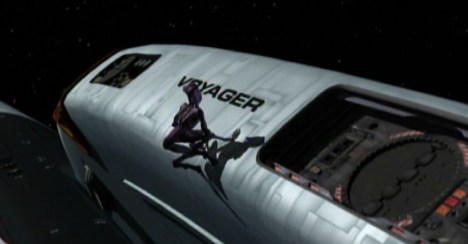
There’ll be hull to pay.

Continue reading

Star Trek: Deep Space Nine – The Quickening (Review)

This February and March (and a little bit of April), we’re taking a look at the 1995 to 1996 season of Star Trek, including Star Trek: Deep Space Nine and Star Trek: Voyager. Check back daily for the latest review.

Somehow, it happened. Star Trek: Deep Space Nine went from a show that could barely produce one good Bashir episode in a season to a series that could crank out three great Bashir episodes within the same production year.

The fourth season of Deep Space Nine is a fantastic season of television, even allowing for the episodes that don’t quite work (Sons of Mogh, Rules of Engagement) and those that fall completely apart (Shattered Mirror, The Muse). There any number of ways of measuring this success: the ease with which Worf has been integrated into the ensemble; the very high average quality of the individual episodes; the skill with which the production team navigated the introduction of the Klingon plot threads at the suggestion of the studio.

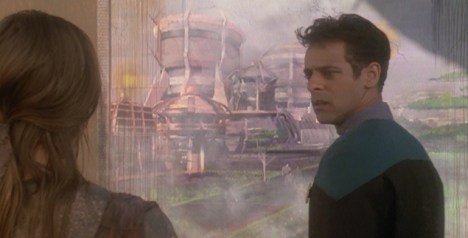
Paradise lost.

Paradise lost.

These are all perfect valid barometres of the season’s success. As is the most obvious indicator: the season is fun to watch and largely holds up on rewatch. However, the simple fact that Deep Space Nine could produce three great centring around Julian Bashir over the course of a single season speaks to how far the production team had come. After all, the studio had repeatedly asked the staff to write Bashir out of the show, convinced that fans were not responding to the station’s chief medical officer.

The Quickening is the third and final “good Bashir episode” of the fourth season, and it demonstrates just how important Bashir is to the fabric and framework of Deep Space Nine. Bashir represents Deep Space Nine‘s esoteric utopianism.

Bashir determination...

Bashir determination…

Continue reading

The X-Files – The Sixth Extinction (Review)

This November, we’re taking a trip back in time to review the seventh season of The X-Files and the first (and only) season of Harsh Realm.

The fate of individual human beings may not now be connected in a deep way with the rest of the universe, but the matter out of which each of us is made is intimately tied to processes that occurred immense intervals of time and enormous distances in space away from us. Our Sun is a second- or third-generation star. All of the rocky and metallic material we stand on, the iron in our blood, the calcium in our teeth, the carbon in our genes were produced billions of years ago in the interior of a red giant star. We are made of star-stuff.

– Carl Sagan’s Cosmic Connection

Sea of blood...

Sea of blood…

Continue reading

Star Trek: Enterprise – The Council (Review)

Next year, Star Trek is fifty years old. We have some special stuff planned for that, but – in the meantime – we’re reviewing all of Star Trek: Enterprise this year as something of a prequel to that anniversary. This August, we’re doing the third season. Check back daily for the latest review.

From a technical standpoint, The Council is the third last episode of the third season. From an arc-based standpoint, the third season Xindi arc is not completely resolved until the events of Home three episodes into the fourth season. However, there is an argument to be made that The Council represents the logical conclusion of the third season arc. Sure, Countdown and Zero Hour provide a suitably bombastic resolution to the year-long story, but The Council is the story that really resolves the central conflict driving the season.

After twenty-one episodes of moral ambiguity and ethical compromise, The Council exists to assure viewers that Star Trek: Enterprise has not forgotten the optimistic humanism that has guided the franchise. The Council confirms what most even-handed fans had probably deduced from The Expanse and what had been rendered explicit in The Shipment. The third season was never about getting away from the core utopian values associated with the Star Trek franchise; instead, it was about an attempt to get back to those hopeful ideals.

"I told you not to interrupt me when I'm working on my tan!"

“I told you not to interrupt me when I’m working on my tan!”

As the name implies, The Council is a rather talky script; it is certainly the most talky script between this point and the end of the third season. The episode’s plot finds Archer making his case to the Xindi Council, appealing for a peaceful resolution to the escalating crisis. Archer puts aside his anger and his thirst for retribution, in the hope of finding common ground that might accommodate both sides without resort to warfare or attempted genocide. Naturally, Archer is not entirely successful; the season needs an action climax. However, he is close enough.

Much like The Forgotten, it turns out that The Council is a script about moving beyond grief and hatred towards reconciliation and understanding. It affirms that the third season of Enterprise is (and was always) following a very traditional Star Trek arc.

"Et tu, Dolim?"

“Et tu, Dolim?”

Continue reading

Star Trek: Enterprise – Chosen Realm (Review)

Next year, Star Trek is fifty years old. We have some special stuff planned for that, but – in the meantime – we’re reviewing all of Star Trek: Enterprise this year as something of a prequel to that anniversary. This August, we’re doing the third season. Check back daily for the latest review.

Chosen Realm is Manny Coto’s second script for Star Trek: Enterprise.

His script for Similitude marked Coto as something of an old-fashioned Star Trek writer. It was clear that Coto harboured a great deal of affection for the source material, and Similitude was structured in the style of a classic Star Trek morality play. It was a story about the circumstances in which “the needs of the many outweigh the needs of the few… or the one.” There is a reason that Star Trek fans are so very fond of Similitude, particularly given its position in the middle of a rather polarising and provocative season.

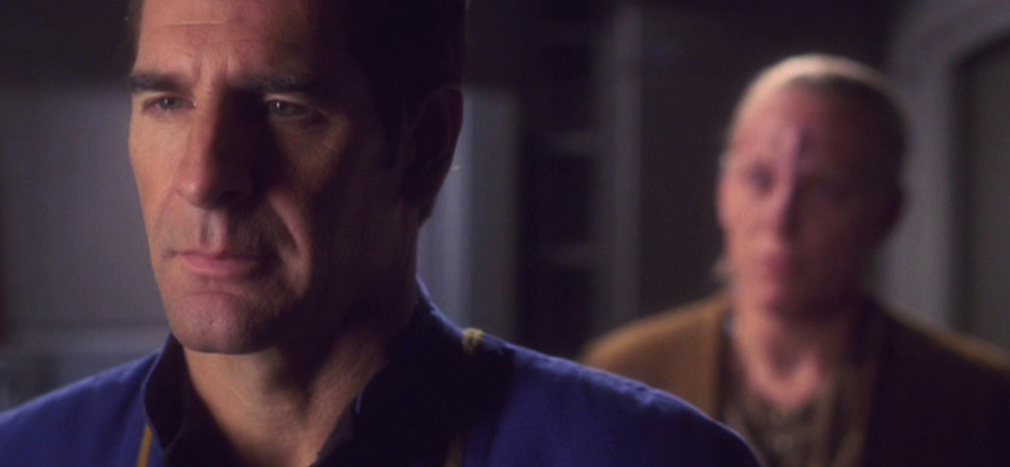
Archer encounter an enemy with faith of the heart...

Archer encounter an enemy with faith of the heart…

However, it was not entirely clear just how traditional Manny Coto was in his approach to Star Trek until the broadcast of Chosen Realm. If Similitude felt like a classic Star Trek morality play, then Chosen Realm literally was a classic Star Trek morality play. A commentary on religious fanaticism and zealotry, Chosen Realm was very much an update of the iconic Let That Be Your Last Battlefield. Coto is quite explicit about this, rather blatantly borrowing the emotive (and poignant) ending from that episode.

Although it aired in the much-maligned third season, and has no shortage of its own problems, Let That Be Your Last Battlefield is an instantly recognisable Star Trek allegory. Casual fans – and even those with a passing familiarity with the franchise – remember “the one with the aliens who are half-black and half-white who are racist against the aliens who are half-white and half-black.” It is not a subtle or nuanced allegory, but it doesn’t really need to be. It is not as if the sort of blatant racism against which the Civil Rights movement fought was a grey area.

"I think I've seen this before..."

“I think I’ve seen this before…”

Unfortunately, Chosen Realm chooses to apply this simplistic metaphor to a complicated issue. In keeping with the War on Terror metaphor running through the third season, Chosen Realm explicitly ties religion into the larger arc. Archer finds his ship hijacked by a bunch of religious suicide bombers actively intent on turning Enterprise into a weapon that can be deployed against those who believe differently than they do. This is a very classic Star Trek morality tale – the “religion is bad” theme dating back to Who Mourns For Adonais? or The Apple.

Religion is undoubtedly an element of the War on Terror, but it is not the only issue or an issue that exists in isolation. Islamic extremism (as Chosen Realm never seems particularly interested in the trope of Christian extremism) is rooted in more than simply faith. There are political and economic factors at play that are just as vital to understanding why things happen in the way that they happen. Chosen Realm is uninterested in any of this, structuring itself as Richard Dawkins rant in science-fiction form.

What was that about politics or religion?

What was that about politics or religion?

Continue reading

Millennium – Seven and One (Review)

This July, we’re taking a trip back in time to review the sixth season of The X-Files and the third (and final) season of Millennium.

Seven and One is the last episode of Millennium to be written by Chris Carter and Frank Spotnitz.

That is a pretty big deal. Frank Spotnitz had been a vital part of Ten Thirteen since the second season of The X-Files. He had also been the only X-Files writer apart from Chris Carter, Glen Morgan and James Wong to cross over to work on Millennium. He would become one of Carter’s most trusted associates, also contributing scripts to Harsh Realm and The Lone Gunmen. When The X-Files: Fight the Future took Carter’s attention away from Millennium in its second season, he proposed Spotnitz to run the show in his stead.

Here's Frankie!

Here’s Frankie!

Chris Carter had created Millennium, and it was clearly a show that meant a lot to him. While The X-Files was populist and accessible, Millennium always felt like more of an auteur project. It was solemn, abstract, contemplative. There is a sense that he was quite disappointed when his attention was diverted away from the show in its second year. Carter has talked time and time again about how he created Millennium as an examination of evil in the world. Appropriately enough, Seven and One finds him circling back around to that idea right before the show concludes.

Seven and One might be the most overtly religious script that Carter and Spotnitz have ever written. It seems to foreshadow the closing themes of Carter’s script for The Truth, the final episode of The X-Files. It emphasises just how essential religious themes are to Carter’s work.

Eye spy...

Eye spy…

Continue reading

Millennium – TEOTWAWKI (Review)

This July, we’re taking a trip back in time to review the sixth season of The X-Files and the third (and final) season of Millennium.

The best thing that can be said about TEOTWAWKI is that it knocks quite a few items off Chris Carter’s “millennial anxieties” checklist – touching on issues of school shootings, gun control, Y2K, anarchy, survivalism, and a few more.

There are some good and interesting ideas in TEOTWAWKI. It is written by Chris Carter and Frank Spotnitz, the first script credited to either writer since the first season of the show. It seems like both writers were clearly thinking about Millennium while working on the fifth season of The X-Files, storing up ideas for late use. TEOTWAWKI is not a script suffering from a lack of ideas. In fact, it has too many ideas packed too tightly. The script isn’t particular graceful; none of the threads dovetail as neatly into one another as they really need to.

Blood money...

Blood money…

This is a recurring theme across the third season of Millennium. There are shows with interesting and compelling ideas, but they are mixed together in a way that doesn’t work – often mingling with some of the more unfortunate creative decisions driving the show. Episodes in the third season frequently feel like curate’s eggs – scrambled messes with good bits and bad bits that are ultimately impossible to separate. TEOTWAWKI might be an interesting mess, but it is still a mess.

TEOTWAWKI makes it clear that The Innocents and Exegesis were not a rough spell as Millennium tried to find its sea legs. This is the way that things will be going forward, at least for a while.

"Doomsday Defense" was a better read...

“Doomsday Defense” was a better read…

Continue reading

Millennium – Exegesis (Review)

This July, we’re taking a trip back in time to review the sixth season of The X-Files and the third (and final) season of Millennium.

It is odd to think of The Innocents and Exegesis as a two parter, despite the explicit “to be continued” that bridges the two episodes.

The Innocents is very much a straightforward procedural episode, with Frank rejoining the FBI and investigating a string of mysterious occurrences that are all connected. As Frank tries to pull himself back together after the death of his wife, various parties insist that he is more lost than ever before. There is a sense that Frank needs to work though what happened to him, regardless of the doubts expressed by his embittered father-in-law or his friendly supervisor at the FBI. Of course others doubt him, and of course he works through those doubts.

"I can see it all clearly..."

“I can see it all clearly…”

It is very much a standard “lead character gets his life back together” story, complete with obligatory sequence where Frank demonstrates he has made his peace with the loss of Catherine by using his story as emotional leverage to ply a confession (or, at least, an explanation) from a person of interest in the on-going investigation. The Innocents is a very banal and paint-by-numbers episode of television. Underneath all those biohazard warnings and eerie blue-eyed siblings, there is a strong procedural element to The Innocents. It feels trite and coy.

At the very least, Exegesis is more unique. It feels like an episode of Millennium, rather than some generic dime-a-dozen procedural. This is likely down to the fact that The Innocents was written by Michael Duggan and Exegesis was written by Chip Johannessen. Michael Duggan was a writer who had a lot of experience on procedurals (Law & Order and C-16: FBI), but who had no prior experience writing Millennium. Hired to run the show in its third year, he would only write two scripts for the show before departing seven episodes into the season.

Go fly a kite...

Go fly a kite…

In contrast, Chip Johannessen had helped to define Millennium’s identity in its first year. In fact, with a group of nearly identical female sisters working towards a mysterious goal (based on vague prophecy), Exegesis owes a great deal to Johannessen’s earlier script Force Majeure. While it does illustrate how Exegesis feels like a more traditional Millennium episode than The Innocents, it is not a comparison that does Exegesis any favours. Force Majeure was one of the best episodes the show ever produced; Exegesis is… not.

As with The Innocents, Exegesis is handicapped by a lot of the clumsy production decisions made at the start of the third season. It feels curiously disconnected from what came before; it plays a little too much like a reheated leftover from The X-Files; a lot of the nuance and development given to Peter Watts and the Millennium Group over the second season is washed away. Nevertheless, it does have a clearer sense of purpose and energy than The Innocents. It feels like Johannessen knows what he wants to say, even if the show is still tripping over itself.

Welcome back, Frank.

Welcome back, Frank.

Continue reading

The X-Files – All Souls (Review)

This May and June, we’re taking a trip back in time to review the fifth season of The X-Files and the second season of Millennium.

There are a lot of aspects of The X-Files that mark it as an artifact of the nineties.

It is easy to point to all the visual cues and indicators – the mobile phones, the suits, the cars. The political elements are all in play as well – the unquestioned assumption that the United States is the global superpower, the indulgence in a paranoia that exists in sharp contrast to the material prosperity surrounding it. There are even any number of pop cultural references buried within episodes themselves – from Byers and Frohike joking about Bill Clinton’s haircut in Fearful Symmetry to Scully quoting Babe in Home.

Angels in America...

Angels in America…

However, perhaps the most obvious indicator of the nineties is the way that The X-Files seems to fetishise absolute and unquestioning faith. Through episodes like Miracle Man, RevelationsAll Souls and Signs and Wonders, there is the recurring sense that giving oneself over absolutely and completely to religious faith is a sign of strength and certainty. At times, it seems like the writers are almost envious of those who have unwavering conviction in their beliefs amid the wry cynicism of the nineties.

The X-Files finds something romantic in such pure and uncompromised faith. After all, Gethsemane had proved that even Mulder has his doubts. This fixation on unquestioning religious belief made a great deal of sense against the backdrop of nineties disillusionment, but it a lot more uncomfortable when examined in hindsight through the prism of the early twenty-first century.

Scully has seen the light...

Scully has seen the light…

Continue reading

The X-Files – Patient X (Review)

This May and June, we’re taking a trip back in time to review the fifth season of The X-Files and the second season of Millennium.

This should not work.

There are lots of reasons why Patient X and The Red and the Black should simply implode under their own weight. Most obviously, they are scripts that are rather blatantly just piling more and more back story and convolution onto a framework that is already overloaded and over-stretched. They are introducing new characters at a late stage of the game. They rely on contrivance and sketchy character development. They seem to exist at odds with the script for The X-Files: Fight the Future, which had been written and shot, but was awaiting release.

Everything burns...

Everything burns…

However, despite all this, Patient X and The Red and the Black work very well together. They are the strongest story-driven mythology two-parter since Nisei and 731 at the start of the third season. There is an energy and drive to Patient X and The Red and the Black that has been largely absent from the show’s big blockbuster two-parters since Herrenvolk at the start of the fourth season. After a year-and-a-half treading water as the release date of the movie draws ever closer, it is nice to see Chris Carter cut completely loose.

Patient X and The Red and the Black form a story which doesn’t seem at all worried about what any of this means for the summer realise of Fight the Future. Parts of it become quite difficult to reconcile with the film as released. However, the two-parter is all the stronger for it.

Fog of war...

Fog of war…

Continue reading