












At a time when Star Trek: Voyager was working very hard to disentangle itself from its own past, Star Trek: Deep Space Nine committed to exploring its own.
Things Past hits on one the big recurring themes of the series in general and fifth season in particular. Deep Space Nine has always been a show about memory and history, the relationship between past, present and future that is seldom as clear-cut as one might like it to be. Across the show’s run, characters are constantly exploring and re-evaluating their own histories. This has always been the case, dating back to Sisko working through his trauma with the Prophets in Emissary, Kira facing her past in Past Prologue and Odo doing the same in A Man Alone.
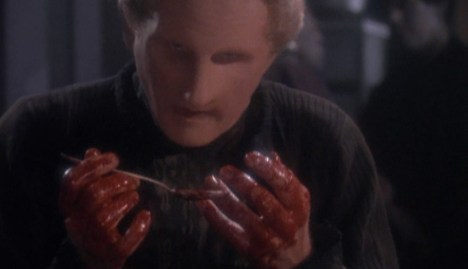
“You know, my subconscious can be pretty heavy handed.”
At this point, Deep Space Nine has been on the air for over four years. Many other shows would already have moved on from their foundational premises. Voyager has already completely forgotten what it originally promised, and it is less than half way through its third season. However, the fifth season finds Deep Space Nine engaging repeatedly and enthusiastically with a history that stems back to before the events of the first episode. The characters on Deep Space Nine are shaped and informed by events that occurred long before fate or chance brought them together.
Some of these episodes work better than others, but the fifth season is still fascinated with the characters’ lives long before the series began. Let He Who Is Without Sin… attempted to build a story like this around Worf, playing almost as a parody of this kind of storytelling. Doctor Bashir, I Presume walks a very fine line between when it comes to exploring Bashir’s secret history. Empok Nor returns to the question of whether O’Brien is an engineer or a soldier in a much pulpier and trashier vein than earlier episodes like Hippocratic Oath.
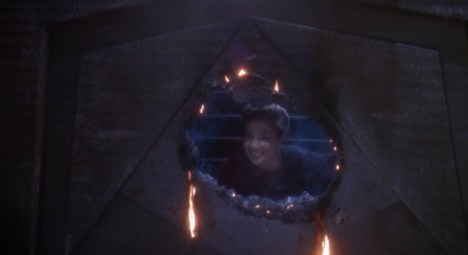
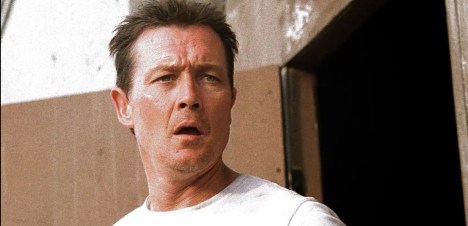
The hole in things…
Unsurprisingly, the best examples of these sorts of stories tend to focus on the characters who were actually around Terok Nor during the Occupation. The Darkness and the Light and Ties of Blood and Water, the two episodes focusing on Kira, are among the strongest of the season. They also have some pretty great titles, although neither is quite Wrongs Darker Than Death or Night. However, it is Things Past that marks the fifth season’s first trip back to the Cardassian Occupation, telling the story from Odo’s perspective.
It is an episode that really pushes Odo, to the point where it seems like the changeling might snap. “Nobody ever had to teach me the justice trick,” Odo monologued in Necessary Evil, way back in the second season. “That’s something I’ve always known.” Over the course of Things Past, Odo must eventually admit that this is not the case.
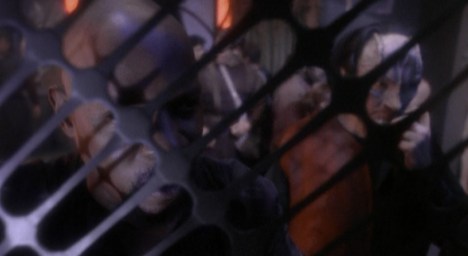
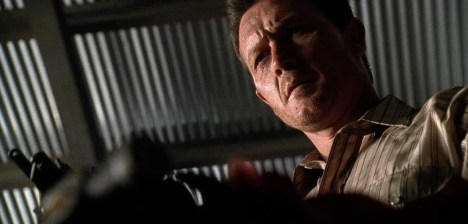
Barriers to entry.
Filed under: Deep Space Nine | Tagged: cardassian occupation, Changeling, collaboration, Guilt, Odo, shapeshifter, star trek, star trek: deep space nine | 22 Comments »




 the m0vie blog
Star Trek: Enterprise – The Breach (Review)
Next year, Star Trek is fifty years old. We have some special stuff planned for that, but – in the meantime – we’re reviewing all of Star Trek: Enterprise this year as something of a prequel to that anniversary. This April, we’re doing the second season. Check back daily for the latest review.
One of the more interesting aspects of a heightened franchise like Star Trek is the way that invites particular members of staff to define their own voices. On most of the Star Trek shows, it is easy to distinguish the work of particular writers from one another. Ronald D. Moore likes militarism and world-building; Brannon Braga likes time travel and classic science-fiction. There are clear voices that can be distinguished from the choir on each of the shows, for better or for worse.
Although it enjoyed a considerably shorter run than the other Star Trek spin-offs, Star Trek: Enterprise is no exception. The Breach is a script credited to writers Chris Black and John Shiban. The two had collaborated unofficially on Canamar, a script credited to Shiban alone. The two would work together again on First Flight towards the end of the season. It is certainly a partnership that had considerable potential, if not for Shiban’s departure at the end of the season.
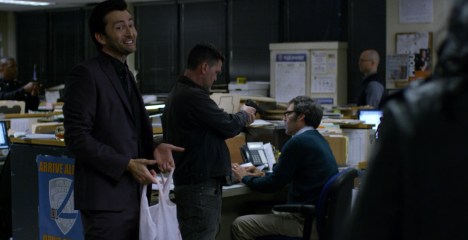
What’s up, Doc?
In many respects, The Breach feels like the product of those two voices. Xenophobia is a major theme of The Breach – as it was in Shiban’s other scripts for the season like Minefield, Dawn or Canamar. Like their last collaboration on Canamar and their future collaboration on First Flight, it seems The Breach presents a more balanced version of Archer than episodes like The Crossing or Horizon. This is a version of Archer who feels compelled to do the right thing, but without the same oppressive self-righteousness that drives his more awkward moments.
However, it seems like Chris Black provides The Breach with its very traditional and old-fashioned Star Trek aesthetic. A veteran of genre television with an understanding of the narrative conventions associated with the franchise, Black understands how Star Trek storytelling is supposed to work. The Breach is perhaps a little too formulaic and traditional in its storytelling, but it does demonstrate that – despite its best efforts – The Crossing had not completely buried a certain optimistic strain of Star Trek ethics.
Into darkness…
Continue reading →
Filed under: Enterprise | Tagged: 9/11, allegory, chris black, cycle of violence, cycles of violence, denobulans, enterprise, ethics, Guilt, hatred, john shiban, legacy, metaphore, morality, morals phlox, robert duncan macneill, social commentary, star trek: enterprise, the breach, war, xenophobia | 5 Comments »