• Following Us

  • Categories

  • Check out the Archives


  • Awards & Nominations

The X-Files – Improbable (Review)

This December, we’re taking a trip back in time to review the ninth season of The X-Files.

So I am convinced, from many experiments, I could not study to any degree of perfection either mathematics, arithmetic or algebra without being a deist, if not an atheist.

– John Wesley, The Use of Money

Dio ti ama.”

God loves you. A nice though. An ordering principle.

Three simple words.

There are worse Gods to believe in.

There are worse Gods to believe in.

Continue reading

The X-Files – Orison (Review)

This November, we’re taking a trip back in time to review the seventh season of The X-Files and the first (and only) season of Harsh Realm.

The X-Files has generally avoided sequels.

There are exceptions, of course. Eugene Victor Tooms appeared twice in the first season, bookending the show’s first year in Squeeze and Tooms. The character of Robert Patrick Modell resurfaced in Kitsunegari, two years after his debut in Pusher. In a way, the mythology could be read as a series of sequels and inter-related plots, with the show lacking the sort of truly overarching design that would identify it as a single story that had been serialised. Still, The X-Files has been reluctant to resurrect old monsters, perhaps acknowledging the law of diminishing returns.

Here's Donnie!

Here’s Donnie!

So Orison is something of an oddity. It marks the second and final appearance of Donnie Pfaster, the demonic Ted Bundy type who made such an impression in Irresistible. Much like Robert Patick Modell or Eugene Victor Tooms, Donnie Pfaster was popular enough the bringing him back made a certain amount of sense; if the show had to do a “sequel” episode, Donnie was as good a candidate as any. Meanwhile, Flukeman waits by the phone. However, the question remains: why?

What is the point of bringing back Donnie? What didn’t the show do last time that it would do this time? It’s a very basic, very fundamental question. Unfortunately, Orison does not have much of an answer.

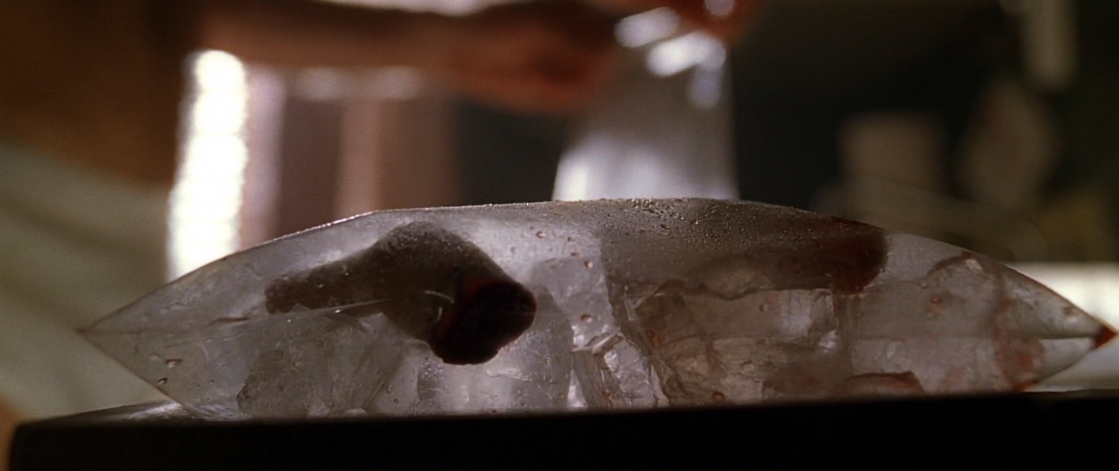
Finger food...

Finger food…

Continue reading

The X-Files – All Souls (Review)

This May and June, we’re taking a trip back in time to review the fifth season of The X-Files and the second season of Millennium.

There are a lot of aspects of The X-Files that mark it as an artifact of the nineties.

It is easy to point to all the visual cues and indicators – the mobile phones, the suits, the cars. The political elements are all in play as well – the unquestioned assumption that the United States is the global superpower, the indulgence in a paranoia that exists in sharp contrast to the material prosperity surrounding it. There are even any number of pop cultural references buried within episodes themselves – from Byers and Frohike joking about Bill Clinton’s haircut in Fearful Symmetry to Scully quoting Babe in Home.

Angels in America...

Angels in America…

However, perhaps the most obvious indicator of the nineties is the way that The X-Files seems to fetishise absolute and unquestioning faith. Through episodes like Miracle Man, RevelationsAll Souls and Signs and Wonders, there is the recurring sense that giving oneself over absolutely and completely to religious faith is a sign of strength and certainty. At times, it seems like the writers are almost envious of those who have unwavering conviction in their beliefs amid the wry cynicism of the nineties.

The X-Files finds something romantic in such pure and uncompromised faith. After all, Gethsemane had proved that even Mulder has his doubts. This fixation on unquestioning religious belief made a great deal of sense against the backdrop of nineties disillusionment, but it a lot more uncomfortable when examined in hindsight through the prism of the early twenty-first century.

Scully has seen the light...

Scully has seen the light…

Continue reading

The X-Files – Patient X (Review)

This May and June, we’re taking a trip back in time to review the fifth season of The X-Files and the second season of Millennium.

This should not work.

There are lots of reasons why Patient X and The Red and the Black should simply implode under their own weight. Most obviously, they are scripts that are rather blatantly just piling more and more back story and convolution onto a framework that is already overloaded and over-stretched. They are introducing new characters at a late stage of the game. They rely on contrivance and sketchy character development. They seem to exist at odds with the script for The X-Files: Fight the Future, which had been written and shot, but was awaiting release.

Everything burns...

Everything burns…

However, despite all this, Patient X and The Red and the Black work very well together. They are the strongest story-driven mythology two-parter since Nisei and 731 at the start of the third season. There is an energy and drive to Patient X and The Red and the Black that has been largely absent from the show’s big blockbuster two-parters since Herrenvolk at the start of the fourth season. After a year-and-a-half treading water as the release date of the movie draws ever closer, it is nice to see Chris Carter cut completely loose.

Patient X and The Red and the Black form a story which doesn’t seem at all worried about what any of this means for the summer realise of Fight the Future. Parts of it become quite difficult to reconcile with the film as released. However, the two-parter is all the stronger for it.

Fog of war...

Fog of war…

Continue reading

The X-Files – Gethsemane (Review)

This February and March, we’re taking a trip back in time to review the fourth season of The X-Files and the first season of Millennium.

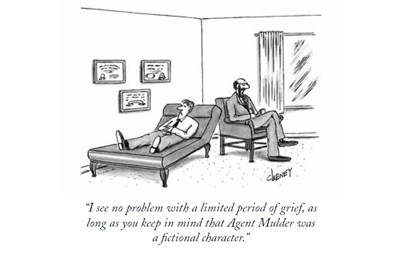
Agent Mulder died late last night from an apparent self-inflicted gunshot wound to the head.

– Agent Dana Scully, 22nd October 1997

xfiles-gethsemane27 Continue reading

Star Trek – The Apple (Review)

The first Star Trek pilot, The Cage, was produced in 1964. To celebrate its fiftieth anniversary, this December we are reviewing the second season of the original Star Trek show. You can check out our first season reviews here. Check back daily for the latest review.

It’s amazing how iconic Star Trek could be, even when it was terrible. There’s something quite ironic about how much of the franchise’s truly memorable iconography is rooted in some of the show’s weakest episodes. The Apple is one of the most iconic and memorable Star Trek episodes, featuring a giant evil dragon head sculpture, David Soul in orange body paint, lots of speechifying from Kirk, and a strong atheistic message with Kirk casting himself as Satan in the Garden of Eden.

It is also just terrible.

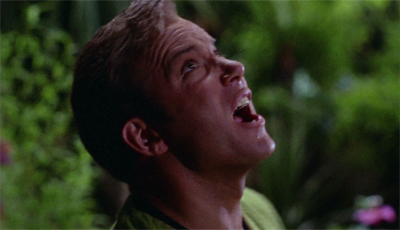
"VAAAAAAAL!!!"

“VAAAAAAAL!!!”

Continue reading

Non-Review Review: Exodus – Gods and Kings

Exodus: Gods and Kings might be more traditional in structure and execution than the year’s other big biblical epic, but it shares a lot of the same core sentiments of Noah. Both films posit the Old Testament God as a primordial and almost unfathomable force, transforming biblical parables in epic horror stories. Both accept the divine as inhuman, almost by definition; both offer harrowing and unsettling depictions of stories that many viewers will know from childhood or have heard dozens of times before.

Exodus: Gods and Kings suffers a bit with its pacing, trying to boil the core Moses stories down into a single two-and-a-half hour narrative. The film runs through a check list of iconic moments, struggling to squeeze so much in that the story of the reed basket is mentioned only in passing. Instead, the film moves from Moses’ relationship with Ramses II through to his exile through to his epiphany through to his military rebellion through to the plagues through to the exodus.

"Well, I got back to Gotham in six days, I think I can get us to the Promised Land."

“Well, I got back to Gotham in six days, I think I can get us to the Promised Land.”

It is an epic story in almost every sense of the word, and Exodus: Gods and Kings struggles to contain it all. Often key elements are only present for moments before the film has to hurry along – the burning bush lingers in the background; the golden calf is glimpsed only from the distance. So much ground is covered that it is occasionally difficult to maintain focus, as Moses seems to lose and gain families with each passing act break. Exodus: Gods and Kings holds itself together under the pressure, but the strain can be felt.

Nevertheless, Exodus: Gods and Kings largely works. Feeling more like Kingdom of Heaven than Gladiator, the movie does a wonderful job of building a massive and sprawling (and foreign) world. Exodus: Gods and Kings looks and feels like a more traditional biblical epic than Noah, and Scott’s efforts to ground the film in a tangible reality only serves to enhance the awe-inspiring scale of the horror on display here. Exodus: Gods and Kings is an exploration of faith and devotion, asking uncomfortable questions and leaving the answers to the audience.
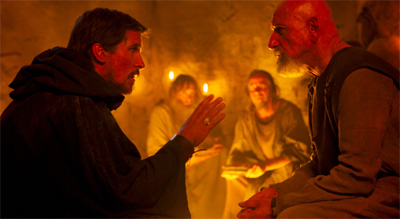
"Let us sit upon the ground and tell sad stories of the death of kings..."

“Let us sit upon the ground and tell sad stories of the death of kings…”

Continue reading

Star Trek – Who Mourns For Adonais? (Review)

The first Star Trek pilot, The Cage, was produced in 1964. To celebrate its fiftieth anniversary, this December we are reviewing the second season of the original Star Trek show. You can check out our first season reviews here. Check back daily for the latest review.

In many respects, Who Mourns for Adonais? is a formative episode for Star Trek as a franchise. It’s a show that really informs a lot of the franchise that would follow, even beyond the confines of the original television show. It’s an episode that represents the first clear articulation of a strand of thought that has been bubbling away through the first season of Star Trek and into the second, exploring the religious side of the Star Trek universe and mankind’s place in the cosmos.

The episode is iconic and memorable. It is packed with images that are familiar to even the most casual of fans. “Kirk confronts a Greek god in deep space!” is a catchy premise. “A giant hand grabs the Enterprise and threatens to crush the ship!” is the type of delightfully insane visual that ranks with “Captain Kirk as a Nazi!” or “space Lincoln!” when it comes to Star Trek visuals that stick with people outside the context of the show itself. Coupled with the distillation of those themes, this is a “big” episode.

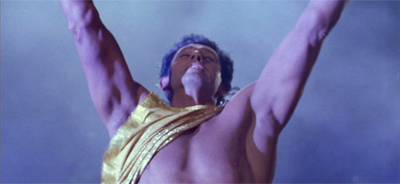
"Jack, I'm flying!"

“Jack, I’m flying!”

Unfortunately, Who Mourns for Adonais? is also a deeply troubling episode. It has problems heaped upon problems. Some of those problems are inherited from the general aesthetic of the show, and are not specific to this episode. However, some of those problems are explicitly articulated here. Who Mourns for Adonais? is an episode that embodies quite a few of the very serious problems that run through the original Star Trek and haunt the franchise for quite some time.

The fact that these problems come baked into an iconic and memorable episode is disappointing.

"Oh, your gods..."

“Oh, your gods…”

Continue reading

Star Trek V: The Final Frontier (DC Comics, 1989) (Review)

This June, we’re taking a look at some classic Star Trek movie tie-ins and other interesting objects. Check back daily for the latest reviews and retrospectives.

In many respects, the late eighties represented a changing of the guard when it came to Star Trek. The feature films had been relatively serialised. The events of Star Trek II: The Wrath of Khan led into the events of Star Trek III: The Search for Spock, which itself led directly into the events of Star Trek IV: The Voyage Home. At the same time, the expanded universe was generally left free to its own devices. Novelists and writers were given the freedom to do whatever they wanted.

In the late eighties, things changed. Directed by William Shatner, Star Trek V: The Final Frontier stood quite clearly apart from the events of the last three Star Trek films. At the same time, the franchise had found its way back to weekly television in the form of Star Trek: The Next Generation. Whereas comic books and novels had served to fill a gap when there was a scarcity of “official” Star Trek material, they were now very clearly of secondary importance to the “real” (or simply “live action”) versions of Star Trek.

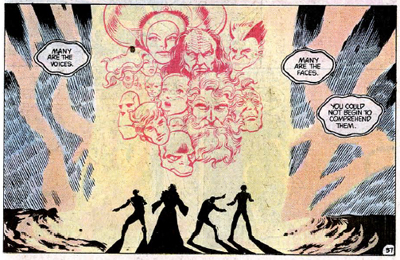
Oh your God...

Oh your God…

There was a rather seismic shift in the nature and tone of tie-ins and adaptations. Rather notably, the creators who had adapted the last couple of films into prose and comic book form did not return to translate The Final Frontier across different media. Vonda McIntyre had written the novelisations of the last three Star Trek films, but was replaced by J.M. Dillard. Mike W. Barr and Tom Sutton had produced the comic book adaptations of the last two Star Trek films, but were replaced by Peter David and James W. Fry. Both Dillard and David would find themselves tasked with adaptation of Star Trek VI: The Undiscovered Country.

Peter David and James W. Fry’s adaptation of The Final Frontier is clearly intended as a launchpad for their new on-going Star Trek series that would debut only a few months later. Indeed, the final page of The Final Frontier includes an advertisement for that new series. In many respects, this adaptation of The Final Frontier seems to serve as a pilot for a new comic book series, a starting point for a bold new beginning to DC’s Star Trek line. Opening with the The Final Frontier, you might be forgiven for assuming it was doomed from the outset.

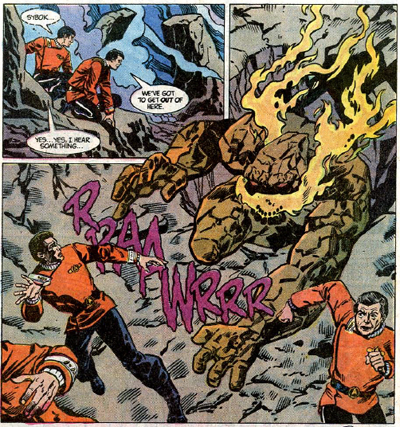
Here there be rock monsters...

Here there be rock monsters…

Continue reading

Star Trek: The Next Generation – The Royale (Review)

This January and February, we’ll be finishing up our look at the second season of Star Trek: The Next Generation and moving on to the third year of the show, both recently and lovingly remastered for high definition. Check back daily for the latest review.

“None of it makes any sense, sir,” Riker succinctly states before the credits role on The Royale. The Royale is a decidedly nonsensical episode of Star Trek: The Next Generation, where an away team find themselves trapped inside an atrocious casino melodrama and have to figure out how to return to the ship. The episode is packed with interesting visuals and a bizarre situations, but it never quite comes together in the end.

And, yet, despite the obvious problems, The Royale is intriguing. Visually, it’s one of the most striking and memorable episodes of the show’s first two season. The rotating door to nowhere is a beautifully strange image, and the sight of the Enterprise away team wandering around a twentieth century casino is enough to prevent the episode from ever becoming boring. The Royale isn’t the best constructed episode of the show’s first two years, and it has more than its fair share of problems.

However, it’s also a wonderfully bizarre and adventurous piece of science-fiction, as if Riker has beamed into a cheap imitation of The Twilight Zone. That’s enough to make it well worth a watch.

The whole plot revolves around absurdities...

The whole plot revolves around absurdities…

Continue reading