• Following Us

  • Categories

  • Check out the Archives


  • Awards & Nominations

Star Trek – Bread and Circuses (Review)

The first Star Trek pilot, The Cage, was produced in 1964. To celebrate its fiftieth anniversary, this December we are reviewing the second season of the original Star Trek show. You can check out our first season reviews here. Check back daily for the latest review.

Bread and Circuses is not subtle. Then again, that is the point.

There’s a lot of interesting stuff happening in Bread and Circuses, the fourteenth episode produced for the second season, but the last to air. There’s the idea of a world dominated by “a twentieth century Rome”, a rogue captain, a Prime Directive dilemma and a scathing indictment of modern television. Not only is it one of the last episodes with a “produced by Gene L. Coon” credit, it is also an episode co-written by Roddenberry and Coon. It is also the episode of Star Trek that endorses Christianity most explicitly and heavily.

"Wait, we're only getting it in black and white?"

“Wait, we’re only getting it in black and white?”

Bread and Circuses is a bold and audacious piece of television, full of venom and righteous anger, rich in satire and cynicism. It’s a plot so ridiculously over-stuffed with good ideas that viewers are liable to forgive the show’s somewhat cop-out ending where Kirk and his away team beam back to the Enterprise and continue on their merry way as though little has actually happened. Bread and Circuses feels like it uses every minute of its fifty-minute runtime wisely, balancing character with world-building.

It is probably a little bit too messy and disjointed to be labelled a dyed-in-the-wool classic, particularly when compared to the shows produced around it. Nevertheless, it is a decidedly ambitious piece of work, and one that demonstrates what Star Trek could do when it sets its mind to something.

When in Rome...

When in Rome…

Continue reading

Star Trek – The Trouble With Tribbles (Review)

The first Star Trek pilot, The Cage, was produced in 1964. To celebrate its fiftieth anniversary, this December we are reviewing the second season of the original Star Trek show. You can check out our first season reviews here. Check back daily for the latest review.

This is a classic.

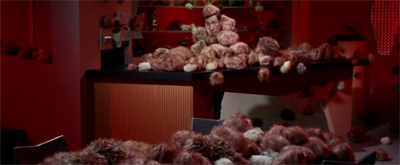
The Trouble With Tribbles is an episode that can make a legitimate claim to being the best episode of Star Trek, if not the best episode of the entire franchise. It is a genuine classic in countless ways, perfectly embodying so much of what makes Star Trek classic and iconic and loved. David Gerrold’s script, polished by Gene Coon, is easily the best comedy episode that the franchise has ever produced, but never at the expense of the show’s credibility. The Trouble With Tribbles may be silly, but it is also very clever and insightful.

Nobody knows the Tribbles I've seen...

Nobody knows the Tribbles I’ve seen…

Continue reading

Star Trek – The Apple (Review)

The first Star Trek pilot, The Cage, was produced in 1964. To celebrate its fiftieth anniversary, this December we are reviewing the second season of the original Star Trek show. You can check out our first season reviews here. Check back daily for the latest review.

It’s amazing how iconic Star Trek could be, even when it was terrible. There’s something quite ironic about how much of the franchise’s truly memorable iconography is rooted in some of the show’s weakest episodes. The Apple is one of the most iconic and memorable Star Trek episodes, featuring a giant evil dragon head sculpture, David Soul in orange body paint, lots of speechifying from Kirk, and a strong atheistic message with Kirk casting himself as Satan in the Garden of Eden.

It is also just terrible.

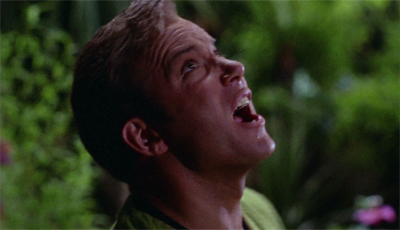
"VAAAAAAAL!!!"

“VAAAAAAAL!!!”

Continue reading

Star Trek – The Changeling (Review)

The first Star Trek pilot, The Cage, was produced in 1964. To celebrate its fiftieth anniversary, this December we are reviewing the second season of the original Star Trek show. You can check out our first season reviews here. Check back daily for the latest review.

The Changeling, an episode so good that they made it twice.

Sarcasm aside, The Changeling is mostly interesting for reasons outside the episode itself. It is the first contribution from John Meredyth Lucas, who would become the show’s producer towards the end of the season. Lucas took over from Gene L. Coon and is notable for being the first production staff member on Star Trek to direct an episode from his own script, with Elaan of Troyius in the show’s troubled third season. The Changeling arguably had an even bigger influence on the franchise, serving as a template for the first feature film.

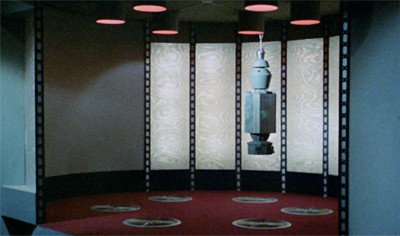
Probing problems...

Probing problems…

Okay, “template” may be a slight exaggeration. However, you can definitely feel the influence of The Changeling on Star Trek: The Motion Picture. However, that may simply be because the script to The Changeling hits quite heavily on some of Gene Roddenberry’s pet themes. It has a villainous robot outwitted by emotional humans, Kirk besting a god-like entity, and larger philosophical questions about religion and theology.

Even outside of the themes that resonate specifically with Roddenberry, The Changeling hits on a variety of other classic Star Trek tropes – from a threat leaving nothing but dead star systems in its wake through to an abundance of dead red shirts. There’s an argument to be made that The Changeling is one of the most archetypal Star Trek episode. If you were to bake a Star Trek episode from a stock list of ingredients, it would look a lot like this. For better or worse.

Melding metal...

Melding metal…

Continue reading

Star Trek VI: The Undiscovered Country (DC Comics, 1992) (Review)

This June, we’re taking a look at some classic Star Trek movie tie-ins and other interesting objects. Check back daily for the latest reviews and retrospectives.

In many respects, adapting a Star Trek feature film into comic book form is very much an editorial function. With so little space available, particularly as compared to a feature film or novel, the assignment is more about whittling the script down to something that can be covered in fifty-five pages of a comic book. While those adapting the features films into novels frequently have to expand and flesh out the material to make it fit within the allocated page count and account for plot hole and logic error, the comic book adaptations just have to keep everything ticking over.

So Peter David and Gorden Purcell’s adaptation of Star Trek VI: The Undiscovered Country plays quite well as a condensed version of the narrative, covering the requisite story beats in the available space.

In space, everybody can hear you scream...

In space, everybody can hear you scream…

Continue reading

Star Trek VI: The Undiscovered Country by J.M. Dillard (Review)

This June, we’re taking a look at some classic Star Trek movie tie-ins. Check back daily for the latest reviews and retrospectives.

Reading her novelisation of Star Trek VI: The Undiscovered Country, it’s hard to shake the feeling that author J.M. Dillard really does not like this film.

It’s a very peculiar sensation, to read an adaptation clearly written by somebody who could not care less for the source material. It is not unique, of course. Diane Carey’s adaptation of Broken Bow is downright scathing in its attitude towards Star Trek: Enterprise. It just seems rather strange that J.M. Dillard’s early adaptation of Star Trek V: The Final Frontier seems a lot fonder of its source material.

st-theundiscoveredcountry-dillard

Continue reading

Star Trek: The Motion Picture by Gene Roddenberry (Review)

This June, we’re taking a look at some classic Star Trek movie tie-ins and other interesting objects. Check back daily for the latest reviews and retrospectives.

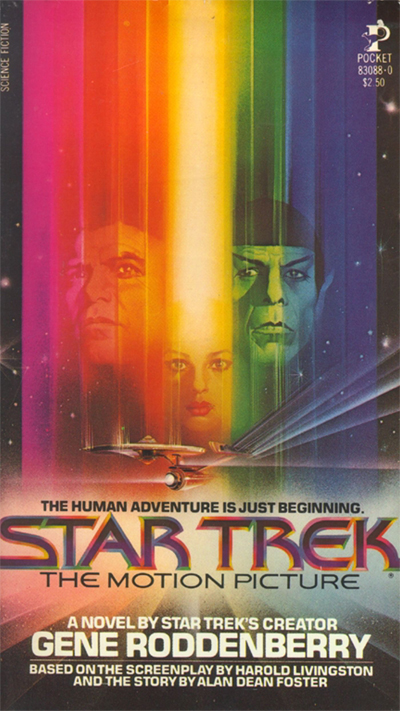
Star Trek: The Motion Picture is heavily influenced by Gene Roddenberry. It’s a piece of work that serves as an example of Roddenberry’s vision of the franchise – what he felt Star Trek should look like in the late seventies and beyond. Much like the first and second seasons of Star Trek: The Next Generation, there’s a sense that this is the perfect distillation of Roddenberry’s later-day version of Star Trek, distinct from the versions that existed before and afterwards.

Although Roddenberry doesn’t have a writing or story credit on The Motion Picture, his influence is keenly felt; right down to hiring a bona fides science-fiction writer (Alan Dean Foster) to provide the story. (After hearing pitches from other authors like Ray Bradbury, Harlan Ellison and Theodor Sturgeon.) This was in keeping with his work on the early seasons of the show, where he tried to convince published science-fiction authors to contribute to Star Trek.

While Roddenberry doesn’t have a writing credit on the film, he did write the novelisation of the screenplay, which serves as a direct insight into how Roddenberry approached the franchise and how he saw Star Trek in 1979.

st-tmp-roddenberry

Continue reading

Star Trek: The Next Generation – Brothers (Review)

This January and February, we’ll be finishing up our look at the second season of Star Trek: The Next Generation and moving on to the third year of the show, both recently and lovingly remastered for high definition. Check back daily for the latest review.

Brothers is Star Trek: The Next Generation getting back to business at usual. Well, not quite usual, but close enough. Following the monumental season-bridging epic that was The Best of Both Worlds and the breathing space afforded by Family, Brothers is a good old-fashioned science-fiction adventure story revolving around one of the show’s most popular character and really written to satisfy a laundry list of Star Trek tropes and conventions.

Although its notable for maintaining a thematic consistency that is threaded through the fourth season, and also for affording Brent Spiner to play three different roles, the most striking aspect of Brothers from a production point of view is the fact that it is written by Rick Berman. Berman had been serving as producer on the show since Encounter at Farpoint, but this was his first scripting contribution. He’d only write one more episode of The Next Generation before the show went off the air.

Given Berman’s production style, it feels strangely appropriate that Brothers is so carefully and meticulously structured and constructed.

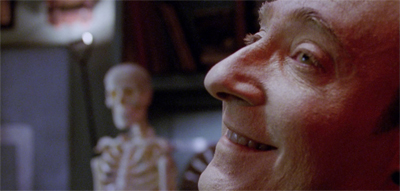
"Let's put a smile on that face..."

“Let’s put a smile on that face…”

Continue reading

Star Trek: The Next Generation – Season 3 (Review)

This January and February, we’ll be finishing up our look at the second season of Star Trek: The Next Generation and moving on to the third year of the show, both recently and lovingly remastered for high definition. Check back daily for the latest review.

The third season is on a very short list of contenders for “the best season of Star Trek ever produced.” Maybe one or two other Star Trek: The Next Generation seasons make the list, maybe the first two seasons of the original Star Trek and maybe two seasons of Star Trek: Deep Space Nine. From beginning to end, the third season of The Next Generation hangs together remarkably well, churning out consistently entertaining adventures and several runs of truly classic episodes.

There are two main stretches in the season where the show produces episodes that could legitimately be ranked as the best of The Next Generation. The first comes around the midpoint of the season, from Yesterday’s Enterprise through to Sins of the Father, all episodes that would not look out of place on a “top ten episodes of The Next Generation” list. The second runs from Tin Man through to Sarek. And that’s ignoring the wonderful gems scattered throughout the season, from The Defector and The Hunted through to The Best of Both Worlds.

Of course, one of the most impressive aspects of the third season is the fact that the consistent quality visible on the television screen belies the chaos unfolding behind the scenes. The third season was a deeply troubled year of television, with plenty of unfortunate conflicts and moments of sheer desperation from the creative team. Perhaps the most wonderful demonstration of how far the show has come is obvious in the consistent professional quality of the output.

tng-bestofbothworlds1n

Continue reading

Star Trek: The Next Generation – Ménage à Troi (Review)

This January and February, we’ll be finishing up our look at the second season of Star Trek: The Next Generation and moving on to the third year of the show, both recently and lovingly remastered for high definition. Check back daily for the latest review.

So, here we are again. We almost made it. Two episodes away from the series finalé and… boom! Lwaxana Troi episode. Sometimes you just can’t catch a break.

Still, this is the point where we reflect on how far the show has come in a season. Ménage à Troi is hardly the best episode of the season, but then Lwaxana episodes rarely are. We need to compare like with like, to get a sense of how far the show has come along. It’s not enough to say that Star Trek: The Next Generation is a better show when it made Ménage à Troi than it was when it made Manhunt or Haven, but it’s close.

Ménage à Troi is a problematic episode, much like Manhunt and Haven are both problematic episodes. There’s a weird awkward dated quality to the show’s attempts to do relationship humour – a vaguely unsettling sexist undertone about how confident older women are inherently hilarious and its great fun to see them involved in embarrassing relationships. Unfortunately, Ménage à Troi continues that trend.

Two Ferengi walk into a bar...

Two Ferengi walk into a bar…

Continue reading