• Following Us

  • Categories

  • Check out the Archives


  • Awards & Nominations

Star Trek: The Next Generation – Shades of Grey (Review)

This January and February, we’ll be finishing up our look at the second season of Star Trek: The Next Generation and moving on to the third year of the show, both recently and lovingly remastered for high definition. Check back daily for the latest review.

Well. That’s over now. Star Trek: The Next Generation limps across the finish line of its second season with a compilation clip show designed to save money and keep the season’s episode count up. Shades of Grey is frequently cited as the worst episode not just of the second season of The Next Generation, but of the show as a whole. While it’s hard to entirely agree with this assessment – Shades of Grey is cynical and lazy, but it’s neither as sexist as Angel One or The Child nor as racist as Code of Honour or Up the Long Ladder – it is possible to see where that argument comes from.

Like the first season before it, there’s a sense that the second season of The Next Generation might have been better had it ended an episode earlier. Indeed, the second season could have ended with Q Who? and the only episode anybody would really miss would be The Emissary. Unfortunately, one imagines the syndication agreements and network policy made this impossible. While one suspects many of those involved would be happy if Shades of Grey simply faded from existence, it remains part of the show’s syndication package.
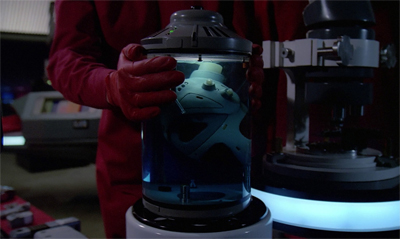
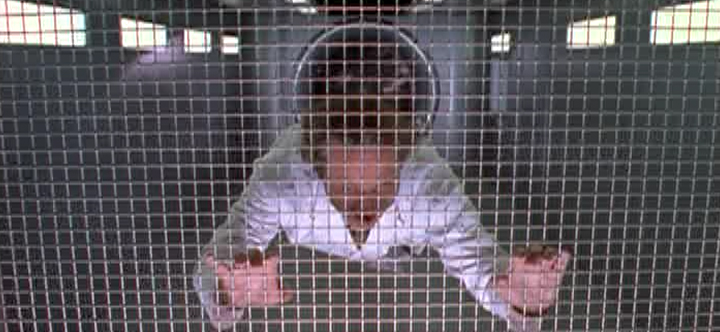
This is a little like what this episode feels like...

This is a little like what this episode feels like…

Continue reading

Star Trek: The Next Generation – Samaritan Snare (Review)

This January and February, we’ll be finishing up our look at the second season of Star Trek: The Next Generation and moving on to the third year of the show, both recently and lovingly remastered for high definition. Check back daily for the latest review.

To describe Samaritan Snare as a step down from Q Who? feels like an understatement. Q Who? was Star Trek: The Next Generation realising that it needed to improve its game if it ever wanted to measure up to its predecessor, interrogating some aspects of the series that had been taken for granted, calling the crew out on their arrogance and offering an opponent that could really push the Enterprise crew for all that they are worth.

It was really the logical culmination of themes running through the second season, themes that seem to faintly echo into Samaritan Snare, another story about the arrogance and ego of the Enterprise crew. Unfortunately, while it does seem to acknowledge many of the same weaknesses and flaws that Q Who? hit upon, it can’t help but seem a little disappointing. Here, the Enterprise are not thrown against an impossible-to-defeat adversary. Instead, their arrogance turns them into interstellar marks.

His heart just isn't in it...

His heart just isn’t in it…

Continue reading

Star Trek: The Next Generation – Q Who? (Review)

This January and February, we’ll be finishing up our look at the second season of Star Trek: The Next Generation and moving on to the third year of the show, both recently and lovingly remastered for high definition. Check back daily for the latest review.

Q Who? throws down the gauntlet for Star Trek: The Next Generation. It serves as a fitting reminder that Picard and his crew are still amateurs when it comes to space exploration. They don’t even win the day – they suffer “a bloody nose” before limping away from their strange new opponents to lick their wounds. For a crew that never seemed to sweat before, who never seemed like they were under pressure, this is a shocking development.

More interestingly, it’s something unknown in a universe that has become far too familiar. Three of the four episodes leading into Q Who? ended with the crew accepting that there were some things they’d never fully understand or comprehend, and – while it’s unlikely this was intentional – it seems like a nice bit of thematic foreshadowing rather than haphazard plotting. For the first season-and-a-half of the show, it seemed like the Enterprise was always dealing with the familiar, always in control of the situation.

With Q Who?, everything is put into perspective.

Borg to death...

Borg to death…

Continue reading

Star Trek: The Next Generation – The Measure of a Man (Review)

This January and February, we’ll be finishing up our look at the second season of Star Trek: The Next Generation and moving on to the third year of the show, both recently and lovingly remastered for high definition. Check back daily for the latest review.

Ah, The Measure of a Man.

It’s the first point in the run of Star Trek: The Next Generation where we’ve reached an episode that could legitimately be ranked as one of the best that the show would ever produce. Even today, the episode remains a favourite of Star Trek fans around the world, and a superb demonstration of what the series is capable of. Almost half-way into the second season, we get a glimpse of what The Next Generation could be, and how it balance its own identity against the proud philosophical traditions of its parent series.

It’s also quite brilliant.

A Data with destiny...

A Data with destiny…

Continue reading

My 12 for ’13: Gravity & Good Old-Fashioned Simplicity

This is my annual countdown of the 12 movies that really stuck with me this year. It only counts the movies released in Ireland in 2013, so quite a few of this year’s Oscar contenders aren’t eligible, though some of last year’s are.

This is number 4…

One of the more interesting aspects of blockbuster cinema over the past decade or so has been the way that bigger movies tend to have become more complicated and ambitious in their storytelling. This isn’t a bad thing, by any measure. The Dark Knight is a plot-driven blockbuster with no shortage of plot complications, reversals and reveals. However, not every blockbuster is as deftly constructed.

There’s been a surge in overly complicated and excessively convoluted blockbusters over the past few years. It’s not enough to have good guys and bad guys and spectacle. There’s a sense that there needs to be more crammed on in there. Double-crosses and triple-crosses, betrayal and redemption, shock reveals and game-changing twists. Bad guys no longer plan to simply destroy the world or kill the good guy, everybody has competing agendas, and big epic blockbusters often struggle to smooth those into a cohesive narrative.

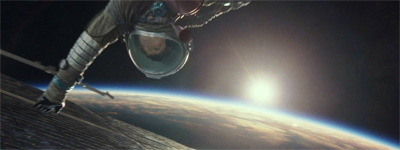
gravity3

From this year, for example, Star Trek Into Darkness – while still an exceptionally enjoyable film – suffered from an over-complicated plot and a surplus of villainous motivation. The Wolverine featured a fiercely convoluted middle act where it seemed like half-a-dozen bad guys were all trying to kill our hero for different reasons. G.I. Joe: Retaliation featured an evil plot that was not only brilliantly stupid, it was also unnecessarily convoluted.

Gravity serves to buck the trend, offering something of a sharp contrast to this convoluted storytelling. Gravity is a celebration of old-school visual spectacle, guided through a decidedly old-fashioned plot.

gravity4

Continue reading

Doctor Who: A Christmas Carol (Review)

To celebrate the fiftieth anniversary of the longest-running science-fiction show in the world, I’ll be taking weekly looks at some of my own personal favourite stories and arcs, from the old and new series, with a view to encapsulating the sublime, the clever and the fiendishly odd of the BBC’s Doctor Who.

A Christmas Carol originally aired in 2010.

If you’re my babysitter, why are you climbing in the window?

Because if I was climbing out of the window, I’d be going in the wrong direction. Pay attention.

– Kazran and the Doctor get things straight

A Christmas Carol might just be the best Doctor Who Christmas Special ever produced, if only because it’s such a brilliantly obvious idea, executed with the show’s traditional wit and charm. Russell T. Davies tended to write the Christmas Special in the style of a gigantic blockbuster episode of Doctor Who, but Moffat adopts a slightly different approach to what has quickly become the annual tradition of the Doctor Who Christmas Special.

Davies traditionally had the Doctor collide with genres of Christmas television viewing. The Christmas Invasion was American blockbuster sci-fi, The Runaway Bride was fun odd-couple comedy action film, Voyage of the Damned was a disaster flick in space and The Next Doctor was a celebration of quaint Victoriana. In contrast, Moffat has Doctor Who collide with beloved children’s stories in his first two Christmas Specials. His second two are burdened with dealing with left-over plot threads.

A Christmas Carol is perhaps the most effective distillation of “Doctor Who as a story” that the show has ever managed, on top of being a wonderfully moving piece of Christmas television and hitting on the major themes of the Moffat era as a whole.

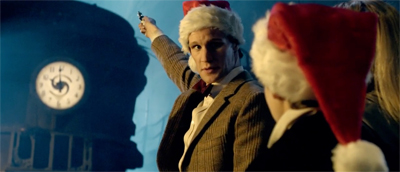
Turning back the clock...

Turning back the clock…

Continue reading

Doctor Who: The Next Doctor (Review)

To celebrate the fiftieth anniversary of the longest-running science-fiction show in the world, I’ll be taking weekly looks at some of my own personal favourite stories and arcs, from the old and new series, with a view to encapsulating the sublime, the clever and the fiendishly odd of the BBC’s Doctor Who.

The Next Doctor originally aired in 2008.

Oh, goodness me. Well. But this is… but this is nonsense.

Well, that’s one word for it.

Complete and utter, wonderful nonsense. How very, very silly.

– Jackson Lake and the Doctor

The Next Doctor actually has a pretty audacious concept. It’s one gigantic tease that plays off the audience’s media savvy. Airing after David Tennant’s departure from the role had been announced, but before Matt Smith had been named as Tennant’s successor, The Next Doctor is one gigantic tease. Like the surprise “regeneration” at the climax of The Stolen Earth, it’s a shrewd attempt to turn the audience’s expectations against themselves.

After all, the gap between an announced departure of an existing lead and the point where he actually leaves is rife for experimentation – particularly in a show about time travel. Up until The Next Doctor actually aired, it was quite possible that David Morrissey was Tennant’s successor, and The Next Doctor was a rather clever twist on the classic “multi-Doctor” story by having the Doctor team up with his future self.

Of course, as with The Doctor’s Daughter, Davies was just teasing. It’s to Davies’ credit that The Next Doctor remains interesting even after the illusion begins to slip. The first half is actually a wonderfully solid mystery and character study, albeit one that descends into confusion and chaos in the second half of the episode.

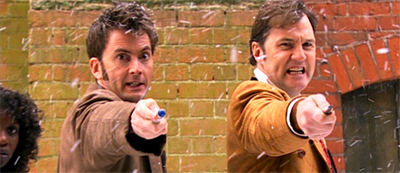
The Next Doctor...?

The Next Doctor…?

Continue reading

The X-Files – Roland (Review)

Roland is an episode that works much better than it really should. On the surface, it has many of the same problems as Born Again, to the point where it seems like “angry spirits” take up a disproportionate amount of Mulder and Scully’s case load. The filming and broadcast of Born Again and Roland in rapid succession probably points to the kind of pressure that Carter and his crew were under towards the end of the first year – both episodes play a lot better spaced out, and having the room to shuffle the production order on the two stories probably would have helped them seem less derivative.

And yet, Roland is elevated by a superb guest performance. Željko Ivanek isn’t the first stellar guest star that we’ve seen this year. Doug Hutchinson was perfectly cast as Tooms, and Brad Dourif did a marvellous job as Luther Lee Boggs. However, Ivanek might be the first guest star on The X-Files to elevate an otherwise bland episode through the sheer force of his performance.

It doesn't suck or blow...

It doesn’t suck or blow…

Continue reading

The X-Files – Shapes (Review)

Shapes feels like something of a companion piece to Shadows. Both are very traditional horror monster stories, feeling a little dated and out of place among the more modern paranoia of The X-Files. Shapes might carefully avoid using the word “werewolf”, instead dressing up the classic movie monster in loose fitting Native American mythology, but it feels like an attempt to pay homage to one of the definitive Hollywood monsters. Unfortunately, like Shadows, it winds up feeling a little stale and tired, a little too familiar and cliché.

It’s a werewolf story that lacks bite.

Chew on this...

Chew on this…

Continue reading

Star Trek: Deep Space Nine – Season 2 (Review)

Star Trek: Deep Space Nine is twenty years old this year. To celebrate, I’m taking a look at the first and second seasons. Check back daily for the latest review or retrospective.

Well, that’s more like it. The second season of Star Trek: Deep Space Nine might not rank with the very best of the franchise, but it doesn’t have to. Deep Space Nine is still a young show, and Star Trek spin-offs have a long history of taking their time to find their feet. The second season of Deep Space Nine contains its fair share of classic or memorable episodes, but it’s defined by a sense that the producers are still trying to figure out what works and what doesn’t.

While the first season occasionally felt like the series was stumbling back towards safety, trying to become a lighter version of Star Trek: The Next Generation as faith in its premise wavered, the second season is a lot more confident in itself. It’s willing to play around a bit to figure out how to be the show that it wants to be. And there’s a sense, as the season winds to a close, that we’re almost there.

By the time we hit the second half of the season, it seems the show has learned to churn out inoffensive episodes that feel unique and distinctively Deep Space Nine – episodes like Playing God or Shadowplay. However, it’s in the final third that the show seems to figure out how make truly great episodes of Deep Space Nine.

ds9-playinggod22

Continue reading