• Following Us

  • Categories

  • Check out the Archives


  • Awards & Nominations

The X-Files – Christmas Carol (Review)

This May and June, we’re taking a trip back in time to review the fifth season of The X-Files and the second season of Millennium.

Part of the challenge of the fourth and fifth seasons is watching The X-Files adapt the speed of its mythology.

The mythology has a very clear momentum in the first three seasons. For all that Chris Carter and his writers loved teasing out new questions, there was a clear sense of momentum and movement. The show had gone from a series about an isolated alien abduction in The Pilot to a series with a date set for the alien colonisation of Earth in Talitha Cumi. For all that the series was accused of being ambiguous and mysterious, there was a sense that it was at least going somewhere.

And so this is Christmas...

And so this is Christmas…

Things changed during the fourth season, most likely as the prospect of The X-Files: Fight the Future loomed in the future. It was clear that Fox would not allow Carter to set an end date on the television show before transitioning to feature films, and that the series would have to stretch beyond Carter’s original roadmap for it. All of a sudden, the mythology started stalling. The fourth season’s mythology had no clear direction in which to go, as evidenced by the fact that the decision to give Scully cancer in Leonard Betts was an eleventh hour decision with no long-term planning.

The fifth season’s mythology comes with its own particular set of problems. The movie had been written during the fourth season and filmed during the gap between the fourth and fifth seasons. This is quite evident in the way that the movie carries over abandoned elements of the fourth season mythology like the bees, who do not register at all in the fifth season. However, this also meant that the end point of the fifth season was essentially set in stone for the production team. The End would have to lead into Fight the Future, no matter what happened in the intervening nineteen episodes.

Picture perfect...

Picture perfect…

This means a lot of things for the fifth season. It means that the fifth season is stuck with the “Mulder as a skeptic… sort of” setup until Fight the Future, even if the show generally ignores it as much as it can. It also means that the mythology episodes probably should not contain any earth-shattering revelations or introduce any major character who were not already written into the film. Although Patient X and The Red and the Black effectively throw out these constraints almost completely, Christmas Carol and Emily try to adhere to them.

The result is a mythology episode that adheres rather closely to the successful approach adopted by Tempus Fugit and Max, a story that takes the backdrop of what the show has already revealed about the conspiracy and then uses that as a setting in which it can tell a decidedly more intimate and personal story.
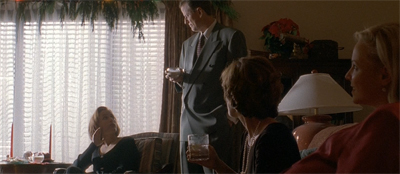
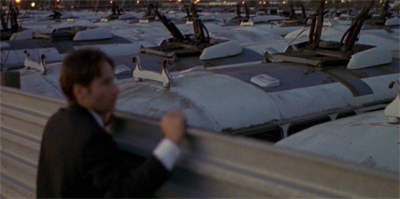
It's a Scully family Christmas...

It’s a Scully family Christmas…

Continue reading

The X-Files – Detour (Review)

This May and June, we’re taking a trip back in time to review the fifth season of The X-Files and the second season of Millennium.

Detour is a wonderfully traditional little episode in the middle of a somewhat eccentric season.

Although it lacks the off-kilter improvisational madness that drove much of the fourth season, the fifth season of The X-Files is a rather strange beast. With The X-Files: Fight the Future already filmed, the show was somewhat limited in what it could and couldn’t do in the fifth season – preventing the series from doing anything as dramatic as throwing Memento Mori into the middle of the run. Nevertheless, the fifth season features a variety of experimental and off-format episodes. Stephen King and William Gibson contribute scripts while Darren McGavin pops in as a guest star.

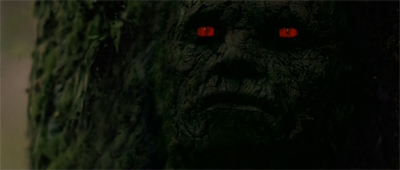
The woods are alive...

The woods are alive…

Detour was broadcast between Unusual Suspects and The Post-Modern Prometheus. Unusual Suspects was an episode headlined by the Lone Gunmen, while The Post-Modern Prometheus was broadcast in black-and-white as an homage to James Whale’s feature film adaptation of Frankenstein. As such, Detour feels like a rather conventional and old-fashioned episode, with Mulder and Scully encountering something strange in a rural setting, getting trapped in the wilderness, and encountering a monster threatened by the expansion of civilisation.

The beauty of Detour is that the episode’s decidedly traditional aesthetic feels out of place and almost novel amid all the off-format episodes surrounding it. Detour represents something of a literal detour – away from the more eccentric episodes of the season and towards something more familiar and safe. This allows Detour to have the best of both worlds – it feels at once traditional and quintessential, but also distinct from everything happening around it. Detour is a refreshingly old-fashioned episode of The X-Files, a reminder of just how much fun the show could have in its comfort zone.

Back to nature...

Back to basics…

Continue reading

The X-Files – Season 4 (Review)

This February and March, we’re taking a trip back in time to review the fourth season of The X-Files and the first season of Millennium.

The fourth season of The X-Files is a work of chaotic genius.

While the third season of The X-Files is one of the most consistently well-made seasons of television ever produced, the fourth season is a lot more uneven. There are a lot of reasons for this. Chris Carter was busy launching Millennium. Fox had decided to press ahead with The X-Files: Fight the Future. Behind the scenes, it was chaotic. Glen Morgan and James Wong hung around for half the season before leaving to work on their own pilot, a planned script from Darin Morgan fell through, Chris Carter’s attention was divided.

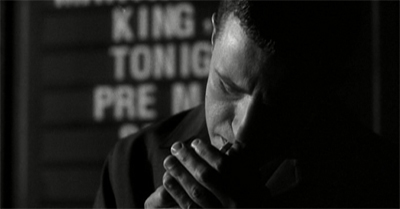
xfiles-musingsofacigarettesmokingman17

However, the fourth season represents something of a changing of the guard on the writing staff, a transition between two generations. The fourth season sees the permanent departure of writers Glen Morgan, James Wong and Howard Gordon. These were all writers who worked hard to give The X-Files its unique flavour and identity in the show’s earliest years. The X-Files would not be the same show without the input of those three writers. It is a shame to see them depart, although four years is a long time in the industry.

In contrast, the fourth season also sees younger talent rising up. It sees the first collaboration of Vince Gilligan, John Shiban and Frank Spotnitz. The trio would become one of the most consistent (and productive) writing ensembles on the series. The fourth season also saw the rapid ascent of Vince Gilligan, who had only contributed one script to the third season; Gilligan’s three solo scripts for the third season are iconic and influential in their own right. These are the voices that will steer The X-Files through to the end of its nine-year run.

xfiles-paperhearts22

As such, the fourth season feels transitional. It is a season that lacks the finely-honed efficiency that defined the third season, in favour of a more ambitious and even experimental style. The result is a season that feels wildly creative, a joyous cacophony rather than a harmonious symphony. The fourth season may not always hit the notes, but it is doing something very fresh and exciting. There is an energy and enthusiasm to the season that carries even some of the weaker episodes.

The fourth season is not consistently brilliant, but it is more than occasionally transcendental.

xfiles-max15

Continue reading

The X-Files – Zero Sum (Review)

This February and March, we’re taking a trip back in time to review the fourth season of The X-Files and the first season of Millennium.

For all that The X-Files exists in a murky shadow world populated by ambiguous figures and a government conspiracy dating back generations, the show has a pretty straightforward sense of morality. No good can stem from evil, the show seems to suggest; the show’s central mythology repeatedly has Mulder and Scully confront the legacy of sins committed by their forefathers. Even the title of Zero Sum alludes to the hollowness of Walter Skinner’s deal with the devil, his moral compromise that has no demonstrable benefit and severe demonstrable harm.

In Memento Mori, Walter Skinner compromised himself. He made a deal with the Cigarette-Smoking Man, in return for Agent Scully’s continued well-being. “What’ll it take?” Skinner asked, desperate for a chance to save Dana Scully. Ever ambiguous, the Cigarette-Smoking Man offered, “Well, I’ll have to get back to you on that.” Unfolding a few months later, Zero Sum is essentially about paying the piper. It is Walter Skinner settling up with the Cigarette-Smoking Man. He rolls up his sleeves and jumps into the dirty work.

Fire and brimstone...

Fire and brimstone…

Zero Sum is a story that you could not tell with Mulder. Although Mulder never faces the same choice as Skinner, the show has been quite consistent in its portrayal of Mulder’s morality. Mulder does not compromise; Mulder does not subscribe to the theory that a deal with the devil could ever pay dividends. In contrast, Skinner is a more ambiguous and pragmatic figure. Skinner spent significant sections of the second season caught between Mulder and the Cigarette-Smoking Man. The show only firmly committed him to Mulder and Scully in Paper Clip.

Zero Sum is a fantastic example of how the world of The X-Files has really grown and expanded around the lead characters. While the show will never quite develop into an ensemble, it is a series with a broad cast. It makes sense that it should begin to use them in a productive manner.

"Walter Skinner, F.B.I."

“Walter Skinner, F.B.I.”

Continue reading

Millennium – Sacrament (Review)

This February and March, we’re taking a trip back in time to review the fourth season of The X-Files and the first season of Millennium.

If Force Majeure and The Thin White Line seem to call forwards towards the weird and eccentric second season, Sacrament is a bit more modest. In many ways, Sacrament seems to foreshadow the last stretch of episodes in the first season. The forces of evil seem to encircle the Black family, creeping closer and closer to the big yellow house and everything it represents. For the first time, Sacrament explicitly puts Frank’s family at the heart of a case; this time focusing on the kidnapping of his sister-in-law from her child’s christening.

In many respects, this points towards the direction the show will take in its final stretch of episodes. Lamentation and Powers, Principalities, Thrones and Dominions will see the forces of evil explicitly violate the Black residence, insidiously eroding the idealised life that Frank has tried to build for his family in their new Seattle home. The cliffhanger at the end of Paper Dove pushes the concept to its logical conclusion, as a secret that Frank has tried to keep from his family finally comes home to roost.

Worst. Uncle. Ever.

Worst. Uncle. Ever.

As with WeedsSacrament demonstrates that writer Frank Spotnitz has an uncanny understanding of how Chris Carter built Millennium. It is an episode that is soaked through with the core themes of the series; it is a story about good and evil, and how evil taints everything that it touches. As with a lot of Millennium, Sacrament is not subtle; the moment that Tom Black is identified as the brother of our protagonist, it is inevitable that the forces of evil will come barrelling down upon him.

Nevertheless, Sacrament demonstrates a clear understanding of what it wants to be, and is a pretty effective snapshot of Millennium at this moment in time. The first season of Millennium is often overlooked and overshadowed amid the controversies surrounding the second or third seasons, but Sacrament stands as a great example of what the first season was trying to do.

Our father...

Our father…

Continue reading

The X-Files – Memento Mori (Review)

This February and March, we’re taking a trip back in time to review the fourth season of The X-Files and the first season of Millennium.

It is easy to see why Scully’s cancer arc is so fondly remembered.

It arrived at a point where the show was at the very top of its game. Scully’s cancer arc comes amid a slew of beloved and classic episodes, in the middle of a season that contains Home, Unruhe, Paper Hearts and many more. It is the defining mythology plot point for the show’s fourth season, which was the point at which The X-Files just exploded into the centre of popular consciousness. More than that, the episode introducing Scully’s cancer – Leonard Betts – was the most-watched episode of The X-Files ever broadcast.

What's in your head?

What’s in your head?

Memento Mori has its own endearing aspects. If Leonard Betts was the show’s highest profile and most populist success, Memento Mori counts as one of the show’s biggest critical successes. The episode is largely responsible for winning Gillian Anderson her Primetime Emmy Award for Outstanding Lead Actress in a Drama Series. It also took home the Primetime Emmy Award for Outstanding Art Direction for a Series and received a nomination for Outstanding Writing for a Drama Series. It is perhaps the most prestigious episode of the fourth season.

However, in spite of all of that, Memento Mori remains something of a mess. It feels like a clumsy retread of One Breath, a story that worked much better in the show’s second season.

Send in the clones...

Send in the clones…

Continue reading

The X-Files – Leonard Betts (Review)

This February and March, we’re taking a trip back in time to review the fourth season of The X-Files and the first season of Millennium.

Leonard Betts is a big one. In fact, it may just be the biggest one.

Leonard Betts attracted the largest audience in the history of The X-Files, with almost thirty million people tuning in to watch the episode. This audience was largely carried over from Superbowl XXXI, but it arrived at a fortuitous moment for the series. The X-Files was exploding into the mainstream. Chris Carter and Frank Spotnitz had spent Christmas 1996 in Hawaii plotting The X-Files: Fight the Future, a blockbuster movie based on the series. The week before, Mulder and Scully had paid a visit to Springfield in The Springfield Files.

What a waste...

What a waste…

The show’s moment had arrived. Leonard Betts makes for quite the moment. It might not be the best episode in the history of the show; it might not even be the best episode of the season. However, it ranks with Pusher as one of the great archetypal episodes of The X-Files. The show captures so much of what makes The X-Files great, almost perfectly distilling the appeal of the show into a tight forty-odd minute package. It is a beautifully-crafted piece of television that checks all of the right boxes. This is a pretty fantastic introduction to the show and its world.

Leonard Betts is an episode that has been put together with incredible skill, one that demonstrates why The X-Files had such an impact on the popular consciousness.

Comfortable in his skin...

Comfortable in his skin…

Continue reading

Millennium – Weeds (Review)

This February and March, we’re taking a trip back in time to review the fourth season of The X-Files and the first season of Millennium.

Weeds concludes the loose “suburban trilogy” running through the first season of Millennium. In fact, Weeds was filmed directly after Wide Open, but was pushed back in the broadcast schedule so as to air after The Wild and the Innocent. While this change in broadcast and production order is nowhere near as confusing as the scheduling hijinx happening with The X-Files at the same time, it does give an indication that the production team recognised the potential similarities between Weeds and Wide Open.

Both episodes are about the violation of a supposedly “safe” space, bypassing and subverting all the potential security put in place to keep the home secure. In Wide Open, the killer visits open houses and hides in wardrobes until the family go to sleep that night; in doing so, he avoids setting off any alarms. In Weeds, a secure and gated community discovers that they cannot keep their children safe; someone within the community is preying on the residents’ children. As with The Well-Worn Lock, there is a sense that families are not safe, even when they think that they are.

Community watch...

Community watch…

As with Wide Open, Weeds feels just a little bit sensationalist. It is the kind of episode that attracts criticisms about gratuitous violence or exploitation. Millennium was never quite as excessive or as sadomasochistic as its critics would suggest, but there are definite tendencies towards those extremes on display at certain points in the run. While Millennium is very clearly driven by a core moral philosophy, it can occasionally seem a little too comfortable with its brutality or depravity.

Indeed, Weeds hits on quite a few of the stock fears that run through the first season of Millennium: children are victimised by a person in a position of trust and authority; there is biblical quotation; there is sadistic (and disturbing) torture filmed in a heavily stylised manner. There is something almost cynical and calculated about how Weeds hits these familiar buttons; these impulses towards excess haunt the first season of Millennium, and are building to something of a catharsis in Loin Like a Hunting Flame.

There will be blood...

There will be blood…

Continue reading

The X-Files – 731 (Review)

This November (and a little of December), we’re taking a trip back in time to review the third season of The X-Files and the first (and only) season of Space: Above and Beyond.

731 is a lot more substantial than Nisei.

This is most likely due to the episode’s production history. Frank Spotnitz had pitched the episode that would become 731 as a single standalone episode, but the production team discovered that the show was too large to fill a single forty-five minute block. So the show was extended into a two-parter. Given that Spotnitz was the credited writer on 731, it would seem that the second part retained most of the substance.

It's in the eye of the beholder...

It’s in the eye of the beholder…

This makes a great deal of sense, given that the two-parter eschews the stand format of a two-part X-Files episodes, featuring a frantic run-around in the first forty-five minutes and a tighter more intimate story in the second. Coupled with the fact that the episode is more about working through what we already know instead of heaping more information on top, and the two-parter seems a lot more substantial than most of the series’ big mythology shows.

Thoughtful, introspective, and unnerving, 731 is perhaps the highpoint of the show’s entire nine-season conspiracy arc.

Where the bodies are buried...

Where the bodies are buried…

Continue reading

The X-Files – Our Town (Review)

This August (and a little of September), we’re taking a trip back in time to review the second season of The X-Files. In November, we’ll be looking at the third season. And maybe more.

A rare “monster of the week” script from Frank Spotnitz, Our Town could be seen as a mirror to Humbug. Humbug seemed to mourn the way that eccentric little communities seemed to be fading into history in the nineties – the loss of unique and distinct little hamlets. Our Town seems to offer a counterpoint, suggesting that perhaps the intrusion of the outside world into these tightly-knit communities is not a bad thing.

Inspired by the classic Spencer Tracy film Bad Day at Black Rock, Our Town sees Mulder and Scully investigating a small-town disappearance that eventually leads the duo to uncover a horrifying secret at the heart of the local community.

Fresh bones...

Fresh bones…

Continue reading