• Following Us

  • Categories

  • Check out the Archives


  • Awards & Nominations

Non-Review Review: Paradox

This film was seen as part of the Audi Dublin International Film Festival 2018.

The obvious point of comparison for Paradox is Taken.

Of course, Taken is so archetypal an action film that it has become a stock point of comparison for any gritty action movie with a paternal protagonist. However, the similarities to Paradox are quite apparent. Both Paradox and Taken are the stories of fathers who discover that their daughters have been kidnapped while holidaying abroad, and who inevitably use their investigative skills (and their capacity for violence) in order to track down their lost loved one while venturing into a disturbing subculture that exists for the gratification of the rich and the privileged.
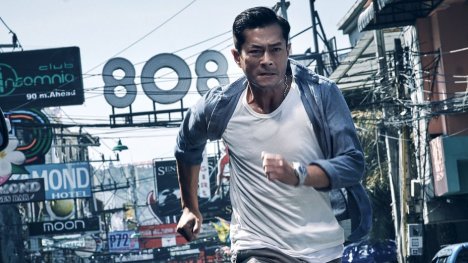
Paradox follows veteran Hong Kong police negotiator Lee Chung-Chi when his daughter is kidnapped in Thailand. It quickly becomes clear that the girl has been targeted by illegal organ dealers to provide a heart transplant for the corrupt local mayor, meaning that the father is caught in a desperate race against time to pull back the layers of corruption and indifference that serve to insulate those responsible. Along the way, he teams up with local police inspector Tsui Kit to crack the case.

However, much like the obvious comparison to Taken, the simple plot description does not do justice to the weirdness and tonal awkwardness of Paradox. It is perhaps most accurate to describe Paradox as a film quite like Taken, if Taken featured a scene in which one character dangles another off the roof by their penis.

Continue reading

Non-Review Review: You Were Never Really Here

This film was seen as part of the Audi Dublin International Film Festival 2018.

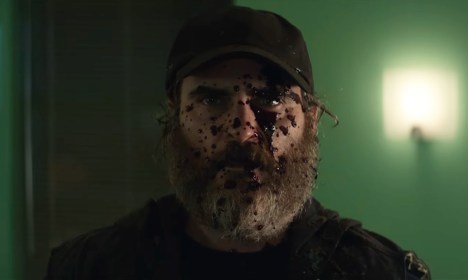
“Close your eyes,” the vigilante “Joe Rogers” advises the Nina Votto as he takes the ball hammer to the naked man standing in the doorway. The camera remains focused on Nina, foregrounding her as Joe goes to work. The audience knows what is happening, even if they only see it out of focus and in the background. This small moment is indicative of how You Were Never Really Here has chosen to approach its subject matter. Director Lynne Ramsay cannily keeps most of its violence off-screen.

Ramsay does this in a number of interesting ways. Part of this is through the skilful editing of Joe Bini, who pieces together fragmented flashbacks that suggest unfathomable horror without ever feeling gratuitous or grotesque; leaving a tangible feeling of unease without ever feeling voyeuristic or intrusive. Part of this is down to how Ramsay chooses to place the camera during acts of violence, while keeping the acts themselves very abrupt and brief; characters are frequently thrown through doorways, for example. Part of this is simply cutting around the violence, exploring its aftermath.

The result is intriguing. Appropriately enough, given its title, You Were Never Really Here is defined more by what it isn’t (or what it consciously chooses not to be) rather than what it actively is. The concept of the film would seem to suggest some brutal seventies vigilante extravaganza, revelling in the righteous violence of a man who hunts paedophiles and exacts a terrible vengeance upon them. However, You Were Never Really Here instead opts to be something a lot quieter and a lot more considerate; a film about violence that refuses to linger upon or indulge in that violence.

There is something very effective in all of these choices, both as a response to how such violence is typically portrayed in cinema and on their own merits. Perhaps the most striking of these choices is the manner in which Ramsay chooses to approach this story from the perspective of a child, through the eyes of the victim rather than the archetypal hero. It is a bold and provocative choice, one that elevates the material.

Continue reading

Non-Review Review: The Bookshop

This film was seen as part of the Audi Dublin International Film Festival 2018.

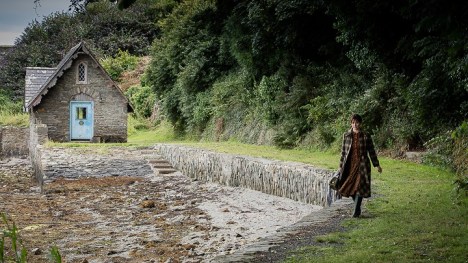
The Bookshop opens with the cinematic equivalent of that frustrating modern home decoration trend of shelving books with the spines facing inwards so as to ensure something approaching uniformity of style while denying anything resembling individual identity.

This is perhaps the perfect encapsulation of The Bookshop then.

Continue reading

Non-Review Review: The Cured

This film was seen as part of the Audi Dublin International Film Festival 2018.

The biggest problem with The Cured might be that the film bites off more than it can chew.

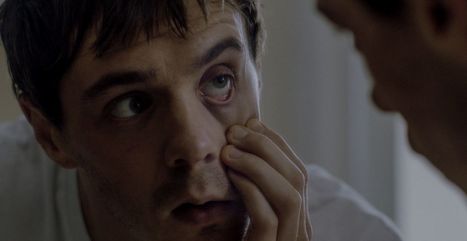
At least in their modern post-Romero phase, zombies have often been a tool of social allegory. They are a potent metaphor for any number of familiar anxieties; unchecked consumerism in Dawn of the Dead, the working class in The Land of the Dead, an insurgent enemy population in 28 Weeks Later. In many ways, The Cured feels like a logical extension for this. The story about society trying to claw its way back from the horrors of zombie apocalypse, The Cured is a bold and ambitious piece of horror movie social commentary.

A population of rehabilitated zombies raises any number of obvious parallels in the modern world. The Cured plays with a number of these ideas, using zombies as a metaphor for class anxieties and for a politically subjugated (and literally dehumanised) political population. However, the most potent metaphor at the heart of the story is to do with criminal rehabilitation and social reintegration, the challenge of how society embraces or shuns those who have committed horrible acts but are also deemed to have served their time.

Writer and director David Freyne explores these ideas in a charged and playful manner, balancing the expectations of zombie storytelling against the backdrop of a broader political allegory. Indeed, The Cured arguably suffers from a surplus of good ideas, with enough material to sustain a television miniseries crammed into a lean ninety-five minute runtime.

Continue reading

Non-Review Review: Revenge

This film was seen as part of the Audi Dublin International Film Festival 2018.

What if Nicolas Winding Refn directed a Blumhouse film?

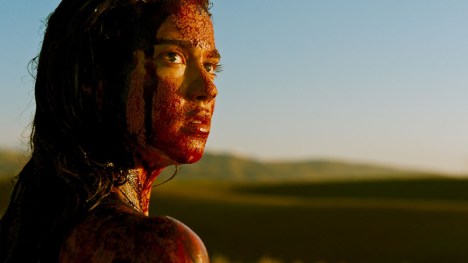
Revenge is a neon-drenched and synth-saturated exploitation flick that takes some of the most familiar conventions of the survival horror genre and executes them with incredible style. Revenge puts a beautiful sheen on a very ugly film, constructing an effective revenge narrative full of striking imagery. As realised by director Coralie Fargeat, Revenge is a visceral experience. The film’s violence is almost tangible, the audience feeling every act of brutality inflicted upon the bodies of its cast.

A lot of this is down to the craft of those involved, working under Fargeat’s direction. Jérôme Faurel’s sound design ensures that the audience hears every drip of blood, every splash on every surface. Cinematographer Robrecht Heyvaert and colourist Frédéric Savoir play up the contrast in the compositions, so the blood seems to burst off the screen against the bright yellows and the deep blues. Make-up effects artists Laetitia Quillery ensures that the cast carry every scar with them as the movie puts them through an endurance nightmare.

This attention to pure craft elevates Revenge above so many of its genre contemporaries. Revenge is undoubtedly trashy piece of cinema, but is never ashamed of what it is or apologetic for what it does. Instead, the film commits itself with an engaging and exhilarating enthusiasm. Revenge never views its genre as a limitation to transcend, but instead as a field in which to excel. And it certainly does.

Continue reading

New Podcast! Scannain Podcast (2018) #6!

Into the mouth of madness…

Discussing the latest in film news here and abroad, the Scannain podcast is a weekly podcast discussion of what we watched, what we watched, what is dominating and the box office, and what is lurking on the horizon film-wise. This week’s episode was recorded right before the premiere of Black ’47 at the launch of the eleven-day-long Audi Dublin Film Festival 2018, and covered everything from Black Panther to Galway cinema.

I’m thrilled to be part of a panel including returning host Niall Murphy and returning guests Ronan Doyle and Alex Towers. Give it a listen below.

Non-Review Review: Sweet Country

This film was seen as part of the Audi Dublin International Film Festival 2018.

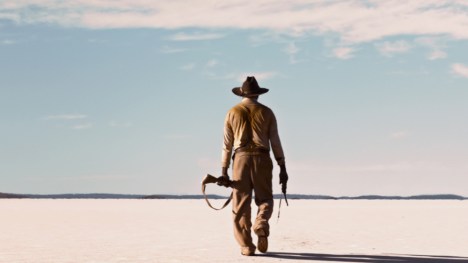
“What chance does this country have?” asks Sam Neill towards the climax of Sweet Country.

In the context of the scene, it isn’t entirely clear to whom the character is speaking. There is one other individual in the scene, but they are preoccupied at that moment and it’s not clear they are even within earshot when Neill’s character makes his grave assessment about the future of this young nation. However, outside the context of the scene, it is very apparent to whom Neill’s character is addressing his concerns. He is speaking directly to the audience through the medium of film.

Sweet Country is not a film that does subtlety or nuance. As Neill’s character offers this pointed question, he stumbles through the Australian wilderness, as if to suggest that he is lost. He stops just short of bluntly stating that he is lost, just like this country, the film demonstrating uncharacteristic faith in the audience’s narrative and thematic comprehension. Nevertheless, just in case the audience still doesn’t get it, Neill’s character asks this very profound question while wandering in the direction of the tail end of a rainbow set against a stormy sky.

“What chance does this country have?” the character wonders. The audience doesn’t feel the need to articulate the obvious response, “Not much, if it produces films like this.”

Continue reading

Non-Review Review: First Reformed

This film was seen as part of the Audi Dublin International Film Festival 2018.

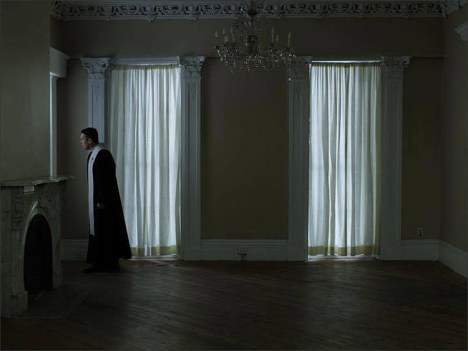
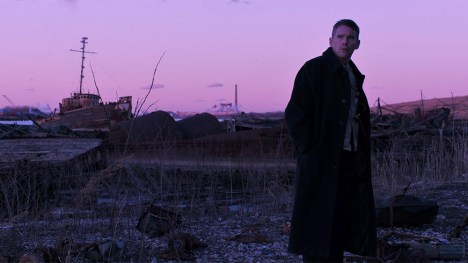
First Reformed is an unholy mess.

On paper, First Reformed has some very interesting ideas. It is a film grappling very consciously with weighty themes and heavy subject matter. It is about the challenge of finding faith in a modern and cynical world, and about reconciling the mundane maintenance of spiritual belief with the euphorically elevation of pure devotion. This is a broad theme that resonates in a world that feels increasingly disconnected and diffused, in a time when people feel increasingly distant from purpose or meaning.

Indeed, the core premise invites comparisons to Taxi Driver, which remains the defining work in Schrader’s filmography. Schrader has been working as a writer for almost forty-five years, and as a director for forty years, but his body of work is still discussed in terms of the second script that he wrote. Although most audiences associate Taxi Driver with the creative partnership of Scorsese and DeNiro, it was a work that was very important to Schrader, articulating themes and ideas to which he would return time and time again.

First Reformed brings Schrader back to that, with Reverend Ernst Toller feeling very much like a spiritual sibling to Travis Bickle, a man who struggles to make sense and to find meaning in a chaotic world and who decides to impose his own order upon the universe. Schrader is very much playing with his own history and iconography here, playing out a familiar story in a new setting with a slightly different emphasis. As with a lot of artists revisiting their earlier and defining, the results are frustrating. First Reformed bends and contorts in the shadow of its predecessor, never coming into its own.

Continue reading

Non-Review Review: The Breadwinner

This film was seen as part of the Audi Dublin International Film Festival 2018.

Stories enrich us, stories empower us, stories sustain us.

The Breadwinner is many things. It is a beautifully animated film from Irish studio Cartoon Saloon, a worthy successor to The Secret of Kells and Song of the Sea, and also the first time that the company have looked beyond Irish shores for one of their feature-length releases. It is a stunning adaptation of Deborah Ellis’ novel, offering a compelling glimpse into Afghanistan as controlled by the Taliban at the turn of the millennium. It is a genuinely affecting tale of a young girl surviving in a climate that seems actively hostile to her very existence.

However, The Breadwinner is also a meditation upon the power of stories. This is not a surprise, it is very much in keeping with the aesthetics and interests of Cartoon Saloon. It is a recurring theme in their work. (As a point of comparison, Pixar Studios are invested in parental anxieties, down to the inclusion of the “Pixar Babies” in the credits of every major release.) Indeed, The Breadwinner might be seen as a spiritual successor to (or the third part of a thematic trilogy with) The Secret of Kells and Song of the Sea, stories about children reconnecting with the mythic history of their countries.

Indeed, this is one of the most striking and appealing aspects of The Breadwinner is the way in which it finds something universal in its very specific setting. The Breadwinner is a story very firmly anchored in one time and place, but one that should resonate with everyone.

Continue reading

Non-Review Review: Mute

Mute is a bold and ambitious mess.

Mute is perhaps most interesting for what it is, and most frustrating in what it is about. In its own way, Mute stands as a triumph of the Netflix model. As it streams, Mute is undoubtedly the film that director Duncan Jones wanted to make. Indeed, it is next to impossible to imagine Mute making its way through the conventional studio system, and certainly not in the form that appeared on Netflix. Even watching the film play out, those never-materialised studio notes suggest themselves. (Most notably, “What is this film saying?”) There is nothing that feels like compromise about the film, and there is something very appealing in that.

However, there is also something deeply frustrating in Mute. The film is undoubtedly the unfiltered creative vision of its director, but there is something overwhelming in that. Mute is beautiful to look at, but almost too much to take in. Its world is vivid and fully formed, its atmosphere rich and evocative. However, there is something awkward in the story that unfolds within this dystopian landscape, the narrative never quite cohering in the same way as its grimy futuristic Cold War Berlin.

Mute is a film that is fascinating and impressive, if far from satisfying.

Continue reading