• Following Us

  • Categories

  • Check out the Archives


  • Awards & Nominations

New Podcast! Scannain Podcast (2019) #4!

It’s time for the latest Scannain podcast!

This week, I join Jay Coyle and Graham Day from Speakin’ Geek to discuss the week in film news. It’s a fun and wide-ranging discussion, covering everything from the growth of Dreamworks as an animation studio to the extended cut of Terrence Malick’s Tree of Life. There’s also discussion of Dragonball Z and Destroyer. In film news, we mark the passing of Dick Miller, the coverage of Sundance, February at the Irish Film Institute and the thirtieth anniversary of the Cork French Film Festival.

The top ten:

  1. The Favourite
  2. Wreck-It Ralph 2: Ralph Breaks the Internet
  3. Stan and Ollie
  4. Second Act
  5. Mary Poppins Returns
  6. The Mule
  7. Vice
  8. Mary Queen of Scots
  9. Glass
  10. A Dog’s Way Home

New releases:

You can download the episode here, or listen to it below.

Non-Review Review: High Flying Bird

High Flying Bird is a quietly radical movie about a sports agent.

This should not be a surprise. Director Steven Soderbergh is a director fascinated with systems, particularly capitalist systems. Unsane might have taken the form of a trashy and tacky nineties thriller, but it was primarily interested in exploring the horrors of a psychiatric industrial complex. Side Effects touched upon the way in which pharmaceutical companies and legal systems work. Contagion was a story about structural responses to a viral infection that spread rapidly through an increasingly interconnected world.

Managing the situation.

With that in mind, it makes sense that Steven Soderbergh’s movie about the NBA lockout of 2011 would feature very little actual basketball. Sure, footage of games plays on several of the large flatscreens adorning bar or office walls, but it’s just window dressing. Just when it looks like Soderbergh might actually show a game, he cuts away dramatically to a shot of a billionaire’s daughter carrying her dog on board a private jet, flanked by two helpful staff holding umbrellas to protect her from the wind. High Flying Bird is about basket ball as an institution, but not a sport.

A cynic would argue that  High Flying Bird is about basket ball in the same way that the NBA is about basket ball, interested in institutions and structures more than the actual sport itself. Such a cynic would be right at home in the world of High Flying Bird, where characters talk freely and repeatedly about the  “game that’s been played behind the game”, “the game that they made over the game”, or “a game on top of a game.” Professional basket ball is not about basket ball, High Flying Bird argues coherently and consistently. Professional basket ball is about profiting off basket ball.

“What are you doing here?”
“Beatz me.”

High Flying Bird is drawn from a script by Tarell Alvin McCraney, who is perhaps best known for working on the story for Moonlight with Barry Jenkins. Indeed, the cast is anchored by Moonlight co-star André Holland. High Flying Bird recalls Moneyball, in that it is a film about sport that does not feature sport, understanding that the activity does not exist in a vacuum. For High Flying Bird, professional basket ball is about money and power and race, and the real game is being played away from where the camera and the audience is looking.

The only thing that keeps High Flying Bird from being a slam dunk is a lack of focus. High Flying Bird doesn’t entirely trust its cast and its premise to hold the audience’s attention through all of these conversations about abstract concepts layered upon abstract concepts placed over a game that the film only shows in the background. As a result, McCraney and Soderbergh crowd out the story with subplots designed to generate human interest; a tragic back story, an emerging romance. These elements ultimately distract from the most interesting aspects of the film.

This screenshot is also about capitalism. Somehow.

Continue reading

Non-Review Review: Alita – Battle Angel

Alita: Battle Angel is the result of a creative union between James Cameron and Robert Rodriguez.

This partnership makes a certain amount of sense. Both Cameron and Rodriguez are genre film-makers, and one suspects that the two men would have been fast friends had they emerged at around the same time; Cameron came of age making films like Piranha 2 or Terminator, and those are certainly of a piece with Rodriguez’s filmography from Desperado through to Planet Terror and even Sin City. Cameron has arguably elevated his work into the mainstream, in that it is impossible to imagine Rodriguez producing a mass-appeal cultural smash like Cameron did with Terminator 2: Judgment Day Titanic or Avatar.

Slice o’ life.

However, allowing for that core similarity, Cameron and Rodriguez are still fundamentally different film-makers. Their interests might align when it comes to genre work, but they construct their movies in a very different manner, with a different emphasis on different aspects of their technique. Cameron is much more interested in bringing polish to his genre work, in finding a way to transform otherwise niche high-concept tales into crowd-pleasing blockbusters with mass appeal. In contrast, Rodriguez revels in the grottier aspects of his genre work, believing that the lack of sheen is part of the appeal.

Alita: Battle Angel finds these two aesthetics at odds with one another. The story at the heart of Alita is pure Cameron, dedicated to world-building and social commentary while relying on exposition and centring on big set pieces. However, the delivery of Alita is very much in the style of Rodriguez, stressing cool beats and individual sequences rather than the singular cohesive whole. The result is jarring and deeply fascinating, but it doesn’t quite come together. Alita is an intriguing piece of cinema, but a less than satisfying would-be blockbuster. Like its central character, it seems constructed of parts that don’t quite fit.

Red is dead.

Continue reading

Non-Review Review: The Lego Movie 2 – The Second Part

Appropriately enough, given the brand involved, The Lego Movie 2: The Second Part very skillfully builds on The Lego Movie.

Of course, The Second Part faces the typical challenges that haunt sequels to beloved and genre-bending films. A large part of what made The Lego Movie such a joy was the way in which it played with audience expectations of what it could be. More specifically, it built very cleverly and very consciously to a late development that was both entirely organic and very surprising, which is a difficult balance to strike. The Second Part starts with that late development baked into the premise, which means that it can’t pull the same twist again. It removes an important toy from the chest.

Bricking it.

However, while The Second Part lacks the novelty that made The Lego Movie so refreshing, it does have the advantage of building on what came before. In keeping with the nature of the toys depicted, The Second Part has the luxury of building upon an established template to tell its own story. The Second Part can trust that the audience understands the logic (both literal and metaphorical) that guided The Lego Movie, and so can develop that idea in interesting directions.

The result is a sequel that is fulfilling and satisfying, but which never quite matches the highs of the original film. The Second Part is clever, funny and canny. However, it is also – by its very nature – less innovative and creative. The results are impressive and affecting. While they don’t have quite the same impact as they did in The Lego Movie, the success of The Second Part is at least reassuring. That the template works so well even without disguising its twists offers proof that the fundamental building blocks are solid.

Piece in our time.

Continue reading

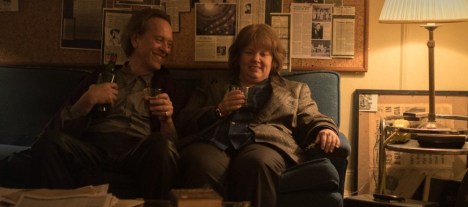
Non-Review Review: Can You Ever Forgive Me?

Can You Ever Forgive Me? is, at its core, a story of authenticity.

It is the tale of Lee Israel, the noted biographer who hit a bit a creative and economic snag in the early nineties. Unable to shop around her planned biography of Fanny Brice, Israel instead decided to market forgeries; type-written letters offered up in the voices of famous writers, auctioned on the collector’s circuit. Israel had a knack for capturing the voices of her subjects, from Noel Coward to Dorothy Parker. In fact, Israel’s work was often deemed indistinguishable from the real thing, at least in an abstract and narrative manner.

Forging ahead.

There is something very timely in this premise, in the blurred boundaries between the real and the fake. Of course, this has been an aspect of the American character for well over a century, with P.T. Barnum famously advertising an obvious phony as “a genuine fake.” However, Can You Ever Forgive Me? arrives at a moment in time where the real and the fake seem to have collapsed into one another, where reality is often indistinguishable from fantasy, populated by people who will often happily accept a heartwarming fake over cold reality.

Can You Ever Forgive Me? is largely an unshowy piece of awards fare. The film is never self-consciously stylised and never overly aggressive. Can You Ever Forgive Me? never seems sure how thrilling or how funny or how dramatic it should be, and so tries to split the difference between those three extremes. The result is a very broad film with a very familiar central arc. However, Can You Ever Forgive Me? very insistently avoids getting in its own way, which allows its two central leads room within which they might work their magic.

“Gee, Richard E. Grant sure plays a good drunk.”

Continue reading

Non-Review Review: Polar

At the heart of Polar is a vaguely interesting idea.

The basic premise of Polar filters an archetypal masculine midlife (or retirement) anxiety through the prism of a hyper-violent fantasia. It is almost a cliché to suggest that certain types of men revert to boys when confronted with their own mortality, but only because it permeates popular culture that treats middle age as a relapsed adolescence reflected in the shiny toys that such men buy and the selfish decisions that such men make. Polar just takes that central metaphor and runs with it.

The assassin who came in from the cold.

Even beyond that basic concept, there’s something potentially compelling in the premise of an assassination-themed black comedy that hinges on what amounts to a pension swindle. It’s hyper-capitalism run wild, the commodification of human life to the point that workers are literally killing one another to prevent the company from having to make a pay-out. The Other Guys managed that deft balance with ease and grace. On some strange level, it’s fun to imagine a hyper-violent assassination thriller rooted in something as mundane as balance sheets, mergers and annual reports.

Unfortunately, Polar is a disaster of a film. It just doesn’t work. More than that, the ways in which it doesn’t work are painfully and predictably mundane. It’s leery, voyeuristic and trashy, but not in any fun way. It has a weird anal fixation that most obviously manifests itself in those sleazy tight close-ups of female derrieres, but which has a slight equal opportunity air to it; audiences are also treated to a number of shots of Mads Mikkelsson’s ass as he thrusts into his female co-stars, and the film opens with Mikkelsson receiving a prostate exam that might serve as a metaphor for the store film.

Not a patch on John Wick.

Continue reading

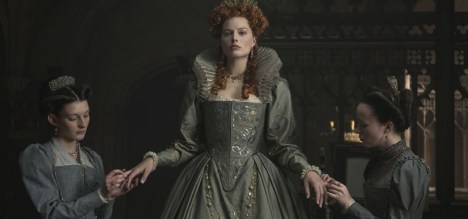
Non-Review Review: Mary, Queen of Scots

Mary, Queen of Scots is unfocused and unmoored.

Mary, Queen of Scots feels like it should be a star vehicle for Saoirse Ronan. This makes sense. Ronan is a star in ascent. She has three Oscar nominations, and has recently headlined films with broad appeal like Brooklyn and Lady Bird. The concept of building a star vehicle for Ronan from the life and times of Mary Stuart seems like a good idea. Ronan experimented with larger-scale films in her teens like The Lovely Bones or The Host, but it seems perfectly reasonable to have her approach a large scale period drama as a genuine movie star.

Beth left unsaid.

However, Mary, Queen of Scots suffers from what feels like a crisis of confidence. The film’s second-billed lead is Margot Robbie, a successful Oscar-winning actor with similar star wattage to Ronan. Despite the fact that Mary Stuart retained the title of the film, Mary, Queen of Scots has largely been sold and marketed as a film with two leads; consider the misguided #dearsister hashtag publicity campaign, or the misguided branding on the character-focused profiles. It often seems like Mary, Queen of Scots clumsily aspires to be a biography of Queen Elizabeth I.

Mary, Queen of Scots is never entirely sure whether it wants to be a character-driven story focused on one woman’s life or a two-hander about lives in parallel. Watching the film, it feels like the decision was repeatedly taken and revised at various points during production, never committing to one approach for fear that it might preclude the other. The result is uneven and disjointed. Mary, Queen of Scots devotes enough time to Queen Elizabeth I that she feels like a major player, but only managed to get Ronan and Robbie together on set for a single day.

Queen of hearts.

Continue reading

Non-Review Review: Monsters and Men

Monsters and Men is an impressive theatrical debut for director Reinaldo Marcus Green, at least in technical sense.

There is an artfulness to Monsters and Men, an impressive level of craft. The compositions are striking and impressive. In particular, the closing shot of the film is an emotive and memorable visual that lingers as the closing credits role. If Monsters and Men is any indication, Green has a long and impressive career ahead of him. He demonstrates a keen eye for cinematic images and an intuitive knack for visual storytelling.

“I’m talkin’ to the man in the two-way mirror…”

Unfortunately, Monsters and Men is much less satisfying as a narrative experience than it is as a collection of shots and images. It is an ambitious and provocative piece of work, a narrative triptych that focuses on three very different characters affected in three very different ways by a police shooting in New York. Monsters and Men hopes to fashion a mosaic, to offer three fractured perspectives that might better illuminate the whole. Unfortunately, these individual stories don’t really work together and do not cohere into a singular or defining statement.

Monsters and Men undoubtedly has its heart in the right place as a piece of low-budget socially-conscious film making, but it simply cannot deliver on its ambitions. Although this ultimately undercuts the film, there are certainly worse flaws to have.

Feeling fenced in.

Continue reading

Non-Review Review: The Upside

The Upside doesn’t work.

From the outset, it is very clear what The Upside wants to be. This a movie that aspires towards a broad feel-good mood. Perhaps its closest companion in this particular awards cycle is Green Book. It is easy to be cynical about such films, and it is particularly easy to be cynical about The Upside. The film’s delayed release is not the result of a studio desperately holding a hidden gem until late in awards season, this is a would-be crowd pleaser pried from the cold dead hands of the Weinstein Company.

Hart to heart.

Everything in The Upside seems designed to guide an audience on an emotionally uplifting journey, a story of two characters from very different circumstances brought together so that each might elevate the other. All of the big moments in The Upside are no so much telegraphed as broadcast, the volume turned up to eleven. Characters scream and shout, at both each other and the world around them. Catharsis isn’t just sought, it is amplified. There is no moment at which The Upside leaves the audience in any doubt about what they should feel.

The result is a clumsy and awkward piece of cinema that constantly trips over itself, repeatedly undermining anything meaningful or significant that it might have to say about either of its two central characters.

“So, what is The Upside here?”

Continue reading

Non-Review Review: Life Itself

Life Itself is a spectacular disaster.

There’s an incredible amount of ego on display in Life Itself, which makes a certain amount of sense. It is an auteur project from Dan Fogelman, written and directed by the guy responsible for This is Us. It is the kind of adult-centric drama that people don’t really make anymore, from the mind responsible for one of the biggest television hits of the decade. On paper, it is easy to see why there was a bidding war over Life Itself on the festival circuit, major studios tripping over one another to offer the largest cheque.

A pregnant pause.

Watching the film, of course, it is easy to see why Life Itself ended up as a cinematic footnote. It was dumped at the United States box office, dead on arrival. It limped into the United Kingdom with a simultaneous theatrical and television release on Sky One, a strategy usually reserved for enjoyable nonsense like Final Score. There is a reason for this. In Life Itself, ego gives way to indulgence. There is an incredibly and obnoxious smugness to Life Itself, the confidence of a truism scrawled clumsily on a beer mat, punctuated by several exclamation marks and underlined for emphasis.

Life Itself watches like the work of an over-eager film student motivated primarily by the profundity of their own insight, having assembled an impressive cast and offering a globetrotting story. Unfortunately, Life Itself is decidedly less fun than the best of those pseudo-profound philosophical treatises, delivered with a suffocating sense of its own self-importance.

Some significant (An)tonal issues.

Continue reading