• Following Us

  • Categories

  • Check out the Archives


  • Awards & Nominations

Doctor Who: Journey’s End (Review)

To celebrate the fiftieth anniversary of the longest-running science-fiction show in the world, I’ll be taking weekly looks at some of my own personal favourite stories and arcs, from the old and new series, with a view to encapsulating the sublime, the clever and the fiendishly odd of the BBC’s Doctor Who.

Journey’s End originally aired in 2008.

Stand witness, humans. Your strategies have failed, your weapons are useless, and… oh, the end of the universe has come.

– Davros, master of understatement

Journey’s End covers a lot of ground incredibly quickly. Even running one-and-a-half times the length of a regular episode, Journey’s End feels like it’s ready to burst at any given moment. Those who don’t like Davies’ finalés will find a lot to complain about here. The stakes are raised so high as to become almost abstract. The plot is written into a corner where it takes nothing short of a convenient deus ex machina to resolve it all. The Tenth Doctor and Rose are as annoying together as they have ever been, despite both being quite awesome apart.

However, if you’re looking at The Stolen Earth and Journey’s End as a story, you’re missing the point. The real news is that this was a crowning accomplishment for the series. Not only did The Stolen Earth and Journey’s End both pull a record high Appreciation Index of 91, Journey’s End edged out East Enders and Coronation Street to become the most-watched show on British television that week. This was the first time that Doctor Who had accomplished this since it came back.

The Daleks' master plan...

The Daleks’ master plan…

The only comparable accomplishment in the history of the show is City of Death scoring the show’s highest ever ratings. And that only happened because an ITV strike made it quite difficult for anybody to watch anything else at the time. So, no matter how you cut it, Journey’s End is a phenomenal piece of event television, one that really solidifies the importance of the resurrected Doctor Who in British popular consciousness.

In a very real way, the title feels somewhat apt. The long journey of Doctor Who from a failed science-fiction show in the wilderness to a crown jewel in British television was finally over.

It's been a hell of a ride...

It’s been a hell of a ride…

Continue reading

Doctor Who: The Stolen Earth (Review)

To celebrate the fiftieth anniversary of the longest-running science-fiction show in the world, I’ll be taking weekly looks at some of my own personal favourite stories and arcs, from the old and new series, with a view to encapsulating the sublime, the clever and the fiendishly odd of the BBC’s Doctor Who.

The Stolen Earth originally aired in 2008.

Someone tried to move the Earth once before. Long time ago. Can’t be.

– the Doctor reminds us that just because the Daleks are threatening doesn’t mean they aren’t completely insane

The Stolen Earth and Journey’s End are not, by any stretch of imagination, tightly-constructed episodes. They don’t represent the pinnacle of the Davies era from any technical or production standpoint. The story logic is questionable at best, and Davies’ primary concern seems to be keeping the script moving fast enough that the plot holes and illogical narrative loose ends never overwhelm the production. It is basically the most bombastic and large-scale season finalé of the Davies era. And given that it’s measured against The Parting of the WaysDoomsday and The Last of the Time Lords, that’s really saying something.

And yet, despite that, I have a strange affection for this season finalé. It’s an excuse for Davies to really bask in the success of the revitalised Doctor Who, creating a plot that draws together all manner of disparate elements into one gigantic tribute to the past four years of Doctor Who. It’s hard to hate, on those grounds alone.

An explosive finalé...

An explosive finalé…

Continue reading

Doctor Who: Turn Left (Review)

To celebrate the fiftieth anniversary of the longest-running science-fiction show in the world, I’ll be taking weekly looks at some of my own personal favourite stories and arcs, from the old and new series, with a view to encapsulating the sublime, the clever and the fiendishly odd of the BBC’s Doctor Who.

Turn Left originally aired in 2008.

You said I was going to die, but you mean this whole world is going to blink out of existence. But that’s not dying, because a better world takes its place. The Doctor’s world. And I’m still alive. That’s right, isn’t it? I don’t die. If I change things, I don’t die. That’s that’s right, isn’t it?

– poor Donna… poor, poor Donna

The fourth season is basically one gigantic victory lap for Russell T. Davies’ Doctor Who. Davies has done the hard work of returning the show to television. He’s made the Daleks threatening. He’s rebooted the Cybermen. He’s made the Master sexy again. The fourth season is really just about enjoying the success of the show, and using that success to do crazy things like bringing back the Sontarans or Davros. Because nobody was clamouring for another Sontaran or Davros story.

That sense of celebration is probably most obvious in Turn Left, the penultimate story of the fourth season. It’s basically It’s a Wonderful Life, starring the Tenth Doctor. Or, to be more accurate, It’s a Wonderful Life for the new series of Doctor Who. It’s an excuse to celebrate a raft of continuity from The Runaway Bride through to The Sontaran Stratagem, to bring back Billie Piper and just to celebrate not only the wonder of Doctor Who, but the virtue of Davies’ approach to the series.

Everything goes up in smoke...

Everything goes up in smoke…

Continue reading

Doctor Who: Midnight (Review)

To celebrate the fiftieth anniversary of the longest-running science-fiction show in the world, I’ll be taking weekly looks at some of my own personal favourite stories and arcs, from the old and new series, with a view to encapsulating the sublime, the clever and the fiendishly odd of the BBC’s Doctor Who.

Midnight originally aired in 2008.

And you be careful, all right?

Nah. Taking a big space truck with a bunch of strangers across a diamond planet called Midnight? What could possibly go wrong?

– Donna and the Doctor tempt fate

Midnight was the fiftieth episode of the revived Doctor Who to enter production. It had been intended to air as the fiftieth episode of the new series, but plotting similarities between Forest of the Dead and Turn Left forced Davies to shift the broadcast order of the episodes. As a result, we end up with the longest consecutive streak of Davies-written episodes in the history the show, stretching from Midnight through to The End of Time, Part II. In essence, although it’s not really intended as part of the over all arc, Davies’ swan song begins here.

And it’s the best episode that Davies has ever written. It might be the best episode of the fourth season. It might even compete for the best episode of show produced by Davies.

So it’s pretty great.

The long dark midnight of the soul...

The long dark midnight of the soul…

Continue reading

Doctor Who: Forest of the Dead (Review)

To celebrate the fiftieth anniversary of the longest-running science-fiction show in the world, I’ll be taking weekly looks at some of my own personal favourite stories and arcs, from the old and new series, with a view to encapsulating the sublime, the clever and the fiendishly odd of the BBC’s Doctor Who.

Forest of the Dead originally aired in 2008.

Everybody knows that everybody dies. But not every day. Not today. Some days are special. Some days are so, so blessed. Some days, nobody dies at all. Now and then, every once in a very long while, every day in a million days, when the wind stands fair, and the Doctor comes to call, everybody lives.

– River brings Moffat’s contributions to the Davies era a full circle

There’s actually quite a lot to like about Forest of the Dead. Like Silence in the Library, it doesn’t really push Moffat’s work on Doctor Who that much further. A lot of its big ideas can be found in Moffat’s earlier Doctor Who work. Still, it is quite clever and quite well-written, and a pretty well-constructed episode. This is, after all, the last episode of the Davies era that is not credited to Davies himself. Given it’s written by the showrunner elect, that celebratory feel is justified.

At the same time, however, there are some very uncomfortable gender roles at work in Forest of the Dead for female characters like Donna or River. Moffat would come under a lot of fire during his tenure producing Doctor Who for the way that he wrote female characters, but I’d actually argue that the problems with Forest of the Dead are more in keeping with wider Davies-era trends towards the way that female characters are written.

It just clicked...

It just clicked…

Continue reading

Doctor Who: Silence in the Library (Review)

To celebrate the fiftieth anniversary of the longest-running science-fiction show in the world, I’ll be taking weekly looks at some of my own personal favourite stories and arcs, from the old and new series, with a view to encapsulating the sublime, the clever and the fiendishly odd of the BBC’s Doctor Who.

Silence in the Library originally aired in 2008.

There’s the real world, and there’s the world of nightmares. That’s right, isn’t it? You understand that?

Yes, I know, Doctor Moon.

What I want you to remember is this, and I know it’s hard. The real world is a lie, and your nightmares are real.

– Cal and Doctor Moon get to the root of what makes Moffat scripts terrifying

Ah, Silence in the Library. The Steven Moffat story that isn’t, that doesn’t. The first Steven Moffat script that isn’t the strongest story in its season by a clear margin; the first Steven Moffat adventure that didn’t claim the Hugo for Doctor Who. The biggest problem with Silence in the Library and Forest of the Dead is that they can’t quite measure to The Empty Child, The Doctor Dances, The Girl in the Fireplace or Blink. That’s hardly an unforgivable sin, and there’s no shame in not being quite as good an episode of Doctor Who as Midnight was.

I’m quite fond of the two-parter, even though I’ll concede that it has its problems. The most obvious of which is the fact that – four years into the revival – the audience has had a chance to come to appreciate “Moffat-isms”, with many viewers able to recognise the writer’s preferred genre tricks and tropes. Silence in the Library is far from the most original script of the season, but it’s well written and well executed.

It’s just a little too familiar.

Going by the book on this one...

Going by the book on this one…

Continue reading

Doctor Who: The Unicorn and the Wasp (Review)

To celebrate the fiftieth anniversary of the longest-running science-fiction show in the world, I’ll be taking weekly looks at some of my own personal favourite stories and arcs, from the old and new series, with a view to encapsulating the sublime, the clever and the fiendishly odd of the BBC’s Doctor Who.

The Unicorn and the Wasp originally aired in 2008.

Oh, it’s you… I was just doing a little research… I say, what are you doing with that lead piping? But that’s impossible. Oh, no!

– Professor Peach discovers the point of crossover between Agatha Christie and Doctor Who

The Unicorn and the Wasp is the most fun episode of the fourth season, by a significant margin. It’s a high-concept high-energy run-around that has a great deal of fun playing with a genre mash-up, as the Doctor intrudes on an Agatha Christie mystery (starring Agatha Christie!) to create curious horror/sci-fi/mystery/class drama hybrid of an episode. It’s an episode that really benefits from the lighter tone of the fourth season. Despite some of the darkness creeping in at the edge of the frame, especially towards the final scenes, it’s an astonishingly light-hearted and playful episode.

In spite of Christie’s stern admonishings, it’s hard not to seize on the story with same glee as the Doctor does.

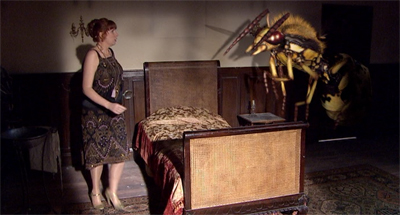
A sting in the tale...

A sting in the tale…

Continue reading

Doctor Who: The Doctor’s Daughter (Review)

To celebrate the fiftieth anniversary of the longest-running science-fiction show in the world, I’ll be taking weekly looks at some of my own personal favourite stories and arcs, from the old and new series, with a view to encapsulating the sublime, the clever and the fiendishly odd of the BBC’s Doctor Who.

The Doctor’s Daughter originally aired in 2008.

Not what you’d call a natural parent, are you?

They stole a tissue sample at gunpoint and processed it. It’s not what I call natural parenting.

Rubbish. My friend Nerys fathered twins with a turkey baster. Don’t bother her.

You can’t extrapolate a relationship from a biological accident.

Er, Child Support Agency can.

– Donna and the Doctor discussing parenting

The Doctor’s Daughter is the weakest script of the fourth season. It’s just a mess of high concepts and ideas and in-jokes mashed together and then cut down to fit into a forty-five minute time slot. It’s a fundamentally flawed episode that has some meritorious elements, but a whole host of other ingredients that just fall flat. It’s the speed bump in the fourth season of the show, Russell T. Davies’ final season of Doctor Who, which had started out of the gate so very strong.

I suppose the real positive of The Doctor’s Daughter is that it doesn’t cause too much damage as it stumbles.

The ball's in his court...

The ball’s in his court…

Continue reading

Doctor Who: The Poison Sky (Review)

To celebrate the fiftieth anniversary of the longest-running science-fiction show in the world, I’ll be taking weekly looks at some of my own personal favourite stories and arcs, from the old and new series, with a view to encapsulating the sublime, the clever and the fiendishly odd of the BBC’s Doctor Who.

The Poison Sky originally aired in 2008.

They’ve taken it. I’m stuck on Earth like, like an ordinary person. Like a human. How rubbish is that? Sorry, no offense, but come on.

– take that, Jon Pertwee!

Like The Sontaran Stratagem before it, The Poison Sky is pretty effective at accomplishing what it sets out to do. The first two-parter was always a troubled part of the Davies era, and so it feels strangely appropriate that the production team should manage to nail it on the fourth and final go-round. The Poison Sky isn’t the best episode of the show’s superlative fourth season, but neither it nor The Sontaran Stratagem are the worst, either. Instead, it’s a solidly entertaining feature-length adventure featuring the return of various old favourites from the classic show (U.N.I.T.! Sontarans!) and the revived series (Martha! the Valiant!).

It is goofy, silly, and fluffy, but it’s entertaining fluff.

His finger on the button...

His finger on the button…

Continue reading

Doctor Who: The Sontaran Stratagem (Review)

To celebrate the fiftieth anniversary of the longest-running science-fiction show in the world, I’ll be taking weekly looks at some of my own personal favourite stories and arcs, from the old and new series, with a view to encapsulating the sublime, the clever and the fiendishly odd of the BBC’s Doctor Who.

The Sontaran Stratagem originally aired in 2008.

Sontar-Ha!

– Sontaran hakka

The expectations for the opening two-parter of any Russell T. Davies season are markedly different from the expectations surrounding the second two-parter or even the season finalé – just as the expectations for the opening few episodes are different from the expectations for a mid-season stand-alone. It should go without saying, but it’s worth stressing at this point. The opening two-parter of a Davies season isn’t meant for the adults in the audience – it’s traditionally aimed towards the kids, with big epic iconic monsters, ridiculous set-pieces, broadly-defined settings and little room for nuance.

That’s not to excuses messes like World War III or Evolution of the Daleks, but simply to place them in context. The Sontaran Stratagem and The Poison Sky aren’t quite as profound or weighty as The Fires of Pompeii or Planet of the Ood. Instead, they offer bombastic spectacle, goofy visuals and a heightened sense of absolutely everything. In other words, The Sontaran Stratagem and The Poison Sky combine to form the strongest opening two-parter of the Davies era.

They hardly represent a crowning artistic accomplishment for the show, but they do a great job of accomplishing what they set out to do.

There's a potato eyes joke here, but I just can't make it work...

There’s a potato eyes joke here, but I just can’t make it work…

Continue reading