• Following Us

  • Categories

  • Check out the Archives


  • Awards & Nominations

Doctor Who: A Good Man Goes to War (Review)

To celebrate the fiftieth anniversary of the longest-running science-fiction show in the world, I’ll be taking weekly looks at some of my own personal favourite stories and arcs, from the old and new series, with a view to encapsulating the sublime, the clever and the fiendishly odd of the BBC’s Doctor Who.

A Good Man Goes to War originally aired in 2011.

Demons run when a good man goes to war.

Night will fall and drown the sun, when a good man goes to war.

Friendship dies and true love lies,

Night will fall and the dark will rise,

When a good man goes to war.

Demons run but count the cost.

The battle’s won, but the child is lost.

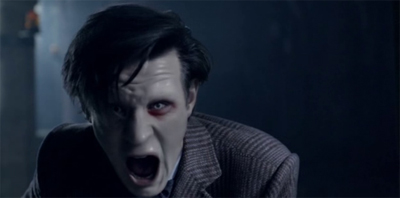
A Good Man Goes to War is pretty much the epitome of Moffat’s “let’s cram as much as possible into forty-five minutes” approach to Doctor Who. This is the episode directly following Matt Smith’s last proper two-part adventure, and it firmly sets the status quo for the rest of the Eleventh Doctor’s tenure. Moffat doesn’t opt for two-parters after this point, and you can see the roots of the “blockbuster” approach he adopted for the show’s fiftieth season.

A Good Man Goes to War has enough crammed into it to sustain a bombastic Russell T. Davies season finalé. There’s character arcs, betrayal, redemption, heroism, continuity, twists and radical game-changers – all bursting at the seams of this episode. There’s a staggering amount of ambition powering A Good Man Goes to War, and even attempting to do all this in the course of a single episode earns Moffat a significant amount of respect.

What’s even more impressive is that A Good Man Goes to War manages to carry it all off.
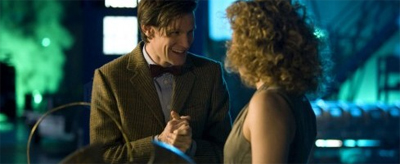
The Doctor goes with the flow…

Continue reading

Doctor Who: The Almost People (Review)

“How can you both be real?”

“Because we are.”

– Amy & the Doctor

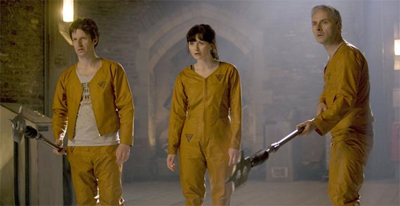
Hm. That was a vast improvement on last week. And I say that as someone who enjoyed last week’s episode a lot more than most. It’s very formulaic Doctor Who, with the team running around gothic corridors (“a maze,” as the Doctor describes it) and bright lights fleshing, while continuing the series’ key theme: as a race, humans can be absolutely horrible… but sometimes, just sometimes, absolutely brilliant. Throw in a fairly substantial cliffhanger and larger elements from the season-long mythos, and you end up with an episode that feels like it’s filled to the top. Not everything’s golden, and not everything gels, but it works consistently enough to make for entertaining tea-time telly.

Doppel!Doctor!

Continue reading

Doctor Who: The Rebel Flesh (Review)

I love Matthew Graham. After all, the writer who gave us Life on Mars is surely something of a British national treasure. however, his track record on Doctor Who seems just a little bit spottier, with his previous contribution being the somewhat… poorly received Fear Her way back at the end of the second season. So, perhaps giving Graham a two-parter, especially the two-parter directly before the cliffhanger before the break in the season might have seemed like a bit of a gambit. Fortunately, The Rebel Flesh is a much stronger entry than Fear Her, even if it’s not quite as spectacular as last week’s episode.

Flesh and bone?

Continue reading

Doctor Who: The Doctor’s Wife (Review)

“Are all people like this?”

“Like what?”

“So much bigger on the inside.”

– TARDIS and the Doctor

That was awesome. Neil Gaiman’s Doctor Who episode, The Doctor’s Wife, was perhaps the strongest stand-alone episode the series has had in quite some time – packed to the brim with wonderful and cheeky and clever concepts, executed in wonderful style. It had just about everything, from small fanboy-ish references (“the old control room”) through to clever explorations of the ideas the show takes for granted, managing to fit perfectly with what had come before and suggest some new takes on classic concepts at the same time.

The Smith-en young couple...

Continue reading

Doctor Who: The Curse of the Black Spot (Review)

Arriving just in time for the latest Pirates of the Caribbean movie (On Stranger Tides), Doctor Who has decided to go all pirate on us – even adopting the episode title The Curse of the Black Spot, to mirror The Curse of the Black Pearl. What we get feels genuinely like “Old School” Doctor Who, with the action confined to a very tight remote location, some corny (but effective) special effects and advanced technology masquerading as superstition. I suppose it was inevitable that a “monster of the week” episode would feel like a bit of a letdown after the superb Day of the Moon, but – while fun – The Curse of the Black Spot never really feels essential.

Not quite a wash-out...

Continue reading

Doctor Who: Day of the Moon (Review)

“No, it’s not Apollo 11. That would be silly. It’s Neil Armstrong’s foot.”

– The Doctor discusses his secret weapon

Well, that was fun. Reportedly, Steven Moffat stated that he wanted the season-opening two-parter to feel like a big season finale, with epic scale, huge stakes and genuine consequences, and – to be frank – I think he accomplished it. Perhaps Day of the Moon leaves just a little bit too much hanging for my own personal taste, but it’s still an exciting and fun conclusion to this story arc.

Spaced out...

Continue reading

Doctor Who: The Impossible Astronaut (Review)

To celebrate the fiftieth anniversary of the longest-running science-fiction show in the world, I’ll be taking weekly looks at some of my own personal favourite stories and arcs, from the old and new series, with a view to encapsulating the sublime, the clever and the fiendishly odd of the BBC’s Doctor Who.

The Impossible Astronaut originally aired in 2011.

Rory, would you mind going with her?

Yeah, a bit.

Then I appreciate it all the more.

– The Doctor and Rory

While Steven Moffat’s first season as showrunner followed the same basic format as the seasons run by Russell T. Davies, his second up-ends that. Viewers had become so conditioned to that structure that The Impossible Astronaut proves quite a shock. Far from an accessible and enjoyable romp in the style of Rose or New Earth or Smith & Jones or Partners in Crime or The Eleventh Hour, The Impossible Astronaut jumps right into the middle of things.

Taking advantage of the fact that this is the first time since New Earth (and only the second time in the revival) that a season premiere hasn’t been burdened with the weight of introducing a new Doctor or companion, Moffat is able to really mess up the structure of the season. Indeed, you might go so far as to suggest that he’s reversed it. Moffat’s second season ends with a one-part adventure that introduces us to a new era and new mission statement, but opens with a bombastic two-part climax.

It’s certainly ambitious.

Cowboys and aliens…

Continue reading

A Matter of Time – Doctor Who: Season 5

Sorry… Sorry! Dropped it!

Hello, Stonehenge! Who takes the Pandorica, takes the universe. But bad news everyone… cause guess who! Listenw you lot, cause you’re all whizzing about – it’s really could distracting. Could you all just stay still for a minute? Because I. am. talking!

Now, question of the hour: who’s got the Pandorica? Answer: I do. Next question: who’s coming to take it from me?

C’mon!

Look at me: no plan, no backup, no weapons worth a damn – oh, and something else I don’t have? Anything to lose! So if you’re sitting up there in all your silly little spaceships with your silly little guns and you’ve got any plans on taking the Pandorica tonight, just remember who’s standing in your way; remember every black day I ever stopped you; and then – and then! – do the smart thing: let somebody else try first.

– The Doctor, The Pandorica Opens

Well, the first season of Stephen Moffat’s run of Doctor Who is over. And what a ride it was. On one hand, you had budget cuts at the BBC, putting an even great financial strain on the show’s transition to high definition, the first wholsecale chance of the entire cast between seasons since the show’s transition to colour in 1970 (and, fittingly, this was the show’s transition to high definition), and you had the World Cup skewing ratings towards the backend of the season. On the other hand, you had the writer of some of the show’s best episodes directing the entire run behind the scenes, the exploration of the time travelling nature of the central protagonist, and a blatant admission that the show is more a fairytale than a science fiction epic. And along the way, there was barely enough time to catch your breath.

No time to lose...

Continue reading