• Following Us

  • Categories

  • Check out the Archives


  • Awards & Nominations

Doctor Who: The Poison Sky (Review)

To celebrate the fiftieth anniversary of the longest-running science-fiction show in the world, I’ll be taking weekly looks at some of my own personal favourite stories and arcs, from the old and new series, with a view to encapsulating the sublime, the clever and the fiendishly odd of the BBC’s Doctor Who.

The Poison Sky originally aired in 2008.

They’ve taken it. I’m stuck on Earth like, like an ordinary person. Like a human. How rubbish is that? Sorry, no offense, but come on.

– take that, Jon Pertwee!

Like The Sontaran Stratagem before it, The Poison Sky is pretty effective at accomplishing what it sets out to do. The first two-parter was always a troubled part of the Davies era, and so it feels strangely appropriate that the production team should manage to nail it on the fourth and final go-round. The Poison Sky isn’t the best episode of the show’s superlative fourth season, but neither it nor The Sontaran Stratagem are the worst, either. Instead, it’s a solidly entertaining feature-length adventure featuring the return of various old favourites from the classic show (U.N.I.T.! Sontarans!) and the revived series (Martha! the Valiant!).

It is goofy, silly, and fluffy, but it’s entertaining fluff.

His finger on the button...

His finger on the button…

Continue reading

Doctor Who: The Green Death (Review)

To celebrate the fiftieth anniversary of the longest-running science-fiction show in the world, I’ll be taking weekly looks at some of my own personal favourite stories and arcs, from the old and new series, with a view to encapsulating the sublime, the clever and the fiendishly odd of the BBC’s Doctor Who.

The Green Death originally aired in 1973.

Where are you off to?

To pack a suitcase.

Oh, good. Give me a couple of minutes and we’ll be off.

Off? Off where?

Well, Metebelis III, of course.

I’m not going to Metebelis III.

Why? Where are you thinking of going to?

Well, South Wales, of course. Llanfairfach.

– the Doctor and Jo discuss travel plans… why would you want to go to Metebels III when you can visit South Wales?

The Green Death is a great example of the Jon Pertwee era. It offers a pretty solid showcase of the best of the era, along with the glaring structural and thematic weaknesses that the show never really tackled head-on. It’s a great yarn, an affectionate run-around. There is a reason, after all, that the overgrown maggots have managed to wedge themselves in British popular consciousness. There’s a conscious sense that The Green Death is a season finalé, in the biggest and boldest terms possible.

In an era where television wasn’t really structured in that way, you can trace a pretty clear line between The Green Death and the big epic series finalés of the Russell T. Davies era of Doctor Who.

And the Beatz go on...

And the Beatz go on…

Continue reading

Doctor Who: Army of Ghosts (Review)

To celebrate the fiftieth anniversary of the longest-running science-fiction show in the world, I’ll be taking weekly looks at some of my own personal favourite stories and arcs, from the old and new series, with a view to encapsulating the sublime, the clever and the fiendishly odd of the BBC’s Doctor Who.

Army of Ghosts originally aired in 2006.

How long are you going to stay with me?

Forever.

– the Doctor and Rose tempt fate

It’s only logical that anybody diving head-first into a fifty-year-old television show is going to have an opinion that radically diverges from the fandom consensus on a couple of stories. So, for example, I’ll concede that I like The Talons of Weng-Chiang, but less than most. However, the biggest divide – and the point on which I feel furthest from consensus – comes with Army of Ghosts and Doomsday, Russell T. Davies’ massive farewell to Rose Tyler, the companion he introduced all the way back in Rose. It’s generally acknowledged as one of the high points of Davies’ tenure and one of the truly great Tenth Doctor stories.

I am far from convinced.

The cracks are starting to show...

The cracks are starting to show…

Continue reading

Doctor Who: The Last of the Time Lords (Review)

To celebrate the fiftieth anniversary of the longest-running science-fiction show in the world, I’ll be taking weekly looks at some of my own personal favourite stories and arcs, from the old and new series, with a view to encapsulating the sublime, the clever and the fiendishly odd of the BBC’s Doctor Who.

The Last of the Time Lords originally aired in 2007.

I just need you to listen.

No, it’s my turn. Revenge!

– the Doctor and the Master

I like quite a lot of The Last of the Time Lords. I think, for example, that Russell T. Davies does an exceptional job creating a version of the Master that manages to remain true to the character’s pantomime roots, while also seeming a credible threat and dark mirror to the Doctor. I also think that Martha’s character arc has a fairly logic and fluid conclusion. On the other hand, there’s a great deal about the resolution to The Last of the Time Lords that feels a bit rushed, a bit convenient, a bit tidy.

I’m quite fond of Davies’ writing style, but I’ll concede that he tends to favour theme and character over plot and structure. The Last of the Time Lords does an excellent job illustrating this, providing a bunch of fascinating thematic and character-based moments, but positioning them in a plot that doesn’t really work.

You know, for once I actually feel sorry for the Master...

You know, for once I actually feel sorry for the Master…

Continue reading

Doctor Who: The Sound of Drums (Review)

To celebrate the fiftieth anniversary of the longest-running science-fiction show in the world, I’ll be taking weekly looks at some of my own personal favourite stories and arcs, from the old and new series, with a view to encapsulating the sublime, the clever and the fiendishly odd of the BBC’s Doctor Who.

The Sound of Drums originally aired in 2007.

Doctor.

Master.

I like it when you use my name.

You chose it. Psychiatrist’s field day.

As you chose yours. The man who makes people better. How sanctimonious is that?

– the Doctor and the Master

The Sound of Drums is really more interesting than it is successful. Building off Utopia as the second part of a three-part finalé, building the longest single story in the revived Doctor Who, The Sound of Drums does an excellent job moving the characters along and getting everything where it needs to be for the requisite cliffhanger. Unfortunately, Davies’ weaknesses when it comes to plotting are at play here. While Utopia took advantage of a leisurely pace and conventional plot in order to do some nice set-up, The Sound of Drums doesn’t have that luxury. Utopia came out of left-field, with the last ten minutes taking the audience by surprise. Now the audience knows the game is afoot, so the rules have changed.

The Sound of Drums kicks off with everything in full swing, and Davies has to ratchet up the tension from there. The result is that Davies does solid character work, but that the plot points and set-ups occasionally feel a bit forced. That’s especially true when it comes to the ideas that will be important to the resolution of The Last of the Time Lords.

The End of the World... oh, wait, we already did that one...

The End of the World… oh, wait, we already did that one…

Continue reading

Doctor Who: Rise of the Cybermen (Review)

To celebrate the fiftieth anniversary of the longest-running science-fiction show in the world, I’ll be taking weekly looks at some of my own personal favourite stories and arcs, from the old and new series, with a view to encapsulating the sublime, the clever and the fiendishly odd of the BBC’s Doctor Who.

Rise of the Cybermen originally aired in 2006.

Delete. Delete.

– the moment the Cybermen realise they are second-rate Daleks

I’ll freely concede that I am sceptical of the Cybermen. Okay, that’s not fair. I actually really like the early Cybermen stories. However, it seems like Doctor Who really forgot how the Cybermen worked when it turned them into a recurring “once per Doctor” sort of threat. However, they are part of the show’s iconography. The image of the Cybermen marching down the steps of St. Paul’s Cathedral from The Invasion is important enough to earn them a sacred place in the show’s history.

So the return of the Cybermen was inevitable, even before we caught a glimpse of one of their silly helmets in Dalek. Russell T. Davies has generally done a great job revitalising old concepts for the revived series, so Rise of the Cybermen has that in its corner. Unfortunately, I’m not convinced that Rise of the Cybermen approaches anything resembling the quality of Dalek, and I think that Rise of the Cybermen manages the rare feat of turning most of Davies’ strengths into weaknesses.

March of the Cybermen...

March of the Cybermen…

Continue reading

Doctor Who: The Vampires of Venice (Review)

To celebrate the fiftieth anniversary of the longest-running science-fiction show in the world, I’ll be taking weekly looks at some of my own personal favourite stories and arcs, from the old and new series, with a view to encapsulating the sublime, the clever and the fiendishly odd of the BBC’s Doctor Who.

The Vampires of Venice originally aired in 2010.

Tell me the whole plan!

One day that will work.

– the Doctor

The Vampires of Venice is interesting because it looks very different in 2013 as compared to when it was originally broadcast in 2010. In 2010, it looked a bit overly familiar, a collection of the tropes and storytelling tricks that we took for granted in the show under Russell T. Davies. The elements felt, at the time, a little over-familiar. Indeed, it seemed like Toby Whithouse’s script owed a great deal to his earlier adventure School Reunion.

However, Doctor Who looks very different in 2013. The show has definitely radically changed, so that these familiar plot points don’t seem quite so familiar any longer. Whereas The Vampires of Venice didn’t feel so strange after five years of Russell T. Davies, it does seem a bit more unique after three years of Steven Moffat. It doesn’t seem so much an attempt to repackage these story elements as it does one final celebration of them, a fond farewell to many of the narrative bits and pieces that we’d come to take for granted.

How times change.

A late-night bite...

A late-night bite…

Continue reading

Doctor Who: Tooth and Claw (Review)

To celebrate the fiftieth anniversary of the longest-running science-fiction show in the world, I’ll be taking weekly looks at some of my own personal favourite stories and arcs, from the old and new series, with a view to encapsulating the sublime, the clever and the fiendishly odd of the BBC’s Doctor Who.

Tooth and Claw originally aired in 2006.

I want her to say “we are not amused.” I bet you five quid I can make her say it.

Well, if I gambled on that, it’d be an abuse of my privileges of traveller in time.

Ten quid?

Done.

– Rose and the Tenth Doctor are “cute”

There’s something quite interesting at the heart of Tooth and Claw, which might be the best  “historical celebrity + monster” mash-up of the Davies era. It’s a wonderful pulpy genre hybrid run-around with Queen Victoria, ninja monks and a werewolf, but it’s also a quite interesting vehicle to explore the way that the show deals with historical characters. After all, Queen Victoria is a British icon, a monumentally important part of the British Empire. It would be tempting to reduce her to a bunch of catch-phrases and a stiff upper lip. It’s a testament to Davies as a writer that he can flesh her out a fully-drawn character.

However, there does seem to be something quite strange about a show that opens with a cheap shot at Margaret Thatcher only to wallow in the iconic status of Queen Victoria.

This year's Bad Wolf is in Torchwood...

This year’s Bad Wolf is in Torchwood…

Continue reading

Doctor Who: The Unquiet Dead (Review)

To celebrate the fiftieth anniversary of the longest-running science-fiction show in the world, I’ll be taking weekly looks at some of my own personal favourite stories and arcs, from the old and new series, with a view to encapsulating the sublime, the clever and the fiendishly odd of the BBC’s Doctor Who.

The Unquiet Dead originally aired in 2005.

What the Shakespeare is going on?

– Charles Dickens

It feels appropriate that Mark Gatiss should script the first episode of the revived Doctor Who not written by Russell T. Davies himself. Davies wrote the bulk of the first season’s thirteen episodes, and you could argue that he occasionally spread himself a bit too thin. However, I would argue that the first year of the revived show also had the strongest string of secondary writers on the bench, including Rob Shearman writing Dalek, Steven Moffat writing The Empty Child and The Doctor Dances, Paul Cornell writing Father’s Day and Gatiss writing The Unquiet Dead.

Gatiss and Moffat are two of the most prolific writers for the new series, with Moffat even succeeding Davies as showrunner. It’s also worth noting that both Gatiss and Moffat are fans of the classic show with considerable writing experience in television. It’s very clear that Davies isn’t just recruiting fans of the classic show, even those who may have written material while it was off the air (Gatiss wrote spin-off novels, Moffat wrote The Curse of Fatal Death), but recruiting those with practical experience about how television today works.

And that was a very shrewd decision.

Ghosts of Cardiff...

Ghosts of Cardiff…

Continue reading

Doctor Who: The Parting of the Ways (Review)

To celebrate the fiftieth anniversary of the longest-running science-fiction show in the world, I’ll be taking weekly looks at some of my own personal favourite stories and arcs, from the old and new series, with a view to encapsulating the sublime, the clever and the fiendishly odd of the BBC’s Doctor Who.

The Parting of the Ways originally aired in 2005.

Everything must come to dust. All things. Everything dies. The Time War ends.

– Rose

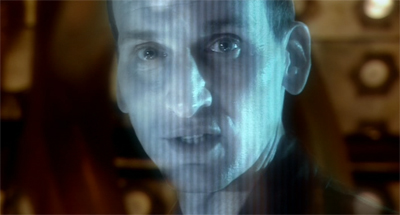
And so the first season of Russell T. Davies’ revived Doctor Who comes to a close. If you asked me, it’s the best season of the show that Davies has produced. The year contains a few clunkers, and it doesn’t contain the highest concentration of enjoyable episodes, but I think the first year has a much clearer direction and purpose than any of the years that followed. Although apparently Christopher Eccleston’s departure was only decided after the show went into production, the first season seems like it is constantly building to the death of the Doctor. The entire first season seems to build, logically and rationally, towards that moment.

He's not all there...

He’s not all there…

Continue reading