• Following Us

  • Categories

  • Check out the Archives


  • Awards & Nominations

Grant Morrison’s Seven Soldiers of Victory: The Guardian (Review)

December is “Grant Morrison month” here at the m0vie blog, as we take the month to consider and reflect on one of the most critically acclaimed (and polarising) authors working in the medium. We’ve got a special treat for you this week, which is “Seven Soldiers Week”, so check back each day for a review of one of the Seven Soldier miniseries that Morrison put together.

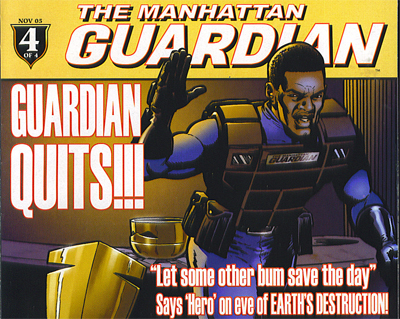
The Guardian really just gives Grant Morrison a chance to play with a whole bunch of high concept crazy ideas inside a loose superhero framework, while allowing the scribe to play with various outmoded comic book concepts. Of course, there are elements of that within the other stories (and, to be frank, within most other major superhero titles the author has ever written), but The Guardian stands out amongst these Seven Soldiers of Victory miniseries as perhaps the most “Morrison-esque” of them.
Making headlines...

Continue reading

Grant Morrison’s Seven Soldiers of Victory: The Bulleteer (Review/Retrospective)

December is “Grant Morrison month” here at the m0vie blog, as we take the month to consider and reflect on one of the most critically acclaimed (and polarising) authors working in the medium. We’ve got a special treat for you this week, which is “Seven Soldiers Week”, so check back each day for a review of one of the Seven Soldier miniseries that Morrison put together.

There’s a whole class of people in hospital wards, Mrs. Harrower, people who’d do just about anything to hang out with the skintight crowd. They expose themselves to radioactive materials or drink home-made potions… They interact with venomous insects and dangerous animals in the expectation of receiving some totem power.

There’s not a lot of sympathy among medical staff who have to clean up the mess.

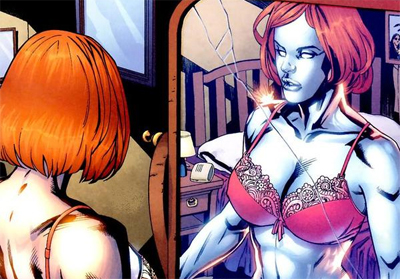
The Bulleteer is a wonderful deconstruction of the superhero world we see so often reflected in the comics of Marvel and DC. These characters were created decades ago, in a different world. Writing elsewhere last year, I wondered if the very concept of a secret identity is outdated, a genre convention which doesn’t reflect the modern world. Clark Kent is a modest cover for Superman, a creation which afford him the opportunity to pretend to be normal, a humble camouflage that seemed perfectly quaint in the thirties. These days, I wonder if people would even bother. After all, in this era of instant celebrity and reality television, with the entire world aspiring to become “special”, why would you ever want to be normal?

What happens when the shine comes off?

Continue reading

Grant Morrison’s Run on Batman – Time & The Batman (Review)

December is “Grant Morrison month” here at the m0vie blog, as we take the month to consider and reflect on one of the most critically acclaimed (and polarising) authors working in the medium. Every Wednesday this month, we’ll have a Grant Morrison related review or retrospective.

I have, I’m not entirely ashamed to admit, grown quite fond of Grant Morrison’s run on Batman. Despite the fact I’m still not overly fond of Batman R.I.P., I really appreciated The Return of Bruce Wayne and Batman & Robin was perhaps the most fun I’ve had reading comics in quite a long time. So I found myself somewhat underwhelmed by Time and the Batman, collecting Morrison’s work on Batman #700 and the two-issue follow-up that served to make explicit the ties between Batman R.I.P. and Final Crisis. It’s not that the book isn’t packed with ideas or even that it’s quite short. I think it’s more that Morrison seems to spend a lot of time here providing exposition and filling in information that perhaps couldn’t fit elsewhere in this tapestry.

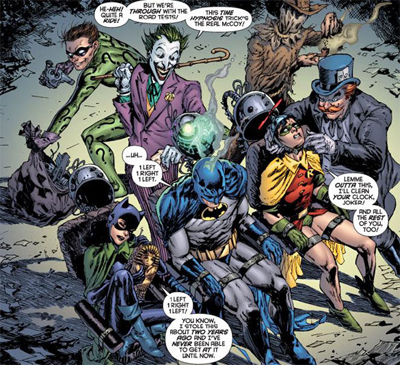
Joker puts the gang back together…

Continue reading

The Adventures of Tintin: The Broken Ear (Review)

To celebrate the release of The Adventures of Tintin: The Secret of the Unicorn in the United States later this month, I’ll be taking a look at some of nineties animated television show. Check back daily!

Note: This is our review of the animated episode, check out our review of the book here.

I have to admit, I was curious about how the animated series would handle some of the more political material Hergé inserted into his work. I admired the way that Cigars of the Pharaoh handled international drug smuggling, but I suspected that broad political satire set in a banana republic might catch some viewers completely off guard. And, to be honest, there’s a lot of other stuff in Hergé’s The Broken Ear that makes it one of the tougher stories to adapt as a cartoon adventure. It’s very close to farce, and while the cartoon acknowledges that this business is a little sillier than usual, it never feels like the episode fully embraces the story it’s trying to tell, instead settling for a fairly generic run-around featuring characters and locales from the origin story.

Spotlight on the fetish...

Continue reading

Mike Carey’s Run on Ultimate Fantastic Four – Vol. 4-6 (Hardcover) (Review/Retrospective)

Celebrating the 50th anniversary of the Fantastic Four, I’m taking a look at some of the stories featuring the characters over the past half-century.

Ultimate Fantastic Four was never really the crown jewel of the Ultimate line. It wasn’t ever as consistent as Brian Michael Bendis’ 100+ issues on Ultimate Spider-Man, nor as zeitgeist-y as Ultimate X-Men (which had the success of the X-Men trilogy to back it up at least). Instead, like Fox’s Fantastic Four movies, Ultimate Fantastic Four was just… well, just kinda there, really. To be fair, I dug Mark Millar’s twelve-issue run on the title. Hell, I even enjoyed elements of the opening arc by Millar and Bendis, and the year-long run by Warren Ellis that followed. However, Mike Carey’s run is somewhat disappointing. This was the run which essentially saw the series through to the big Ultimatum event, and perhaps it justified the decision to clean the slate when it came to Marvel’s Ultimate line. Because, whatever Carey’s run was, it certainly wasn’t consistently fantastic.

That surfer dude looks spaced...

Continue reading

Fantastic Four by John Byrne Omnibus (Review/Retrospective)

Celebrating the 50th anniversary of the Fantastic Four, I’m taking a look at some of the stories featuring the characters over the past half-century.

John Byrne’s Fantastic Four run is pretty major as Marvel comic book runs go. It’s generally regarded to be one of the better comic book runs of the eighties, alongside Frank Miller’s Daredevil and Walt Simonson’s Thor, but it’s also widely regarded as the best run on Marvel’s flagship family since Stan Lee and Jack Kirby finished their record-setting run establishing both the series and the shared Marvel Universe. (The length of the run has since been surpassed, appropriately enough, by Brian Michael Bendis and Mark Bagley on Ultimate Spider-Man.) This was my first time reading the run, which has received the massive omnibus treatment from Marvel. I have to admit, while not quite blown away by it, I was remarkably impressed by the love and craftsmanship that Byrne poured into the run. I wouldn’t class it as iconic or genre-defining, but it’s a remarkably solid examination of the franchise that launched the Marvel Universe.

Fantastic!

Continue reading

Mark Waid’s Run on the Fantastic Four – Vol. 1-3 (Hardcover) (Review/Retrospective)

Celebrating the 50th anniversary of the Fantastic Four, I’m taking a look at some of the stories featuring the characters over the past half-century.

The Fantastic Four helped launch Marvel to publishing greatness over the 100+ issues drafted by Stan Lee and Jack Kirby, but they’ve seldom occupied a prominent place in their publishing line-up since that dramatic introduction. Sure, the title earned a place as one of the three Ultimate on-going titles (at least before Ultimatum) and sure, there were occasionally hugely successful and iconic runs like that of John Byrne, but these were the exception rather than the rule. The title never really reached a stage like the X-Men, Spider-Man or even Avengers books (in modern Marvel), where they were clearly the title to watch. While I’m not entirely convinced he succeeded, Mark Waid is consciously trying to find a definitive approach to the title. And I respect that.

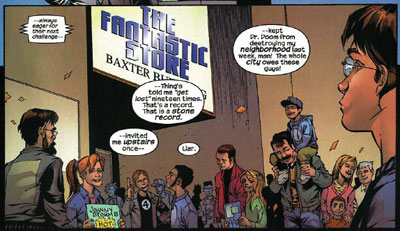
The adoring public…

Continue reading

Is Captain Haddock the Ultimate Hero of Hergé’s Tintin?

I think it’s safe to agree that Captain Archibald Haddock was the breakout character of Hergé’s The Adventures of Tintin. Introduced in The Crab With the Golden Claws, one of three adventures to form the basis of Spielberg’s The Adventures of Tintin: The Secret of the Unicorn, Haddock has rarely been absent from the series in the time that followed. Indeed, Hergé even went back and wrote him into the end of a story (The Land of Black Gold) that he began before Haddock was even created. Haddock’s appeal seems to be incredible, with the blue-turtleneck-wearing sea-captain almost as iconic as Tintin and Snowy. Returning to the series for the first time in years, as the release of the new movie approaches, I couldn’t help but wonder if Haddock was the real hero of the series.

He'll never desert Tintin...

Continue reading

Tintin: The Calculus Affair (Review)

In the lead-up to the release of The Adventures of Tintin: The Secret of the Unicorn, I’m going to be taking a look at Hergé’s celebrated comic book character, from his humble beginnings through to the incomplete post-modern finale. I hope you enjoy the ride.

The Calculus Affair is an interesting little story that is one part suspense thriller, and another part mystery. In short, it’s almost the perfect cocktail to brew up a Cold War espionage thriller, which was exactly what Hergé was going for. It wouldn’t be too difficult to rework the adventure as a James Bond movie (in fact, it even features a sequence with our lead piloting a tank), but Hergé does a lot of work to ensure that the story never gets too heavily bogged down. Much like King Ottokar’s Sceptre, the story stands quite well as an examination of the time when it was written.

Another fine mess!

Continue reading

Tintin: Explorers on the Moon (Review)

In the lead-up to the release of The Adventures of Tintin: The Secret of the Unicorn, I’m going to be taking a look at Hergé’s celebrated comic book character, from his humble beginnings through to the incomplete post-modern finale. I hope you enjoy the ride.

The one thing I really admire about Explorers on the Moon is the fact that – for an adventure that takes the iconic boy reporter off te surface of the planet and launches him into outer space – it’s a remarkably low key affair. In fact, most of the book is devoted to nice character moments for the ensemble, and to explore some of the wonderful research Hergé did to put his story together. There’s no great mystery on the moon, none of the aliens that would later appear in Flight 714. Instead, Hergé seems to accept that launching his cast out of the planet’s atmosphere was enough of a radical deviation from the norm as it was. So what we get is a strange situation where Explorers on the Moon feels like one of the more grounded adventures in the series.

"Can you hear me, Major Tom?"

Continue reading