• Following Us

  • Categories

  • Check out the Archives


  • Awards & Nominations

The Amazing Spider-Man – The Gauntlet: The Vulture – Scavenging (Review)

This April, to celebrate the release of The Amazing Spider-Man 2, we are taking a look at some classic and modern comics featuring Spider-Man (and friends). Check back daily for the latest review.

The biggest problem with Scavenging is the villain.

The classic Vulture is admittedly a goof design, but – as with most of Steve Ditko’s villains – there’s an undeniable charm. With his silly “villainous green” colour scheme and the image of a super villain old enough to be collecting his pension, the classic Vulture sticks in the memory. Like so many of those classic Amazing Spider-Man bad guys, the Vulture has a sense of character that extends beyond his goofiness. (After all, Electro, Sandman and Mysterio are no less goofy in design.)

Feeding time...

Feeding time…

In contrast, the “new” Vulture featured in Scavenging feels decidedly generic. More animalistic, with a pinsir-like mouth and the ability to spew hot bile, the character is dressed in red – as if to suggest the classic costume design is more menacing in that colour. Introduced by Mark Waid in the 24/7 arc of Brand New Day, there nothing memorable at all about this version of the character, and he feels like an awkward fit for The Gauntlet, which traverses Spider-Man’s iconic selection of foes.

There is a reason that the character ended up as C-list fodder at the start of Greg Rucka’s Punisher run.
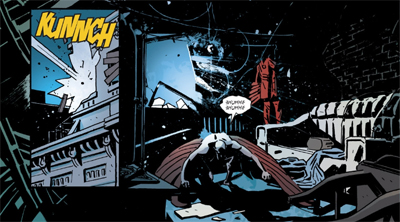
The Vulture has landed...

The Vulture has landed…

Continue reading

Non-Review Review: The Amazing Spider-Man II

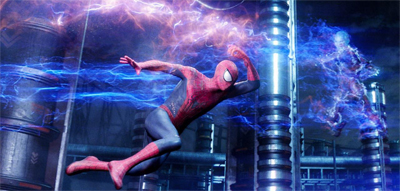
What is remarkable about Marc Webb’s The Amazing Spider-Man II is how much it resembles a comic book. Not a particular comic book – although there are numerous shout-outs to iconic Spider-Man moments, right down to the choice of costuming – but in general terms. It isn’t that Marc Webb tries to construct his film to evoke the look and feel of a comic book – this isn’t Ang Lee’s Hulk; in fact, Webb seems much more comfortable here than he was with The Amazing Spider-Man, making a movie that feels more playful and relaxed within its medium.

Instead, The Amazing Spider-Man II borrows the structure of a comic book. It offers its own story, but that story isn’t constructed particularly tightly. Instead, the story seems to have been fashioned as part of a greater – as if part of a larger serialised narrative that has yet to take form. It’s quite distinct from the approach taken with Marvel’s Cinematic Universe, where the films feel more like blocks that fit together. Instead, this feels more like the second chapter in a larger story, without being dissolved completely into the larger narrative.

The Amazing Spider-Man II has its own themes and motifs, and it documents a pretty epic selection of events, but the emphasis isn’t so much on this one encounter as what this encounter says about its hero. It’s much more interested in what these events tell us about our hero than it is in documenting a single self-contained story. It’s a novel (and somewhat bold) attempt at a serialised superhero narrative, and the results are absolutely fascinating.

Electro-fying!

Electro-fying!

Note: The Amazing Spider-Man II is probably best seen absolutely blind, with no real information about its themes or the story beats that it might hit. I do try to keep the reviews as spoiler-light as possible (and we do have a spoiler-laden review available for your perusal), but if you are interested in seeing the film – I would recommend avoiding any discussion or review. It is good, if flawed; endearingly ambitious and engagingly bold; it does a lot of great things that excuse some cliché plotting, sacrificing novelty in some areas for storytelling efficiency.

Continue reading

The Amazing Spider-Man – The Gauntlet: Morbius – It Is The Life (Review)

This April, to celebrate the release of The Amazing Spider-Man 2, we are taking a look at some classic and modern comics featuring Spider-Man (and friends). Check back daily for the latest review.

At a scant fourteen pages (sharing a single issue with a larger Flash Thompson story), It is the Life feels like something of an interlude in the large scheme of The Gauntlet. While most of the stories in the cycle are relatively short and contained (with nothing running over four issues), this is an exceptionally brief encounter between Spider-Man and one his older foes-turned-allies.

At the same time, writer Fred Van Lente manages to pile a lot into the fourteen pages of It is the Life, maintaining a wonderful thematic consistency across the line. Editor Stephen Wacker has done a wonderful job managing his team of “web-heads” and making sure that The Gauntlet remains internally consistent and on-point. Despite the diversity in talent working on the sprawling Spider-Man epic, it never feels like the larger threads get away from any of the writers.

Even a short fourteen-page interlude manages to hit on many of the event’s core themes.

What's at stake?

What’s at stake?

Continue reading

Andy Diggle’s Run on Daredevil – Shadowland (Review/Retrospective)

This April, to celebrate the release of The Amazing Spider-Man 2, we are taking a look at some classic and modern comics featuring Spider-Man (and friends). Check back daily for the latest review.

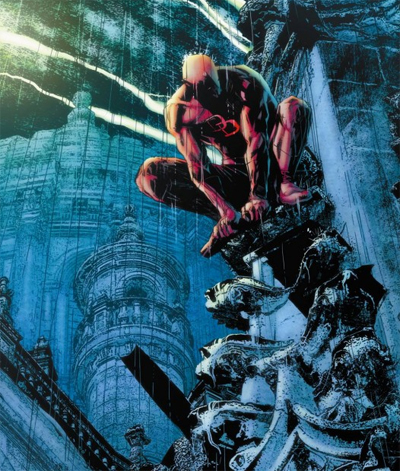
Shadowland is a disappointing climax to a wonderful decade of Daredevil. From the moment that Kevin Smith launched the second volume of the character through to the end of Ed Brubaker’s run, the Man Without Fear enjoyed a wonderfully consistent run of stories including runs from some of the best writers and artists working in comics, pushing the character in bold new directions and well outside his comfort zone.

Shadowland has a lot of problems, but the most obvious is that it betrays its central character. Matt Murdock is one of the most fascinating protagonists in comics, a proud (and occasionally arrogant) individual who might have the best of intentions but isn’t always able to make the right choices. Watching Murdock deal with his own mistakes and setbacks was a pretty compelling hook, as the comic pushed its protagonist into increasingly uncomfortable positions.

Unfortunately, the same cannot be said for Shadowland. Despite an interesting premise, it all falls apart when it decides that “a demon did it” is an acceptable explanation for Murdock’s latest errors in judgement.

Devilish delight?

Devilish delight?

Continue reading

The Amazing Spider-Man – The Gauntlet: Mysterio – Mysterioso (Review)

This April, to celebrate the release of The Amazing Spider-Man 2, we are taking a look at some classic and modern comics featuring Spider-Man (and friends). Check back daily for the latest review.

And so The Gauntlet circles around to writer Dan Slott and artist Marcos Martín. It really is impressive the talent that Marvel was able to draw to The Amazing Spider-Man as part of their Brand New Day. The comic was publishing several times a month, requiring rotating writers and artists to keep everything moving, with a strong editorial hand to guide the comic. Whatever one might say about the motivations and consequences of Brand New Day, it affirmed the idea that The Amazing Spider-Man was one of Marvel’s premier titles, featuring some incredible creative talent.

The Gauntlet is focused on the idea of re-working and re-engineering various classic Spider-Man bad guys. Both Power to the People and Keemia’s Castle stressed the idea that Spider-Man’s bad guys are really tragic figures – that there is something to pity in figures like Max Dillon or Flint Marko. With Mysterioso, Dan Slott and Marcos Martin focus on Mysterio, perhaps the least sympathetic bad guy featured as part of The Gauntlet. (The only real competition comes from either the new Rhino or the Lizard, if you separate him from Curt Connors.)

"Mister Spider-Man, I've been expecting you..."

“Mister Spider-Man, I’ve been expecting you…”

Far from a tragic figure trapped by circumstance, Slott positions Mysterio as a arch-criminal-as-artisté – a character who not only revels in the crime that he causes, but also the psychological damage he inflicts. He is a super villain who considers the entire world to be his set, staging elaborate set-pieces for nothing beyond his own amusement. There’s no fractured psyche here, no familial love, no excuse. Mysterio is a character who simply enjoys what he does. It doesn’t add much depth to the character, even if it is great fun.

And yet, despite this, Slott manages to make Mysterioso something of an encapsulation of the themes of The Gauntlet. This is the first time in the epic that Spider-Man’s “no kill rule” is discussed and stressed, and a story that emphasises that Spider-Man’s unique brand of heroism is about enduring the impossible without being corrupted by it. As such, it feels like Slott is really codifying some of the rules of this epic. Mysterioso skilfully closes out the first third of The Gauntlet, confirming what lies ahead.

All bets are off...

All bets are off…

Continue reading

The Amazing Spider-Man – The Gauntlet: Sandman – Keemia’s Castle (Review)

This April, to celebrate the release of The Amazing Spider-Man 2, we are taking a look at some classic and modern comics featuring Spider-Man (and friends). Check back daily for the latest review.

As much as The Gauntlet might seem to be a single over-arching story stretched across eight months of The Amazing Spider-Man, it really makes more sense a collection of smaller stories grouped together exploring the same core themes and ideas. There’s very little to directly connect Keemia’s Castle to the large plot in The Gauntlet. In many respects, this is just a typical confrontation between Spider-Man and recurring opponent Flint Marko.

On the other hand, it plays beautifully into the themes of the larger event, offering a glimpse at how desperate situations can push people to desperate decisions and how sometimes it’s possible to win without a sense of accomplishing anything. It also manages a pretty clever re-working and reinvention of a classic Spider-Man foe, doing a much better job at re-purposing the Sandman than Power to the People did with Electro.

A cold heart...

A cold heart…

Continue reading

The Amazing Spider-Man – The Gauntlet: Electro – Power to the People (Review/Retrospective)

This April, to celebrate the release of The Amazing Spider-Man 2, we are taking a look at some classic and modern comics featuring Spider-Man (and friends). Check back daily for the latest review.

Trying to channel Batman while writing Spider-Man is a risky business. The two characters are iconic – each can make a credible claim to be the most iconic character at their publisher, and perhaps the most iconic superhero ever. Both have imprinted themselves on the public consciousness; both have enjoyed multiple iterations across cartoons and movies; both have iconic stories and popular runs, as well as bucket loads of merchandise; both have truly wonderful supporting casts.

However, trying to use Spider-Man to evoke Batman is a risky move. You can end up with a mess like Spider-Man: Reign, demonstrating that the dark cynicism many associate with the Caped Crusader does not translate to the wall-crawling web-head. Alternatively, you get a sense that what makes Peter Parker unique and appealing is being crushed in a desire to fit a round peg in a square hole, like with The Amazing Spider-Man.

Shocking...

Shocking…

That said, The Gauntlet is a pretty spectacular Spider-Man story, one only enhanced by its similarities to the iconic Batman saga Knightfall. It’s a massive sprawling epic that seems to have been written with those comparisons in mind, with the writing staff very cleverly using the story as a springboard to emphasise the differences between Spider-Man and Batman. The Gauntlet, like Knightfall, is fundamentally a story about trying to break the central character a sinister new adversary launches a sustained assault using a collection of classic baddies.

However, The Gauntlet serves as an argument that Peter Parker can never be completely consumed by darkness. Even in his darkest hours, even when the story twists in a way that it really shouldn’t, there is an inherent optimism and reserve of strength and hope that keeps Spider-Man from tipping completely into the abyss. The entire Knightfall saga is about Batman clawing his way back from the abyss. The Gauntlet is about how Spider-Man really can’t be pushed into that abyss in the first place.

Swinging into action...

Swinging into action…

Continue reading

Rick Remender’s Venom (Review/Retrospective)

This April, to celebrate the release of The Amazing Spider-Man 2, we are taking a look at some classic and modern comics featuring Spider-Man (and friends). Check back daily for the latest review.

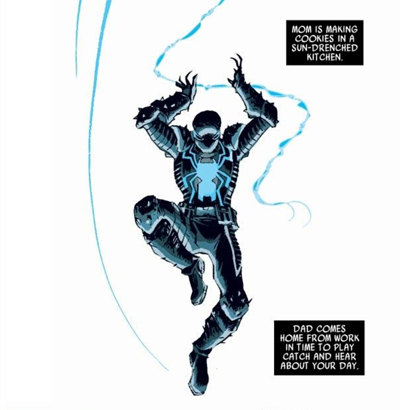
Venom demonstrates Rick Remender’s talent with nineties comic concepts. Like Remender’s work on Uncanny X-Force, there’s a sense that the author is taking a dysfunctional and somewhat outdated comic book concept and finding a way to make it work. Uncanny X-Force is the best use of the “X-Force” concept ever put on paper, and Remender’s Venom stands out as the best work to feature the Spider-Man baddie as a protagonist.

Venom doesn’t work quite as well as Uncanny X-Force. The run is a bit shorter and less well developed, and gets caught in a couple of crossovers that split focus a little. Still, the twenty-odd-issue run is a fascinating piece of work from Remender, who was one of Marvel’s most promising emerging talents at the time. Like Uncanny X-Force, it is fundamentally a story about fathers and sons. However Venom also feels like an examination of also-rans, a look at those characters who tend to get a little lost in the crossfire.

Can he swing from a web?

Can he swing from a web?

Continue reading

Andy Diggle’s Run on Daredevil (Review/Retrospective)

This April, to celebrate the release of The Amazing Spider-Man 2, we are taking a look at some classic and modern comics featuring Spider-Man (and friends). Check back daily for the latest review.

One of the most remarkable things about Daredevil was how consistent the quality of the title had been. Andy Diggle inherited Daredevil at the height of its popularity. Ed Brubaker’s Daredevil was well-loved and enjoyed, climaxing on a celebratory 500th issue. Brubaker had come on after Brian Michael Bendis’ much-lauded run on the title. The two are considered among the best writers to work on the character since Frank Miller redefined the Man Without Fear. Diggle was succeeded by Mark Waid, who has made a reinvigoured and nostalgic Daredevil into one of Marvel’s best-reviewed and best loved books.

These are all great runs. Andy Diggle’s Daredevil run is not well-remembered. Diggle essentially wrote twelve issues of the main title, and almost the same number of crossover tie-ins, miniseries and one-shots. Whereas those other successful runs of Daredevil existed with their own space and freedom, Diggle’s Daredevil was very much event-driven. The big moment in all of Diggle’s Daredevil writing is the street-level crossover event Shadowland. It’s a problematic event, and quite a few of those problems reverberate back into Diggle’s work on the main title.

And yet, despite that, what’s most frustrating about Diggle’s Daredevil run is that it really could (and should) have been so much better.

The Devil you know...

The Devil you know…

Continue reading

Spider-Man: Reign (Review/Retrospective)

This April, to celebrate the release of The Amazing Spider-Man 2, we are taking a look at some classic and modern comics featuring Spider-Man (and friends). Check back daily for the latest review.

Spider-Man is not Batman.

This really should be self-evident, but it doesn’t seem to be. The biggest problem with Marc Webb’s The Amazing Spider-Man was that it wasted a lot of time telling audiences an origin story they all knew and had last seen a decade earlier. The second biggest problem was that the movie seemed to want to be a Batman film. There are a variety of tropes and conventions that work much better in a Batman story than they ever will in a Spider-Man story, and vice verse.

Unfortunately, The Amazing Spider-Man is far from the only Spider-Man story to make this mistake. Spider-Man: Reign, written and illustrated by Kaare Andrews, is essentially an attempt to use Spider-Man to tell another version of The Dark Knight Returns. It goes about as well as you might expect. (That is: not at all.)

Swinging through the night...

Swinging through the night…

Continue reading