• Following Us

  • Categories

  • Check out the Archives


  • Awards & Nominations

The X-Files (Topps) – Circle Game (Review)

This November (and a little of December), we’re taking a trip back in time to review the third season of The X-Files and the first (and only) season of Space: Above and Beyond.

There are any number of events that suggest The X-Files was on the cusp of exploding into a phenomenon. The show was spawning conventions and merchandise. It was becoming a hot property in international markets, moving from BBC 2 up to BBC 1 and then across to Sky. It was quickly becoming compelling water-cooler television. The first season had been lucky to avoid cancellation. The second season had rocketed up the ratings. The third was going to be a pretty big deal.

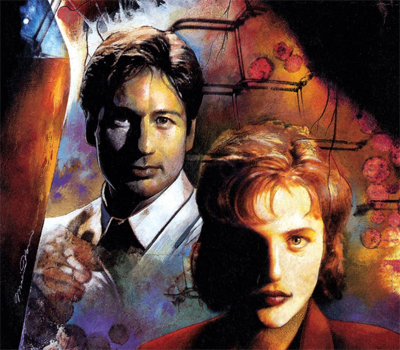
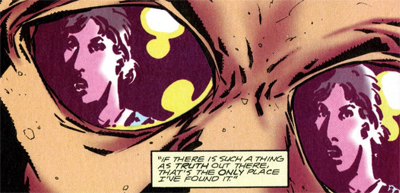
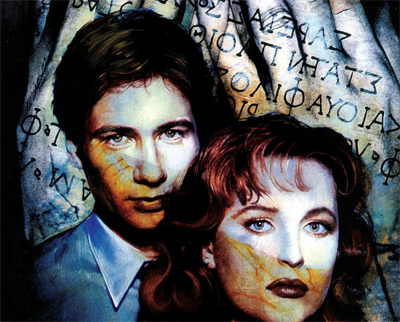
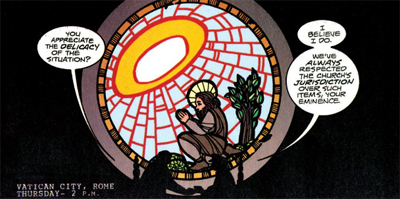
In light of all of this going on around it, a five-page comic doesn’t seem like that big a deal. Written by Stefan Petrucha and illustrated by Charles Adlard, Circle Game would almost seem as business-as-usual for Topps’ popular X-Files tie-in comic. The only significant difference was that Circle Game had been written and illustrated specifically for the July 15th issue of TV Guide. As part of their “stellar summer sci-fi issue!”, the magazine had given over five pages to Petrucha and Adlard to tell an entire X-Files story.
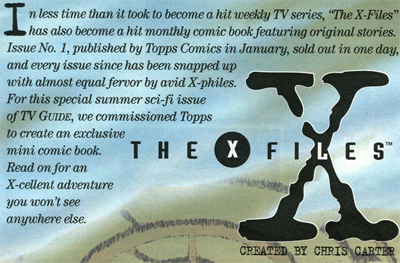
X marks the spot...

X marks the spot…

Even ignoring the narrative challenges posed by such an assignment, that’s a pretty big deal. Even in the age of the internet, time-shifted viewing and multi-channel television, TV Guide still has a circulation of over two million readers. To give a sense of scale, the biggest-selling contemporary comic books would have a readership of less than a tenth of that. To give it a more relevant sense of scale, the July 1995 issue of The X-Files comic book – the version on the stands at this point – sold approximately 72,000 copies.

All of this is just to stress that giving The X-Files comic book five pages of TV Guide was a pretty big deal.
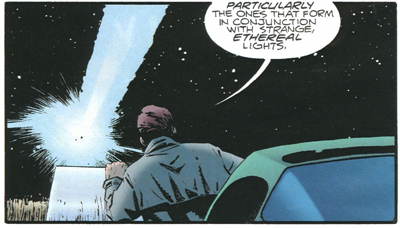
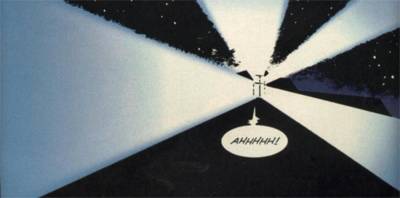
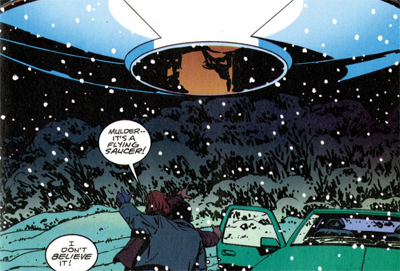
Lights in the sky...

Lights in the sky…

Continue reading

The Flash – Some Things You Can’t Outrun (Review)

So, I’m considering reviewing this season of The Flash, because the pilot looks interesting and I’ve always had a soft spot for the Scarlet Speedster. I’m also considering taking a storyline-by-storyline trek through the 1987-2009 Flash on-going series as a companion piece. If you are interested in reading either of these, please let me know in the comments.

The Flash is a show that can withstand a certain amount of cheese. After all, it is a television series about a character dressed in a red jumpsuit who can run faster than the speed of sound. There is going to be a certain amount of cheesiness baked into the premise by default. City of Heroes and Fastest Man Alive managed to skirt along the edge of the show’s threshold of cheesiness. Some Things You Can’t Outrun just jumps right on over that threshold.

Some Things You Can’t Outrun is the show’s first misfire. It’s the first time that the show has been written by anybody other than Andrew Kreisberg & Geoff Johns, and the first time it has been directed by anybody other than David Nutter. It feels like there’s something of a learning curve here, as Some Things You Can’t Outrun doesn’t work on multiple levels. The show seems to take forever to get going, is hampered by a fairly weak guest star, and weighed down by cringe-inducing dialogue.

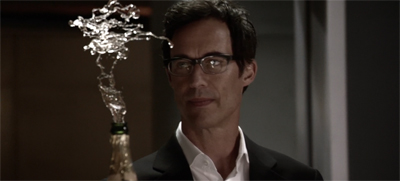
Let's not pop the champagne that fast...

Let’s not pop the champagne that fast…

Balancing cheesiness and earnestness will by one of the biggest challenges to The Flash, as the show has to figure out how to strike the best balance between the inherent goofiness of the character and the demands of a prime-time network drama show. City of Heroes and Fastest Man Alive seemed to suggest that the show had already got a good grip on this delicate equilibrium. Unfortunately, Some Things You Can’t Outrun struggles to be light-hearted without being cheesy, and earnest without being angsty.

There is a sense that the show has hit its first speed bump.

A gas time...

A gas time…

Continue reading

The Flash – Fastest Man Alive (Review)

So, I’m considering reviewing this season of The Flash, because the pilot looks interesting and I’ve always had a soft spot for the Scarlet Speedster. I’m also considering taking a storyline-by-storyline trek through the 1987-2009 Flash on-going series as a companion piece. If you are interested in reading either of these, please let me know in the comments.

In many ways, Fastest Man Alive plays like the second part of a pilot for The Flash. Like City of Heroes before it, Fastest Man Alive is written by Andrew Kreisberg and Geoff Johns, with Greg Berlanti credited on the story. It is also directed by David Nutter, one of television’s most respected pilot directors – even if his famous “hot streak” of pilots going straight to show was interrupted when CBS did not pick up The Doctor in 2011.

Fastest Man Alive is still about building the world around Barry Allen. City of Heroes established the basics, the ground rules of the world in which Barry operates. Fastest Man Alive exists to delineate them a bit further. It defines the ensemble better, clarifying the roles of Joe West and Iris West in the grand scheme of things; it gives Barry the confidence he needs to do what he does; it imposes limits on Barry’s ability; it clarifies that Harrison Wells is not entirely heroic.

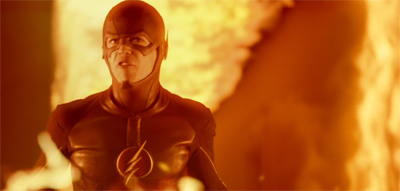
CGI flames! My fatal weakness!

CGI flames! My fatal weakness!

Given the amount of attention and effort that Fastest Man Alive devotes to cementing the foundations of The Flash, it’s understandable that there really isn’t too much room for anything else. Fastest Man Alive is about settling the cast and the writers into a sustainable status quo for the next stretch of episodes – maybe even the entire first season. It makes sure that everybody knows where everything lies and that there’s a solid base upon which to build.

So, while Fastest Man Alive might not be an especially brilliant episode of television, it does a very good job of setting up what it needs to set up.

Born to run...

Born to run…

Continue reading

The Flash – City of Heroes (Review)

So, I’m considering reviewing this season of The Flash, because the pilot looks interesting and I’ve always had a soft spot for the Scarlet Speedster. I’m also considering taking a storyline-by-storyline trek through the 1987-2009 Flash on-going series as a companion piece. If you are interested in reading either of these, please let me know in the comments.

Appropriately enough for a television show based around the fastest man alive, City of Heroes moves pretty damn quickly. The forty-five minute episode tears through all the requisite superhero origin elements in forty-five minutes. It takes us two minutes to brush through the story of Barry Allen’s childhood trauma. By the ten-minute mark, Barry has already been hit by lightning. At the end of the forty-five minutes, his uniform is complete and his ensemble fully formed.

There are some minor problems with The Flash, but City of Heroes offers a pretty solid start for the series – hinting that perhaps the show has already found its legs.

Suit up...

Suit up…

Continue reading

The X-Files (Topps) – Trick of the Light (Review)

This August (and a little of September), we’re taking a trip back in time to review the second season of The X-Files. In November, we’ll be looking at the third season. And maybe more.

The X-Files tie-in comic book was a massive success for Topps. It’s interesting to note the amount of cross-promotion that went into the comic. Factoring in short stories and tie-ins and annuals and other obligations, the output from writer Stefan Petrucha and Charles Adlard was nothing short of astounding. Topps worked very hard to promote the book, an approach that paid off – the comic would frequently appear in Diamond’s top 100 and was the publisher’s most successful monthly book.

Trick of the Light was a short twelve-page comic that was published as part of the The X-Files/Hero Illustrated Special, featuring an interview with Petrucha and packaged with Hero Illustrated #22 in March 1995. It was something of a glorified advertising gimmick, but one that demonstrates the popularity of the comic in question.

Don't go into the light!

Don’t go into the light!

Continue reading

The X-Files (Topps) #2 – A Dismembrance of Things Past (Review)

This August (and a little of September), we’re taking a trip back in time to review the second season of The X-Files. In November, we’ll be looking at the third season. And maybe more.

A Dismembrance of Things Past is an absolute delight, and a nice demonstration of how well writer Stefan Petrucha and Charles Adlard could tell stories set within The X-Files universe.

There are many interesting things about A Dismembrance of Things Past. It’s a fine piece of work, deftly balancing the demands on a new comic book set within the world of The X-Files with an urge to tell a story that fits very clearly and very comfortably within the show’s basic structure. It is easy to imagine A Dismembrance of Things Past receiving a live-action adaptation. Indeed, Petrucha’s script feels like something of a tribute to writer Darin Morgan before Darin Morgan had even written for the show, half-way between Blood and Jose Chung’s “From Outer Space.”

Something to remember them by...

Something to remember them by…

A Dismembrance of Things Past confronts the difficulties of writing a tie-in comic book to The X-Files, while using those constraints to tell an interesting story in its own right. After all, the comic book would have to tell an alien or U.F.O. story eventually. The words “The X-Files” are written on the cover, and that comes with the territory. At the same time, Petrucha and Adlard have to acknowledge the fact that the tie-in comic book cannot advance the on-screen mythology arc. Indeed, it seems unlikely Carter had shared too much of that arc with Petrucha or Adlard.

It takes a lot of skill to balance these competing demands of a tie-in comic book – to remain connected to the source material, but never pulling too far away or ahead, while remaining interesting. A Dismembrance of Things Past manages to satisfy all of its obligations and then some.

Through alien eyes...

Through alien eyes…

Continue reading

The X-Files (Topps) #1 – Not To Be Opened Until X-Mas (Review)

This August (and a little of September), we’re taking a trip back in time to review the second season of The X-Files. In November, we’ll be looking at the third season. And maybe more.

If you needed proof that The X-Files had made it, then the forty-issue Topps comic book series from the mid-nineties seems a place to start. Of course, this has less to do with the stories published in the comics themselves – though some are very interesting – and more to do with the comic book market in the nineties and the business model employed by Topps. The comic book industry was perhaps at its peak in the nineties – at least when it came to exposure and public profile.

Chris Claremont and Jim Lee’s X-Men #1 became the biggest-selling comic book of all time in 1991, selling over eight million copies. A year later, DC Comics published The Death of Superman, a sprawling highly-publicised comic book event that killed off (and then revived) the Man of Steel. The year after that, Batman got in on the action with the Knightfall trilogy, a suitably spectacular event that featured the crippling of Bruce Wayne, his replacement as Batman, and the eventual return of the Caped Crusader.

The truth is in here?

The truth is in here?

It is important to put those figures in perspective. While this was a financial peak for the comic book industry, it was still something of a fringe economy. In the mid-nineties, a television show attracting only eight million viewers would find itself on the bubble line when it came to renewal. However, that figure was the largest readership of any comic book ever. (Audience diversification means that both television audiences and comic book readers have dwindled in the years since, but the latter much more than the former.)

However, the business model for comic books in the nineties made them highly profitable, despite their smaller audience. Price gouging was not uncommon, with some retailers charging as much as $30 for Superman #75 in 1992. Poly bags, gimmick covers, variant artwork, celebrity authors – comics were largely driven by gimmicks in the nineties. More than that, the emphasis on comic books as an investment in the mainstream media helped to suggest the industry was more for collectors than for readers.

Holy conspiracy, Mulder!

Holy conspiracy, Mulder!

It is telling that the company to land the license for The X-Files was Topps, a company famous for producing sports memorabilia. The company had branched into comics in 1993, as the industry was growing and growing, hoping to license various characters and properties. The implication was that The X-Files comic had been designed more as an accessory than as a story. The cover to Not To Be Opened Until X-Mas ever features a handy “first collectors item issue” tag below the “1” at the top left-hand corner.

Licensed comic books have something of a chequered history. In the context of the mid-nineties, it would be easy to write off the forty-one issues (and change) of The X-Files as a cynical cash-in. However, the series has moments of brilliance and insight that mark it as a worth extension of the brand name.

Up in the sky!

Up in the sky!

Continue reading

Star Trek VI: The Undiscovered Country (DC Comics, 1992) (Review)

This June, we’re taking a look at some classic Star Trek movie tie-ins and other interesting objects. Check back daily for the latest reviews and retrospectives.

In many respects, adapting a Star Trek feature film into comic book form is very much an editorial function. With so little space available, particularly as compared to a feature film or novel, the assignment is more about whittling the script down to something that can be covered in fifty-five pages of a comic book. While those adapting the features films into novels frequently have to expand and flesh out the material to make it fit within the allocated page count and account for plot hole and logic error, the comic book adaptations just have to keep everything ticking over.

So Peter David and Gorden Purcell’s adaptation of Star Trek VI: The Undiscovered Country plays quite well as a condensed version of the narrative, covering the requisite story beats in the available space.

In space, everybody can hear you scream...

In space, everybody can hear you scream…

Continue reading

Wolverine: Japan’s Most Wanted (Review/Retrospective)

This May, to celebrate the release of X-Men: Days of Future Past, we’re taking a look at some classic and modern X-Men (and X-Men-related) comics. Check back daily for the latest review.

The only way to read Wolverine: Japan’s Most Wanted is on a personal tablet.

Part of Marvel’s “Infinite Comics” initiative, Japan’s Most Wanted is a comic specifically tailored to the digital experience. Although a print version of the comic is available, it can’t help but seem inferior to the way the comic was meant to be experienced. Demonstrating that digital is not just a new format for comic books, but also a new medium, the work done by Yves Bigerel storyboarding the thirteen-part adventure is nothing short of astounding. It’s a fantastic experience.

A slice of the action...

A slice of the action…

The story Japan’s Most Wanted is fairly light. This makes sense. Japan’s Most Wanted isn’t intended to push Marvel’s continuity forward or to build off a lot of what has come before. Launched in the lead-up to the release of The Wolverine, Japan’s Most Wanted is a rather transparent attempt to appeal to those interested in Wolverine’s second solo trip to the big screen – playing more as a collection of imagery and iconography than a story in its own right.

The adventure is set in Japan and pits our hero against legions of ninja, playing up to Frank Miller and Chris Claremont’s iconic Wolverine miniseries. However, it also features action set pieces on a bullet train and in an abandoned village, two of the more notable action sequences showcased in the trailer for James Mangold’s The Wolverine. The story wrapped around these sequences is almost incidental, perhaps the most basic of Jason Aaron’s Wolverine stories, as scripted by collaborator Jason LaTour.

Run and jump...

Run and jump…

Continue reading

Ed Brubaker’s X-Men – Deadly Genesis (Review/Retrospective)

This May, to celebrate the release of X-Men: Days of Future Past, we’re taking a look at some classic and modern X-Men (and X-Men-related) comics. Check back daily for the latest review.

In 2006, Ed Brubaker was one of the hottest younger writers working at Marvel Comics. He was writing a celebrated run on Captain America. He was about to take over Daredevil following a monumental run by Brian Michael Bendis. He was also going to launch The Immortal Iron Fist with collaborator Matt Fraction. It was a year that cemented Ed Brubaker as one of the primary voices writing at Marvel Comics. In the midst of all that, Brubaker also took over the X-Men franchise.

In the early years of the decade, Marvel had tasked Brian Michael Bendis to reinvent the Avengers franchise, which he had done with Avengers Disassembled and an extended stint on New Avengers. Bendis had done this by tearing down a lot of the elements of The Avengers taken for granted and demonstrating that nothing was safe. The Avengers Mansion was destroyed, Hawkeye and Vision were killed, Wolverine and Spider-Man were recruited. The approach was iconoclastic, but it worked.

Sentinels of liberty...

Sentinels of liberty…

It’s not too hard to see Ed Brubaker’s stint on the X-Men franchise as a not-entirely-successful attempt to emulated Bendis’ reinvention of The Avengers. There was a clear attempt to focus on aspects of the mythology that were outside the comfort zone, and to attack and undermine some of the most sacred areas of the mythology. After all, Brubaker began his run on Uncanny X-Men with The Rise and Fall of the Shiar Empire, a twelve-issue space opera that took the focus of the book off the wake of House of M.

Logically, then, Deadly Genesis serves as the equivalent of Bendis’ Avengers Disassembled. It’s the story that exists as the lead-in to Brubaker’s run, outside the monthly series. It sets the agenda for a lot of what is to follow, shifting the premise and changing the rules. However, Brubaker’s work suffers because he doesn’t have the same freedom that Bendis had with New Avengers. He can’t just clear the board and start anew. Deadly Genesis find him heaping a bold new status quo on top of a bold new status quo.

Burning it all down...

Burning it all down…

Continue reading