• Following Us

  • Categories

  • Check out the Archives


  • Awards & Nominations

Millennium – The Beginning and the End (Review)

This May and June, we’re taking a trip back in time to review the fifth season of The X-Files and the second season of Millennium.

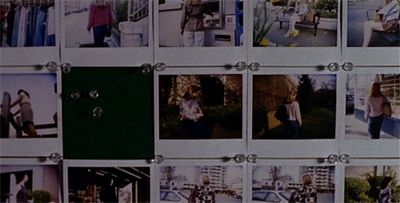
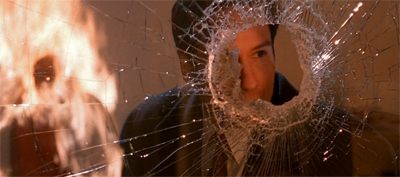
The Beginning and the End manages the impressive and paradoxical feat of both rebooting Millennium and resolving the cliffhanger at the end of Paper Dove. These two contradictory impulses become part of the thematic fabric of The Beginning and the End, an episode fascinated by duality and opposition. Can the polaroid stalker be both a serial killer of the week and the herald of something so much greater? Can Catherine and Frank Black be both united and separated? Can Millennium be the same show it was last year and something completely new?

The Beginning and the End is the start of the show’s polarising and divisive second season. To critics, the second season completely branches off from the first season of the show, replacing a framework that had grown and developed over the course of the year with a bizarre and unwieldy approach that was gonzo and surreal. To fans, the second season was an ambitious and exciting piece of television utterly unlike anything that had been broadcast before or has been broadcast since.

Up in the sky...

Up in the sky…

With Chris Carter back focusing on the development of The X-Files and the looming release of The X-Files: Fight the Future, Fox drafted in Glen Morgan and James Wong to steer the second season of Millennium. The duo had helped to define the identity of The X-Files in its first year, and had produced the failed (but ambitious and prescient) series Space: Above and Beyond for the network. After working on the fourth season of The X-Files and the first season of Millennium, Fox allowed the pair to produce their own pilot – The Notorious Seven.

When Fox opted not to take The Notorious Seven to series, they asked Glen Morgan and James Wong to take charge of Millennium in its sophomore season. As The Beginning and the End demonstrates, Morgan and Wong promptly made the show their own.
Looking up and wondering...

Looking up and wondering…

Continue reading

The X-Files – Season 4 (Review)

This February and March, we’re taking a trip back in time to review the fourth season of The X-Files and the first season of Millennium.

The fourth season of The X-Files is a work of chaotic genius.

While the third season of The X-Files is one of the most consistently well-made seasons of television ever produced, the fourth season is a lot more uneven. There are a lot of reasons for this. Chris Carter was busy launching Millennium. Fox had decided to press ahead with The X-Files: Fight the Future. Behind the scenes, it was chaotic. Glen Morgan and James Wong hung around for half the season before leaving to work on their own pilot, a planned script from Darin Morgan fell through, Chris Carter’s attention was divided.

xfiles-musingsofacigarettesmokingman17

However, the fourth season represents something of a changing of the guard on the writing staff, a transition between two generations. The fourth season sees the permanent departure of writers Glen Morgan, James Wong and Howard Gordon. These were all writers who worked hard to give The X-Files its unique flavour and identity in the show’s earliest years. The X-Files would not be the same show without the input of those three writers. It is a shame to see them depart, although four years is a long time in the industry.

In contrast, the fourth season also sees younger talent rising up. It sees the first collaboration of Vince Gilligan, John Shiban and Frank Spotnitz. The trio would become one of the most consistent (and productive) writing ensembles on the series. The fourth season also saw the rapid ascent of Vince Gilligan, who had only contributed one script to the third season; Gilligan’s three solo scripts for the third season are iconic and influential in their own right. These are the voices that will steer The X-Files through to the end of its nine-year run.

xfiles-paperhearts22

As such, the fourth season feels transitional. It is a season that lacks the finely-honed efficiency that defined the third season, in favour of a more ambitious and even experimental style. The result is a season that feels wildly creative, a joyous cacophony rather than a harmonious symphony. The fourth season may not always hit the notes, but it is doing something very fresh and exciting. There is an energy and enthusiasm to the season that carries even some of the weaker episodes.

The fourth season is not consistently brilliant, but it is more than occasionally transcendental.

xfiles-max15

Continue reading

Millennium – Season 1 (Review)

This February and March, we’re taking a trip back in time to review the fourth season of The X-Files and the first season of Millennium.

Millennium is a strange television show.

It is quite clear that Chris Carter and Fox both had a very different understanding about how best to follow on from the success of The X-Files. Fox clearly wanted another popular hit, a television show that it could plug comfortably into its 9pm Friday slot and grow into a multimedia franchise. The network spent a phenomenal amount of money promoting Millennium, with advertising and screenings and other publicity attempts. This approach paid off; The Pilot broke all sorts of records for Fox.

millennium-lamentation11

However, Millennium could not sustain those viewing figures. Over the first season, it haemorrhaged viewers. Chris Carter was not trying to present an accessible and popular pop hit; instead, Carter was taking advantage of the success of The X-Files to construct something decidedly more esoteric. Millennium is a tough show to watch. It is grim, unrelenting and oppressive. It is a show about darkness in the world that tends to roll up its sleeves and jump right in. Millennium has a clear idea of what it wants to be, but what it wants to be is alienating and uncomfortable.

On just about any level, the first season of Millennium is more accomplished than the first season of The X-Files. The production is more confident, the ideas are much bolder, the themes are much clearer. In fact, the first season of Millennium even holds up well when stacked against the fourth season of The X-Files on an episode-by-episode basis. But that’s not the problem. By definition, “Lance Henriksen fights serial killers and the concept of evil in America” will never be as popular as “David Duchovny and Gillian Anderson fight aliens and monsters and weird stuff!”

millennium-pilot11

The first season of Millennium is a show that offers a distinctive and uncompromising auteur vision which cares little for what the audience might want or expect. For better or worse, that approach would prevent Millennium from ever approaching the critical or popular support that The X-Files had already begun to accrue at the end of its own first season. The result is a television show that was never going to rival The X-Files as a pop culture phenomenon , but which serves as a bold philosophical statement from its creator.

“This is who we are,” the opening credits state, unapologetically. They seem to be speaking for the show as much for society.

millennium-bloodrelatives13 Continue reading

The X-Files – Gethsemane (Review)

This February and March, we’re taking a trip back in time to review the fourth season of The X-Files and the first season of Millennium.

Agent Mulder died late last night from an apparent self-inflicted gunshot wound to the head.

– Agent Dana Scully, 22nd October 1997

xfiles-gethsemane27 Continue reading

Millennium – Paper Dove (Review)

This February and March, we’re taking a trip back in time to review the fourth season of The X-Files and the first season of Millennium.

Millennium is an odd show in a number of ways.

The most obvious of these oddities is the sense that each of the three seasons feels like a different television show. The first season is markedly distinct from the second, the second is clearly delineated from the third. It is a very strange structure, one explained by the fact that the three seasons were overseen by three different creative teams with three very different visions of the show. One of the results of this approach is that each season finalé becomes a de facto series finalé, an episode bidding farewell to a particular vision of the show.

This is what it feels like... when doves cry...

This is what it feels like… when doves cry…

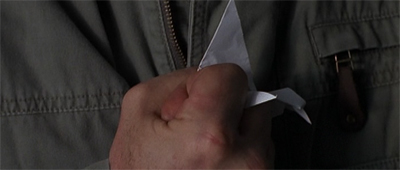
Paper Dove bids farewell to the “serial-killer-of-the-week” mechanics of the first season. Of course, there would be later episodes that would feature serial killers. In fact, The Mikado is possibly the best serial killer the show ever did. The Beginning and the End seems explicitly about killing off the “serial-killer-of-the-week” so that the show can invest its time and energy in other pursuits. However, stripped down to its core, Paper Dove takes the show’s approach to serial killers to its logic conclusion.

Although the show has featured serial killers with motivations that might be easily understood and perhaps even pitiable, Henry Dion is the show’s first serial killer to becomes almost sympathetic; it is one of the rare times that the show manages to capture the banality of evil, as opposed to the show’s traditional approach – one that brushes up against (and occasionally crosses over into) a sensationalist or gratuitous approach to serial killer pathology.

Picture this...

Picture this…

Continue reading

Millennium – Powers, Principalities, Thrones and Dominions (Review)

This February and March, we’re taking a trip back in time to review the fourth season of The X-Files and the first season of Millennium.

High matter thou injoinst me, O prime of men,

Sad task and hard, for how shall I relate

To human sense th’ invisible exploits

Of warring Spirits; how without remorse

The ruin of so many glorious once

And perfet while they stood; how last unfould

The secrets of another World, perhaps

Not lawful to reveal? yet for thy good

This is dispenc’t, and what surmounts the reach

Of human sense, I shall delineate so,

By lik’ning spiritual to corporal forms,

As may express them best, though what if Earth

Be but the shaddow of Heav’n, and things therein

Each to other like, more then on earth is thought?

– Raphael, Paradise Lost, Book V

This is about to get biblical...

This is about to get biblical…

Continue reading

The X-Files – Synchrony (Review)

This February and March, we’re taking a trip back in time to review the fourth season of The X-Files and the first season of Millennium.

Time travel is one of the great science-fiction tropes.

Although magical or metaphorical time travel has long been a part of literary tradition, pseudo-scientific or pseudo-rational versions of science-fiction really took root towards the end of the nineteenth century. Although H.G. Wells blazed a trail with The Time Machine, Edward Page Mitchell actually beat him to the punch – he published the short-story The Clock That Went Backward fourteen years before Wells wrote The Time Machine. Nevertheless, time travel quickly caught on as a literary device.

The hole in things...

The hole in things…

There are films, television show, novels, comics and songs all playing with the idea of moving through time. Although there is considerable debate about the feasibility of actually travelling backwards through time, time travel serves as a wonderful narrative device. It opens up all sorts of possibilities for structure and style; it provides some pretty heavy themes; it opens up a myriad of settings and possibility. It is no surprise that there have been so many variations and permutations based upon the idea of going backwards in time.

Indeed, it seemed like it was only a matter of time before The X-Files got around to telling its own time travel story. Synchrony was as inevitable as the decision to close the episode with a clumsy hint toward predetermination.

Ghosts of future self...

Ghosts of future self…

Continue reading

Millennium – Walkabout (Review)

This February and March, we’re taking a trip back in time to review the fourth season of The X-Files and the first season of Millennium.

Walkabout continues to demonstrate the flexibility of Millennium‘s format.

Millennium is often unfairly dismissed as a “serial-killer-of-the-week” show, an impression undoubtedly created by the stretch of early- to mid-season episodes that adopted an almost procedural formula in their exploration of evil. However, after Sacrament, the show takes a break from those narratives to do something a little more experimental and nuanced. Covenant had seen Frank investigating a murder that had already been solved. Here, Frank finds himself struggling to piece together a fractured memory of his own recent experiences.

A bleedin' disaster!

A bleedin’ disaster!

Walkabout is the third of four scripts from writer Chip Johannessen in the first season of Millennium. Each is a rather strange entity; doing something strange or unconventional for the show, helping to define the boundaries for this young television series. Walkabout is perhaps most interesting for the way that it engages with an aspect of Millennium that has been bubbling away in the background since The Pilot. Although Walkabout never explores the nature or purpose of Frank’s visions, the episode is built around the visions as a concept rather than simply a tool.

Walkabout is an unsettling and effective mood piece that grows more conventional as it progresses. While the final act is a little clunky, Walkabout is a fascinating piece of television and a demonstration of how Millennium has found its own voice.

"Let me outta here!"

“Let me outta here!”

Continue reading

Millennium – Covenant (Review)

This February and March, we’re taking a trip back in time to review the fourth season of The X-Files and the first season of Millennium.

Apparently, the original cut of Covenant ran over an hour and twenty minutes. This is not unusual in network television. Glen Morgan and James Wong faced similar problems when producing The Field Where I Died. However, while cutting The Field Where I Died down to forty-five minutes left something of a jumble, Covenant feels much stronger for the rather ruthless editing done to fit the episode into the broadcast slot. In many ways, Covenant feels quite minimalist – an episode that says the bare minimum, but conveys everything that needs to be conveyed.

Covenant is an episode that could easily seem exploitative. After all, there are points where Millennium feels like it is wallowing in human anguish and suffering. A story concerning the brutal murder of a nuclear family (including three children and a pregnant wife) is something that needs to be approached with care and delicacy. The original script for Covenant is perhaps overwritten, trying to draw too many parallels to Frank’s own family; these associations are best left unsaid.

Bloody handiwork...

Bloody handiwork…

In many ways, Millennium could be described as a “horror” show, and Covenant hones on some of the same fears that the first season has targeted repeatedly. Millennium is a show that is keen to assure viewers that their family members are not safe in their own homes and communities. However, there is a deftness and a tactfulness on display here that elevates Covenant above many of the similar stories in this début season. Covenant is all the more unsettling for its restraint and its control.

Covenant continues a strong late-season streak for Millennium, demonstrating the versatility and the nuance possible within the framework that the show has established. Covenant is a triumph for all involved.

Solid as a rock...

Solid as a rock…

Continue reading

The X-Files – Unrequited (Review)

This February and March, we’re taking a trip back in time to review the fourth season of The X-Files and the first season of Millennium.

Unrequited opens with Mulder and Scully’s attempts to stop an assassination attempt by an invisible man, before jumping back twelve hours to explain how our heroes got into this situation. With that set-up, Unrequited falls into a lot of the narrative traps associated with an in media res teaser. After all, there’s not really anything special about the teaser. There is no mystery to be solved, no strange behaviour to explain. What questions are we meant to ask, based on that opening scene? How are we meant to look at the rest of the episode differently, knowing what we know?

Sure, Mulder and Scully are protecting Major General Benjamin Bloch. That would seem to be a little bit outside the remit of “the FBI’s most unwanted”, but that is not too strange a situation for the duo. They are FBI agents, so there is a certain flexibility in their job description. The Field Where I Died – an episode with a much more effective non-linear teaser – featured Mulder and Scully collaborating with the ATF. So it isn’t as if the set-up should be striking or compelling.

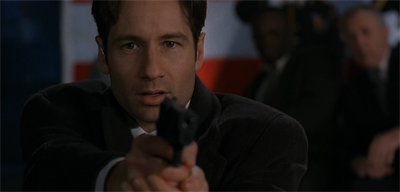
Stop, or my Mulder will shoot!

Stop, or my Mulder will shoot!

It seems like we are meant to focus on the monster of the week – Vietnam veteran Nathaniel Teager. Teager has the ability to turn himself invisible, which is quite something. Sure enough, the teaser to Unrequited offers a glimpse of that ability in action. But why is it important to have show us that ability in a scene from the climax of the episode? With a few adjustments, Teager’s first murder in the back of the limousine would serve the same purpose; introducing the audience to his powers without the need to recycle several minutes of footage from the climax.

After all, the most dissatisfying aspect of the in media res teaser is not the fact that it is completely inessential. Instead, the decision to use footage from the climax means that the audience has to sit through the same sequence twice. The teaser for Unrequited works well enough the first time around, but the sequence is not clever or inventive enough to merit a live-action replay towards the end of the hour. It just saps momentum from episode, rendering the final sequences somewhat tedious. That is the biggest problem with the opening of Unrequited, even beyond laziness.

Flags of our father figures...

Flags of our father figures…

Continue reading