• Following Us

  • Categories

  • Check out the Archives


  • Awards & Nominations

The Lone Gunmen – Three Men and a Smoking Diaper (Review)

This October/November, we’re taking a trip back in time to review the eighth season of The X-Files and the first (and only) season of The Lone Gunmen.

Three Men and a Smoking Diaper might just be the worst episode of The Lone Gunmen.

It is also the only episode to be written solely by Chris Carter, who had also contributed to The Pilot.

Good advice...

Good advice…

Continue reading

The Lone Gunmen – Pilot (Review)

This October/November, we’re taking a trip back in time to review the eighth season of The X-Files and the first (and only) season of The Lone Gunmen.

It is meant to be a joke.

It is an episode known as The Pilot, because it is a proof of concept for a new series that can be shown to executives in the hopes that they might green-light it and give the production team a series order. That is, after all, what a television pilot is. It is the first episode of a television show to be filmed, usually with considerable space between it and the rest of the first season. There is time for network notes and feedback, to determine what works and what doesn’t. There is space for recasting and reshooting, which becomes more problematic on a weekly schedule.

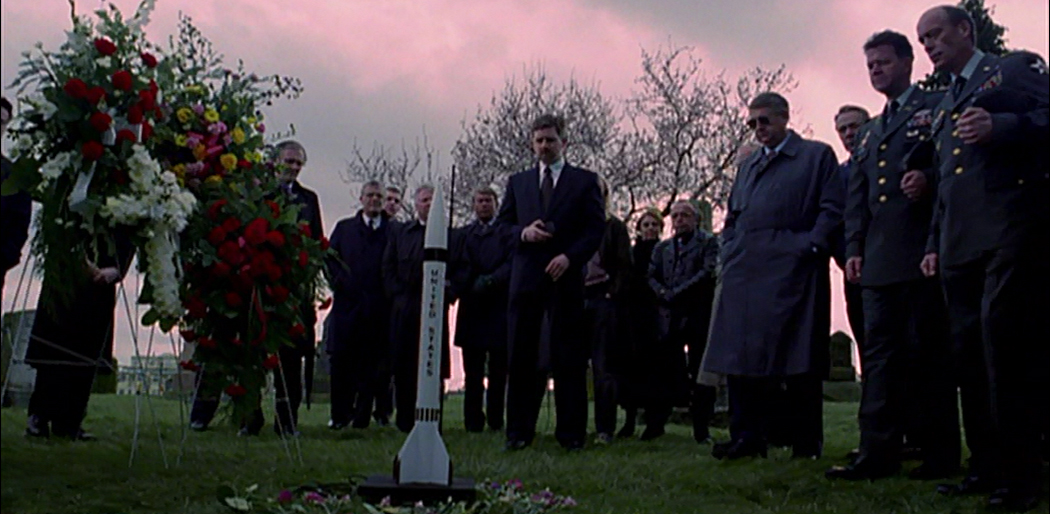
Rocket man.

Rocket man.

However, the fact that the first episode of The Lone Gunmen is called The Pilot is also a rather wry punchline. It is a self-aware reminder that the show takes itself considerably less seriously than Millennium or Harsh Realm. After all, even if this weren’t the very first episode of a new television show, it might be called The Pilot. Based purely on the plot, the episode might have been called The Pilot. It is an episode about a sinister plot to hijack planes using advanced technology. So calling the episode The Pilot is a cheesy and goofy bit of wordplay.

Of course, there is very little funny about it in hindsight.

Don't leave us hanging...

Don’t leave us hanging…

Continue reading

The X-Files – Patience (Review)

This October/November, we’re taking a trip back in time to review the eighth season of The X-Files and the first (and only) season of The Lone Gunmen.

Patience is necessary.

The eighth season of The X-Files is conservative. There are arguments to be made that this is true in a political sense, but it is certainly true in a narrative sense. The eighth season generally plays it quite safe when it comes to the structuring and plotting. The most structurally ambitious episode of the eighth season is perhaps Redrum, which feels a lot less “out there” than episodes like The Post-Modern Prometheus, Bad Blood, Triangle, X-Cops or First Person Shooter. Narratively, the eighth season plays it relatively “safe.”

Batsh!t crazy...

Batsh!t crazy…

There is a reason for this, of course. Losing David Duchovny for half the season and rotating in Robert Patrick represents perhaps the biggest risk that the show will ever take. Given how essential Duchovny had been to the show’s success, the eighth season is taking quite the gamble. With that in mind, it makes sense to play it safe. Without Mulder around, the show’s primary goal is to reassure fans that it is still The X-Files. This is not the time for experimental “event” episodes, because “Mulder is not in this episode” is an experimental event of itself.

As such, the eighth season feels largely like a return to a more traditional X-Files aesthetic, a “back to basics” approach. In that respect, Patience is essentially about kicking the tires and taking the show for a gentle test drive in its new configuration.

The show won't be caught with its pants down...

The show won’t be caught with its pants down…

Continue reading

The X-Files – Season 7 (Review)

This September, we’re taking a trip back in time to review the seventh season of The X-Files and the first (and only) season of Harsh Realm.

The seventh season of The X-Files feels like the end.

Indeed, going into the season, the production team were quite certain that it was going to be the end. Chris Carter and David Duchovny had signed two-year extensions to their initial five-year contracts that would expire at the end of the season. David Duchovny had signalled that he was unlikely to return for an eighth season. Frank Spotnitz suggested that the writing staff were approaching the seventh season like it was their last time working with these characters on this show.
xfiles-requiem37

Gradually, however, things changed. As the seventh season continued, it became more and more likely that it wouldn’t be the seventh season of the show. Most obviously, Fox endured one of its worst seasons on record; there was simply no show that could hope to replace The X-Files in the network’s line-up. As a result, there was a clear urge to continue the show into an eighth season. However, the production team could not commit to the possibility because David Duchovny was in the midst of an on-going lawsuit against Fox.

As a result, the entire seventh season occupies a hazily-defined realm between life and death. As the season goes on, it feels more and more like the seventh season is hedging its bets; that the production team might be happy to move on to other projects, but are not entirely ready to give up on The X-Files yet. Watching the season in hindsight feels weird; it often feels like the production team want to bring the curtain down, but are unwilling to definitively or conclusive wrap up all the threads.

xfiles-xcops8a

If the sixth season of The X-Files fixated on the show’s immortality and timelessness, the seventh season plays as a reaction against that. The seventh season is very keenly aware that everything must end and that The X-Files‘ cultural moment might be fading. There is something mournful and morose about the seventh season, as if The X-Files is watching itself slip away into history. After all, this was the point where the show became readily available on DVD and where Duchovny was engaged in a lawsuit over syndication; The X-Files was becoming a legacy concern.

The seventh season is about death and undeath.
xfiles-theamazingmaleeni15a

Continue reading

Harsh Realm (Review)

This November, we’re taking a trip back in time to review the seventh season of The X-Files and the first (and only) season of Harsh Realm.

Harsh Realm seems destined to be a curiosity in the career of Chris Carter.

Sure, other projects would fail. Millennium had lasted three seasons, but its audience had been in decline since the second episode was broadcast. The Lone Gunmen would fold after only half a season. However, nothing was quite as sudden and brutal as the failure of Harsh Realm. The show did not even make it to half a season. It was cancelled by the network during the production of its ninth episode, after only three episodes had aired. The six unaired episodes were shunted over to FX, where they could be broadcast away from the media spotlight.

harshrealm-pilot34

This might not have been such a big deal if it wasn’t the first project developed by Chris Carter as part of his new contract at Fox, if it hadn’t been hyped up and analysed and debated. Harsh Realm was one of the most talked about new dramatic shows of 1999, and so its death was not a quiet or dignified affair. The cancellation became something of a public spectacle. Most of the attention fell on Fox Chief of Programming Doug Herzog, who seemed to be out of his depth running a major network.

Inevitably, though, some of the attention was focused on Chris Carter. Harsh Realm was a spectacular commercial failure for Carter, and one which raised questions about whether Carter and his production team were ready to face the twenty-first century.

harshrealm-leviathan5

Continue reading

The X-Files – Requiem (Review)

This September, we’re taking a trip back in time to review the seventh season of The X-Files and the first (and only) season of Harsh Realm.

As with a lot of the seventh season, Requiem is an oddity.

It is an episode that exists in a weird limbo state, carefully designed and calibrated so that it might serve two – if not three – very different purposes. Requiem was written and filmed at a point where nobody knew what was going to happen next. Requiem could have been either a season or a series finalé; it could have been the last episode of the seventh season, the last episode of the series before the launch of a movie franchise, or even just the last episode ever. That is a lot of weight to put on a single episode.

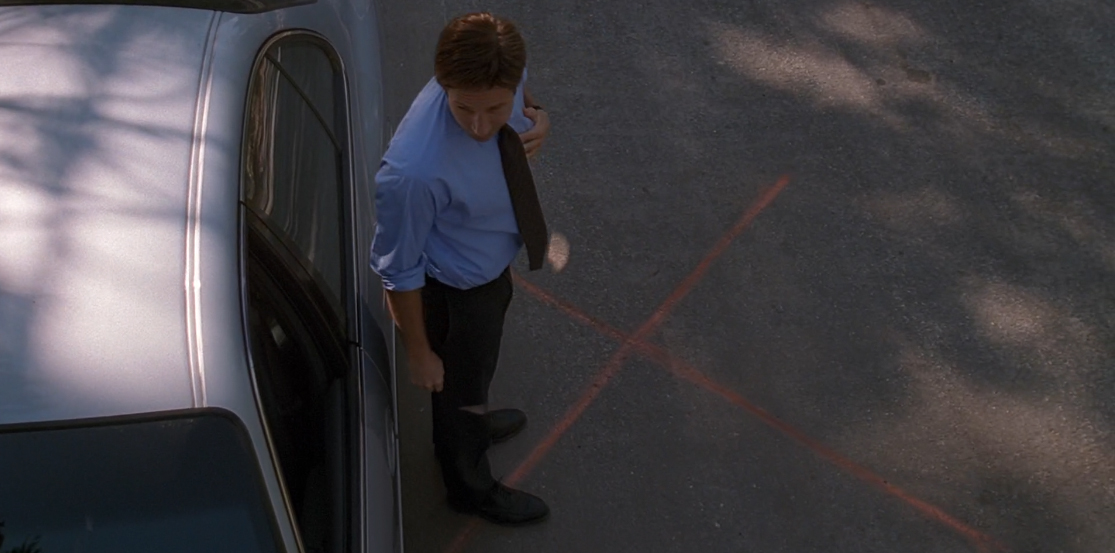
"X" marks the spot where it all began...

“X” marks the spot where it all began…

In essence, Requiem existed in a state of ambiguity and flux. It was never entirely sure what Requiem would be when Chris Carter wrote it or when Kim Manners directed it. Requiem had to be designed to be fluid and malleable; it had to support any context that might be heaped upon it in the editing suite or on broadcast. Stories like Jose Chung’s “From Outer Space” and Bad Blood had explored the blurred boundaries of reality and perception; Requiem is perhaps that idea applied to the show itself.

Chris Carter could tell you what happened in Requiem as it went through production. He could explain plot details and character motivation; he could outline the chain of events that bind Requiem together. However, it was impossible for anybody working on Requiem to actually assert what the episode was until three days before the episode aired. Until that point, Requiem was a shadow or a blur, just waiting for some larger context to bring it into proper focus.

Things are looking up...

Things are looking up…

Continue reading

Harsh Realm – Camera Obscura (Review)

This November, we’re taking a trip back in time to review the seventh season of The X-Files and the first (and only) season of Harsh Realm.

And so, with Camera Obscura, it seems that Harsh Realm comes to an end

The show had been developed as a television series for the new millennium; all involved had great plans for it. Fox had made no secret of the fact that they planned for Harsh Realm to take pride of place in their schedule going forward. The assumption was that it would replace The X-Files after that juggernaut was retired. There was a lot of hype around the development, a lot of excitement about the new show from producer Chris Carter. Harsh Realm was to be the first of many new shows developed by the producer as part of a highly lucrative contract with Fox.

Burning down the House (of God)...

Burning down the House (of God)…

Sadly, it did not work out that way. Harsh Realm had premiered to low ratings. Fox shuffled it off the schedule after only three episodes, which seemed a knee-jerk response given the talent involved in the show’s production. The six remaining episodes were locked away from the light of day, relegated to premiering on FX at the tail end of that season of television. For all that everybody involved had hoped that Harsh Realm would be a breakout hit, it ended up little more than a footnote.

Here, it dies. After nine episodes aired across two channels over seven months, the curtain comes down on Harsh Realm. It ends not with a bang, but a whimper.

Time for reflection...

Time for reflection…

Continue reading

Harsh Realm – Cincinnati (Review)

This November, we’re taking a trip back in time to review the seventh season of The X-Files and the first (and only) season of Harsh Realm.

Cincinnati finally gives Terry O’Quinn something to do.

Despite the fact that O’Quinn is credited as a series regular on Harsh Realm, he has appeared about as frequently in the first nine episodes as he did during the equivalent episodes of Millennium. With his “and…” credit at the end of the opening title sequence, it felt like O’Quinn might be forgotten by the show. His face might appear on posters and propaganda, but he was not going to play a particularly dynamic role in the events of the first season. After all, Hobbes is trying to assassinate Santiago; there are reasons why the writers would want to keep them separate.

Walk softly, but carry a big stick...

Walk softly, but carry a big stick…

Nevertheless, Cincinnati is a story that unfolds from Santiago’s perspective. Hobbes and Pinochio play a major part in unfolding events, but they largely reacting. The bulk of Cincinnati concerns a conflict between Santiago’s forces and the Native American population of Ohio. When a military strike goes horribly wrong, Santiago is forced to survive on his own terms. He infiltrates the eponymous city and sets about furthering his own agenda with ruthless efficiency.

A lot of Cincinnati is pure nonsense; the plot is barely held together by contrivance and coincidence, hinging on a final twist that manages to be both obvious and completely unearned. At the same time, it is hard to hate an episode that is carried by Terry O’Quinn and offers the actor a chance to sink his teeth into a juicy part.

It's all in ruins...

It’s all in ruins…

Continue reading

The X-Files – Fight Club (Review)

This September, we’re taking a trip back in time to review the seventh season of The X-Files and the first (and only) season of Harsh Realm.

Fight Club is an unpleasant episode of The X-Files.

It’s not “unpleasant” in a good way, like (arguably) Signs and Wonders or (definitely) Theef. It is “unpleasant” in a way that feels ill-judged and tone-deaf. Following on the charm and whimsy of Hollywood A.D., the script for Fight Club seems packed with forced charm and staged whimsy. At its most basic level, Fight Club is a comedy episode that simply isn’t funny. More than that, it’s an episode that isn’t particularly funny or clever to begin with, but then spends forty-five minutes insisting upon its own wit.

"Some of us are looking at the stars..."

“Some of us are looking at the stars…”

There is also a sense of unpleasantness about the themes and content of the episode in the context of the late seventh season. After all, it is no secret that the production team were facing considerable internal and external pressure. These pressures included a lawsuit involving the show’s lead actor and the show’s creator (not to mention the show’s network) and the fact that everybody on the production team was waiting for David Duchovny to determine if they would have a job the following season.

With all of this going on in the background, maybe an episode the implicitly features the show’s two lead actors knocking the stuffing out of each other for no good reason is not the best idea in the world.

"Hm..."

“Hm…”

Continue reading

Harsh Realm – Manus Domini (Review)

This November, we’re taking a trip back in time to review the seventh season of The X-Files and the first (and only) season of Harsh Realm.

Manus Domini continues the influx of assistance from the writing staff on The X-Files, with John Shiban contributing a script to the first season of Harsh Realm.

Manus Domini is a very strange episode. In a way, it feels more keenly aligned with the sensibilities of Chris Carter than those of John Shiban. It is the most overtly religious episode from the short run of Harsh Realm, with characters contemplating faith and spirituality in an otherwise cruel world. It is the logical continuation of themes seeded and developed across the rest of the season, bringing the religious subtext of the show to the fore so that it might be acknowledged and explored.

Florence in the machine...

Florence in the machine…

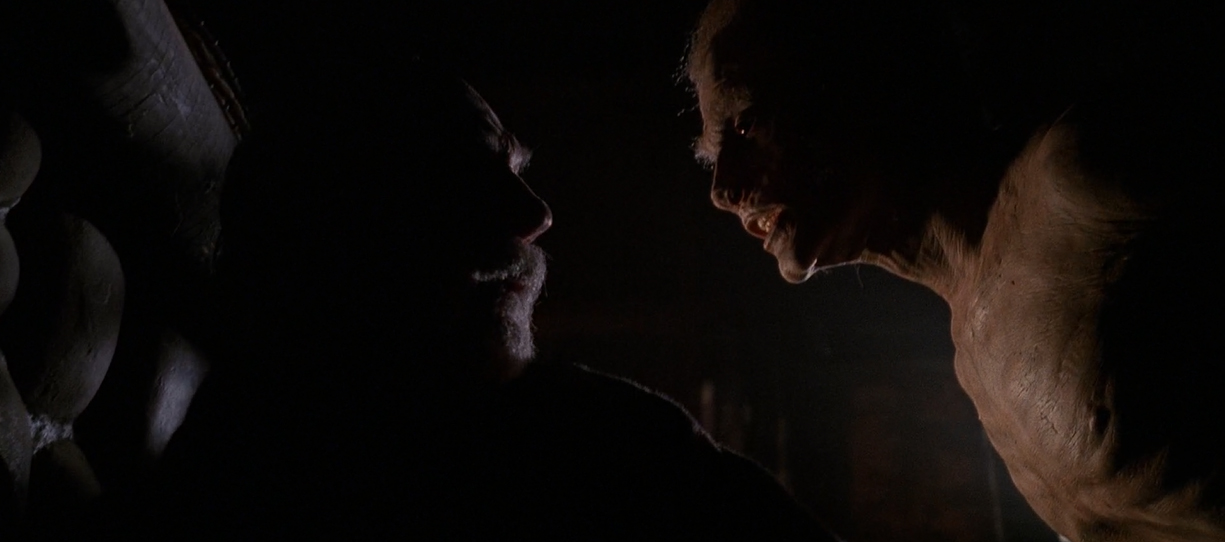
To be fair, there are elements that fit comfortably within Shiban’s oeuvre. Shiban is very much a fan of classic horror tropes, so it makes sense that his script should feature a monstrous supporting character whose complete moral decay is symbolised through grotesque facial deformities. (The element recurs in Camera Obscura, but is not as pronounced as it in this episode.) There are elements of Manus Domini that feel like they might have been lifted from classic seventies horror.

Nevertheless, Manus Domini is defined by its religious components, making it clear that the show retains the same core moral perspective that runs through Carter’s work; there is a recurring sense that faith and spirituality are essential to survive and endure in an increasingly faithless world.

A literal mine field...

A literal mine field…

Continue reading