• Following Us

  • Categories

  • Check out the Archives


  • Awards & Nominations

Doctor Who: Revelation of the Daleks (Review)

To celebrate the fiftieth anniversary of the longest-running science-fiction show in the world, I’ll be taking weekly looks at some of my own personal favourite stories and arcs, from the old and new series, with a view to encapsulating the sublime, the clever and the fiendishly odd of the BBC’s Doctor Who.

Revelation of the Daleks originally aired in 1985.

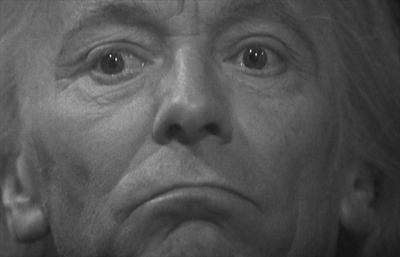
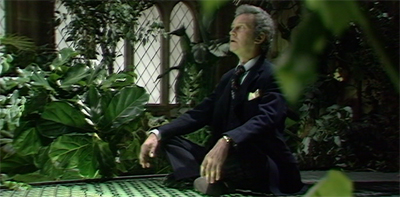
There’s an argument to be made that Revelation of the Daleks is the only truly classic episode that Doctor Who produced during Colin Baker’s stint in the leading role. I’m not sure I agree – I’d argue that Vengeance on Varos, despite a misleading title, is surprisingly solid and clever – but I can see the logic. In fact, Revelation of the Dalekswas a fitting choice to close out Baker’s first season in the role, the last episode to air before BBC placed the series on hiatus, as it represents the very best of mid-eighties Doctor Who.

We can see right through the Daleks’ plan…

Continue reading

Doctor Who: Victory of the Daleks (Review)

To celebrate the fiftieth anniversary of the longest-running science-fiction show in the world, I’ll be taking weekly looks at some of my own personal favourite stories and arcs, from the old and new series, with a view to encapsulating the sublime, the clever and the fiendishly odd of the BBC’s Doctor Who.

Victory of the Daleks originally aired in 2010.

Would! you! care! for! some! TEA???!!!

– the Daleks

Ah, the Daleks. They tend to rise and fall. They get built up and then they fall back down. Like the show itself, they come and go in cycles. The Dalek Invasion of Earth has the psychotic pepperpots invade Earth, while The Chase reduces them to little more than comic foils. Destiny of the Daleks makes jokes about them being unable to climb stairs, while Remembrance of the Daleks then proves that they can. In 2005, both Dalek and The Parting of the Ways invested considerable effort in making them scary again. The show eroded that away over time, turning them into bitchy foils for the Cybermen in Doomsday for the Doctor to hover up and competing to create the most phallic monster ever in Evolution of the Daleks.

Steven Moffat took over the show in 2010, and that means that he also took over the Daleks. Tending to the Doctor also means tending to his worst enemies. And, to be fair, that’s a bit what Victory of the Daleks feels like. It feels like an obligation, a bit of business to get out of the way quickly (the first episode not penned by Moffat) so that the fun stuff can commence.

Exterminate the rainbow...

Exterminate the rainbow…

Continue reading

Doctor Who: The Chase (Review)

To celebrate the fiftieth anniversary of the longest-running science-fiction show in the world, I’ll be taking weekly looks at some of my own personal favourite stories and arcs, from the old and new series, with a view to encapsulating the sublime, the clever and the fiendishly odd of the BBC’s Doctor Who.

The Chase originally aired in 1965.

You’re from Earth?

No, no, Ma’am. No, I’m from Alabama.

– Barbara and Morton set things straight

There are times when Doctor Who seems to straddle the line between genius and insanity, when the viewer is left completely unsure whether they’ve witnessed something profoundly clever, or infuriatingly stupid. The Chase is one of those stories, one of those rare cases where I’m honestly not sure if I’m reading too much into a piece of television or simply scratching the surface of a whole wealth of complex meaning and symbolism. The Chase is, as near as I can make out, either a desperate attempt to cash-in on the then-current Dalek craze, or one of the craziest attacks the show ever made on the fourth wall. It’s either completely terrible or breathlessly brilliant, and I refuse to rule out the possibility that it is both, possibly at the same time.

Cutting to the chase...

Cutting to the chase…

Continue reading

Doctor Who: The Seeds of Doom (Review)

To celebrate the fiftieth anniversary of the longest-running science-fiction show in the world, I’ll be taking weekly looks at some of my own personal favourite stories and arcs, from the old and new series, with a view to encapsulating the sublime, the clever and the fiendishly odd of the BBC’s Doctor Who.

The Seeds of Doom originally aired in 1976.

Very impressive. What do you do for an encore, Doctor?

I win.

– Chase and the Doctor

“The mixture of styles is charming,” Miss Ducat notes of Harrison Chase’s impression mansion, and it’s also true of the story itself. I think that part of the reason that The Seeds of Doom works so well is because it’s actually a rather wonderful blend of any number of pulp subgenres, mixing a spy adventure, a trashy sci-fi adventure, an end-of-the-world catastrophe story, a gothic horror tale and an alien invasion saga, all within one six-part story. The story’s meglomaniac, Harrison Chase, might believe hybrids are “a crime against nature” (which opens up all sorts of avenues of plant racism), but I think this works quite well.

Hamilton Chase goes green…

Continue reading

Doctor Who: The Brain of Morbius (Review)

To celebrate the fiftieth anniversary of the longest-running science-fiction show in the world, I’ll be taking weekly looks at some of my own personal favourite stories and arcs, from the old and new series, with a view to encapsulating the sublime, the clever and the fiendishly odd of the BBC’s Doctor Who.

The Brain of Morbius originally aired in 1976.

How did you get her here, by the way?

The power of the Sisterhood.

Really? What, you mean you still practise teleportation? How quaint. Now, if you got yourself a decent forklift truck–

Doctor, you have but a little time left. Will you waste it prattling nonsense or confess your guilt.

What do you mean, I have but a little time left?

Before you die.

But I’m only seven hundred and forty nine. Life doesn’t begin until seven hundred and —

At the next sun. That is agreed.

Not by me, it isn’t. I haven’t even been consulted.

– The Doctor, Ohica and Maren are clear on a few things

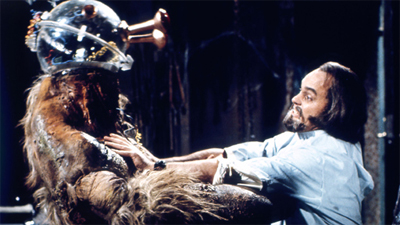
The Brain of Morbius continues the trend of phenomenally strong episodes in Baker’s sophomore season. Barring The Android Invasion, it’s a fairly stellar run of adventures, and I think that it’s these stories that a lot of people (casual follower and hardened fanatic alike) think of when they remember Tom Baker’s celebrated tenure in the role. Producer Philip Hinchcliffe continues his “gothic adventures… in space!” trend from Planet of Evil, this time offering a futuristic take on a Hammer-Horror-style Frankenstein. And the results are as fun, as wonderful and as grotesque as you might have imagined.

They did the monster mash…

Continue reading

Doctor Who: The Android Invasion (Review)

To celebrate the fiftieth anniversary of the longest-running science-fiction show in the world, I’ll be taking weekly looks at some of my own personal favourite stories and arcs, from the old and new series, with a view to encapsulating the sublime, the clever and the fiendishly odd of the BBC’s Doctor Who.

The Android Invasion originally aired in 1975.

Is that finger loaded?

– the Doctor

We’re in the middle of one hell of a season here, aren’t we? Indeed, The Android Invasion is sandwiched between two stories that could legitimately vie for the title of “best Doctor Who story ever.” Perhaps that’s why it feels like such a let-down. The Android Invasion isn’t the worst Doctor Who story ever. Indeed, it isn’t the worst Tom Baker Doctor Who story ever, nor is it the worst Philip Hinchcliffe Doctor Who story ever. It is just sort of… there. It’s a very dull and mundane piece of television, one that feels all the more dull and mundane for the fact that it’s positioned in one of the strongest seasons that the show ever produced.

He needs a Doctor...

He needs a Doctor…

Continue reading

Doctor Who: Pyramids of Mars (Review)

To celebrate the fiftieth anniversary of the longest-running science-fiction show in the world, I’ll be taking weekly looks at some of my own personal favourite stories and arcs, from the old and new series, with a view to encapsulating the sublime, the clever and the fiendishly odd of the BBC’s Doctor Who.

Pyramids of Mars originally aired in 1975.

Yes, that’s resonating tuner. Part of an anti-gravity drive. Oh! They must be building a rocket.

Egyptian mummies building rockets? That’s crazy.

– the Doctor and Sarah Jane demonstrate how arbitrary “crazy” is on this show

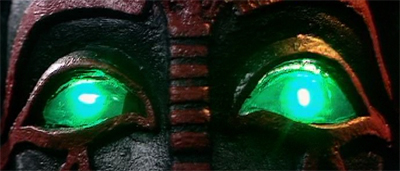
Pyramids of Mars is a classic slice of Doctor Who. It’s a piece of television that I dearly love, even if it is quite clear watching it that Robert Holmes was re-writing it by the seat of his pants. It’s got all the right ingredients for the Philip Hinchcliffe era of the show. Tom Baker is on phenomenal form. Sarah Jane has full adapted to being the only companion again. There’s one of those nice period settings that the BBC does so well. There’s an ancient evil arising to destroy the planet, and maybe the universe. Said evil is deliciously hammy, yet somehow quite intimidating.

Pyramids of Mars is the perfect storm, a carefully mixed cocktail of Doctor Who in the Hinchcliffe era. Given that the Hinchcliffe era is generally regarded as one of the best periods in the show’s history, that should give an idea of just how impressive it is.

Because "Sutekh the Benign" doesn't sound quite so threatening...

Because “Sutekh the Benign” doesn’t sound quite so threatening…

Continue reading

Doctor Who: Planet of Evil (Review)

To celebrate the fiftieth anniversary of the longest-running science-fiction show in the world, I’ll be taking weekly looks at some of my own personal favourite stories and arcs, from the old and new series, with a view to encapsulating the sublime, the clever and the fiendishly odd of the BBC’s Doctor Who.

Planet of Evil originally aired in 1975.

He used the neutron accelerator. If he hit Sorenson, it could be disastrous.

You mean things can get worse? I don’t believe it.

– the Doctor and Sarah Jane make sure we understand the stakes

I feel a bit sorry for Planet of Evil. I mean, it sits near the start of one of the best seasons of Doctor Who, and yet it’s generally overlooked. It’s not that Planet of Evil is bad – The Android Invasion from the same season is actually bad, and is remembered as such. It’s more that Planet of Evil doesn’t really feel as exceptional as it could be. The Hinchcliffe and Holmes era of Doctor Who was cranking out classic adventures and iconic images to beat the band, but Planet of Evil just wound up feeling relatively generic. That’s not necessarily entirely fair. The opening two episodes of Planet of Evil are superb, but it is let down by a fairly average conclusion and undermined by a fairly weak supporting cast.

It is nowhere near the best story of the season, but it’s hardly a spectacular failure. there are times in the history of Doctor Who where Planet of Evil would be a welcome relief. However, it suffers from being a reasonably mediocre adventure in a fantastic season.

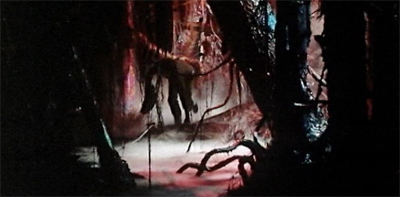
In the jungle, the peaceful jungle...

In the jungle, the peaceful jungle…

Continue reading

Doctor Who: The Bells of St. John (Review)

There’s something in the wifi.

– the Doctor does his best Jaws impression

The Bells of St. John is an intriguing piece of Doctor Who. This is the first time that the show has had to manage a companion swap in the middle of a season. That said, it doesn’t really work to think of the seventh season as a single cohesive entity.

The first five episodes are something of an abridged season, akin to the 2009 season of specials starring David Tennant. They are dedicated to tidying away lingering plot threads from the last two years of the show, and resolving Moffat’s lingering plot threads. The Power of Three and The Angels Take Manhattan are very much about tidying up the Doctor’s lingering connection to Rory and Amy.

In contrast, the second half of the season has a much more celebratory feeling to it, tied together by the over-arching mystery around Clara. While Clara pops up in Asylum of the Daleks, she’s very much a teaser of a mystery to come rather than a character in her own right. Instead, the themes of the season start in The Snowmen, introducing (or reintroducing) the Great Intelligence and Clara, and outlining the mystery of “the twice-dead girl.”

As a result, The Bells of St. John feels very much like a season opener to an unfortunately brief season of celebration.

Maybe that should be "thrice dead"?

Maybe that should be “thrice dead”?

Continue reading

Non-Review Review: The Omega Man

The Omega Man remains, perhaps, the most high-profile adaptation of Richard Matheson’s genre-busting vampire sci-fi survivalist novel, I Am Legend. Of course, the film has little resemblance to Matheson’s truly iconic piece of literature, save for the basic premise. Charleton Heston is Robert Neville, the last man alive in a world of monsters. While I Am Legend is a bold and thought-provoking exploration of the implications of that idea, The Omega Man seems to have no loftier goal than simply telling an entertaining apocalyptic yarn. There’s nothing wrong with that, but – much like Robert Neville himself – The Omega Man is haunted by the ghost of what could have been.

Goodbye to all of that...

Goodbye to all of that…

Continue reading