• Following Us

  • Categories

  • Check out the Archives


  • Awards & Nominations

Star Trek: Enterprise – Shadows of P’Jem (Review)

Next year, Star Trek is fifty years old. We have some special stuff planned for that, but – in the meantime – we’re reviewing all of Star Trek: Enterprise this year as something of a prequel to that anniversary. This January, we’re doing the first season. Check back daily for the latest review.

Shadows of P’Jem is a wonderful episode. It is, in many respects, the first true post-9/11 episode of Star Trek: Enterprise, and it is a surprisingly thoughtful one at that.

In many respects, Enterprise has already established itself as Star Trek for the George W. Bush era. Archer is the franchise’s first white American male lead character since Kirk, and his contempt for politics and thirst for action mirrors the popular image of George W. Bush – a dynamic man with no time for questions or hesitation. Even little touches – like the fact that officers drink beer rather than champagne, or the anti-intellectual contempt that Archer and Trip feel towards Vulcans – suggest a Star Trek show that is very much in line with Bush’s America.

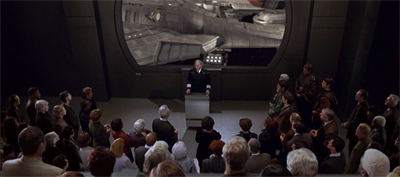
Shadows on Coridan...

Shadows on Coridan…

However, Shadows of P’Jem was among the first episodes written after the events of 9/11, and it’s an episode that seems quite thoughtful and introspective. The franchise has often used the Federation as a stand-in for American values and ideals. Shadows of P’Jem twists this idea on its head, offering the future Federation members as stand-ins for various facets of American foreign policy.

Shadows of P’Jem is a considerate and reflective look at what Walter Nugent termed “the habits of empire”, a look at the cost and consequences of imperialism in a post-colonial age, and how those issues tend to fester.
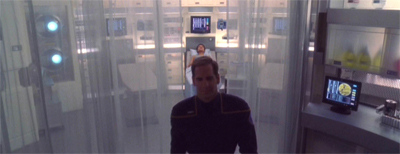
A night in sickbay...

A night in sickbay…

Continue reading

Star Trek: Enterprise – Strange New World (Review)

Next year, Star Trek is fifty years old. We have some special stuff planned for that, but – in the meantime – we’re reviewing all of Star Trek: Enterprise this year as something of a prequel to that anniversary. This January, we’re doing the first season. Check back daily for the latest review.

Strange New World is the first episode of Star Trek: Enterprise to come from a writing team other than Brannon Braga and Rick Berman. Berman and Braga would dominate the writing credits for the first season. Even when the final teleplay was credited to another writer or writing team, there was often a “story by” credit given to Berman and Braga. Braga himself has conceded that he essentially re-wrote all of the episodes of the first season.

Still, Strange New World is credited to the writing team of Mike Sussman and Phyllis Strong. Both had worked on Star Trek: Voyager before migrated to Star Trek: Enterprise along with André Bormanis. Sussman had pitched the story for Meld and worked on a number of solo stories and scripts before teaming with Strong on the seventh and final season of the show. The two would remain a writing team for the first two seasons of Star Trek: Enterprise, hitting their stride with some of the strongest episodes of the troubled second season.

Picture perfect...

Picture perfect…

Strange New World is an interesting début for the pair. On the hand, it is a story that celebrates the unique place of Star Trek: Enterprise in the Star Trek pantheon. It’s a story about how great it must be to set foot on an alien planet, and how wondrous it must be to breath air from outside our atmosphere. With its emphasis on shuttlepods and primitive transporters, it does remain relatively true to the prequel premise of Enterprise.

On the other hand, Strange New World is a very familiar Star Trek template. Indeed, it’s a very familiar first season template. It’s the episode where the crew of the ship are exposed to some strange outside force that makes them all act out of character. It’s something of a Star Trek standard. The original Star Trek had The Naked Time and Star Trek: The Next Generation had The Naked Now, while Star Trek: Deep Space Nine had both Babel and Dramatis Personae. In many ways, Strange New World feels like a familiar old story.

Strange yellow daisy fields forever...

Strange yellow daisy fields forever…

Continue reading

Star Trek: Enterprise – Broken Bow (Review)

Next year, Star Trek is fifty years old. We have some special stuff planned for that, but – in the meantime – we’re reviewing all of Star Trek: Enterprise this year as something of a prequel to that anniversary. This January, we’re doing the first season. Check back daily for the latest review.

Broken Bow is probably the strongest pilot in the Star Trek canon, with Emissary and The Cage vying for second place.

That’s not saying a lot. Broken Bow is still a troubled production with some rather sizeable issues marring what is otherwise an ambitious début for a new Star Trek show. Watching, Broken Bow – as with watching most of the first few years of Star Trek: Enterprise (or just Enterprise) – it feels like the show is at war with itself. It wants to be something new and fresh and exciting, but it also wants to be an important part of this larger tapestry. And the episode has difficulty reconciling that.

New (old) frontier...

New (old) frontier…

So we get new aliens like the Suliban, but a plot that revolves around the Klingons; we get an entirely new crew with a Vulcan science officer and Southern gentleman as the Captain’s best friend; we get a ship without most of the conveniences that we take for granted on Star Trek, but with substitutes and a resolution that relies on technological gimmickry; we get to explore an uncharted part of the Star Trek canon, but with the intrusion of the future to help make it feel a little more familiar.

From the first episode, Star Trek: Enterprise seems to exist as a show trapped between what it could have been and what it has to be. It’s a premise rich with potential, but which still feels a little too much like everything that came before.

Into the sunset...

Into the sunset…

Continue reading

Non-Review Review: A Most Wanted Man

For better or worse, A Most Wanted Man is going to be overshadowed by the passing of its lead actor. Philip Seymour Hoffman was a giant, a performer with a wonderful gift for bringing flawed and real characters to life, and A Most Wanted Man serves as his last leading role in a major motion picture. It is impossible to talk about A Most Wanted Man without talking about Philip Seymour Hoffman’s performance, and that’s not necessarily a bad thing.

It is a great performance, one that reminds the audience of why they loved Hoffman in the first place – Günther Bachmann is the sort of flawed human being that Hoffman played so well, given a great deal of depth by the late actor.

What's on the table?

What’s on the table?

Continue reading

Ed Brubaker’s Run on Detective Comics – Dead Reckoning (Review/Retrospective)

23rd July is Batman Day, celebrating the character’s 75th anniversary. To celebrate, this July we’re taking a look at some new and classic Batman (and Batman related) stories. Check back daily for the latest review.

It remains quite surprising that DC have never capitalised on the work that Ed Brubaker and Greg Rucka did on their Batman line during the early years of the twenty-first century. Given the popularity of Batman as a character, and considering the success that has been enjoyed by Brubaker and Rucka in the years since, it seems strange that DC has never made a consistent or concerted effort to package and release high-profile collections of their work on the character.

It is a shame, because the work is very good – both as solo writers on various titles and in collaboration with one another. Ed Brubaker enjoyed a solo run on Batman with artist Scott McDaniel shortly after No Man’s Land and through the end of Bruce Wayne: Fugitive. A few years later, while collaborating with Greg Rucka on the underrated and sorely missed Gotham Central, Brubaker also had a short run on Detective Comics.

Putting on his game face...

Putting on his game face…

He wrote a team-up between Bruce Wayne and Alan Scott in Made of Wood. However, Brubaker also wrote the epic six-part story, Dead Reckoning. On the surface, Dead Reckoning appears quite familiar. It follows a fairly standard set-up. It’s an adventure that features the width and breadth of Batman’s iconic rogues’ gallery, and unearths a terrible secret about the history of Gotham that – in Brubaker’s style – is a clever updating of a classic piece of continuity.

However, underneath the surface, Dead Reckoning is something much more harrowing and unsettling. It’s the story of lives destroyed by calamities and forces outside the normal human experience – it’s about wounds inflicted on ordinary people by monsters playing a very strange game. It feels like a post-9/11 superhero story, treating Batman’s world as something hostile and horrifying.

Snow escape...

Snow escape…

Continue reading