• Following Us

  • Categories

  • Check out the Archives


  • Awards & Nominations

Non-Review Review: Blue Jasmine

Blue Jasmine is Woody Allen’s irreverent modernised take on A Streetcar Name Desire. Sure, some of the finer details have been changed to protect the not-quite-innocent. The story is relocated from New Orleans to San Diego. (“This is such a European city,” our lead notes, as if to suggest it isn’t such a significant change.) The character of Stanley Kowalski has been divided across several different supporting characters – the Polish Augie and the car mechanic Chili. (“He’s just another version of Augie,” Jasmine suggests of her sister’s later boyfriend, drawing attention to the fact that they are both other versions of another character.)

Allen plays of the structure and the beats of Tennessee Williams’ hugely iconic play, even playfully branding his Blanche Dubois stand-in as the movie’s “blue” Jasmine French. The result is enjoyable and intriguing, anchored on a fantastic central performance from Cate Blanchett as the Southern belle who might not be quite the victim that she claims to be. As with so many Allen films, there’s a rich ensemble at work here, but Blue Jasmine works beautifully by riffing cleverly on a classic of American theatre.

"... the kindness of strangers..."

“… the kindness of strangers…”

Continue reading

Star Trek: Deep Space Nine – Season 1 (Review)

Star Trek: Deep Space Nine is twenty years old this year. To celebrate, I’m taking a look at the first season. Check back daily for the latest review or retrospective.

Well, that was actually pretty satisfying. Star Trek: Deep Space Nine has probably the most satisfying debut season of any of the Star Trek spin-offs. While the show’s first year can’t quite measure up to the very first season of Star Trek ever produced, it can hold its head high among the spin-offs. Although I will concede that the bar isn’t exactly high when it comes to measuring the first year of the tie-in television shows.

When I began a recent re-watch of Star Trek: The Next Generation, I was glad to finish the show’s rocky first season. It was a slog, like the work one has to put in before delving into “the good stuff.” I recently picked up the blu ray of the first season of Star Trek: Enterprise. While there are a couple of nice episodes, there are quite  a few I’d forgotten entirely because they were so bland. There are more I would like to forget. Star Trek: Voyager‘s first season is the single largest missed opportunity in the history of the franchise.

So Deep Space Nine‘s first year doesn’t have to do that much beyond “not sucking” in order to earn the coveted title of “best pilot season of a Star Trek spin-off.” However, as I watched the season, I was continually impressed with the quality of work done. There are a few duds (and a few classics), but the first year demonstrates remarkable insight into what is unique about the show’s premise. It doesn’t always have the courage to follow through on that promise, but it at least acknowledges it.

ds9-season1a

Continue reading

Star Trek: Deep Space Nine – In the Hands of the Prophets (Review)

Star Trek: Deep Space Nine is twenty years old this year. To celebrate, I’m taking a look at the first season. Check back daily for the latest review or retrospective.

Both Star Trek and Star Trek: The Next Generation allowed their first seasons to run an episode too long. The City on the Edge of Forever, the penultimate episode of the first ever season of Star Trek, is a genuine classic. I don’t envy any story that has to follow it, especially not something as mediocre as Operation — Annihilate! While Conspiracy, the second-to-last episode of the first season of The Next Generation, is hardly a classic in the same league, it does up the stakes on the show’s first year, and tie up a dangling plot thread. The Neutral Zone, on the other hand, is a bland return to form, with a particularly insufferable b-plot.

So the excellence of Duet might offer the viewer cause to worry. A penultimate first-season episode which is significantly above average? One would be forgiven for wondering if the first season might have been best served to wrap itself up at that point, going out in a high, safe in the knowledge that it had contributed one classic episode to the Star Trek mythos and with the potential to offer quite a few more. Quit while you’re winning, and don’t tempt fate with another superfluous episode.

In the Hands of the Prophets, however, puts those fears to rest. Serving as a companion piece to Duet, it’s another one of those “only on Deep Space Nine stories, closing out the first season with a reminder of what makes the show unique. In the Hands of the Prophets is another classic piece of Deep Space Nine. It might not pack quite the punch that Duet did, but it’s a compelling piece of drama which demonstrates just how much Deep Space Nine has to offer the Star Trek mythos.

Beyond belief...

Beyond belief…

Continue reading

Star Trek: Deep Space Nine – Duet (Review)

Star Trek: Deep Space Nine is twenty years old this year. To celebrate, I’m taking a look at the first season. Check back daily for the latest review or retrospective.

And here we hit the first truly classic episode of Star Trek: Deep Space Nine. Positioned almost at the very end of what has been a fairly uneven season of television, Duet firmly demonstrates that this spin-off can hold its head tall among the other franchise installments. Duet isn’t just a quintessential Deep Space Nine episode. It isn’t just a classic Star Trek episode. It is an absolutely beautiful piece of allegory, a stunning character study and a probing exploration of collective guilt and responsibility.

J'accuse...

J’accuse…

Continue reading

Non-Review Review: Prisoners

Prisoners is very much a game of two halves. Feeling like two separate films grafted together, Prisoners feels at once like a psychological exploration of American masculinity and also a far more conventional serial killer film. Indeed, had director Denis Villeneuve and writer Aaron Guzikowski decided to cut suddenly to black two-thirds of the way through Prisoners, we’d have a frustrating but much more cohesive atmospheric drama.

Instead, it seems like the duo conspired to surgically attach the last act from a far more conventional thriller on to their robust framework. The result is intriguing, but disappointing – the conventional paint-by-numbers final third diminishing a lot of the richness to be found in the first section of the film.

Somebody is about to get Jack(man)ed...

Somebody is about to get Jack(man)ed…

Continue reading

Star Trek: Deep Space Nine – Dramatis Personae (Review)

Star Trek: Deep Space Nine is twenty years old this year. To celebrate, I’m taking a look at the first season. Check back daily for the latest review or retrospective.

Dramatis Personae tends to get lost in the shuffle at the end of Star Trek: Deep Space Nine‘s first season. Sitting between two of the season’s most generic Star Trek stories (If Wishes Were Horses… and The Forsaken) and two distinctly Deep Space Nine classics (Duet and In the Hands of the Prophets), it’s easy to see why Joe Menosky’s tale of repeated history tends to get overlooked. It manages to sit quite neatly in both camps, as a generic Star Trek tale and as something more specific to Deep Space Nine.

After all, possession stories are scattered throughout the Star Trek mythos. Star Trek: The Next Generation was quite fond of have various members of the crew impersonated or doubled or controlled by a variety of alien influences. Dramatis Personae also feels like a very Joe Menosky script, linked by various thematic connections to the writer’s work on both The Next Generation and later on Star Trek: Voyager.

And yet, despite all those links, Dramatis Personae feels quite anchored to Deep Space Nine. It’s hard to imagine the dynamic working with any other Star Trek cast, even Voyager‘s Maquis and Starfleet ensemble. There’s also the sense that the episode’s pattern of repeated history feels more in keeping with Deep Space Nine‘s perception of history than any other Star Trek show’s.

The man with the plan...

The man with the plan…

Continue reading

Star Trek: Deep Space Nine – The Forsaken (Review)

Star Trek: Deep Space Nine is twenty years old this year. To celebrate, I’m taking a look at the first season. Check back daily for the latest review or retrospective.

Following on directly from If Wishes Were Horses…, The Foresaken combines another bunch of familiar Star Trek clichés into a plot that fells like it has been elsewhere. To be fair, the “malfunctioning computer” plot is a plot that lends itself to a Star Trek setting, and the key is the execution of that most familiar set up. The franchise has done it quite well in the past. I’m fond of Star Trek: The Next Generation‘s foray into the subgenre with Disaster. Even Star Trek: Deep Space Nine would do a number of later episodes working quite well from this starting point – Civil Defense and Starship Down ranking quite highly.

The problem with The Foresaken, then, isn’t the fact that it falls back on a bunch of familiar Star Trek clichés, but it fails to use them to tell an especially compelling story.

Oh, what a world!

Oh, what a world!

Continue reading

Rick Remender’s Run on Secret Avengers – Avengers vs. X-Men (Review/Retrospective)

To celebrate the release of Thor: The Dark World towards the end of next month, we’ll be looking at some Thor and Avenger-related comics throughout September. Check back weekly for the latest reviews and retrospectives.

Secret Avengers manages one of the strongest tie-ins to Avengers vs. X-Men. I will confess that I am not normally a fan of comic book event tie-ins. They tend to distract from on-going narratives crafted by long-term writers in order to assure a cynical short-term sales boost. At worst, they can feel like vacuous filler, comics full of nonsense that are impossible to decipher unless you’re reading the giant crossover of the month. Both Ed Brubaker’s Captain America and Matt Fraction’s Invincible Iron Man lost a lot of momentum thanks to crossovers.

On the other hand, I’ll concede that good writers can shrewdly use crossovers to tell their own stories. Perhaps the most obvious example is Alan Moore’s wonderful Swamp Thing tie-in to Crisis on Infinite Earths – stories that can be read (and be quite entertaining) on their own terms, without requiring the reader to constantly flick back or forth. Kieron Gillen’s Uncanny X-Men tie-in to Avengers vs. X-Men manages to retain its own identity and tell its own story, and Rick Remender’s Secret Avengers makes a valiant attempt.

Into the fire...

Into the fire…

Continue reading

Star Trek: Deep Space Nine – If Wishes Were Horses… (Review)

Star Trek: Deep Space Nine is twenty years old this year. To celebrate, I’m taking a look at the first season. Check back daily for the latest review or retrospective.

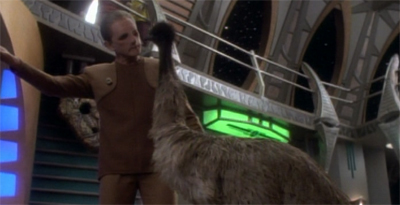
And after Progress gives us the most Deep-Space-Nine-y” episode yet, If Wishes Were Horses… offers the most generic Star Trek episode this side of The Passenger. The plot here should be very familiar. Like in Imaginary Friend or Shore Leave, the characters find their imaginations seem to be bringing things to life. Of course, it turns out to be an advanced alien intelligence that really just wants to study our crew, like in The Observer Effect or Scientific Method or even Schism. What I’m getting at here is that there’s really very little in this premise which hasn’t been done before or since on Star Trek, and nothing which wouldn’t feel more at home on Star Trek: The Next Generation or Star Trek: Voyager.

While it’s not as bad as The Passenger or Move Along Home, it is terribly generic and it feels like a waste of an episode in an already truncated season.

If wishes were emus...

If wishes were emus…

Continue reading

Star Trek: Deep Space Nine – Progress (Review)

Star Trek: Deep Space Nine is twenty years old this year. To celebrate, I’m taking a look at the first season. Check back daily for the latest review or retrospective.

Progress is the best episode of Star Trek: Deep Space Nine‘s first season to date. Of course, there are better episodes ahead – two of them clustered at the end of the show’s truncated first year – but Progress still represents a considerable improvement over anything that has come before. It isn’t quite perfect, but it does have a nice character focus and takes advantage of the show’s unique perspective and position. It’s evidence that the writing staff were at least engaging with the show’s status quo and trying to work with it to tell interesting stories, with Progress offering an early pure example of what Deep Space Nine story should probably look like.

While the first season has been quite bumpy (although notably less bumpy than any of the opening seasons of the other three Star Trek spin-offs), Progress offers a demonstration that we are getting somewhere. The title might apply as much to the status of the show itself as to the themes of the episode.

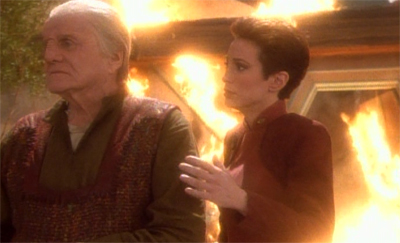
Burning down the house...

Burning down the house…

Continue reading