• Following Us

  • Categories

  • Check out the Archives


  • Awards & Nominations

Ed Brubaker’s X-Men – Deadly Genesis (Review/Retrospective)

This May, to celebrate the release of X-Men: Days of Future Past, we’re taking a look at some classic and modern X-Men (and X-Men-related) comics. Check back daily for the latest review.

In 2006, Ed Brubaker was one of the hottest younger writers working at Marvel Comics. He was writing a celebrated run on Captain America. He was about to take over Daredevil following a monumental run by Brian Michael Bendis. He was also going to launch The Immortal Iron Fist with collaborator Matt Fraction. It was a year that cemented Ed Brubaker as one of the primary voices writing at Marvel Comics. In the midst of all that, Brubaker also took over the X-Men franchise.

In the early years of the decade, Marvel had tasked Brian Michael Bendis to reinvent the Avengers franchise, which he had done with Avengers Disassembled and an extended stint on New Avengers. Bendis had done this by tearing down a lot of the elements of The Avengers taken for granted and demonstrating that nothing was safe. The Avengers Mansion was destroyed, Hawkeye and Vision were killed, Wolverine and Spider-Man were recruited. The approach was iconoclastic, but it worked.
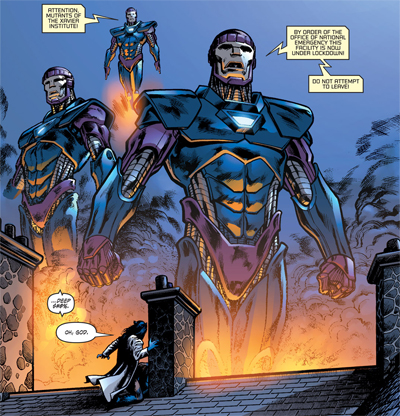
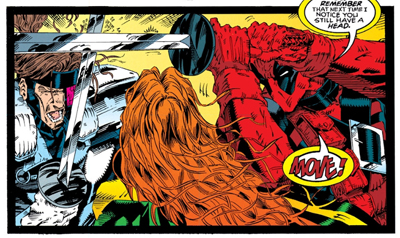
Sentinels of liberty...

Sentinels of liberty…

It’s not too hard to see Ed Brubaker’s stint on the X-Men franchise as a not-entirely-successful attempt to emulated Bendis’ reinvention of The Avengers. There was a clear attempt to focus on aspects of the mythology that were outside the comfort zone, and to attack and undermine some of the most sacred areas of the mythology. After all, Brubaker began his run on Uncanny X-Men with The Rise and Fall of the Shiar Empire, a twelve-issue space opera that took the focus of the book off the wake of House of M.

Logically, then, Deadly Genesis serves as the equivalent of Bendis’ Avengers Disassembled. It’s the story that exists as the lead-in to Brubaker’s run, outside the monthly series. It sets the agenda for a lot of what is to follow, shifting the premise and changing the rules. However, Brubaker’s work suffers because he doesn’t have the same freedom that Bendis had with New Avengers. He can’t just clear the board and start anew. Deadly Genesis find him heaping a bold new status quo on top of a bold new status quo.

Burning it all down...

Burning it all down…

Continue reading →

Mark Waid, Ian Churchill and Ken Lashley’s Deadpool – Sins of the Past (Review/Retrospective)

This May, to celebrate the release of X-Men: Days of Future Past, we’re taking a look at some classic and modern X-Men (and X-Men-related) comics. Check back daily for the latest review.

It’s interesting to try to chart the meteoric rise of Deadpool. Over the past decade, Deadpool has emerged as one of Marvel’s most popular comic book characters. He features in various miniseries and variant covers, populated quite a few books from month-to-month. While his exposure hasn’t quite reached the same level as that of Spider-Man or Wolverine, Deadpool is easily one of the most frequently-appearing characters in Marvel Comics.

It is strange to think that he is a relatively young character, originating in Rob Liefeld’s New Mutants shortly before it became X-Force. First appearing in February 1991, Rob Liefeld created Deadpool as a decidedly nineties character – “the merc with the mouth”,  he felt like a conscious composite of Spider-Man with more outrageous villains (or anti-heroes) like Deathstroke. Indeed, the similarity is something of a cheesy joke. Where might one practise their Deathstroke? In the Deadpool, of course.

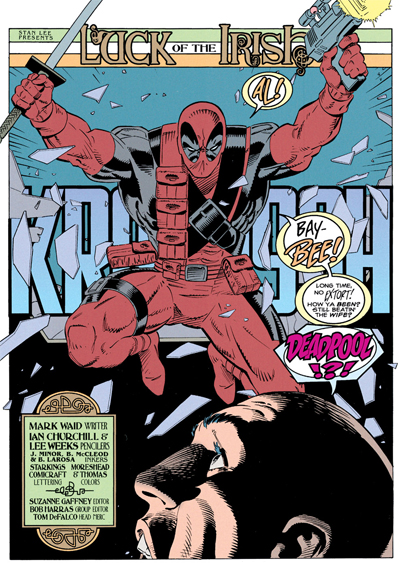
Crossing swords...

Crossing swords…

Liefeld created a cheesy and hyperactive foe for his mutant characters, allowing the character all manner of cheesy and awkward one-liners. However, that version of Deadpool is almost unrecognisable when compared to the character as he exists today. The modern version of Deadpool is a character aware of his own fictional nature, with dialogue balloons painted yellow to distinguish him from the less self-aware characters around him.

Today’s Deadpool is more of a comedy force of nature than a serious anti-hero, a character basking in the absurd rather than trying to appear badass. It’s interesting to wonder how that character transformed so radically (and so thoroughly). Certainly, his first solo miniseries seems to occupy the strange space between Rob Liefeld’s half-serious mercenary psychopath and Joe Kelly’s comic book comic. While still a little too steeped in nineties aesthetic for its own good, Mark Waid’s Deadpool is a small step in that direction.

Well, at least he knows how to make an entrance...

Well, at least he knows how to make an entrance…

Continue reading →

X-Men – Battle of the Atom (Review)

This May, to celebrate the release of X-Men: Days of Future Past, we’re taking a look at some classic and modern X-Men (and X-Men-related) comics. Check back daily for the latest review.

Battle of the Atom is a gigantic mess – but it’s a very fun gigantic mess.

Battle of the Atom seems to exist to fill two separate niches. On the one hand, its publication syncs up rather nicely with the fiftieth anniversary of Marvel’s merry mutants – something that the comic acknowledges by focusing on Stan Lee and Jack Kirby’s original creations and by setting the climax at a recognisable setting from that first issue all those years ago. There’s a palpable sense of nostalgia about the whole thing – focusing on the past, present and future of the superhero team.

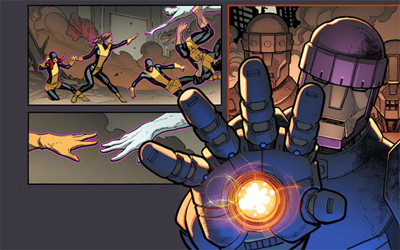
Stop or my Sentinel will shoot...

Stop or my Sentinel will shoot…

At the same time, it’s the big X-Men crossover event published half-a-year before the release of a multi-million dollar Bryan Singer motion picture. As such, Battle of the Atom feels heavily influenced by X-Men: Days of Future Past. Not only does it play with a variety of the tropes and conventions cemented by that classic Chris Claremont and John Byrne story, it includes numerous shout-outs and even the same basic structure.

Writers Brian Michael Bendis, Brian Wood and Jason Aaron are all having a great deal of fun writing Battle of the Atom, even if the comic does occasionally feel a little bit too light or too familiar. Then again, what’s the point in a fiftieth birthday party if you can’t be a little indulgent?

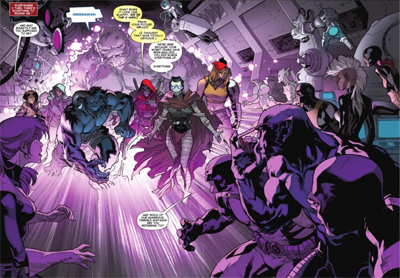
Dazed by X-Men past...

Dazed by X-Men past…

Continue reading →

X-Men – Days of Future Past (Review/Retrospective)

This May, to celebrate the release of X-Men: Days of Future Past, we’re taking a look at some classic and modern X-Men (and X-Men-related) comics. Check back daily for the latest review.

What’s striking about Days of Future Past is how incredibly short it is.

That’s not to suggest that the comic “feels” small or has a shortage of ideas or anything like that. In Days of Future Past, writer Chris Claremont and artist John Byrne toss out a whole host of ideas that shape and define the entire X-Men mythos. These issues continue to inspire the X-Men comic book line. Without Days of Future Past, there would be no Age of Apocalypse. The franchise’s fiftieth anniversary “event” – Battle of the Atom – is essentially a gigantic tribute to Days of Future Past.

Everything burns...

Everything burns…

In fact, the influence of this story extends beyond the X-Men as a comic book franchise. “Bad alternate future” may be a trope favoured by the X-Men comics, but it’s a staple of the genre and – arguably – the medium. There’s a reason that the iconic cover to the first issue of this story arc has been emulated so often, or that Alan Moore planned to riff on the story’s central idea for his proposed Twilight of the Superheroes. Days of Future Past is just a great story hook.

However, reading it today, it’s striking how short it is. All of this come from two issues.

The poster child for this sort of story...

The poster child for this sort of story…

Continue reading →

Non-Review Review: Brick Mansions

Brick Mansions is an incredibly stupid film. It’s a movie that doesn’t make any real sense. It hinges on a series of set-ups and reversals that don’t even hold together while watching the movie. Anybody expecting an action movie that makes any semblance of sense is probably best advised to look elsewhere. And yet, despite this, there’s a point where the sheer unrelenting absurdity of Brick Mansions becomes fun in a grindhouse “this is probably great fun at 2am” sort of way.

At its heart, Brick Mansions feels like a throwback to a very particular style of eighties science-fiction cinema. It’s an action movie with the faintest trace of a social conscience that really exists just to justify ridiculous plot developments and excuse a central story that makes absolutely no sense. Lacking the awareness or intelligence that defined the best of the socially-conscious eighties science-fiction action films, Brick Mansions feels a lot like the kind of guilty pleasure that eats up the airwaves at the most unsocial broadcast hours.

You don't need that to make out the plot holes...

You don’t need that to make out the plot holes…

Continue reading →

Todd McFarlane’s Run on Spider-Man (Review/Retrospective)

This April, to celebrate the release of The Amazing Spider-Man 2, we are taking a look at some classic and modern comics featuring Spider-Man (and friends). Check back daily for the latest review.

Todd McFarlane is undoubtedly one of the best artists ever to work on Spider-Man. His take on the character is iconic and influential. He really captures the sense of Spider-Man as a character who should be unnerving or disturbing – a character who is part insect, whose limbs are able to bend and contort in ways that would seem unnatural to a casual observer. His run on The Amazing Spider-Man with writer David Michelinie is one of the most underrated Spider-Man comics ever produced.

McFarlane was working at Marvel around the time that the company was investing more power in its artists. More and more, artists were becoming more essential to the creative process – whether credited as “plotters” or “writers.” Jim Lee was wresting control of the X-Men franchise from veteran writer Chris Claremont. Rob Liefeld was writing and drawing on his popular X-Force, launched from New Mutants.

Holding it together...

Holding it together…

In this context, it made sense to allow Todd McFarlane to branch out and write his own Spider-Man title. Launched to run alongside The Amazing Spider-Man, McFarlane’s adjectiveless Spider-Man remains one of the comic book success stories of the nineties, selling 2.5 million copied on initial release. It remains one of the best selling comic books of all time, with the original artwork recently selling for over $675,000.

As with many of its contemporary artist-drive series, McFarlane’s Spider-Man is a compelling read. It’s a glimpse inside the mindset of the comic book industry, a snapshot of trends that were still developing. McFarlane’s writing might be a little over-cooked, his plotting a little weak and he may not have the strongest sense of theme or structure. However, McFarlane’s artwork is absolutely spectacular, and there’s something very fascinating about McFarlane’s attempt to write Spider-Man as a horror comic starring the iconic web-slinger.

A sting in the tale...

A sting in the tale…

Continue reading →

Non-Review Review: Pompeii

Pompeii is a cliché love story nested inside a cheesy b-movie sitting inside a good old-fashioned disaster movie. None of these elements are entirely successful – in fact, there are points where the love story is downright painful – but Paul W.S. Anderson manages to construct a reliably pulpy (if entirely predictable) action adventure. While by no means exceptional – it’s a mess from both a plotting and a thematic perspective – Pompeii does look as sound quite nice. As with a lot of Anderson’s films, there’s a sense that the director is more interested in his action sequences than the characters trapped inside them.

Setting the town alight...

Setting the town alight…

Continue reading →

Spider-Man: Chapter One (Review/Retrospective)

This April, to celebrate the release of The Amazing Spider-Man 2, we are taking a look at some classic and modern comics featuring Spider-Man (and friends). Check back daily for the latest review.

Spider-Man: Chapter One is a strange little comic. In context, it makes a great deal of sense. Spider-Man has always been one of Marvel’s most popular and iconic comic book heroes. In the late nineties, the comic book industry was trying to figure out how to push forward, following the sales explosion and implosion of the mid-nineties. With superheroes like Spider-Man and the X-Men primed for a transition to the big screen, revisiting the early days of these heroes made a great deal of sense.

And John Byrne was the logical choice for a book like this. Byrne was a unique talent. He had enjoyed incredibly successful runs on Uncanny X-Men and The Fantastic Four at Marvel. More than that, though, he had already overseen the successful relaunch of another classic character. In the wake of DC’s universe-altering line-wide Crisis on Infinite Earths, John Byrne had been the writer who re-drafted Superman’s origin as part of the Man of Steel miniseries in 1986.

Boundless enthusiasm...

Boundless enthusiasm…

And so, Marvel gave us Spider-Man: Chapter One. The comic was a reimagining of the earliest days of the wall-crawling superhero, spanning thirteen issues and covering many of the character’s earliest encounters with his classic foes. John Byrne was writing the script and providing the artwork for the comics, which seemed primed to introduced Spider-Man to a whole new generation of readers, giving audiences a back-to-basics take on Spider-Man that was fresh and accessible.

At least, that was the idea. In actuality, Spider-Man: Chapter One feels like a massive miscalculation on just about everybody’s part. It seems to be aiming for some middle ground between Kurt Busiek and Pat Olliffe’s contemporary Untold Tales of Spider-Man and Brian Michael Bendis’ pending Ultimate Spider-Man. It seems like Byrne is never sure whether he’s simply re-telling the classic Stan Lee and Steve Ditko run on The Amazing Spider-Man with a few bells and whistles, or trying to make it his own.

You are about to enter... the Spidey zone...

You are about to enter… the Spidey zone…

Continue reading →

Non-Review Review: The Amazing Spider-Man II

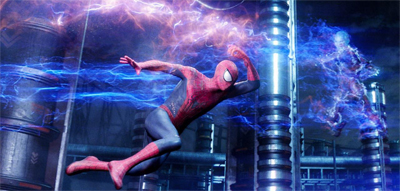
What is remarkable about Marc Webb’s The Amazing Spider-Man II is how much it resembles a comic book. Not a particular comic book – although there are numerous shout-outs to iconic Spider-Man moments, right down to the choice of costuming – but in general terms. It isn’t that Marc Webb tries to construct his film to evoke the look and feel of a comic book – this isn’t Ang Lee’s Hulk; in fact, Webb seems much more comfortable here than he was with The Amazing Spider-Man, making a movie that feels more playful and relaxed within its medium.

Instead, The Amazing Spider-Man II borrows the structure of a comic book. It offers its own story, but that story isn’t constructed particularly tightly. Instead, the story seems to have been fashioned as part of a greater – as if part of a larger serialised narrative that has yet to take form. It’s quite distinct from the approach taken with Marvel’s Cinematic Universe, where the films feel more like blocks that fit together. Instead, this feels more like the second chapter in a larger story, without being dissolved completely into the larger narrative.

The Amazing Spider-Man II has its own themes and motifs, and it documents a pretty epic selection of events, but the emphasis isn’t so much on this one encounter as what this encounter says about its hero. It’s much more interested in what these events tell us about our hero than it is in documenting a single self-contained story. It’s a novel (and somewhat bold) attempt at a serialised superhero narrative, and the results are absolutely fascinating.

Electro-fying!

Electro-fying!

Note: This is a spoiler-filled review of The Amazing Spider-Man II. You can find a spoiler-lite version here. Continue reading for more in-depth thoughts on the film, with the knowledge that absolutely everything is up for discussion. Continue at your own peril!

Continue reading →

Spider-Men (Review/Retrospective)

This April, to celebrate the release of The Amazing Spider-Man 2, we are taking a look at some classic and modern comics featuring Spider-Man (and friends). Check back daily for the latest review.

Spider-Men feels very light. It is the first official crossover between the mainstream Marvel Universe and the Ultimate Universe, something that readers had been promised would never happen. However, despite the fact that this is a big event that has been more than a decade in the making – something rumoured since the earliest days of Ultimate Spider-Man – Spider-Men feels decidedly low-key.

It’s pretty much a collection of vignettes rather than a compelling story in its own right, allowing Bendis to run through a checklist of material to smooth the transition between ultimate!Peter Parker and his successor, Miles Morales.

"Well, this is awkward..."

“Well, this is awkward…”

Continue reading →