












Extreme Measures is the closest thing to a standalone story within this epic ten-part conclusion to Star Trek: Deep Space Nine.
All of the other episodes carry over plot threads and subplots that either develop existing narratives or set-up future twists. This is true even of the more self-contained chapters: When It Rains… and Tacking Into the Wind are something of a two-parter in the middle of the arc, but they pick up in the wake of The Changing Face of Evil; although The Dogs of War has a self-contained subplot focusing on the Ferengi, it deals with baggage from Extreme Measures while setting up What You Leave Behind.
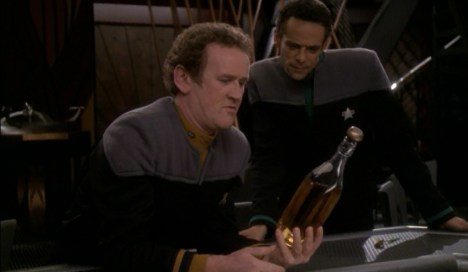
“Well, Miles. If you think it’ll make the episode go easier.”
In contrast, Extreme Measures is practically a bottle show. With the exception of a short one-scene appearance from Garak, Extreme Measures is devoid of the recurring guest stars that populate this final run of episodes. Although Damar and Martok are mentioned, neither Casey Biggs nor J.G. Hertzler appear. Perhaps glad of a week off before his double duty on The Dogs of War, Jeffrey Combs is entirely absent. There is no guest appearance from Louise Fletcher, Marc Alaimo, James Darren, Barry Jenner or Salome Jens.
Indeed, Extreme Measures is very precisely focused on the single story that it wants to tell. Most episodes in this final stretch of the final season have at least two or three plots running through them: Penumbra focuses on the loss of Worf, on Sisko’s retirement plans, on Damar’s growing unease; When It Rains… features the plotting of Dukat and Winn, the development of Damar’s rebellion, and the threat to the Alliance posed by Gowron; The Dogs of War witnesses Ferengi succession, the plan for the invasion of Cardassia, the implosion of Damar’s rebellion.
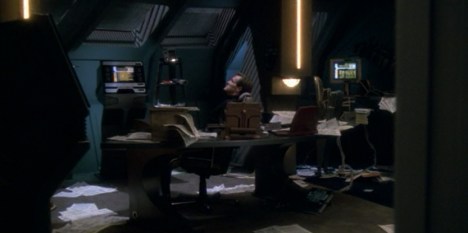
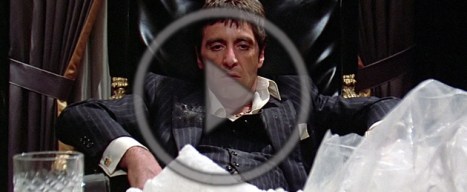
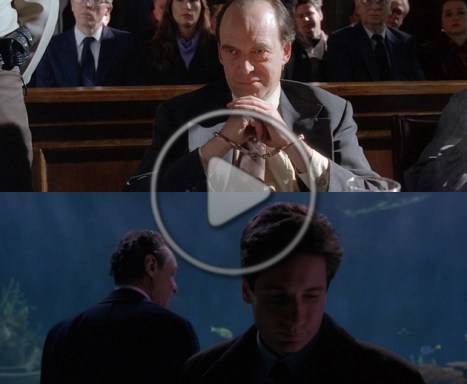
Journey to the Centre of Sloan’s Mind.
There is so much happening across these ten episodes that it feels strange that Extreme Measures can effectively call a timeout on these recurring plot threads. There are references to the Breen weapon and the Cardassian rebellion, to the ascension of Chancellor Martok and to Bashir’s lingering attraction to Ezri. However, Extreme Measures is an episode without a b-plot or a c-plot. The episode is driven entirely by its primary narrative, the story of how Julian Bashir and Miles O’Brien embark on one last adventure together.
There is something surreal, and almost endearing, about the fact that Deep Space Nine feels comfortable taking time out from its most ambitious experiment with serialisation to make the journey to the centre of Sloan’s mind.
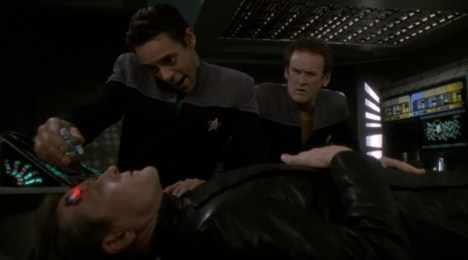
“Julian, are you sure you haven’t been watching too much Star Trek: Voyager?”
Filed under: Deep Space Nine | Tagged: Arc, Bashir, bradley thompson, david weddle, friendship, O'BRIEN, section 31, sloan, star trek, star trek: deep space nine | 4 Comments »
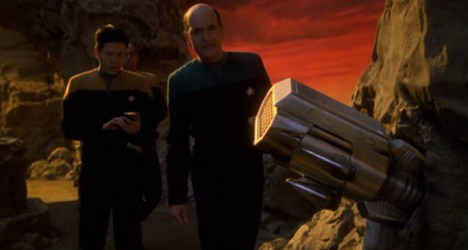













Star Trek: Discovery – The Butcher’s Knife Cares Not for the Lamb’s Cry (Review)
The Butcher’s Knife Cares Not for the Lamb’s Cry represents another attempt to reconcile one of the central tensions of Star Trek: Discovery, the conflict that exists between the expectations of a Star Trek series and the demands of a piece of prestige television. It frequently feels like there is a tug of war between these two competing impulses within the series, and the production team are trying desperately to find the right balance between these two very different storytelling models.
Much like Context is for Kings, the basic story at the heart of The Butcher’s Knife Cares Not for the Lamb’s Cry is quintessential Star Trek plotting. The contours of the plot will be recognisable to any viewer with even a passing familiarity with the narrative structures and templates of the larger Star Trek franchise. At the same time, a lot of the episode’s finer details are more recognisable as the hallmarks of contemporary prestige television. The result is a piece of television that tells a very simplistic Star Trek in a manner that feels somewhat dissonant.
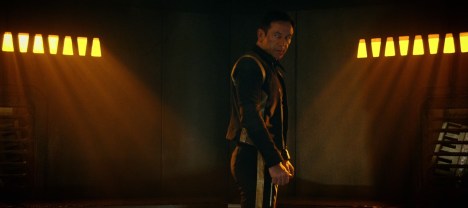
Hanging out with the Kol kids.
There is an awkwardness to The Butcher’s Knife Cares Not for the Lamb’s Cry, a sense that the creative team are still working out the proverbial kinks. Much like the engineering and science staff on the Discovery itself, the production team are creating something new and exciting, but something without a clear precedent or blueprint. Discovery often struggles to properly mix its constituent elements, some of its narrative choices feeling clumsy and others struggling to mesh with the story being told.
At the same time, like Context is for Kings before it, The Butcher’s Knife Cares Not for the Lamb’s Cry is an episode that exists primarily to reassure viewers that Discovery is still fundamentally Star Trek, no matter the production design or the prestige trappings. However, Discovery is investing so much time in proving that it is Star Trek, that it is still searching for its own clear voice.
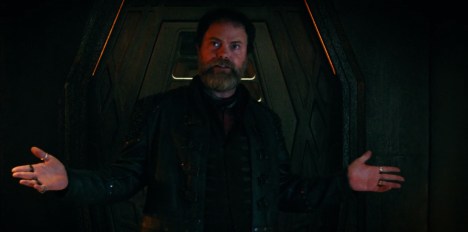
Resting uneasy.
Continue reading →
Filed under: Star Trek | Tagged: burnham, death, klingons, landry, Lorca, prestige television, social commentary, star trek, star trek: discovery, the devil in the dark | 5 Comments »