• Following Us

  • Categories

  • Check out the Archives


  • Awards & Nominations

159. Gone With the Wind – Winter of ’39 (#165)

Hosted by Andrew Quinn and Darren Mooney, and this week with special guests Grace Duffy and Rioghnach Ní Ghrioghair, The 250 is a fortnightly trip through some of the best (and worst) movies ever made, as voted for by Internet Movie Database Users. New episodes are released Saturdays at 6pm GMT.

So this week, Victor Fleming, George Cukor and Sam Wood’s Gone With the Wind.

A tale of revolution, romance and redemption set against the backdrop of the Civil War, Gone With the Wind remains one of the most sweeping epics ever produced by the studio system. The decades-long love affair between Scarlett O’Hara and Rhett Butler unfolds against the backdrop of the fall and rise of Scarlett’s family fortune.

At time of recording, it was ranked 165th on the list of the best movie of all time on the Internet Movie Database.

Continue reading

New Podcast! The X-Cast – Season 5, Episode 2 (“Redux II”)

It’s a bit of a change up on The X-Cast this week. Last week, I joined Tony Black to discuss the first part of the fifth season premiere Redux I. This week, Tony swapped out with Russell Hugo, whom I joined to discuss Redux II.

Redux II is an interesting beast. I am actually appreciably fonder of Redux II than I am of Redux I. I think the second part of the premiere does a lot of the stuff that the first half attempts, but in a much more interesting and compelling manner. It’s not quite as good as Gethsemane at the end of the fourth season, but it’s still a surprisingly ambitious and adventurous story for The X-Files to tell at this point in its run – the moment at which the series is at the peak of its popularity and The X-Files: Fight the Future is looming large in the horizon. I hope this was a fun and interesting discussion.

You can listen to the episode here, or click the link below.

Continue reading

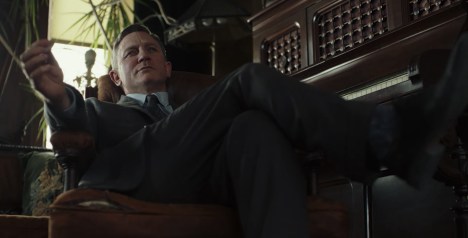
New Escapist Column! “Knives Out” and the Suggestion that the Rich are Not So Sharp…

I published a new In the Frame piece at Escapist Magazine this evening. This one covers something that I’ve wanted to talk about for a little while, which is the interesting aspect of this year’s recurring theme of class warfare that runs through works as diverse as Joker, HustlersReady or Not, Succession, Parasite and Knives Out.

To be fair, it is not unusual to see this sort of tension playing out on the big screen. After all, American cinema has long been fascinated by working class con men and hucksters getting one over on the wealthy establishment. However, what distinguishes the recent crop of media exploring this theme is the recurring suggestion that the wealthy are not especially sharp. Historically, the rich have been portrayed as canny and suave – often dangerous adversaries because of their ruthlessness and relentlessness. What is interesting about the class warfare dimension of this year’s films is the way in which money and success often seem to have coddled the wealthy leaving them surprisingly naive and foolish despite their arrogance and privilege.

You can read the piece here, or click the picture below.

Non-Review Review: Just Mercy

Just Mercy feels like a timely and relevant update to the classic death row prestige picture.

The bulk of Just Mercy unfolds over six years, between 1987 and 1993. This roughly overlaps with a cinematic interest in this subject matter in the late eighties and into the nineties. Mississippi Burning and A Time to Kill looked at the racially-charged dimension of criminal justice in the American South, released in 1988 and 1996 respectively. Dead Man Walking and The Chamber tackled anxieties around the death penalty in 1995 and 1996. Indeed, Just Mercy feels like something of a companion piece to these explorations of the American criminal justice system.

Courting public opinion.

These sorts of films have become increasingly rare in recent years, largely driven by changes in the market. The death of the mid-budget movie has had a major impact on these sorts of projects, with the most recent major examples being films like The Hurricane in 1999 and The Life of David Gale in 2003. These sorts of projects have largely migrated to television and arguably podcasts, developed as limited series like The Night Of or Now They See Us. As such, it’s rare to see a film like this receiving that sort of awards push.

However, what is truly interesting about Just Mercy is the way in which it doesn’t just revive the starry prestige criminal justice drama, it also modernises it. Just Mercy might be set against the backdrop of the late eighties and early nineties, but it feels undeniably current in how it approaches that familiar subject matter.

Conviction.

Continue reading

New Escapist Column! “No Time to Die” and that Missing Killer Instinct…

So the trailer for No Time to Die, the new James Bond movie, dropped yesterday.

I wrote a bit about my reaction to it at Escapist Magazine, primarily how I was a little underwhelmed by how generic it all felt. It lacked the strong statement of purpose that defined the trailers for movies like GoldenEye, Casino Royale and Skyfall. It seems to be designed to assure audiences that all the required plot elements are in place, but it never actually makes any strong statements about what the movie is supposed to be.

You can read the piece here, or click the picture below.

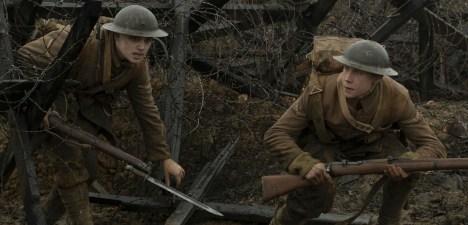
Non-Review Review: 1917

1917 is a stunning technical accomplishment.

Effectively hybridising Dunkirk and Birdman or (The Unexpected Virtue of Ignorance), 1917 is a war movie that is shot in such a way as to suggest a single extended take. Of course, the audience understand that it isn’t really a single take any more than Rope was a single take, and 1917 underscores this sense of unreality by compressing time and space on this epic adventure across the front lines of the First World War. The illusory nature of that long-take style is the entire point of the exercise.

Out in the (Scho)field.

1917 does suffer slightly in narrative terms. From a storytelling perspective, 1917 is a big collection of familiar war movie tropes. Indeed, 1917 ultimately serves to illustrate just how bold and compelling Dunkirk was in its approach to this familiar narrative template. All of the clichés and archetypes that were stripped out of Dunkirk have been inserted back into 1917, which repeatedly leans on genre shorthand to make its points about the folly of war and the senselessness of such carnage.

However, the beauty of 1917 lies not in the story that it is telling, but in the way that it tells that story. In its best moments, 1917 is haunting, nightmarish and ethereal. 1917 works best when it steers clear of the genre’s stock dialogue and characterisation, and instead aims for something much more primal and evocative.

Barbed comments.

Continue reading

Non-Review Review: The Lighthouse

The Lighthouse is a striking, evocative, psychedelic horror. It is also about twenty minutes too long.

Director Robert Eggers made a striking impression with The Witch. Indeed, there’s a clear set of throughlines connecting The Lighthouse to The Witch. Both are fundamentally period pieces about characters who find themselves in extremely isolated conditions, with the unsettling implication that something vague and ominous is lurking in the darkness just beyond the candle light. Both are also highly formal pieces, with Eggers embracing a consciously heightened aesthetic to create a sense of unreality within his film.

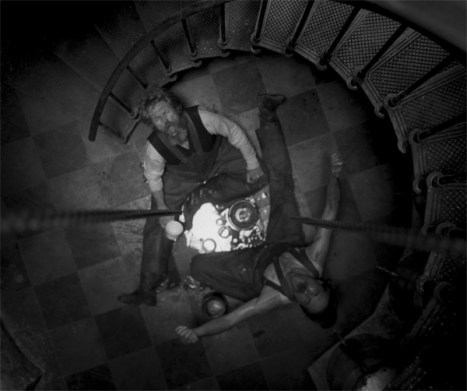
Downward spiral.

However, The Lighthouse stands apart from The Witch in the particulars of its exploration of isolation. After all, The Witch was a story about a young woman who moved into the rural countryside with her entire nuclear family. In contrast, the experience in The Lighthouse is much more intense. It is the story of a young man who finds himself offered a (relatively) high-paying position on a remote rock to work as an assistant to a veteran lighthouse keeper. The two men are strangers when they start to work together, and may remain strangers throughout.

The Lighthouse becomes a study of the descent into madness, the collapse of civility, and the horrors of living with a terrible room mate.

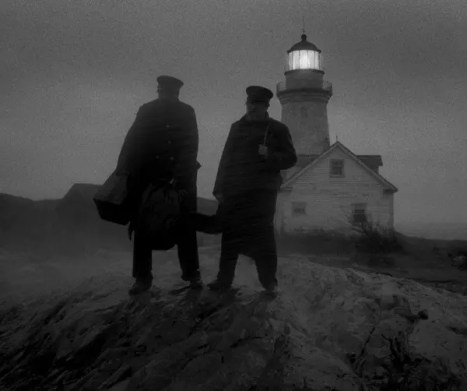
Solid as a rock.

Continue reading

158. The Wizard of Oz – w/ The Movie Palace – Winter of ’39 (#–)

Hosted by Andrew Quinn and Darren Mooney, The 250 is a fortnightly trip through some of the best (and worst) movies ever made, as voted for by Internet Movie Database Users. New episodes are released Saturdays at 6pm GMT.

This week, a special crossover episode with The Movie Palace Podcast, a film podcast hosted by Carl Sweeney taking a look at the classics of Hollywood’s golden age. Carl suggested a crossover episode taking a look at the list, and particularly some of the classic movies listed on it.

So this week, Victor Fleming, George Cukor, Mervyn LeRoy, Norman Taurog, Richard Thorpe and King Vidor’s The Wizard of Oz.

After a freak hurricane scoops her home off the ground and deposits her in a vibrant magical land occupied by talking scarecrows and wicked witches, Dorothy Gale must confront a shocking reality: she’s not in Kansas anymore.

At time of recording, it was not ranked on the list of the best movie of all time on the Internet Movie Database.

Continue reading

Non-Review Review: Ordinary Love

Ordinary Love offers a charming and affecting glimpse inside a marriage.

Liam Neeson and Lesley Manville play Tom and Joan, an ageing couple enjoying their autumn years together. One evening, Joan discovers a lump in her left breast. As a result, the couple find themselves navigating a precarious emotional rollercoaster as Joan deals with the resulting diagnosis and Tom struggles to hold it all together long enough that he might be his wife’s rock. Along the way, the couple try to find some balance in their lives, to maintain a delicate equilibrium inside a marriage that has already been strained by trauma unimaginable.

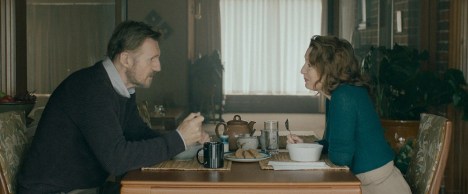
Food for love.
And also just food.

The “cancer” subgenre is a strange thing, encompassing movies such as Me and Earl and the Dying Girl or My Sister’s Keeper. These sorts of movies, and others about terminal diseases or afflictions, have to walk a fine line. Cancer is so common an ailment that such loss and such trauma is almost a universal experience. Movies like Me and Earl and the Dying Girl and My Sister’s Keeper can often struggle to capture the depth of emotion associated with such a diagnosis without slipping into cynical exploitation.

Ordinary Love works so well because of the humanity and empathy at its core. As the title implies, and as Tom outlines during one of the film’s most moving scenes, Ordinary Love understands that this sort of trauma is so horrifying because of the way it intrudes into the familiar and the safe. Cancer is a disease that turns a body against itself, spreading and growing inside the body that a person has known since birth. Ordinary Love captures that intrusion of the unknown into the familiar, offering a beautiful and moving sketch of a marriage that feels lived-in.

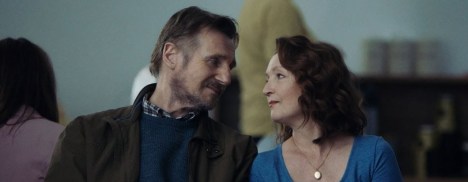
A couple of delights.

Continue reading

Non-Review Review: JoJo Rabbit

JoJo Rabbit is a sincere and sweet movie, but also a hopelessly misguided one.

There’s a lot of warm humanism underpinning Taika Waititi’s adaptation of the novel Caged Skies, about the eponymous young boy who finds himself wrapped up in the propaganda of Nazi Germany. Johannes Betzler is a ten year old boy with who fixates upon being “the bestest, most loyal little Nazi [Hitler will have] ever known.” He has even fashioned his imaginary friend in the form of Adolf Hitler. However, his life is turned upside down when he discovers a Jewish girl living in the crawl space in his dead sister’s bedroom.

He’s going to be Fuhrer-ious.

Waititi’s film has a surprisingly solid grasp of tone, given the material in play. JoJo Rabbit is sweet and sincere, pointed and humane. It is as playful as Waititi’s work on The Hunt for the Wilderpeople or even Thor: Ragnarok, but also appreciates the need to handle certain topis with care and consideration. There’s a warm empathy that radiates from the film, particularly in the dynamic between Jojo and his mother Rosie, who is doing everything she can to protect her son even as she watches his radicalisation.

However, despite all of this, JoJo Rabbit hinges on a fatal miscalculation. It is a story that makes a conscious effort to humanise its Nazi subjects. It is a film so rigourously invested in affirming JoJo’s humanity that it never quite confronts the audience with the horror of his denial of that humanity to others. JoJo Rabbit is a film that suggests the greatest human tragedy in the Second World War is the poor little Nazi boy, and can barely bring itself to look at the actual horrors that he inflicted.

He ain’t Hitler, he’s my buddy.

Continue reading