• Following Us

  • Categories

  • Check out the Archives


  • Awards & Nominations

The X-Files – Unrequited (Review)

This February and March, we’re taking a trip back in time to review the fourth season of The X-Files and the first season of Millennium.

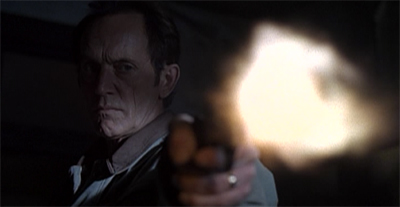
Unrequited opens with Mulder and Scully’s attempts to stop an assassination attempt by an invisible man, before jumping back twelve hours to explain how our heroes got into this situation. With that set-up, Unrequited falls into a lot of the narrative traps associated with an in media res teaser. After all, there’s not really anything special about the teaser. There is no mystery to be solved, no strange behaviour to explain. What questions are we meant to ask, based on that opening scene? How are we meant to look at the rest of the episode differently, knowing what we know?

Sure, Mulder and Scully are protecting Major General Benjamin Bloch. That would seem to be a little bit outside the remit of “the FBI’s most unwanted”, but that is not too strange a situation for the duo. They are FBI agents, so there is a certain flexibility in their job description. The Field Where I Died – an episode with a much more effective non-linear teaser – featured Mulder and Scully collaborating with the ATF. So it isn’t as if the set-up should be striking or compelling.
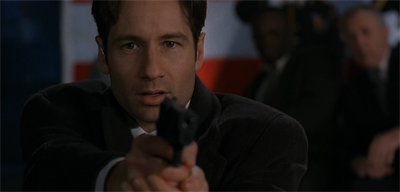
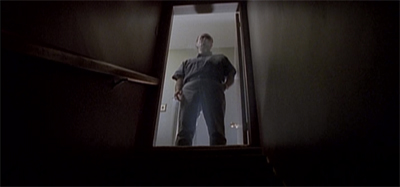
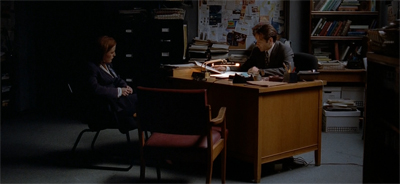
Stop, or my Mulder will shoot!

Stop, or my Mulder will shoot!

It seems like we are meant to focus on the monster of the week – Vietnam veteran Nathaniel Teager. Teager has the ability to turn himself invisible, which is quite something. Sure enough, the teaser to Unrequited offers a glimpse of that ability in action. But why is it important to have show us that ability in a scene from the climax of the episode? With a few adjustments, Teager’s first murder in the back of the limousine would serve the same purpose; introducing the audience to his powers without the need to recycle several minutes of footage from the climax.

After all, the most dissatisfying aspect of the in media res teaser is not the fact that it is completely inessential. Instead, the decision to use footage from the climax means that the audience has to sit through the same sequence twice. The teaser for Unrequited works well enough the first time around, but the sequence is not clever or inventive enough to merit a live-action replay towards the end of the hour. It just saps momentum from episode, rendering the final sequences somewhat tedious. That is the biggest problem with the opening of Unrequited, even beyond laziness.

Flags of our father figures...

Flags of our father figures…

Continue reading

Millennium – Sacrament (Review)

This February and March, we’re taking a trip back in time to review the fourth season of The X-Files and the first season of Millennium.

If Force Majeure and The Thin White Line seem to call forwards towards the weird and eccentric second season, Sacrament is a bit more modest. In many ways, Sacrament seems to foreshadow the last stretch of episodes in the first season. The forces of evil seem to encircle the Black family, creeping closer and closer to the big yellow house and everything it represents. For the first time, Sacrament explicitly puts Frank’s family at the heart of a case; this time focusing on the kidnapping of his sister-in-law from her child’s christening.

In many respects, this points towards the direction the show will take in its final stretch of episodes. Lamentation and Powers, Principalities, Thrones and Dominions will see the forces of evil explicitly violate the Black residence, insidiously eroding the idealised life that Frank has tried to build for his family in their new Seattle home. The cliffhanger at the end of Paper Dove pushes the concept to its logical conclusion, as a secret that Frank has tried to keep from his family finally comes home to roost.

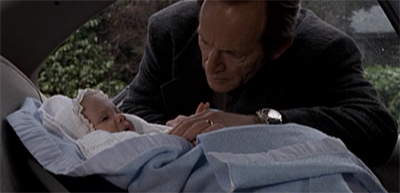
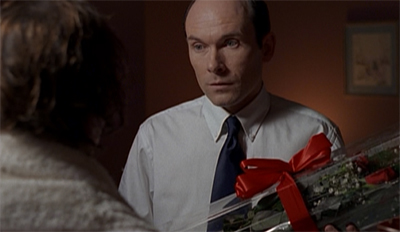
Worst. Uncle. Ever.

Worst. Uncle. Ever.

As with WeedsSacrament demonstrates that writer Frank Spotnitz has an uncanny understanding of how Chris Carter built Millennium. It is an episode that is soaked through with the core themes of the series; it is a story about good and evil, and how evil taints everything that it touches. As with a lot of Millennium, Sacrament is not subtle; the moment that Tom Black is identified as the brother of our protagonist, it is inevitable that the forces of evil will come barrelling down upon him.

Nevertheless, Sacrament demonstrates a clear understanding of what it wants to be, and is a pretty effective snapshot of Millennium at this moment in time. The first season of Millennium is often overlooked and overshadowed amid the controversies surrounding the second or third seasons, but Sacrament stands as a great example of what the first season was trying to do.

Our father...

Our father…

Continue reading

The X-Files – Kaddish (Review)

This February and March, we’re taking a trip back in time to review the fourth season of The X-Files and the first season of Millennium.

Kaddish is the last solo script that Howard Gordon wrote for The X-Files.

The writer would remain part of the writing staff until the end of the fourth season, contributing to scripts like Unrequited or Zero Sum. However, Kaddish would be the last script credited to Howard Gordon alone. So Gordon does not quite get the clean farewell that Darin Morgan got with Jose Chung’s “From Outer Space” or that Glen Morgan and Howard Wong received with Never Again. Instead, Howard Gordon remains a pretty significant presence on the show even after writing his final solo script.

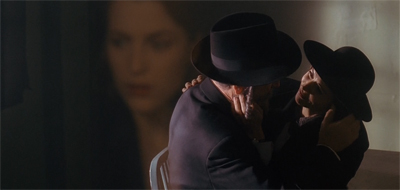
The word made flesh...

The word made flesh…

Nevertheless, Kaddish is packed with a lot of the images and themes associated with Gordon’s work. As with Fresh Bones or Teliko, it is a horror story set within a distinct ethnic community. As with Firewalker or Død Kälm or Grotesque, there is an element of body horror at play. As with Lazarus or Born Again, this is essentially a supernatural revenge story. Kaddish offers a distilled collection of the tropes and signifiers that Gordon helped to define for The X-Files, making it an appropriate final script for the writer.

It helps that Kaddish is a surprisingly sweet and thoughtful little horror story.

The outside looking in...

The outside looking in…

Continue reading

Millennium – The Thin White Line (Review)

This February and March, we’re taking a trip back in time to review the fourth season of The X-Files and the first season of Millennium.

The Thin White Line is the final script from James Wong and Glen Morgan for this season of Millennium, following closely after Never Again, their final script (ever) for The X-Files.

Indeed, there is considerable overlap between the two stories – at least thematically. Both are episodes about destructive cycles. In Never Again, Scully faces the very real possibility that she is now trapped with Mulder; that her life outside the X-files is over. In The Thin White Line, Frank Black contemplates the idea that people are trapped in perpetual cycles of violence and abuse; that the world resembles the ouroboros featured so prominently in the opening credits, a snake constantly eating its own tail.

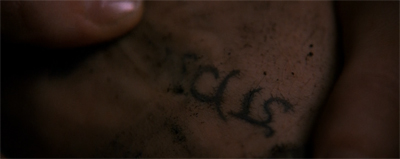
Frank discharge...

Frank discharge…

Never Again is relentlessly cynical. The closing image suggests that nothing will change, that something is broken than cannot be fixed. Important statements hang in the air, unresolved. The Thin White Line is perhaps slightly optimistic. Both Frank Black and Bob Bletcher try in their own way to end cycles of violence and recrimination. While Bob Bletcher responds with brutal cynicism and more violence, Frank Black responds with compassion and humanity. There is a sense of cynicism to The Thin White Line, but there is also some hope.

The Thin White Line is a stand out piece of work, a fantastic illustration of what Millennium can do when it sets its mind to it. Like Force Majeure before it, The Thin White Line suggests that Millennium has very clearly and definitely figured out its own voice. It is no wonder that both episodes come from future showrunners.

Cutting retort...

Cutting retort…

Continue reading

The X-Files – Memento Mori (Review)

This February and March, we’re taking a trip back in time to review the fourth season of The X-Files and the first season of Millennium.

It is easy to see why Scully’s cancer arc is so fondly remembered.

It arrived at a point where the show was at the very top of its game. Scully’s cancer arc comes amid a slew of beloved and classic episodes, in the middle of a season that contains Home, Unruhe, Paper Hearts and many more. It is the defining mythology plot point for the show’s fourth season, which was the point at which The X-Files just exploded into the centre of popular consciousness. More than that, the episode introducing Scully’s cancer – Leonard Betts – was the most-watched episode of The X-Files ever broadcast.

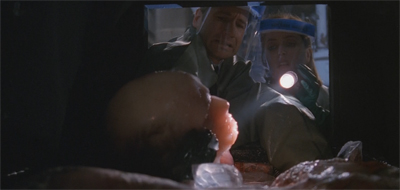
What's in your head?

What’s in your head?

Memento Mori has its own endearing aspects. If Leonard Betts was the show’s highest profile and most populist success, Memento Mori counts as one of the show’s biggest critical successes. The episode is largely responsible for winning Gillian Anderson her Primetime Emmy Award for Outstanding Lead Actress in a Drama Series. It also took home the Primetime Emmy Award for Outstanding Art Direction for a Series and received a nomination for Outstanding Writing for a Drama Series. It is perhaps the most prestigious episode of the fourth season.

However, in spite of all of that, Memento Mori remains something of a mess. It feels like a clumsy retread of One Breath, a story that worked much better in the show’s second season.

Send in the clones...

Send in the clones…

Continue reading

Millennium – Force Majeure (Review)

This February and March, we’re taking a trip back in time to review the fourth season of The X-Files and the first season of Millennium.

Papa?

It’s begun.

Fire and ice.

Fire and ice.

Continue reading

The X-Files – Never Again (Review)

This February and March, we’re taking a trip back in time to review the fourth season of The X-Files and the first season of Millennium.

Not everything is about you, Mulder. This is my life.

Yes but it’s m–

– Glen Morgan and James Wong take their bow; David Chase eat your heart out

...

Continue reading

Millennium – Loin Like a Hunting Flame (Review)

This February and March, we’re taking a trip back in time to review the fourth season of The X-Files and the first season of Millennium.

Loin Like a Hunting Flame represents the peak of a particular type of Millennium story.

It is an episode towards which the season seems to have been building. It is an episode that rather explicitly and candidly ties together two of the show’s favourite subjects: sex and violence, in harmony together. Loin Like a Hunting Flame is something of a stalking horse for the rest of the season; it is the first season episode that most obviously embodies the excesses of any show like Millennium. Fetishised violence has been baked into Millennium since The Pilot opened with a stripper dancing in her own blood; here, it reaches a logical end point.

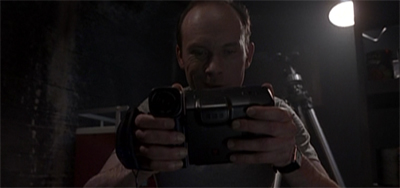
Candid camera!

Candid camera!

Loin Like a Hunting Flame is an episode that is guilty of just about any criticism that might be thrown at it. It is gratuitous; it is sensationalist; it is excessive. It tries to have things both ways, titillating the viewer with glimpse of “exotic” sexual liberation while warning them that those sexually liberated individuals will be punished for their perceived transgressions. Yes, Loin Like a Hunting Flame tries to say something a bit more nuance, but it flails around for most of its forty-five minute runtime like a dying fish.

In many respects, this could be treated as a catharsis for the series. After this point, Millennium turns a corner. The rest of the first season is a lot more ambitious in tone and scope. As much as Loin Like a Hunting Flame closes off a particularly evolutionary line of Millennium, Force Majeure and The Thin White Line push forwards towards a more adventurous show. Loin Like a Hunting Flame just has to work these issues out, once and for all, to their logical (and unsatisfying) conclusion.

Wholesome family fun...

Wholesome family fun…

Continue reading

The X-Files – Leonard Betts (Review)

This February and March, we’re taking a trip back in time to review the fourth season of The X-Files and the first season of Millennium.

Leonard Betts is a big one. In fact, it may just be the biggest one.

Leonard Betts attracted the largest audience in the history of The X-Files, with almost thirty million people tuning in to watch the episode. This audience was largely carried over from Superbowl XXXI, but it arrived at a fortuitous moment for the series. The X-Files was exploding into the mainstream. Chris Carter and Frank Spotnitz had spent Christmas 1996 in Hawaii plotting The X-Files: Fight the Future, a blockbuster movie based on the series. The week before, Mulder and Scully had paid a visit to Springfield in The Springfield Files.

What a waste...

What a waste…

The show’s moment had arrived. Leonard Betts makes for quite the moment. It might not be the best episode in the history of the show; it might not even be the best episode of the season. However, it ranks with Pusher as one of the great archetypal episodes of The X-Files. The show captures so much of what makes The X-Files great, almost perfectly distilling the appeal of the show into a tight forty-odd minute package. It is a beautifully-crafted piece of television that checks all of the right boxes. This is a pretty fantastic introduction to the show and its world.

Leonard Betts is an episode that has been put together with incredible skill, one that demonstrates why The X-Files had such an impact on the popular consciousness.

Comfortable in his skin...

Comfortable in his skin…

Continue reading

Millennium – Weeds (Review)

This February and March, we’re taking a trip back in time to review the fourth season of The X-Files and the first season of Millennium.

Weeds concludes the loose “suburban trilogy” running through the first season of Millennium. In fact, Weeds was filmed directly after Wide Open, but was pushed back in the broadcast schedule so as to air after The Wild and the Innocent. While this change in broadcast and production order is nowhere near as confusing as the scheduling hijinx happening with The X-Files at the same time, it does give an indication that the production team recognised the potential similarities between Weeds and Wide Open.

Both episodes are about the violation of a supposedly “safe” space, bypassing and subverting all the potential security put in place to keep the home secure. In Wide Open, the killer visits open houses and hides in wardrobes until the family go to sleep that night; in doing so, he avoids setting off any alarms. In Weeds, a secure and gated community discovers that they cannot keep their children safe; someone within the community is preying on the residents’ children. As with The Well-Worn Lock, there is a sense that families are not safe, even when they think that they are.

Community watch...

Community watch…

As with Wide Open, Weeds feels just a little bit sensationalist. It is the kind of episode that attracts criticisms about gratuitous violence or exploitation. Millennium was never quite as excessive or as sadomasochistic as its critics would suggest, but there are definite tendencies towards those extremes on display at certain points in the run. While Millennium is very clearly driven by a core moral philosophy, it can occasionally seem a little too comfortable with its brutality or depravity.

Indeed, Weeds hits on quite a few of the stock fears that run through the first season of Millennium: children are victimised by a person in a position of trust and authority; there is biblical quotation; there is sadistic (and disturbing) torture filmed in a heavily stylised manner. There is something almost cynical and calculated about how Weeds hits these familiar buttons; these impulses towards excess haunt the first season of Millennium, and are building to something of a catharsis in Loin Like a Hunting Flame.

There will be blood...

There will be blood…

Continue reading