• Following Us

  • Categories

  • Check out the Archives


  • Awards & Nominations

The X-Files (Topps) #27-29 – Remote Control (Review)

This February and March, we’re taking a trip back in time to review the fourth season of The X-Files and the first season of Millennium.

In many respects, Remote Control is a very “big” story.

It is the biggest story that writer John Rozum has told to date on the comic book, one that spans three issues and seems to brush against the edge of the mythology most associated with The X-Files. Not only does Remote Control feature secret CIA experiments into psychic phenomenon, it also involves a UFO that is being transported through the United States and is hijacked by a foreign power. To top it all off, there is a super-soldier who can render himself invisible and make himself immune to bullets.

Everything is under control...

Everything is under control…

There is a very clear sense of scale to Remote Control, one that suggests this is a blockbuster adventure. This is the comic book equivalent of those mythology episodes that air during sweeps. At the same time, however, Remote Control brushes up against the limitations imposed upon the comic book by Topps and Ten Thirteen. While Remote Control offers the highest stakes that the comic book has seen since Feelings of Unreality, the script is quite clear that this is a story separate and divorced from anything happening in the show.

There are points where it feels like Remote Control goes out of its way to remind readers that this is just a tie-in comic book, and is thus secondary to the television show.
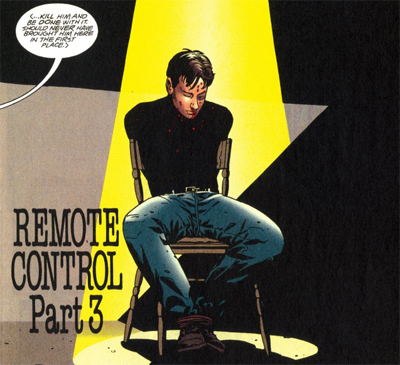
Mulder is a little tied up right now...

Mulder is a little tied up right now…

Continue reading

The X-Files – Zero Sum (Review)

This February and March, we’re taking a trip back in time to review the fourth season of The X-Files and the first season of Millennium.

For all that The X-Files exists in a murky shadow world populated by ambiguous figures and a government conspiracy dating back generations, the show has a pretty straightforward sense of morality. No good can stem from evil, the show seems to suggest; the show’s central mythology repeatedly has Mulder and Scully confront the legacy of sins committed by their forefathers. Even the title of Zero Sum alludes to the hollowness of Walter Skinner’s deal with the devil, his moral compromise that has no demonstrable benefit and severe demonstrable harm.

In Memento Mori, Walter Skinner compromised himself. He made a deal with the Cigarette-Smoking Man, in return for Agent Scully’s continued well-being. “What’ll it take?” Skinner asked, desperate for a chance to save Dana Scully. Ever ambiguous, the Cigarette-Smoking Man offered, “Well, I’ll have to get back to you on that.” Unfolding a few months later, Zero Sum is essentially about paying the piper. It is Walter Skinner settling up with the Cigarette-Smoking Man. He rolls up his sleeves and jumps into the dirty work.

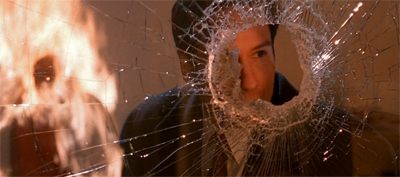
Fire and brimstone...

Fire and brimstone…

Zero Sum is a story that you could not tell with Mulder. Although Mulder never faces the same choice as Skinner, the show has been quite consistent in its portrayal of Mulder’s morality. Mulder does not compromise; Mulder does not subscribe to the theory that a deal with the devil could ever pay dividends. In contrast, Skinner is a more ambiguous and pragmatic figure. Skinner spent significant sections of the second season caught between Mulder and the Cigarette-Smoking Man. The show only firmly committed him to Mulder and Scully in Paper Clip.

Zero Sum is a fantastic example of how the world of The X-Files has really grown and expanded around the lead characters. While the show will never quite develop into an ensemble, it is a series with a broad cast. It makes sense that it should begin to use them in a productive manner.

"Walter Skinner, F.B.I."

“Walter Skinner, F.B.I.”

Continue reading

Millennium – Powers, Principalities, Thrones and Dominions (Review)

This February and March, we’re taking a trip back in time to review the fourth season of The X-Files and the first season of Millennium.

High matter thou injoinst me, O prime of men,

Sad task and hard, for how shall I relate

To human sense th’ invisible exploits

Of warring Spirits; how without remorse

The ruin of so many glorious once

And perfet while they stood; how last unfould

The secrets of another World, perhaps

Not lawful to reveal? yet for thy good

This is dispenc’t, and what surmounts the reach

Of human sense, I shall delineate so,

By lik’ning spiritual to corporal forms,

As may express them best, though what if Earth

Be but the shaddow of Heav’n, and things therein

Each to other like, more then on earth is thought?

– Raphael, Paradise Lost, Book V

This is about to get biblical...

This is about to get biblical…

Continue reading

The X-Files – Small Potatoes (Review)

This February and March, we’re taking a trip back in time to review the fourth season of The X-Files and the first season of Millennium.

Darin Morgan’s absence haunts the fourth season of The X-Files.

According to Frank Spotnitz, Darin Morgan had originally hoped to contribute a script in the middle of the season. Unfortunately, that idea fell through. The scramble to fill that gap in the schedule led to Memento Mori, which ultimately became the centre of the fourth season’s mythology arc, for better or worse. Scully’s cancer arc was just one result of the Darin-Morgan-shaped hole in the fourth season. Small Potatoes is another, the show’s first real “comedy” episode since Morgan departed the staff at the end of the third season.

A sting in the tale...

A sting in the tail…

Darin Morgan often gets credit for introducing the concept of comedy to The X-Files. That is not entirely fair; Glen Morgan and James Wong wrote Die Hand Die Verletzt shortly before Darin Morgan wrote Humbug. However, Morgan did refine the idea of comedy on The X-Files. Darin Morgan won an Emmy for writing Clyde Bruckman’s Final Repose, and he still considers Jose Chung’s “From Outer Space” to be among the best things that he has ever written.

Despite Morgan’s departure, it was clear that The X-Files could not completely avoid comedy. Once a show has demonstrated that it can do something particularly well, it becomes very difficult to stop doing that thing. Comedy episodes became something of a staple on The X-Files, with the show regularly churning out light-hearted and funny episodes (with varying degrees of success) until the show was finally cancelled after its ninth season. However, there was a long stretch after Morgan departed where the series seemed quite grim. Somebody would have to go first.

The inside, looking out...

The inside, looking out…

So Vince Gilligan stepped up to bat. Gilligan had been on staff for a bout a year at this point. He had quickly established himself as one of the most promising young writers in the room. While his first script for the show – Soft Light – was arguably more interesting than successful, Gilligan enjoyed an incredible hot streak when he joined the staff. Pusher, Unruhe and Paper Hearts are among the best scripts of the third and fourth seasons. With Small Potatoes, he seemed to position himself as the logical successor to Darin Morgan.

Darin Morgan even appears in Small Potatoes to pass the metaphorical baton.

"Here's Mulder!"

“Here’s Mulder!”

Continue reading

Millennium – Lamentation (Review)

This February and March, we’re taking a trip back in time to review the fourth season of The X-Files and the first season of Millennium.

Taken together, Lamentation and Powers, Principalities, Thrones and Dominions represent something of a loose mythology two-parter for Millennium. The episodes are not linked by an explicit “to be continued…”, but they feed into one another in a very clear and structured manner. Each of the two episodes exists as a clear and independent entity, but – taken together – they exist as a story that shakes Millennium to its foundation. This is the point at which Millennium seems to know what it is and what it wants to be.

The first season of any show is a difficult time. Everybody working on the series struggles to find the right voice for the series. The goal is to figure out what the show is before the audience loses interest. Lamentation comes quite late in the first season – only four episodes from here to Paper Dove – but it does represent a very clear and dynamic shift. It follows through on a lot of the horror implied throughout the first season, suggesting that Frank Black might be facing something far more sinister and insidious than mere serial killers.

On top of the world...

On top of the world…

In fact, Lamentation exists as a fiendish subversion. It is a story that is very clearly set-up as the sort of procedural serial-killer-of-the-week story that the show was churning out towards the middle of the season. Doctor Ephraim Fabricant is released from prison so he can offer a kidney transplant to his sister; however, while he is recuperating, somebody helps him to escape police custody. Having profiled Fabricant during the initial manhunt, Frank is drafted in to track down Ephraim Fabricant before he inevitably starts killing again. The clock is ticking.

Then everything just explodes. Something from the dark heart of Millennium breaks loose; this more primal evil devours the serial-killer-of-the-week structure. It even leaves his second kidney on a plate in the fridge.

Everybody has their demons...

Everybody has their demons…

Continue reading

The X-Files – Synchrony (Review)

This February and March, we’re taking a trip back in time to review the fourth season of The X-Files and the first season of Millennium.

Time travel is one of the great science-fiction tropes.

Although magical or metaphorical time travel has long been a part of literary tradition, pseudo-scientific or pseudo-rational versions of science-fiction really took root towards the end of the nineteenth century. Although H.G. Wells blazed a trail with The Time Machine, Edward Page Mitchell actually beat him to the punch – he published the short-story The Clock That Went Backward fourteen years before Wells wrote The Time Machine. Nevertheless, time travel quickly caught on as a literary device.

The hole in things...

The hole in things…

There are films, television show, novels, comics and songs all playing with the idea of moving through time. Although there is considerable debate about the feasibility of actually travelling backwards through time, time travel serves as a wonderful narrative device. It opens up all sorts of possibilities for structure and style; it provides some pretty heavy themes; it opens up a myriad of settings and possibility. It is no surprise that there have been so many variations and permutations based upon the idea of going backwards in time.

Indeed, it seemed like it was only a matter of time before The X-Files got around to telling its own time travel story. Synchrony was as inevitable as the decision to close the episode with a clumsy hint toward predetermination.

Ghosts of future self...

Ghosts of future self…

Continue reading

Millennium – Walkabout (Review)

This February and March, we’re taking a trip back in time to review the fourth season of The X-Files and the first season of Millennium.

Walkabout continues to demonstrate the flexibility of Millennium‘s format.

Millennium is often unfairly dismissed as a “serial-killer-of-the-week” show, an impression undoubtedly created by the stretch of early- to mid-season episodes that adopted an almost procedural formula in their exploration of evil. However, after Sacrament, the show takes a break from those narratives to do something a little more experimental and nuanced. Covenant had seen Frank investigating a murder that had already been solved. Here, Frank finds himself struggling to piece together a fractured memory of his own recent experiences.

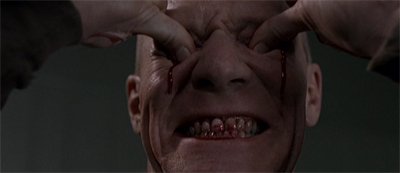
A bleedin' disaster!

A bleedin’ disaster!

Walkabout is the third of four scripts from writer Chip Johannessen in the first season of Millennium. Each is a rather strange entity; doing something strange or unconventional for the show, helping to define the boundaries for this young television series. Walkabout is perhaps most interesting for the way that it engages with an aspect of Millennium that has been bubbling away in the background since The Pilot. Although Walkabout never explores the nature or purpose of Frank’s visions, the episode is built around the visions as a concept rather than simply a tool.

Walkabout is an unsettling and effective mood piece that grows more conventional as it progresses. While the final act is a little clunky, Walkabout is a fascinating piece of television and a demonstration of how Millennium has found its own voice.

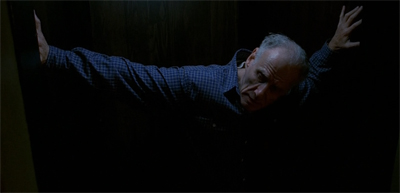
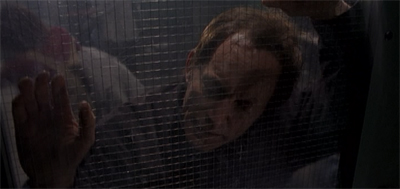
"Let me outta here!"

“Let me outta here!”

Continue reading

The X-Files – Max (Review)

This February and March, we’re taking a trip back in time to review the fourth season of The X-Files and the first season of Millennium.

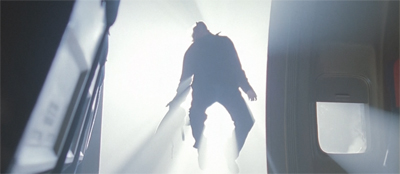
Reportedly, Tempus Fugit and Max took twenty-eight days to shoot. Assistant director Tom Braidwood described the two-parter as a “pretty challenging” effort for the show. The series built an air plane cabin specifically so that it could film those fantastic abduction sequences. There are fields and hangars strewn with dead bodies and the wreckage of a passenger air plane. By just about any definition, Tempus Fugit and Max comprise the most ambitious and large-scale two-part episode that the show has produced to date.

Paradoxically, this is also the smallest two-part episode that the show has produced to date. It brings back a minor guest star from a first season episode, only to kill him off casually in the teaser for the first episode. None of the big players show up for the drama. The most significant consequence of Tempus Fugit and Max is the death of Agent Pendrell. In many ways, Tempus Fugit and Max is the post-mortem story of a little guy who was crushed by the weight of something much larger than himself – caught between forces of immeasurable power.

In-flight serve will now resume...

In-flight service will now resume…

Tempus Fugit and Max do very little to advance the central mythology arc, which has stalled somewhat in the fourth season. However, they manage to encapsulate so many of the core themes of that central storyline. This is a story about the victimisation of the weak by the powerful; this is a tale about the sacrifices that are made in pursuit of the truth; this is a reflection on the appeal of conspiracy theory; this is a morality play about balancing lives against “the greater good.”

In many ways, Tempus Fugit and Max are the quintessential mythology episodes, despite not being that closely related at all.

Things are looking up...

Things are looking up…

Continue reading

Millennium – Covenant (Review)

This February and March, we’re taking a trip back in time to review the fourth season of The X-Files and the first season of Millennium.

Apparently, the original cut of Covenant ran over an hour and twenty minutes. This is not unusual in network television. Glen Morgan and James Wong faced similar problems when producing The Field Where I Died. However, while cutting The Field Where I Died down to forty-five minutes left something of a jumble, Covenant feels much stronger for the rather ruthless editing done to fit the episode into the broadcast slot. In many ways, Covenant feels quite minimalist – an episode that says the bare minimum, but conveys everything that needs to be conveyed.

Covenant is an episode that could easily seem exploitative. After all, there are points where Millennium feels like it is wallowing in human anguish and suffering. A story concerning the brutal murder of a nuclear family (including three children and a pregnant wife) is something that needs to be approached with care and delicacy. The original script for Covenant is perhaps overwritten, trying to draw too many parallels to Frank’s own family; these associations are best left unsaid.

Bloody handiwork...

Bloody handiwork…

In many ways, Millennium could be described as a “horror” show, and Covenant hones on some of the same fears that the first season has targeted repeatedly. Millennium is a show that is keen to assure viewers that their family members are not safe in their own homes and communities. However, there is a deftness and a tactfulness on display here that elevates Covenant above many of the similar stories in this début season. Covenant is all the more unsettling for its restraint and its control.

Covenant continues a strong late-season streak for Millennium, demonstrating the versatility and the nuance possible within the framework that the show has established. Covenant is a triumph for all involved.

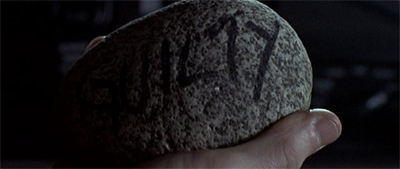
Solid as a rock...

Solid as a rock…

Continue reading

The X-Files – Tempus Fugit (Review)

This February and March, we’re taking a trip back in time to review the fourth season of The X-Files and the first season of Millennium.

Conspiracy lives in the gaps.

Conspiracy theories grow in the gaps of history. They multiple and divide in the absences on the historical record. They entangle and dissemble in the lacunas of memory. In many ways, conspiracy theories represent an attempt to impose order upon a chaotic universe, to know the unknowable. They grow from doubts and questions, holes and voids. Every ellipsis, every redacted line points towards infinite possibilities. Every “no comment” is but conformation of the worst possible outcome.

The truth is up there...

The truth is up there…

Tempus Fugit opens with a nine-minute gap before a plane crash that claims over one hundred lives. Max closes with another nine-minute gap that sees the ever-elusive proof slip through Mulder’s fingers once again. However, Tempus Fugit and Max are not truly “conspiracy” episodes. Characters like the Cigarette-Smoking Man, the Well-Manicured Man, Alex Krycek and Marita Covarrubias are all absent. Even the sinister functions of shadowy government officials are outsourced to “Cummins Aerospace”, a government contractor never mentioned on the show before or since.

Instead, Tempus Fugit and Max are focused on the little people trying to assemble what they can from these gaps. Mike Millar is an honest and hard-working member of the National Transportation and Safety Board trying to piece together a crashed aeroplane. Max Fenig is trying to piece together some meaning for all his suffering. Mulder and Scully are trying to piece together the truth. Even the aliens themselves seem to be searching. Tempus Fugit and Max are populated with characters trying desperately to make sense of the gaps.

Fly by night...

Fly by night…

Continue reading