• Following Us

  • Categories

  • Check out the Archives


  • Awards & Nominations

The X-Files – The Red and the Black (Review)

This May and June, we’re taking a trip back in time to review the fifth season of The X-Files and the second season of Millennium.

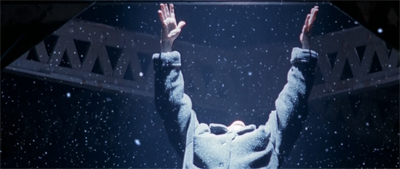
“Before the exploration of space, of the moon and the planets, man hailed that the heavens were the home and province of powerful gods who controlled not just the vast firmament, but the earthly fate of man himself and that the pantheon of powerful, warring deities, was the cause and reason for the human condition, for the past and the future, and for which great monuments would be created on earth as in heaven. But in time man replaced these gods with new gods and new religions that provided no more certain or greater answers than those worshipped by his Greek or Roman or Egyptian ancestors. And while we’ve chosen now our monolithic and benevolent gods and found our certainties in science, believers all, we wait for a sign, a revelation. Our eyes turn skyward ready to accept the truly incredible to find our destiny written in the stars.”

Lift me up...

Lift me up…

Continue reading

Millennium – Owls (Review)

This May and June, we’re taking a trip back in time to review the fifth season of The X-Files and the second season of Millennium.

I am like a pelican of the wilderness; I am become as an owl of the waste places.

– Psalm 102:6

Birds of prey...

Birds of prey…

Continue reading

The X-Files (Topps) – Ground Zero #1-4 (Review)

This May and June, we’re taking a trip back in time to review the fifth season of The X-Files and the second season of Millennium.

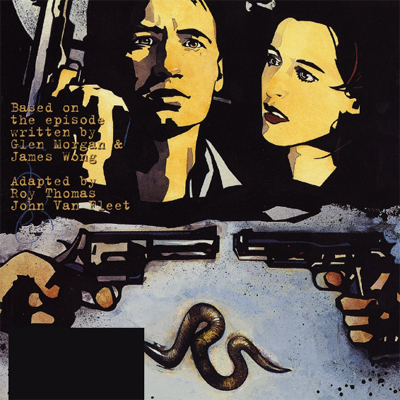
Ground Zero offers an indication of just how much success Topps was enjoying with their line of licensed X-Files comic books.

The monthly series was still being published, and Season One was on a bimonthly schedule. Both books had stable creative teams, and there was no indication that they were likely to wrap up any time soon. Of course, Topps would pull of the comic book market in late 1998, but there was no indication that they considered their X-Files line to be anything other than a complete success. As such, it made sense to expand the line. After all, the company had already used the brand to sell annuals and digests.

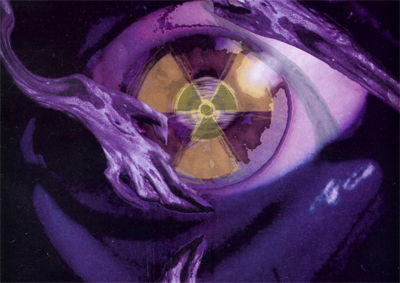
Eye see all...

Eye see all…

However, there was reportedly a considerable amount of friction between Topps and Ten Thirteen over the comic book line. Ten Thirteen was reportedly quite firm in what they would and would not allow to be published. Writers John Rozum and Stefan Petrucha have talked about how difficult it was to get their scripts published for the monthly series. It seems that Topps was eager to work around these restrictions. It is telling that neither Season One nor Ground Zero were original concepts; they were adaptations of ideas and stories Ten Thirteen had already approved.

Ground Zero is written by veteran tie-in author Kevin J. Anderson. Anderson had already written a number of popular X-Files tie-in books and had provided a fill-in arc on the monthly comic book with Family Portrait. The artwork for Ground Zero is provided by Gordon Purcell, one of the best likeness artists in the business. Publishing a four-issue adaptation of a tie-in novel is the very definition of a “safe” choice to expand the line, and only illustrates some of the wasted opportunities towards the end of Topps’ stewardship of the license.

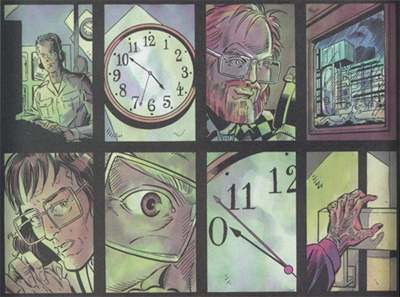
Doomsday clock...

Doomsday clock…

Continue reading

The X-Files – Patient X (Review)

This May and June, we’re taking a trip back in time to review the fifth season of The X-Files and the second season of Millennium.

This should not work.

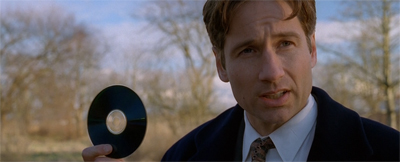
There are lots of reasons why Patient X and The Red and the Black should simply implode under their own weight. Most obviously, they are scripts that are rather blatantly just piling more and more back story and convolution onto a framework that is already overloaded and over-stretched. They are introducing new characters at a late stage of the game. They rely on contrivance and sketchy character development. They seem to exist at odds with the script for The X-Files: Fight the Future, which had been written and shot, but was awaiting release.

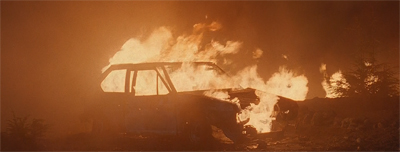
Everything burns...

Everything burns…

However, despite all this, Patient X and The Red and the Black work very well together. They are the strongest story-driven mythology two-parter since Nisei and 731 at the start of the third season. There is an energy and drive to Patient X and The Red and the Black that has been largely absent from the show’s big blockbuster two-parters since Herrenvolk at the start of the fourth season. After a year-and-a-half treading water as the release date of the movie draws ever closer, it is nice to see Chris Carter cut completely loose.

Patient X and The Red and the Black form a story which doesn’t seem at all worried about what any of this means for the summer realise of Fight the Future. Parts of it become quite difficult to reconcile with the film as released. However, the two-parter is all the stronger for it.

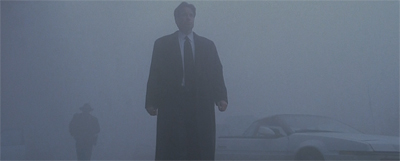
Fog of war...

Fog of war…

Continue reading

Millennium – The Pest House (Review)

This May and June, we’re taking a trip back in time to review the fifth season of The X-Files and the second season of Millennium.

Millennium is largely a show about the nature of evil.

It feels a little redundant to point that out more than halfway through the second of three seasons, but it is worth repeating. When Chris Carter created Millennium, he designed the show to explore the many faces of evil in a variety of ways. It could be argued that Millennium was largely spawned from episodes of The X-Files like Irresistible or Grotesque, stories fascinated by very human forms of evil that almost become supernatural. Carter and his writers played with that idea over the course of the first season, particularly in episodes like The Pilot and Lamentation.

A pointed commentary?

A pointed commentary?

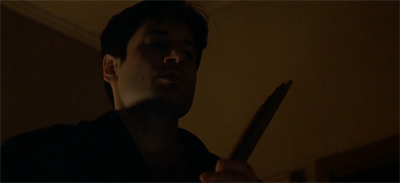
However, Carter was not the guiding visionary for all of Millennium‘s run. He remained involved in the production of the show, but the day-to-day running of the series was handed over to Glen Morgan and James Wong, who immediately reinvented it from the ground up. One of the more interesting aspects of this transition is watching the differences in how the two creative teams approach various aspects of Millennium. In many ways, The Pest House would be read as an exploration and critique of Carter’s approach towards the concept of evil by Morgan and Wong.

Carter’s work seems to suggest that evil is an external and infectious force – a contagion or pathogen that can be passed from one person (or generation) to another. In contrast, Morgan and Wong seem to argue that evil must be rooted in a person, that it must come from inside rather than outside. The Pest House contrasts these two different visions of evil, finding Morgan and Wong playing with the recurring Ten Thirteen trope of evil as a transferable quantity that can be moved and reallocated. And The Pest House seems horrified by such a concept.

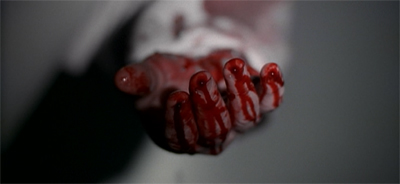
A bloody mess...

A bloody mess…

Continue reading

The X-Files – Bad Blood (Review)

This May and June, we’re taking a trip back in time to review the fifth season of The X-Files and the second season of Millennium.

Despite a notable absence of Darin Morgan, Bad Blood makes a much more convincing case for Vince Gilligan as the heir apparent to Darin Morgan than Small Potatoes did at the end of the fourth season.

Bad Blood finds Gilligan touching on some of the same broad ideas as Small Potatoes – how Mulder is perceived and how he perceives himself, a sly awareness of the show’s tropes and conventions. However, Bad Blood feels a lot more honed and focused than Small Potatoes. It felt like Small Potatoes only got to the meat of the story it wanted to tell in its final third, while Bad Blood is shrewd enough to put its core concepts front-and-centre. While Bad Blood has the same broad humour of Small Potatoes, it feels a lot more convincing when it comes to characters.

The tooth is out there...

The tooth is out there…

It could be argued that Gilligan drew quite heavily on the work of Darin Morgan in some of his scripts. There is no shame in this. After all, Darin Morgan is perhaps the most widely-praised writer to work on The X-Files. In this context, Bad Blood is something of a spiritual successor to Jose Chung’s “From Outer Space.” Gilligan’s script is not quite as structurally or philosophically ambitious as Darin Morgan’s final credited script for the series, but it does hit on the same fundamental idea that truth is an inherently subjective construct.

Bad Blood is essentially an episode that is not only about how Mulder and Scully see each other, but how they see themselves.

Mulder knows what's at stake...

Mulder knows what’s at stake…

Continue reading

The X-Files: Season One (Topps) #5 – Ice (Review)

This May and June, we’re taking a trip back in time to review the fifth season of The X-Files and the second season of Millennium.

With Ice, Season One jumps ahead a bit.

It is hard to blame them. The first four episodes of the first season are relatively solid, outlining the heart of The X-Files and conveying everything the audience really needed to know at this point. However, the first season gets a little bit rocky after Conduit. Episodes like The Jersey Devil and Shadows are unlikely to top anybody’s list of favourite X-Files episodes. Ghost in the Machine is somewhat underrated, but it is hardly a world-beater either. So it makes sense to skip ahead to probably the most highly-regarded episode in the first half of the first season.

Worming its way into your heart...

Worming its way into your heart…

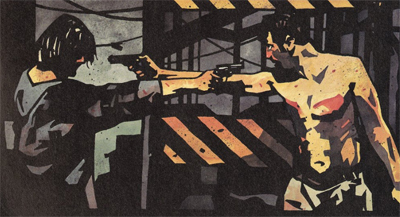
Ice is a classic installment of The X-Files. Like Squeeze, it is an episode that tends to lodge itself in the popular memory. It is hard to verify such things in any objective fashion, but it is an episode that many casual fans reference or point to whenever the show is mentioned. It has just the right balance of memorable imagery and distinctive hooks, brought to life in a haunting and atmospheric fashion. It would have been crazy for Roy Thomas’ adaptations of the Season One episodes to skip over this particular episode, and it makes sense to jump right to it.

Then again, there is also a pretty clear precedent for this.

This is not who we are...

This is not who we are…

Continue reading

The X-Files – Kill Switch (Review)

This May and June, we’re taking a trip back in time to review the fifth season of The X-Files and the second season of Millennium.

On the surface of it, William Gibson seems a strange fit for The X-Files.

He certainly seems like a more eccentric choice than Stephen King. King was a writer famed for his horror stories, with a fascination for small-town life and an interest in guilt as a legacy of American history. On paper, King should have been the perfect “special guest writer” for the show, able to churn out a script that would resonate perfectly with the larger themes of The X-Files while still sitting comfortably within his own oeuvre. While Chinga is not a bad episode, it is not an exceptional episode by any measure. It feels perfectly adequate.

Well, that's going in the DVD menu.

Well, that’s going in the DVD menu.

As such, Kill Switch seems like a story that could go horribly wrong. Gibson is a writer most famous for his work in defining and popularising “cyberpunk”, a science-fiction subgenre that is far removed from the horror trappings generally associated with The X-Files. Gibson was a writer who tended to explore the possible future development of cyberspace and associated issues, while Carter worked very hard to anchor The X-Files in the now. Gibson’s stories seemed to take place in the not-too-distant future; Carter grounded The X-Files in a very particular now.

However, Kill Switch works. It works phenomenally well. It is an episode that feels markedly different from everything else around it, while still feeling like it belongs to The X-Files. The clash of styles is evident in Kill Switch, as writers William Gibson and Thomas Maddox find themselves adapting their themes and ideas to a completely different aesthetic. That is perhaps part of appeal. While Chinga made it look quite easy to construct a solid Stephen King story that was also a solid episode of The X-Files, Kill Switch is nowhere near as smooth. This is a different beast. And it is glorious.

"Woah, woah, woah. What happened to floppies?"

“Woah, woah, woah. What happened to floppies?”

Continue reading

The X-Files (Topps) #37 – The Face of Extinction (Review)

This May and June, we’re taking a trip back in time to review the fifth season of The X-Files and the second season of Millennium.

Suspension of disbelief is a curiously fickle thing.

It is a concept that generates considerable debate in its function and application. After all, the normal mode of fiction generally accepts that fiction is… well, fictional. There is no real belief to shatter, because there is an innate understanding between artist and audience that a work of art should be interpreted as a representation of reality rather than a piece of reality. Even in the case of “true stories”, audiences will willingly and readily accept alterations and adjustments designed to streamline the story in question.

Ramming speed...

Ramming speed…

After all, the concept of “suspension of disbelief” is quite firmly disengaged from the concept of reality. The old cliché about “truth being stranger than fiction” illustrates the distinction. The real world (and the stories of the people who inhabit it) are full of coincidences and contrivances that audiences would consider to be lazy writing or poor construction if they appeared in a work of fiction. Nevertheless, while “suspension of disbelief” might be more complex than its three-word nature would suggest, it is a useful philosophy.

What “breaks” a work of fiction? At what point does the artist – whether intentionally or otherwise – push the audience out of the story? What causes a double take to occur or a quizzical eyebrow to raise? What story developments prompt angry sighs or bitter grumbling? There is no hard and fast answer. The line will always be arbitrary, varying from audience member to audience member. Everybody has different expectations when it comes to art, and so that threshold is distinct for every person.

"Don't worry, Scully! Stay right there... I'm going to get my camera."

“Don’t worry, Scully! Stay right there… I’m going to get my camera.”

Sometimes people can agree on where the line falls on a certain work, but everybody has their limits. There are some people who embrace perceived absurdities or inconsistencies or incongruities in their stories; there are some people who simple do not consider those absurdities or inconsistencies or incongruities to exist at all. One of the great things about The X-Files as a television show is the sense of adventure and excitement that the premise generates. It is highly flexible, allowing for almost anything.

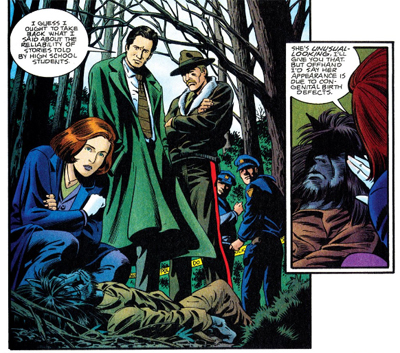
At the same time, it seems quite clear that writer John Rozum and artist Alex Saviuk find themselves charging head-first towards that highly arbitrary and high flexible boundary with The Face of Extinction, a story about a secret race of intelligent goat people who have lived alongside human civilisation for millennia and who also (conveniently) speak perfect English. It is a rather absurd concept, and one that seems at odds with the relatively grounded style of the first five seasons of The X-Files.

Beastly.

Beastly.

Continue reading

The X-Files – Chinga (Review)

This May and June, we’re taking a trip back in time to review the fifth season of The X-Files and the second season of Millennium.

Chinga is the episode of The X-Files that was written by Stephen King.

That is a pretty big deal. Stephen King is one of the most influential American writers of the twentieth and twenty-first centuries. He is a writer who has enjoyed tremendous commercial success, but who has also balanced that popularity with considerable respect of critics and academics. His work has permeated popular cultured, and sparked all sorts of analysis and exploration. While no creator of that calibre works without at least some small level of backlash, King is one of the most successful American writers by any measure.
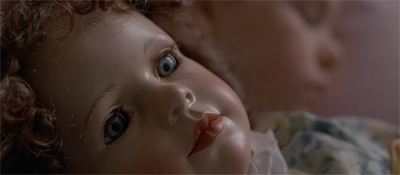
Play time!

Play time!

Writing about King in A Century of Great Suspense Stories, Jeffery Deaver argued that the author “helped free the popular name from the shackles of simple genre writing. He is a master of masters.” As such, he should be quite a comfortable fit for The X-Files. Even aside from any stylistic sensibilities that he might share with the series, King is a creator who manages to consistently producer work that might be dismissed as “genre”, but manages to compete with more prestigious and high-profiler literature.

The X-Files did something similar in the nineties. It was a show that frequently dabbled in cult genres – it was a show that dealt with horror and science-fiction themes on a regular basis. However, thanks to the craftsmanship of those involved, The X-Files was frequently able to compete with more “serious” fare at the major awards ceremonies. Chris Carter worked very hard to prevent the show from being relegated to the horror or science-fiction “ghetto.” It was a show that could slide to high-brow to low-brow over a single act; that was part of what made it so fun.
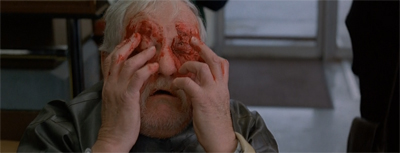
A bloody disaster...

A bloody disaster…

So landing King was very much a coup for The X-Files. He was one of the best-selling and most prolific American writers of the nineties, with his name all over a wealth of media. All that Chinga really needs to do is exist. It would be next to impossible for Chinga to be anything but “that episode of The X-Files written by Stephen King.” Indeed, it seems almost unreasonable to expect anything more from it. The hype on Chinga was unbelievable – as one might expect from a television show that had bagged one of the most popular fiction writers around.

Chinga is a very flawed piece of television, an episode that feels too much like an early draft than a fully-developed concept. The styles of Chris Carter and Stephen King blend reasonably well, but there is a sense that neither is pushing the other out of their comfort zone. Chinga is a pretty average piece of television, a pretty average Stephen King story, and a pretty average episode of The X-Files. While not necessarily a catastrophic failure, it is hardly a fantastic success.
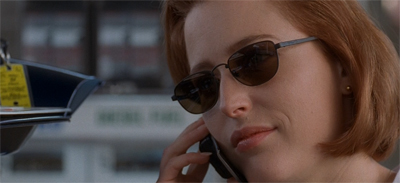
"Yeah, I'm sure this vacation will be completely uneventful!"

“Yeah, I’m sure this vacation will be completely uneventful!”

Continue reading