• Following Us

  • Categories

  • Check out the Archives


  • Awards & Nominations

Millennium – Force Majeure (Review)

This February and March, we’re taking a trip back in time to review the fourth season of The X-Files and the first season of Millennium.

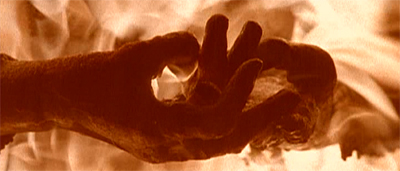
Papa?

It’s begun.

Fire and ice.

Fire and ice.

Continue reading

Millennium – Loin Like a Hunting Flame (Review)

This February and March, we’re taking a trip back in time to review the fourth season of The X-Files and the first season of Millennium.

Loin Like a Hunting Flame represents the peak of a particular type of Millennium story.

It is an episode towards which the season seems to have been building. It is an episode that rather explicitly and candidly ties together two of the show’s favourite subjects: sex and violence, in harmony together. Loin Like a Hunting Flame is something of a stalking horse for the rest of the season; it is the first season episode that most obviously embodies the excesses of any show like Millennium. Fetishised violence has been baked into Millennium since The Pilot opened with a stripper dancing in her own blood; here, it reaches a logical end point.

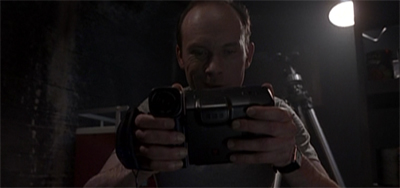
Candid camera!

Candid camera!

Loin Like a Hunting Flame is an episode that is guilty of just about any criticism that might be thrown at it. It is gratuitous; it is sensationalist; it is excessive. It tries to have things both ways, titillating the viewer with glimpse of “exotic” sexual liberation while warning them that those sexually liberated individuals will be punished for their perceived transgressions. Yes, Loin Like a Hunting Flame tries to say something a bit more nuance, but it flails around for most of its forty-five minute runtime like a dying fish.

In many respects, this could be treated as a catharsis for the series. After this point, Millennium turns a corner. The rest of the first season is a lot more ambitious in tone and scope. As much as Loin Like a Hunting Flame closes off a particularly evolutionary line of Millennium, Force Majeure and The Thin White Line push forwards towards a more adventurous show. Loin Like a Hunting Flame just has to work these issues out, once and for all, to their logical (and unsatisfying) conclusion.

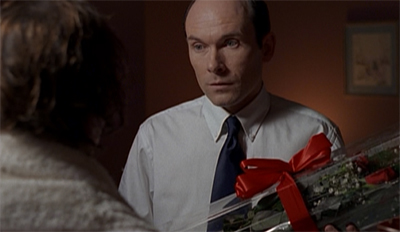
Wholesome family fun...

Wholesome family fun…

Continue reading

Millennium – Weeds (Review)

This February and March, we’re taking a trip back in time to review the fourth season of The X-Files and the first season of Millennium.

Weeds concludes the loose “suburban trilogy” running through the first season of Millennium. In fact, Weeds was filmed directly after Wide Open, but was pushed back in the broadcast schedule so as to air after The Wild and the Innocent. While this change in broadcast and production order is nowhere near as confusing as the scheduling hijinx happening with The X-Files at the same time, it does give an indication that the production team recognised the potential similarities between Weeds and Wide Open.

Both episodes are about the violation of a supposedly “safe” space, bypassing and subverting all the potential security put in place to keep the home secure. In Wide Open, the killer visits open houses and hides in wardrobes until the family go to sleep that night; in doing so, he avoids setting off any alarms. In Weeds, a secure and gated community discovers that they cannot keep their children safe; someone within the community is preying on the residents’ children. As with The Well-Worn Lock, there is a sense that families are not safe, even when they think that they are.

Community watch...

Community watch…

As with Wide Open, Weeds feels just a little bit sensationalist. It is the kind of episode that attracts criticisms about gratuitous violence or exploitation. Millennium was never quite as excessive or as sadomasochistic as its critics would suggest, but there are definite tendencies towards those extremes on display at certain points in the run. While Millennium is very clearly driven by a core moral philosophy, it can occasionally seem a little too comfortable with its brutality or depravity.

Indeed, Weeds hits on quite a few of the stock fears that run through the first season of Millennium: children are victimised by a person in a position of trust and authority; there is biblical quotation; there is sadistic (and disturbing) torture filmed in a heavily stylised manner. There is something almost cynical and calculated about how Weeds hits these familiar buttons; these impulses towards excess haunt the first season of Millennium, and are building to something of a catharsis in Loin Like a Hunting Flame.

There will be blood...

There will be blood…

Continue reading

Millennium – The Wild and the Innocent (Review)

This February and March, we’re taking a trip back in time to review the fourth season of The X-Files and the first season of Millennium.

The Wild and the Innocent is an ambitious piece of television.

It is not a piece of television that works as well as it might, the execution of the central ideas leaving a little to be desired, but it is an episode that commits whole heartedly to something unique. In I Want to Believe, Robert Shearman refers to The Wild and the Innocent as “a plot more suited to Cormac McCarthy than Chris Carter.” He’s not wrong. The Wild and the Innocent is a story about cycles of violence and abuse in the American south, a grim road movie with some very harsh conclusions about the way that the world works.

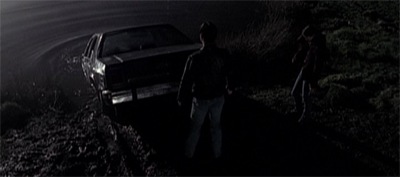
That sinking feeling...

That sinking feeling…

It still fits within the milieu of Millennium. After all the classic “serial killer road movie” is still a serial killer story, and Millennium has already carved out that niche for itself. However, the image of Frank Black and Peter Watts following a trail of bodies from Missouri down through Arkansas suggests a different show than the one that has been airing since The Pilot. In many respects – with its heavy philosophical voice-over, its country-tinged soundtrack, its fixation on the outlaw couple – The Wild and the Innocent feels almost like some old American folk tale.

There’s something decidedly old-fashioned here, with the episode playing more like a western than a police procedural. In the documentary Order in Chaos, Carter described Frank Black as character from a story “like Shane, like any cowboy, any good movie, Western movie.” As such, he fits in quite comfortably with this new type of story.

Road warrior...

Road warrior…

Continue reading

Millennium – The Well-Worn Lock (Review)

This February and March, we’re taking a trip back in time to review the fourth season of The X-Files and the first season of Millennium.

The Well-Worn Lock is trying to say something important.

As easy as it is to mock Chris Carter for being a little heavy-handed in his writing, he tends to wear his heart on his sleeve. There is an honesty and an earnestness to his writing that is quite endearing – a sense that he has some things that he wants to say, and that he will say them. The Well-Worn Lock is a tough and grueling episode, with some pretty harrowing things to say. It confronts the types of issues that are often overlooked or ignored, because they are so uncomfortable to examine head-on. There is a lot to admire here.

Happy families...

Happy families…

However, The Well-Worn Lock is also clumsy and ham-fisted. It is so committed to saying what it wants to say that it occasionally gets caught up in itself. It has been argued that Carter constructed Millennium as a vehicle to examine the nature of evil in the modern world, and there are points where the series feels more like a pulpet that a television show. The Well-Worn Lock is an episode about an insidious and oft-ignored evil, but there are points where it has the depth and complexity of a life-action cartoon.

The problem is not that the episode’s antagonist is a monster – after all, it is hard to describe anybody who commits this sort of abuse as anything but a “monster” – but that he seems a grotesquely exaggerated and one-dimensional caricature. Tackling a subject that requires considerable tact and grace, The Well-Worn Lock often has the emotional nuance of a sledgehammer.

The world according to Catherine Black...

The world according to Catherine Black…

Continue reading

Millennium – Blood Relatives (Review)

This February and March, we’re taking a trip back in time to review the fourth season of The X-Files and the first season of Millennium.

Blood Relatives is the best episode of Millennium to air within the first half of the first season. It is an episode that seems to recognise the potential of a show like Millennium to be more than just a formulaic procedural, acknowledging that the show needs to find its own unique narratives in the same way that The X-Files did during its first season. Blood Relatives adheres rather loosely to the serial-killer-of-the-week format, but is rather more interested in the stories of the characters around the murders than in the murders themselves.

Blood Relatives is also notable as the first Millennium script written by Chip Johannessen. Johannessen would go on to become one of the defining voices of the show’s run, writing some of the best episodes of the first two seasons and steering the show through its troubled two years. Johannessen was good to Millennium, and Millennium was good to Johannessen. It transitioned the writer from shows like Married… With Children, Beverly Hills 90210 and The Monroes towards 24, Dexter and Homeland.

Not cut out for all this...

Not cut out for all this…

As with his next script, Force Majeure, Johannesson hones in quite beautifully on the potential of Millennium. Blood Relatives is an episode of television that is almost perfectly tailored for Millennium. While it retains the elements of a procedural, it is hard to image the episode working on something like Law & Order or CSI, more rigidly-structured television shows with clearer boundaries. Indeed, it seems like Johannessen recognised Millennium as a show spun out of Irresistible, and chose to play Blood Relatives on the same sort of themes about loss and dysfunction.

Blood Relatives is a superbly constructed piece of television, one that marks Johannessen as a talent to watch going forward.

Wading in...

Wading in…

Continue reading

Millennium – Kingdom Come (Review)

This February and March, we’re taking a trip back in time to review the fourth season of The X-Files and the first season of Millennium.

Kingdom Come is a horrible misjudged episode of Millennium, and the show’s first truly spectacular misfire.

Kingdom Come was notably the first episode to air out of production order. It had been produced as the fourth episode following The Pilot, between Dead Letters and The Judge. However, the episode was broadcast as the sixth episode of the television season, after 5-2-2-6-6-6 and before Blood Relatives. The official reason given for this delay was the death of Cardinal Joseph Bernardin in mid-November 1996, following a long and public battle with cancer. It was suggested that an episode about a serial killer targeting religious figures would have been in poor taste at the time.

A light in the darkness...

A light in the darkness…

Still, whatever the official reason given, it cannot help but feel like the production staff were hoping to bury a stinker a little deeper into the season. Kingdom Come is an episode that does not work on any number of levels, offering a rather patronising and condescending view of religious faith as explained through stilted exposition and trite cliché. The show’s observations about faith and hope feel more like sentiments from Hallmark greeting cards than observations on the human condition.

The result is an episode that embodies the worst traits of Millennium, feeling just as crass and sensationalist as it does hollow and superficial.

The episode really bombed...

The episode really bombed…

Continue reading

Millennium – 5-2-2-6-6-6 (Review)

This February and March, we’re taking a trip back in time to review the fourth season of The X-Files and the first season of Millennium.

It is interesting to compare and contrast the scripts that Morgan and Wong wrote for the fourth season of The X-Files with the scripts that they wrote for the first season of Millennium. The duo were writing for both shows at the same time – with episodes frequently airing within a week of each other. Morgan tended to focus more on the four X-Files scripts, while Wong worked primarily on the three Millennium episodes. While the seven scripts are all fascinating in their own way, there is a marked difference in how the duo approach the two shows.

Their four episodes of The X-Files are very bold and experimental – they look and feel utterly unlike anything that the show has done; before or after. These four scripts seem to needle at the show, pushing it further. Home seems designed to see how much unpleasantness the writers can get on to Fox prime time in the nineties. The Field Where I Died is a thoughtful and melancholy romance with no companion in the X-Files canon. Musings of a Cigarette-Smoking Man parodies the show’s central conspiracy. Never Again makes the Mulder/Scully dynamic toxic.

Having a blast...

Having a blast…

That makes a great deal of sense. After all, The X-Files was in its fourth season. It was approaching that impressive “one hundredth episode” landmark, the number of episodes necessary before the show would be secure in syndication. (At least in the television landscape of the nineties.) Although less than half-way through its eventual nine-season run, The X-Files was an old dog by this stage of its life cycle. As such, it made a great deal of sense for Morgan and Wong – two writers who had been there at the beginning – to shake things up.

In contrast, the three scripts that Morgan and Wong wrote for the first season of Millennium are a bit more conservative in scope and tone. They are fascinating pieces of television that help to establish the mood of the show, but they are not as experimental of the work that Morgan and Wong were doing on The X-Files. Again, this makes a great deal of sense. Millennium was still a very young show. It was still defining its own identity, figuring out what it wanted and needed to be. Morgan and Wong’s three scripts are essential in that development.

Taking a page from the Group...

Taking a page from the Group…

Continue reading

Millennium – The Judge (Review)

This February and March, we’re taking a trip back in time to review the fourth season of The X-Files and the first season of Millennium.

The Judge feels very much like an episode that might have worked better later in the first season of Millennium. It deals with pretty big ideas and themes at the heart of the show, but in ways that feel almost clumsy and haphazard. Millennium is still a show that is finding its way, and The Judge pokes and prods at ideas close to the heart of the series as a whole. The episode feels rather clumsy, as though the show hasn’t reached a point where it really has a handle on itself, let alone the sorts of hefty existential questions suggested by The Judge.

At its core, The Judge is fascinated with issues of moral authority and justice – in particular, it asks questions about whether such authority can exist outside (or even inside) the mechanism of the state. Given that Millennium is the story about a man working with a private group to the potential collapse of civil order on the eve of the millennium, The Judge feels like it would be the perfect opportunity to broach questions about the Millennium Group and the work that they do. After all, the Millennium Group and the supporting cast have been haunting the narrative since The Pilot.

Judge not...

Judge not…

While these tough questions hover at the very edge of the episode, it never seems like The Judge addresses them. Then again, The Judge is the fourth episode of the first season of a new show. Millennium is still young. The Judge is written by Ted Mann; it is the first episode of Millennium that is not written by a veteran of The X-Files, by somebody who isn’t Chris Carter or hasn’t experience working within Chris Carter’s world. It is, perhaps, too much to expect it to have a handle on all of that. And The Judge deserves a great deal of credit for marking out areas that the show may want to explore as it grows and develops.

At the same time, while it has some interesting big ideas and a great cast, The Judge feels little clumsy and awkward in its execution. It avoids a lot of the interesting implications of what it says, and it features a rather convenient and contrived final act that seems to exist solely so Frank Black can move on to doing other stuff in the next installment. The Judge is a misfire, but it is an intriguing and interesting misfire. It is precisely the sort of episode that you might expect at this stage in the season.

You've got male (body parts)!

You’ve got male (body parts)!

Continue reading

Millennium – Dead Letters (Review)

This February and March, we’re taking a trip back in time to review the fourth season of The X-Files and the first season of Millennium.

Dead Letters is the first Millennium episode credited to writers James Wong and Glen Morgan, and to director Thomas J. Wright. These are three creative forces that would come to be massively influential in the development of the show.

As with Gehenna, the obvious point of comparison in this early stage of development is with The X-Files. Chris Carter wrote the first two episodes of both shows, outlining the core themes and larger direction. However, the crucial third episode was handed to the team of James Wong and Glen Morgan. They would be the first writers other than Carter to write for Fox Mulder, Dana Scully and Frank Black. They were tasked with demonstrating that these concepts could work in the hands of writers other than Chris Carter.

A hair's breadth away from insanity...

A hair’s breadth away from insanity…

The first script that Wong and Morgan wrote for The X-Files was Squeeze. It was the show’s first stand-alone monster-of-the-week episode, and effectively codified a very flexible subgenre of The X-Files, while also creating a very popular and iconic monster. Dead Letters does something vaguely similar for Millennium, even if it is not quite as effective. Free from a lot of the millennial anxieties that drove The Pilot and Gehenna, Dead Letters offers an example of a fairly pure-blooded “serial-killer-of-the-week” story.

For better or for worse, Dead Letters sets the tone for the rest of the show’s first season.

Bits and pieces...

Bits and pieces…

Continue reading