• Following Us

  • Categories

  • Check out the Archives


  • Awards & Nominations

Star Trek: Voyager – Emanations (Review)

This September and October, we’re taking a look at the jam-packed 1994 to 1995 season of Star Trek, including Star Trek: Deep Space Nine and Star Trek: Voyager. Check back daily for the latest review.

Emanations has a pretty effective set-up and solid premise. It is very clearly one of Star Trek: Voyager‘s “planet of the week” stories – like the show directly before it and the show directly following it – but it’s build around some vaguely interesting ideas. It’s very clearly an episode designed to function as social commentary in the grand Star Trek tradition, hitting on big ideas and bold concepts.

Unfortunately, it’s not the type of script that Brannon Braga is best suited to handle. It doesn’t feel so much an exploration of an important issue as a social treatise. It’s simplistic and heavy-handed while dealing with ideas that require a bit of nuance and sophistication. It feels under-developed, contrived and a little shallow. Despite an attempt at ambiguity in its closing scene, it feels like an episode driven primarily by an agenda rather than a strong story.

Emanations is a misfire, another example of the weird tendency in the first season of Voyager to assign the wrong writers to the wrong scripts.
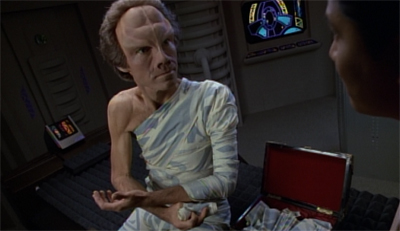
Harry really got wrapped up in local culture...

Harry really got wrapped up in local culture…

Continue reading

Star Trek: Deep Space Nine – Visionary (Review)

This September and October, we’re taking a look at the jam-packed 1994 to 1995 season of Star Trek, including Star Trek: Deep Space Nine and Star Trek: Voyager. Check back daily for the latest review.

Visionary confirms that “O’Brien must suffer” is to become an annual tradition on Star Trek: Deep Space Nine. The second season of the show had made a good start with episodes like Whispers and – to a lesser extent – Armageddon Game, but Visionary confirms that this will really be O’Brien’s niche in the ensemble from this point on. Visionary sees O’Brien randomly jumping forward through time, inevitably glimpsing some horrible tragedy that must be avoided. (Boy, it sure is lucky that he started jumping at this point, isn’t it?)

Visionary should feel contrived and convenient, hinging on a pretty flimsy plot hook. That said, the episode ultimately works quite well, even if it doesn’t stand out as a classic piece of Star Trek. Watching Visionary, there’s very much a sense that Visionary only really works as well as it does because Deep Space Nine has built up a larger mythology of characters and long-form plotting that can support what might otherwise be a fairly flimsy premise.

"Why the hell doesn't this ever happen to Julian?!"

“Why the hell doesn’t this ever happen to Julian?!”

Continue reading

Star Trek: Deep Space Nine (Malibu Comics) – Blood and Honour (Review)

The September and October, we’re taking a look at the jam-packed 1994 to 1995 season of Star Trek, including Star Trek: Deep Space Nine and Star Trek: Voyager. Check back daily for the latest review.

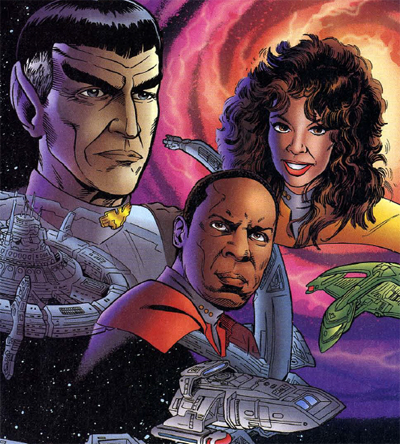
Whatever is to be done about the Romulans?

In space, all warriors are cold warriors...

In space, all warriors are cold warriors…

Continue reading

Star Trek: Voyager – Ex Post Facto (Review)

This September and October, we’re taking a look at the jam-packed 1994 to 1995 season of Star Trek, including Star Trek: Deep Space Nine and Star Trek: Voyager. Check back daily for the latest review.

Ex Post Facto has a lot of problems.

It has logical problems. It has plot problems. It has character problems. It is difficult to fit within the framework of Star Trek: Voyager. It feels like a retread of A Matter of Perspective, a less-than-successful effort from the first season of Star Trek: The Next Generation that Michael Piller produced. It is a bit of a mess, a bit too casual about everything, a bit too contrived.

And yet, despite all this, it almost works. Almost.

"This isn't the head massage I asked for!"

“This isn’t the head massage I asked for!”

Continue reading

Star Trek: Deep Space Nine – Prophet Motive (Review)

This September and October, we’re taking a look at the jam-packed 1994 to 1995 season of Star Trek, including Star Trek: Deep Space Nine and Star Trek: Voyager. Check back daily for the latest review.

Now that Star Trek: Voyager is on the air, there’s a sense that Star Trek: Deep Space Nine can be more relaxed. The show was undeniably contrarian during the short period when it was the only Star Trek on the air, presenting a series of uncompromisingly cynical episodes to assure viewers that it would not be trying to fill the void left by Star Trek: The Next Generation. At the same time, there’s also a sense that show was acutely aware of it potentially wider audience watching during that window.

During that first half of the season, a new adversary was pushed to the fore, the show did a story about Klingons and featured three guest stars from The Next Generation – although not necessarily the guest stars anybody would have chosen. More than that, though, the show seemed to consciously avoid its more controversial types of episodes. Even by the show’s third year, it had become clear that certain “types” of episodes appeared a few times a year – a couple of “old favourites” for the writing team to fall back on while constructing a twenty-six episode season.

'Ear me out 'ere...

‘Ear me out ‘ere…

As such, it’s telling that the most divisive parts of any Deep Space Nine season were pushed into the second half of the season.  So Ira Steven Behr and Robert Hewitt Wolfe’s two Ferengi-centric scripts came after Voyager had premiered. Sure, Quark got to be the focus of the season’s third episode, House of Quark, but he shared that with the popular Klingons. The season’s two big Bajoran plot lines (Life Support and Shakaar) were positioned towards the end of the year.

Prophet Motive feels like the kind of Star Trek episode that could only be produced on Deep Space Nine as part of Ira Steven Behr’s unique vision for the show. It’s the kind of weird script that the show seemed to get away with by virtue of being “the other Star Trek on television.” That doesn’t mean that it’s particularly good, mind you, just that it’s distinctly a Deep Space Nine story.

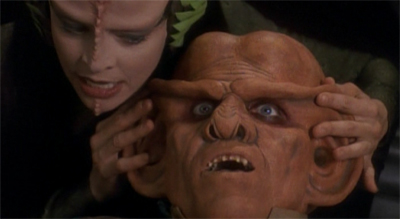
Quark is a by-the-book Ferengi...

Quark is a by-the-book Ferengi…

Continue reading

Star Trek: Deep Space Nine – The 34th Rule by Armin Shimerman & David R. George III (Review)

This September and October, we’re taking a look at the jam-packed 1994 to 1995 season of Star Trek, including Star Trek: Deep Space Nine and Star Trek: Voyager. Check back daily for the latest review.

The 34th Rule is a particularly notable piece of Star Trek fiction. It is the first Star Trek novel credited to a main cast member while their show was still on the air. Armin Shimerman, Eric A. Sitwell and David R. George III had pitched the idea for The 34th Rule as an episode of Star Trek: Deep Space Nine. When the producers were not interested in developing the idea, Shimerman and George decided to expand the idea out into a full-length novel. The 34th Rule was released during the seventh season of Deep Space Nine.

Shimerman was not the first actor to be credited on a Star Trek novel. William Shatner had already launched his own “Shatner-verse” series of novels following the “resurrection” of James Tiberius Kirk after his death in Star Trek: Generations. However, Shatner was pretty much done with the franchise at this point – having officially passed the torch to his successors as part of Generations. However, Shimerman was the first to publish a novel while the show was on the air.

The 34th Rule is a decidedly ambitious piece of work. It is clumsy in places, perhaps a little heavy-handed and on the nose. Nevertheless, it is a well-constructed and thoughtful Star Trek epic – one the feels in keeping with the mood of Deep Space Nine, even if it occasionally veers a little too far.

the34thrule

Continue reading

Star Trek: Voyager – Eye of the Needle (Review)

This September and October, we’re taking a look at the jam-packed 1994 to 1995 season of Star Trek, including Star Trek: Deep Space Nine and Star Trek: Voyager. Check back daily for the latest review.

Eye of the Needle really should be a bigger deal than it is.

Looking at the basic premise of Star Trek: Voyager, a story like Eye of the Needle should be an “event.” It should, at the very least, be a mid-season finalé. Ideally, the episode would serve as the season finalé, bringing a sense of closure to year of adventuring by our crew, suggesting that there is some measure of hope for them. Perhaps home is not as far away as it might seem.

"Hm. You appear to have beamed me up in my pyjamas..."

“Hm. You appear to have beamed me up in my pyjamas…”

Voyager is a show about a ship stranded on the far side of the galaxy. The crew are isolated from friends and family. The return journey will take seventy years. It is quite possible that this will be a generational voyage. The Voyager crew will return home to a world that has changed without them. It’s heartbreaking even to think about.

So the ship’s first chance to get home should be something to get excited about. It should be cause for celebration; it should feel like a lifeline dangling just within the reach of our characters. There should be a sense that this sort of think might only happen once, and everybody best be prepared for it. Instead, it happens six episodes into the season, and the audience spends forty-five minutes waiting for the other shoe to drop.

Thoughtful Janeway pose #452...

Thoughtful Janeway pose #452…

Continue reading

Star Trek: Deep Space Nine – Destiny (Review)

This September and October, we’re taking a look at the jam-packed 1994 to 1995 season of Star Trek, including Star Trek: Deep Space Nine and Star Trek: Voyager. Check back daily for the latest review.

The biggest problem with Destiny is that it doesn’t feel fully-formed. The show plays more like a series of vignettes than a single story. There are some nice character beats, and a sense that Star Trek: Deep Space Nine is an ensemble show, but Destiny meanders far too much. It seems like it wanders around without any singular purpose, any strong central point to tether it.

Is it about Sisko’s relation to the title of “Emissary”? Is about peace between Bajor and Cardassia? Is it about O’Brien and flirty Cardassians? Is it about Kira’s faith and her position on Deep Space Nine? Is it about end time prophecies?

It seems to be about all these things, but with no real commitment to any of them above the others. The end result is that it’s not about any of them particularly well.

Picture perfect...

Picture perfect…

Continue reading

Star Trek: Voyager – The Cloud (Review)

This September and October, we’re taking a look at the jam-packed 1994 to 1995 season of Star Trek, including Star Trek: Deep Space Nine and Star Trek: Voyager. Check back daily for the latest review.

The Cloud feels more like a first season episode than Time and Again and Phage did. Star Trek: Voyager has ploughed fairly effectively into its first season, primarily by treating it as the eighth season of Star Trek: The Next Generation. However, the first season has been falling into a regular pattern so fast that pausing for forty-five minutes to do some awkward and ill-defined character work doesn’t feel like a bad idea.

The Cloud is an awkwardly constructed piece of television that feels like it’s interested in building up this ensemble. As such, the pacing suffers, and the episode makes a number of awkward mistakes along the way, but it still feels like it is at least trying to do something worthwhile.

Shaking things up around here...

Shaking things up around here…

Continue reading

Star Trek: Deep Space Nine – Heart of Stone (Review)

This September and October, we’re taking a look at the jam-packed 1994 to 1995 season of Star Trek, including Star Trek: Deep Space Nine and Star Trek: Voyager. Check back daily for the latest review.

Heart of Stone feels quite similar to Life Support. Once again, there’s a main plot that doesn’t involve Kira quite as much as it should. Once again, this is supplemented by a subplot involving Quark’s mischievous nephew, Nog. And yet – while still flawed in a number of ways – Heart of Stone works a lot better than Life Support did, primarily because it’s a lot more thoughtfully constructed. The lack of focus on Kira is explained as part of the plot; Nog isn’t holding down an unfunny comedy subplot, he’s getting some nice character development.

Heart of Stone is occasionally a little heavy-handed in its character beats, but it works well because it pitches its plot at the right level, focusing on the characters at the heart of these stories.

A rock and a hard place...

A rock and a hard place…

Continue reading