• Following Us

  • Categories

  • Check out the Archives


  • Awards & Nominations

Star Trek: Voyager – Tuvix (Review)

This February and March (and a little bit of April), we’re taking a look at the 1995 to 1996 season of Star Trek, including Star Trek: Deep Space Nine and Star Trek: Voyager. Check back daily for the latest review.

Tuvix is a controversial piece of Star Trek.

The episode tends to polarise fandom. In particular, the climax of the episode seems to divide fans firmly down the middle. When the fan site Trek Today marked the end of Star Trek: Voyager by staging a mock “Court Martial of Captain Kathryn Janeway”, it was argued that the events of Tuvix should have been included as evidence against her. It is no surprise that the episode generated such a strong response. Discussing the production of the episode, Tom Wright reflected, “The truth is that the higher ups of Star Trek knew that this would cause some controversy.”
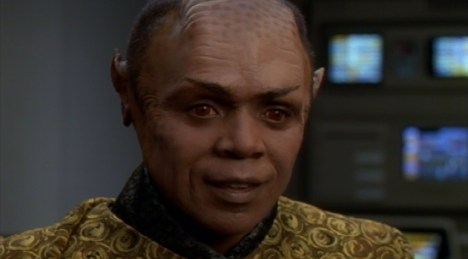
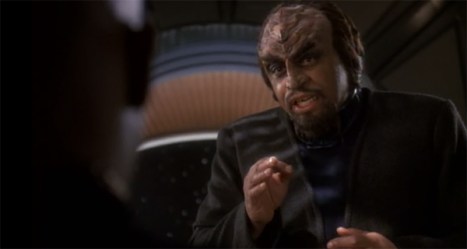
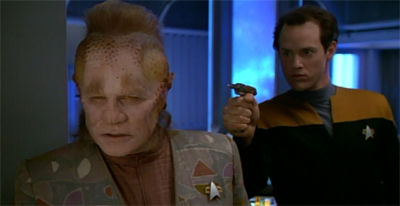
"Neevok was never gonna cut it."

“Neevok was never gonna cut it.”

Of course it generates some controversy. This is the episode where Janeway elects to murder one crew member in order to resurrect two lost crew members. This is a story about how the title character is convenient for about forty-five minutes of screentime, only for the crew to quickly dispose of him as soon as the end credits beacon. Tuvix never really makes a convincing moral case for why the eponymous character has to die, beyond the fact that it conveniently resets the status quo.

Then again, perhaps that is reason enough.
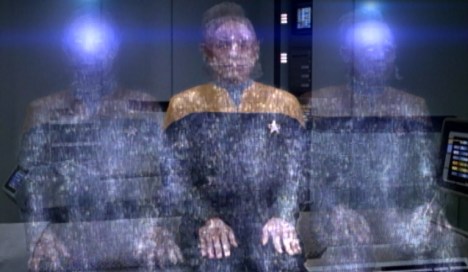
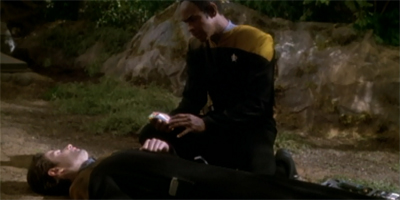
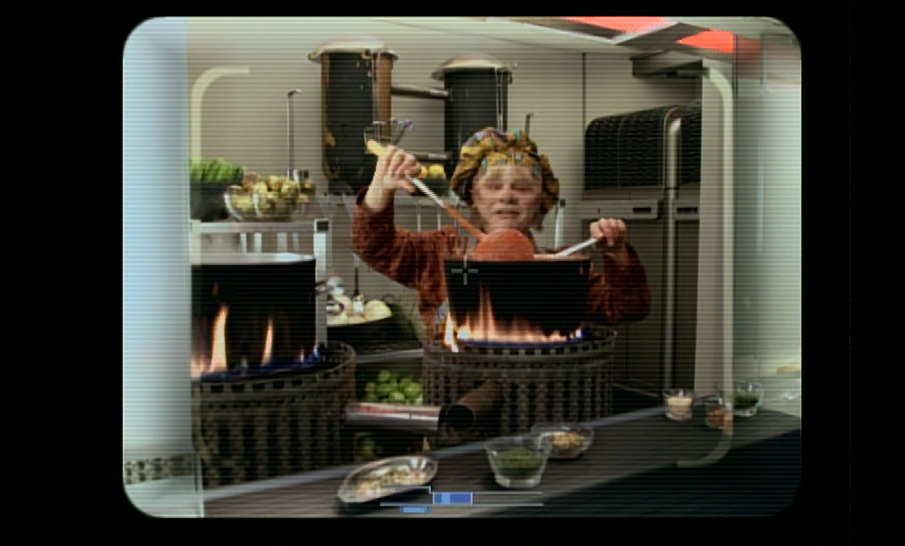
Two for the price of one...

Two for the price of one…

Continue reading

Star Trek: Deep Space Nine – For the Cause (Review)

This February and March (and a little bit of April), we’re taking a look at the 1995 to 1996 season of Star Trek, including Star Trek: Deep Space Nine and Star Trek: Voyager. Check back daily for the latest review.

For the Cause essentially refocuses the fourth season of Star Trek: Deep Space Nine, rallying the season’s strength as the finalé approaches.

After a bunch of lackluster episodes, from Rules of Engagement through to Shattered Mirror and The Muse, the show finds its voice once again. For the Cause is not just a great episode of television, it is an episode uniquely tailored to this particular show. For the Cause would not work on any of the other for Star Trek shows, so precisely is it calibrated to what makes Deep Space Nine unique. It is a story about trust and betrayal, but also one that chips away at the romance of Starfleet and the Federation.

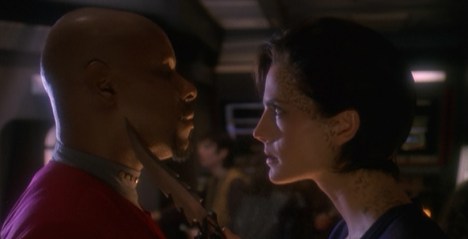
Pinning his colours to the mast...

Pinning his colours to the mast…

What is particularly interesting about the stretch of episodes running from here through to Broken Link is the sense that Deep Space Nine is getting back to basics. The fourth season is somewhat overshadowed by the addition of Worf to the cast and the emphasis placed on the Klingons in The Way of the Warrior. Although the production team do a great job working within the studio mandate, this shift in focus has meant that many more traditional elements of Deep Space Nine have been shunted into the background.

The final stretch of the fourth season finds the show returning to ideas that were threaded through earlier seasons and were shifted slightly out of focus with the return of the Klingons. For the Cause brings the Maquis back to the fore. To the Death, The Quickening and Broken Link focus on the Dominion threat. Body Parts returns to Ferengi politics. To be fair, the Maquis were the only element that totally faded from view over the fourth season, so it makes sense to return to them first.

A stunning betrayal...

A stunning betrayal…

Continue reading

Star Trek: Voyager – The Thaw (Review)

This February and March (and a little bit of April), we’re taking a look at the 1995 to 1996 season of Star Trek, including Star Trek: Deep Space Nine and Star Trek: Voyager. Check back daily for the latest review.

The Thaw is a visually striking piece of Star Trek.

The Thaw is among the most delightfully surreal and abstract episodes of Star Trek to be broadcast after October 1975. One of the more interesting aspects of Star Trek: Voyager is how consciously the show tries to return to the storytelling aesthetic of the original Star Trek show, at least in its early years. While the design aesthetics and characters might have been largely ported over from Star Trek: The Next Generation, the first few seasons of Voyager frequently feel like a conscious attempt to update sixties Star Trek tropes for the nineties.

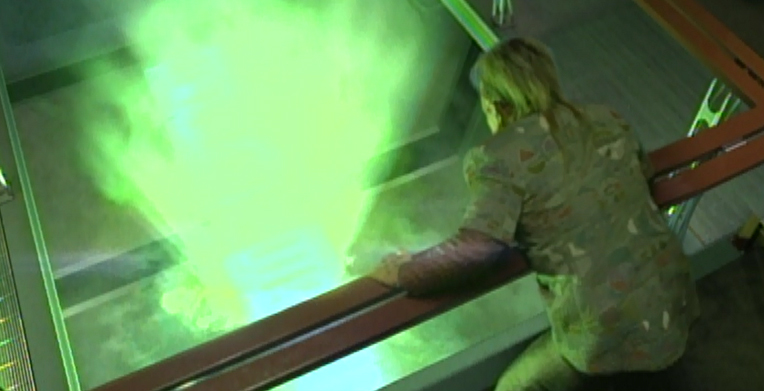
In darkness dwells...

In darkness dwells…

This is obvious in a number of ways. Caretaker consciously tried to evoke the old “space western” aesthetic, to the point of featuring a Native American first officer and introducing the Kazon as horribly racist “primitive” stereotypes. Time and Again relished primary colour costuming for their suspiciously human-like aliens. These themes became more prominent in the second season, with the b-movie aesthetic of Threshold, the space horror of Persistence of Vision and Meld, and the reverse aging allegory of Innocence.

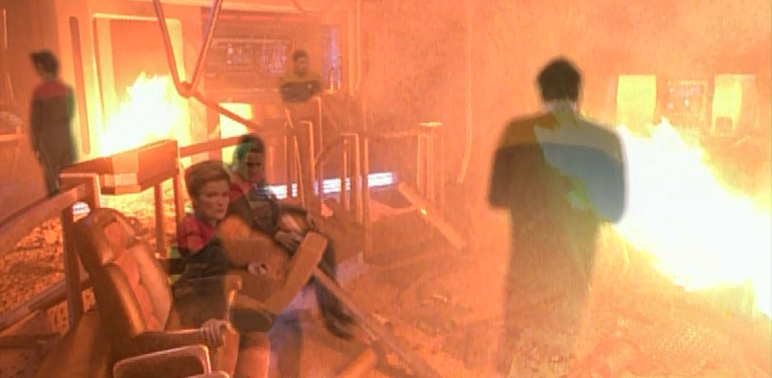
While Tuvix essentially offers a reverse twist on The Enemy Within, it is The Thaw that feels most obviously like a sixties episode trapped in ember. The allegorical storytelling, the abstract set design, the creepy campy tone. Voyager might be half-way across the galaxy, but it is never too far from the familiar.

"We never bother to scream... ... when your mask came off."

“We never bother to scream…
… when your mask came off.”

Continue reading

Star Trek: Deep Space Nine – The Muse (Review)

This February and March, we’re taking a look at the 1995 to 1996 season of Star Trek, including Star Trek: Deep Space Nine and Star Trek: Voyager. Check back daily Tuesday through Friday for the latest review.

If Shattered Mirror represents the writing staff on Star Trek: Deep Space Nine trying to stave off late-season exhaustion by cutting loose with an extended Star Wars homage, then The Muse represents an altogether different response to the strain of the twenty-six episode season.

The Muse was a painful episode. It did not emerge fully-formed, with writer René Echevarria struggling to bring the story to screen. The result is a mess of an episode. The Muse is not a good episode of television, and is almost universally accepted as such. Afforded the opportunity to remove one episode from his Star Trek CV, director David Livingston suggested it was with obvious choice. “Which would I erase? Which was the one with Meg Foster? The Muse. That was not very good. In fact, that was not good.”

Blood on the page...

Blood on the page…

Continue reading

Star Trek: Deep Space Nine – Shattered Mirror (Review)

This February and March, we’re taking a look at the 1995 to 1996 season of Star Trek, including Star Trek: Deep Space Nine and Star Trek: Voyager. Check back daily Tuesday through Friday for the latest review.

Shattered Mirror and The Muse represent the nadir of the fourth season of Star Trek: Deep Space Nine.

To be fair, it could be worse. Neither episode is Let He Who is Without Sin or Profit and Lace or The Emperor’s New Cloak. Neither is a good episode by any measure, and they certainly rank among the weakest episodes in the show’s seven year run. However, they are more misbegotten lumps of clay than spectacular disasters. Still, as critical defenses go, that is a fairly unconvincing effort. “It could be a lot worse” is hardly the most ringing of critical endorsements.

A close shave...

A close shave…

On the other hand, the fourth season of Deep Space Nine is a fairly spectacular piece of television when taken as a whole. There is a strong argument to be made for the fourth season as the most consistently entertaining season of Deep Space Nine, which stands it in good stead when placing it in the context of the franchise as a whole. The fourth season of Deep Space Nine is one of the best seasons that the franchise ever produced, right alongside the third season of Star Trek: The Next Generation.

However, even the third season of The Next Generation had its weaker moments; The Price and Ménage à Troi come to mind. The realities and demands of television production mean that a perfect twenty-six episode season without any duds is an aspirational object rather than an achievable goal. The constant churn required to produce twenty-six forty-five minute blocks of television within nine or ten months means that not every episode is going to end up perfectly sculpted. Some will be great, some will be bland. Some will be bad.

ds9-shatteredmirror11a

Yanking his chain…

Continue reading

Star Trek: Deep Space Nine – Hard Time (Review)

This February and March, we’re taking a look at the 1995 to 1996 season of Star Trek, including Star Trek: Deep Space Nine and Star Trek: Voyager. Check back daily Tuesday through Friday for the latest review.

Hard Time is a fantastic (and vastly underrated) episode of Star Trek: Deep Space Nine.

The episode tends to get overlooked in discussions about the fourth season of Deep Space Nine, perhaps owing to the high average quality of the season or the fact that it arrives in the middle of what is admittedly the season’s weakest run of episodes. However, in spite of all that, Hard Time is an exemplary piece of Deep Space Nine. It is certainly the best of the series’ “O’Brien must suffer” episodes, and a showcase for Star Trek veteran Colm Meaney. In its exploration of trauma and recovery, and cycles of violence, it taps into the heart of the show.

Not phased in the slightest...

Not phased in the slightest…

That said, Hard Time arrives at a point where Deep Space Nine is nudging closer and closer to serialisation. The show has begun to embrace long-form storytelling, as evidenced by the ripple effect of the changes to the status quo in The Way of the Warrior and the way that little plot threads weave through the season. The show has not yet reached the point at which it can structure six- or ten-episode arcs, but it is getting close. Deep Space Nine is clearly moving towards what is (for Star Trek at least) a fairly novel style of television storytelling.

As such, Hard Time is particularly striking for the fact that it is a purely episodic adventure. The episode puts Miles O’Brien through hell, having him struggle with post-traumatic stress disorder while trying to reintegrate into society. This is the kind of plot that feels more suited to a long-running mini-arc than Worf and Dax’s arguments about the relative merits of bladed weapons or Worf’s decision to move to the Defiant. Instead, O’Brien’s trauma is dealt with over the course of a single episode. Hard Time plays as a defence of the tradition television episode structure.

Growing the beard...

Growing the beard…

Continue reading

Star Trek: Deep Space Nine – Rules of Engagement (Review)

This February and March, we’re taking a look at the 1995 to 1996 season of Star Trek, including Star Trek: Deep Space Nine and Star Trek: Voyager. Check back daily Tuesday through Friday for the latest review.

Rules of Engagement is that old Star Trek standard: the trial episode.

The franchise has never really had a lot of luck with the format over the years. The Menagerie, Part I and The Menagerie, Part II were primarily of interest for the way that they repurposed The Cage and offered viewers a glimpse of an alternate kind of Star Trek. Later in that same first season, Court Martial was a disjointed and uneven (and even illogical) story. Later series did not fare much better; neither A Matter of Perspective nor Dax nor Ex Post Facto could be considered highlights of their seasons or their shows or the wider franchise.

Worf really doesn't understand the proper way to lodge an objection...

Worf really doesn’t understand the proper way to lodge an objection…

However, The Measure of a Man remains the exception that proves the rule. Not only a strong episode of itself, it stands as one of the best episodes in the history of the franchise. More than that, it represented a turning point in the history of Star Trek: The Next Generation; it is perfectly reasonable to point to The Measure of a Man as the moment that The Next Generation finally delivered on its potential after almost two seasons of struggling to find a unique voice. It seems entirely possible that the franchise has been chasing that high ever since.

Unfortunately, Rules of Engagement is an example of the rule rather than the exception. It is a misguided and clumsy episode that has a number of interesting ideas that fail to coalesce into a satisfying whole.

Klingon lawyered up... Kl'awyered up, if you will.

Klingon lawyered up…
Kl’awyered up, if you will.

Continue reading

Star Trek: Voyager – Innocence (Review)

This February and March, we’re taking a look at the 1995 to 1996 season of Star Trek, including Star Trek: Deep Space Nine and Star Trek: Voyager. Check back daily for the latest review.

One of the remarkable things about the first two seasons of Star Trek: Voyager is the way that they seem to hark back to the aesthetic of classic Star Trek.

There is a palpable goofiness to some of the ideas in the second season that feels very much in keeping with the mood and tone of the classic sixties series. There’s a surprising amount of high-concept science-fiction allegory running through the first two seasons of the show, with the writer playing with concepts not too far removed from the space!Romans of Bread and Circuses or the half-black half-white allegories of Let That Be Your Last Battlefield. There are points where Voyager seems to drift away from literalism and wander into sci-fi wackiness.

Kids these days...

Kids these days…

There were elements of this to be found in the first season, with Caretaker awkwardly literalising the franchise’s wild west metaphor by having Janeway’s first planetfall occur on a desert world with a primitive aggressive population. The Kazon and the Vidiians seemed like they escaped from pulpy science-fiction serials, with the show even going so far as to present the Vidiians as body horror space nazis in episodes like Phage and Faces. This is to say nothing of the Cold War paranoia of Cathexis or the primary colour atomic anxiety of Time and Again.

However, this tendency really kicked into high gear during the second season, with the crews’ dreams conspiring to kill them in Persistence of Vision, Chakotay meeting his people’s space!gods (er… “sky spirits”) in Tattoo, Voyager embroiling itself in a “robotic war” in Prototype and Paris “evolving” into a salamander in Threshold. There was a sense that the show was embracing the sort of high-concept sci-fi weirdness that Star Trek: The Next Generation had spent so much of its run trying to avoid, and had only really embraced in its final years.

Bennet, we hardly knew ye.

Bennet, we hardly knew ye.

That is particularly apparent in this stretch of episodes towards the end of the second season. Innocence has a species that ages backwards, enjoying a simple allegory without getting too caught up in the internal logic of the situation. The Thaw is arguably a much greater visual tribute to the style and tone of the original Star Trek than Flashback could ever claim to be. Tuvix is a classic transporter accident story, reversing The Enemy Within. These pulpy elements of Voyager would never quite go away, but they would never be as pronounced as they were in the first two years.

Innocence is a weird and goofy little story that works best as a modern fairy tale. It is arguably proof that the Star Trek franchise probably works better as metaphorical allegory than straight-up science-fiction.

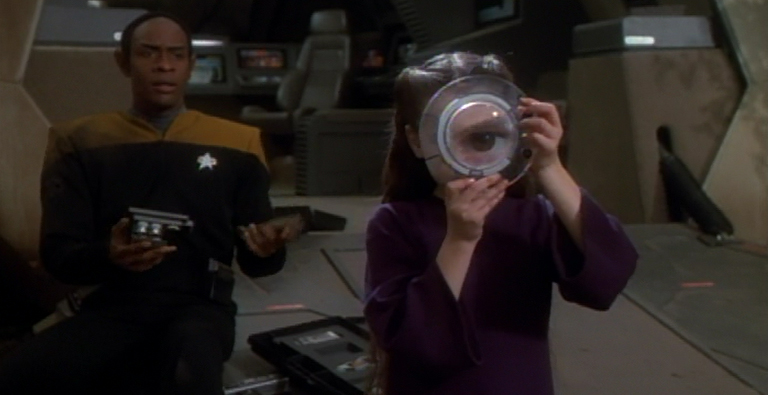
Eye see...

Eye see…

Continue reading

Star Trek: Voyager – Deadlock (Review)

This February and March, we’re taking a look at the 1995 to 1996 season of Star Trek, including Star Trek: Deep Space Nine and Star Trek: Voyager. Check back daily for the latest review.

In some ways, Deadlock is Star Trek: Voyager‘s original sin.

Of course, Deadlock is good. It is really good. It is a well-constructed piece of television that moves with an incredible momentum; it gathers speed and builds towards a suitably epic finalé. In many ways, Deadlock is one of the strongest episodes from the first two seasons of Voyager. There is a credible argument to be made that Deadlock belongs on any list of “best Voyager episodes ever”, thanks to the potent combination of Brannon Braga’s high-concept script and David Livingston’s dynamic direction.

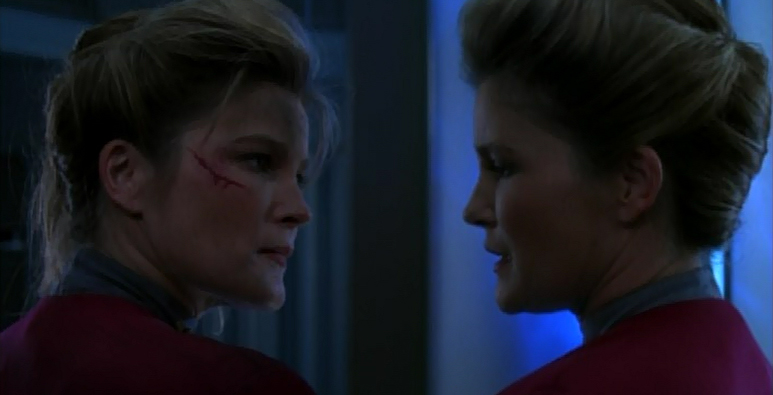
Janeway²...

Janeway²…

At the same time, it is hard not to look at Deadlock in retrospect and see the shape of things to come. It is, perhaps, the ultimate “reset” button episode; it provides a clear template for later “blow up Voyager and kill Janeway” episodes like Year of Hell or Timeless. The trick works very well once; it loses any real impact when it is repeated several times over the course of the show’s run. More than that, the episode feels somewhat generic. Due to the nature of the high-concept premise, there is little room for detail specific to Voyager.

It seems that the end of the second season set the course for the next five years of Voyager. The production team had tried to tell an experimental story specific to Voyager with Investigations, only to fail spectacularly; it would be the last time that the show attempted anything so bold. In contrast, the production team managed to construct a fantastic episode around a generic premise in Deadlock, perhaps indicating that the future of the show lay in that direction. It is easy to see why that production team opted for safe and generic ahead of ambitious and experimental.

Ghost stories...

Ghost stories…

Continue reading

Star Trek: Voyager – Investigations (Review)

This February and March, we’re taking a look at the 1995 to 1996 season of Star Trek, including Star Trek: Deep Space Nine and Star Trek: Voyager. Check back daily for the latest review.

Investigations is a misfire. It is a spectacular misfire.

Investigations is the episode that pretty much single-handedly killed any chance of Star Trek: Voyager embracing long-form storytelling once and for all. The first season had enthusiastically embraced an episodic structure, but the second season had played with the idea of playing out an arc across the majority of the season. Tying together the Kazon with the idea of a traitor on Voyager and the redemption of Tom Paris, the production team decided to attempt something relatively novel for Star Trek.

Kill me. Kill me now.

Kill me.
Kill me now.

It is worth stressing just how experimental this kind of story was. Star Trek: Deep Space Nine had played with the idea of serialisation. Threads like the Romulan and Cardassian invasion of the Gamma Quadrant were carefully seeded through episodes like Defiant and Visionary, but there was not the same tension and momentum afforded to the arcs of Michael Jonas and Tom Paris in the second season. The Romulans and the Cardassians were not discussed in every episode leading up to Improbable Cause and The Die is Cast.

At the same time, Deep Space Nine eased into serialisation in a way that allowed for failures and miscalculations that did not publicly humiliate the show. Bajoran politics could be quietly eased into the background when they weren’t quite working, characters like Primmin and T’Rul could be dropped when they weren’t what the show needed. The second season of Voyager was perhaps a bit too bold in its attempts at long-form storytelling, creating a situation where there was no way to pull back from an arc that wasn’t working.

"Well. That escalated quickly."

“Well. That escalated quickly.”

It became quite clear early on that the Paris and Jonas arc was not working. Episodes like Threshold and Dreadnought ground to a halt so that the audience could get yet another scene of Jonas selling out Voyager to the Kazon; treachery that never seemed to actually go anywhere. At the same time, Paris’ rebellious behaviour was tackled in a superficial manner in episodes like Meld and Lifesigns, with no real exploration of the interesting side of such a sting operation.

Investigations serves to bring the arc to a close, but in a manner that feels perfunctory rather than compelling. It is resolved out of a sense of tired desperation rather than any real inspiration. There is a feeling that the production team have determined this to be a failed experiment, of which they will never speak again.

See? I told you EVERYBODY's thought about it.

See? I told you EVERYBODY’s thought about it.

Continue reading