• Following Us

  • Categories

  • Check out the Archives


  • Awards & Nominations

Star Trek: Voyager – Nothing Human (Review)

Nothing Human is very much an example of Star Trek: Voyager doing archetypal Star Trek, those abstract morality plays with elaborate prosthetics that offer commentary on contemporary conundrums.

Nothing Human is essentially a story about scientific ethics, about the question of what to do with information that was gathered through amoral means. Is knowledge tainted by the mechanisms through which it was acquired? Is the use of that research an endorsement of the means through which it was conducted? At the very least, does employing such information erode the user’s moral high ground? Does the use of such data make them a hypocrite, demonstrating a willingness to reap the benefits of such monstrous work, but without getting their hands dirty?

Something inhuman.

These are tough questions, with obvious applications in the modern world. These are the sorts of abstract ethical queries that are well-suited to a Star Trek episode, and there is something very endearing in the way that Nothing Human often comes down to two characters debating scientific ethics in a room together. To be fair, Nothing Human is a little too cluttered and clumsy to be as effective as it might otherwise be, its conclusions a little too neat, its developments just a little bit too tidy.

However, Nothing Human is a great example of the way in which Voyager tried to offer a version of Star Trek reflecting the popular perception of it. Nothing Human is a little clumsy in places, but it is an episode that is very much in line with what casual viewers expect from Star Trek in the abstract.
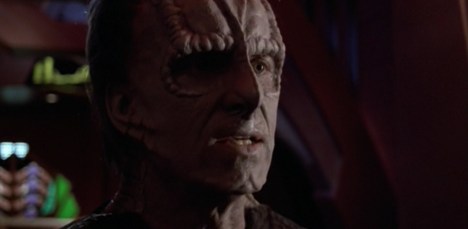
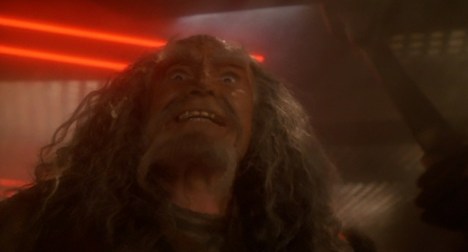
A Cardie-carrying monster.

Continue reading

Star Trek: Deep Space Nine – Covenant (Review)

Covenant is a flawed and fascinating episode.

In its own way, although obviously a much less extreme manner than The Siege of AR-558, this is an episode that could only have been produced on Star Trek: Deep Space Nine. This is not simply down to matters of continuity, and how the episode ties into the mythology of the series. More specifically, it is an exploration of religious themes and ideas that is only really possible within the framework of this particular Star Trek spin-off. It is difficult to imagine Star Trek: The Next Generation or Star Trek: Voyager tackling the idea of religious cults so effectively.

Altaring his plans.

Part of this is down to a lingering suspicion that the other Star Trek shows subtly (or not so subtly) consider all religions to be cults. After all, shows like The Return of the Archons, The Apple, For the World is Hollow and I Have Touched the SkyJustice, Who Watches the Watchers? and Devil’s Due left little room for ambiguity. The other Star Trek series seem downright hostile to the idea of religious belief, even if episodes like The Cloud and Sacred Ground might suggest a more open-minded approach to spirituality.

Deep Space Nine has generally been more willing to engage with the idea of religious belief as something that is worthy of exploration and consideration, something that is for an individual to determine on their own terms. Some characters on Deep Space Nine are explicitly atheist, like Jadzia Dax or Odo. Some characters hold strong religious beliefs, like Kira or Nog. Some characters believe in spiritual traditions without ever seeming particularly devote, like Worf. Some characters even evolve over the course of the series, like Sisko.

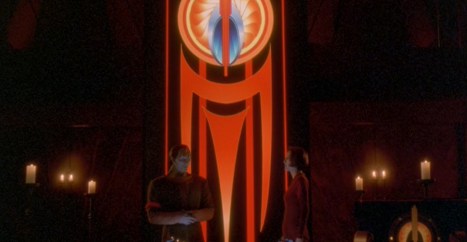
Preach out and touch faith.

This willingness to accept multiple facets and forms of religious belief allows Deep Space Nine to construct a story like Covenant. In any other Star Trek series, Covenant would seem like a knee-jerk dismissal of religious faith and organised belief, the tale of how a group of Bajorans were swindled by a charismatic leader with tragic consequences. It would be read as a generic condemnation of religious belief, an endorsement of an atheistic worldview that has developed beyond the need for such superstition.

Instead, Covenant is something more interesting and nuanced than that. It is an episode about a particular kind of belief, about a particular sort of religion. It is an episode about the dangers of a very particular form of worship. It is an episode about the perils of religious cults, but one which understands the distinction between that and other forms of spirituality.

He hasn’t a prayer.

Continue reading

Star Trek: Voyager – Infinite Regress (Review)

As with One from late in the fourth season, Infinite Regress is an episode that uses Seven of Nine’s cybernetic mind as a vehicle for psychological horror.

Producer Brannon Braga has always been interested in constructing psychological thrillers within the science-fiction framework of Star Trek, using the franchise’s pseudo-science trappings as a way to explore themes of mental deterioration or disconnect. Frame of Mind is probably the first example, but there are many others. Braga is very interested in having his characters question the nature of their reality, of trapping them within their own minds, of undercutting their sense of self. That interest bled into the shows around him.

Self-image.

Star Trek: Voyager presented the writers with an artificial computer-generated character who could more readily combine the writer’s fascination with psychological thrillers and the franchise’s engagement with advanced technology. The EMH was a character whose mind was comprised entirely of computer protocols and software code. His mind could be unfurled on monitors, buffered in memory, fragmented on the hard drive. Episodes like Projections, The Swarm and Darkling suggested a character prone to psychosis, reinforced by Dejaren’s breakdown in Revulsion.

However, the addition of Seven of Nine to the cast in Scorpion, Part II seemed to provide the the Voyager writers (and Braga in particular) with character who could function as an even more effective vehicle for these sorts of stories. Seven is a fusion of human and machine, an organic brain augmented by technological components. She is a character whose mind is in many ways already divided, whose sense of self is understandably fragile. As such, Seven is ideally suited to stories like Infinite Regress.

Mind your step.

Continue reading

Star Trek: Voyager – Timeless (Review)

The one hundredth episode of any television show should be a cause for celebration.

After all, one hundred episodes exists at a number of interesting points in the life of a show. It tends to arrive late in the fourth season or early in the fifth season of a twenty-odd-episode-a-season series, meaning that any television show making it to that point has amassed some cultural cache. By that stage, most of the original contracts are expiring (or close to expiring) and so there is at least some sense as to how secure the future is. One hundred episodes also marks the series as viable for syndication; one hundred episodes airing five days a week can fill substantial airtime.

Ice to see you again.

To be fair, the other Star Trek series tended to mark the occasion with some low-key celebrations. The one hundredth episode of Star Trek: The Next Generation was Redemption, Part I, which was primarily notable for reasons behind the camera; both a set visit from Ronald Reagan and the end of the fourth season that had so frustratingly eluded the original series. Star Trek: Deep Space Nine marked both its one hundredth hour (The Ship) and its one hundredth episode (… Nor the Battle to the Strong) as “business as usual.”

However, Star Trek: Voyager turns its one hundredth episode into an epic event. It is the perfect distillation of the “Voyager as blockbuster Star Trek” aesthetic championed by Brannon Braga: a truly jaw-dropping computer-generated action scene, with Voyager crashing on the surface of an ice world; a high-stakes time-travel plot, with a killer hook; a guest appearance from a beloved Next Generation actor. Timeless is an incredibly ambitious piece of television that practically screams “this is a very special occasion!” to the audience at the top of its lungs.

LaForging ahead.

And, yet, for all of that, there is something decidedly funereal about the episode. The episode opens with the memorable shot of the eponymous starship buried under the ice on some forgotten and unnamed world. The crew are long dead, but the ship itself remains preserved and trapped in amber. While Timeless might eventually end with future!Kim changing the timeline and shaving ten years off the journey, the episode’s most iconic images are destructive: Voyager crashing and bouncing, the familiar sets encased in ice.

This is not a birthday party, it is a wake.

Seven and the EMH never saw eye-to-eye.

Continue reading

Star Trek: Deep Space Nine – The Siege of AR-558 (Review)

The thing that Ira and I both wanted to do, was to make war as gritty as possible. You can make what somebody called the Gameboy wars, the Nintendo War, too clean and too cute. Nobody pays a price. You see ships blowing up, and that is kind of cool. But you don’t get the feeling of what a war is. Everybody said it was our Saving Private Ryan, but we’d come up with it before we were even aware of what they were doing on Saving Private Ryan. It really wasn’t that for us. It was really much more about Starfleet, and what those guys go through, and what it must be like in that time, and how to make that work on a gritty level. Rick Kolbe did a remarkable job directing it. Avery again did a marvelous performance in terms of being the captain in a very difficult situation, and making all of those difficult choices that you have to make under those circumstances.

– Hans Beimler, Cinefantastique

Siege the day.

The Siege of AR-558 is a masterful piece of Star Trek, and one of the finest episodes of Star Trek: Deep Space Nine.

In some ways, The Siege of AR-558 is an episode that has been necessary since the outbreak of the Dominion War at the end of Call to Arms. It is a story that had to be told at some point in the two-year stretch from A Time to Stand to What You Leave Behind. Had the writers and producers on Deep Space Nine opted not to tell a story like this within the framework of the Dominion War, they would have undermined the series as a whole and undercut a lot of the justifications for constructing an epic two-year war arc.

Mumy dearest.

It could reasonably be argued that The Siege of AR-558 is not unprecedented. In many ways, the episode is an extension of a narrative style that had been attempted at various points in the show’s recent history, the familiar “war is hell” story that drove episodes like The Ship, ... Nor the Battle to the Strong and Rocks and Shoals. It is very hard to look at the final three seasons of Deep Space Nine as a narrative glorifying warfare, the series often cynical about such violence.

At the same time, The Siege of AR-558 pushes that idea further than any earlier episode. The Siege of AR-558 is a story that unequivocally confirms that the Dominion War is a nightmarish and existential threat to the Federation with a profound moral and physical cost. While this idea has been reiterated repeatedly in stories like Far Beyond the Stars or In the Pale Moonlight, The Siege of AR-558 frames its argument in more visceral terms. It is an episode not about the abstract concept of war, but of its horrifying realities.

An explosive combination.

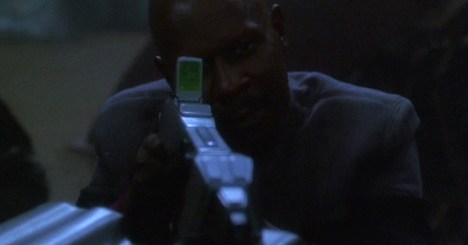
The Siege of AR-558 is not a morality play that operates at a remove from the violence. The Siege of AR-558 is not an episode in which war is reduced to a mathematical model. The Siege of AR-558 is not an episode in which important people sit around a table and engage in vigourous debate about plans of attack. Instead, The Siege of AR-558 is a story about the horrifying realities of combat, of the fear and dread felt by those on ground, of the seemingly pointless bloodshed that results from all of this politicking and scheming.

The Siege of AR-558 is a war story.

A shot in the dark.

Continue reading

Star Trek: Voyager – Once Upon a Time (Review)

Once Upon a Time is another example of thwarted ambition on Star Trek: Voyager.

The original pitch for the episode was incredibly ambitious and narratively experimental, a Star Trek story told exclusively from the perspective of a child character trying to make sense of a world from which the adults are trying to protect her. In many ways, it recalls the original pitch for Macrocosm, an episode that Brannon Braga had originally hoped to write as a piece of silent television. However, like that earlier episode, the original plan for Once Upon a Time was vetoed in favour of something far more conventional.

Toyetic, isn’t he?

In many ways, this conservatism was a reminder of just how far Voyager was being left behind, of how the dominant production strand of the Star Trek franchise was failing to keep pace with the changing media landscape around it. Genre television had been a hotbed for experimentation in the nineties. Twin Peaks changed television, allowing the medium to embrace surrealism and weirdness in a way never seen before. Series like Babylon 5 and Star Trek: Deep Space Nine returned serialisation to prime time, after it had fallen out of fashion.

Over the course of the decade, genre shows were willing to push the boundaries of what was possible in television, proving dynamic in a way that would be hugely influential for the more high-brow “prestige” series that followed. Even shows like The X-Files, Space: Above and Beyond and Buffy: The Vampire Slayer indulged in the occasional experimental episodes like The Post-Modern Prometheus, Triangle, Who Monitors the Birds?, Hush and Once More With Feeling. There was a revolution taking place in television during the nineties.

It’ll never catch on.

Of course, that particular television revolution was already in its final days as the decade drew to a close. The next big innovation in television storytelling was just around the corner, with The Sopranos only a few months away from broadcast. Once that happened, the television revolution would shift away from science-fiction and horror shows on free-to-access broadcasters and towards more critically-respected genres on more prestigious (and exclusive) networks. Voyager would have been late to the party anyway, but instead decided to skip it anyway.

Once Upon a Time is an ambitious premise watered down to mediocre execution. It is Voyager in a nutshell.

Why, I Flotter…

Continue reading

Star Trek: Deep Space Nine – Once More Unto the Breach (Review)

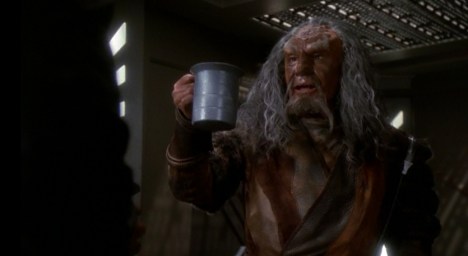
Once More Unto the Breach bids a fond farewell to Kor, the Star Trek franchise’s original Klingon.

To be fair, Star Trek: Deep Space Nine had never been particularly shy about killing off recurring characters, with Enabran Tain dying in In Purgatory’s Shadow, Michael Eddington expiring in Blaze of Glory, and Tora Ziyal being murdered in Sacrifice of Angels. Contractual negotiations had guaranteed the death of Jadzia Dax in Tears of the Prophets. Certainly, Kor was not a major player in the larger fabric of the show when compared to these figures, having only previously appeared in Blood Oath and The Sword of Kahless.

The return of a Kor character.

However, there is a certain gravity to the character owing to the fact that he could trace his appearance all the way back to Errand of Mercy in the very first season of the franchise. Kor was very much the first Klingon, even if he was neither the first Klingon to appear on screen nor the first Klingon to truly resemble the modern template. Kor was a part of the franchise’s history, part of its context. John Colicos had a fairly significant impact on popular culture, but has particularly important to Star Trek.

There would be bigger deaths over the course of the seventh season. Actors who had been with the franchise for years would go out in a blaze of glory. Recurring guest stars would see their stories come to an end. Some of those endings would be happy, whereas others would be more ignoble. Nevertheless, there is a something powerful about the passing of Kor in Once More Unto the Breach. It feels very much like an ending.

No Country for Old Klingons.

Continue reading

Star Trek: Voyager – In the Flesh (Review)

In the Flesh is a curiously nostalgic episode of Star Trek: Voyager.

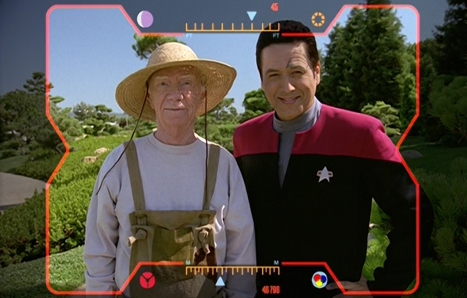
Nostalgic in a number of different ways. Most obviously, it opens on what appears to be Earth, bringing the Voyager crew to something resembling home. The campus recalls visits to Starfleet Command in earlier episodes of Star Trek: The Next Generation and Star Trek: Deep Space Nine like The First Duty, Homefront and Paradise Lost. There is even a prominent guest appearance from Boothby, the groundskeeper who was referenced as early as Final Mission. When it is eventually revealed to be a ruse, it is explained as a ruse orchestrated by old villains Species 8472.

Picture imperfect.

However, In the Flesh feels nostalgic in a deeper sense, extending even beyond the Star Trek canon. There is something very retro about the threat presented here, about a top secret facsimile of a distant world being used to train infiltrators in a deep space cold war. In the Flesh feels like a piece of fifties paranoia, with specific creative choices evoking film noir storytelling and even the aesthetic of Invasion of the Body Snatchers or Night of the Living Dead. The most prominent guest star is Ray Walston, a veteran of cult sixties sci-fi show My Favourite Martian.

To be fair, Voyager has always had a strong nostalgic streak for pulpy fifties and sixties science-fiction, but it is strange to see it so pronounced. In its own weird way, it fits with the general nostalgic tone of the fifth season as a whole.

Look at the “8” in their eyes.

Continue reading

Star Trek: Deep Space Nine – Treachery, Faith and the Great River (Review)

Treachery, Faith and the Great River is a beautiful piece of Star Trek: Deep Space Nine.

It is a meditation on everything suggested by the title, recurring themes across the seven-season run of Deep Space Nine. Indeed, it is a reflection on how each of those three concepts all tie back to the same notion of belief. Treachery is what happens when belief is betrayed, faith is what happens when belief is held without validation, and the great river reflects a more generic belief in the balance and distribution of the wider universe. Treachery, Faith and the Great River is a story about belief and the various forms that it takes, and the rewards that it offers.

“And how can man die better than facing fearful odds, for the ashes of his fathers, and the temples of his Gods?”

In many ways, Treachery, Faith and the Great River marks a return to the sort of softer religious belief that defined the early seasons of Deep Space Nine. It is an episode that engages with the challenges of faith, rather than taking it at face value. It is no small irony that an episode as nuanced as Treachery, Faith and the Great River should be credited to the writers responsible for The Reckoning. In many ways, Treachery, Faith and the Great River asks what it means to truly believe in something, even knowing that this belief might never be rewarded.

Treachery, Faith and the Great River is a story about looking for the divine, and the answers that are offered in return.

Weyoun Six, Weyoun Seven…
All good clones go to heaven…

Continue reading

Star Trek: Voyager – Extreme Risk (Review)

Extreme Risk is another example of Star Trek: Voyager squandering an intriguing premise.

Hunters introduced a number of new and intriguing ideas to Voyager. Suddenly, Janeway was no longer in a long-term relationship with Mark, which made it possible for her to consider romantic entanglements in the Delta Quadrant. Suddenly Starfleet was aware that Voyager was still in one piece, rather than missing in action. These creative choices opened up new storytelling possibilities, paving the way for episodes like Counterpoint or Pathfinder.

Diving right in.

However, the most interesting revelation in Hunters was that the Maquis had been destroyed while Voyager was lost in the Delta Quadrant. This was not a surprise to Star Trek fans who had been watching Star Trek: Deep Space Nine, given that this development had been covered in Blaze of Glory. However, it should have been a big deal to the characters on Voyager. Chakotay and Torres were members of the Maquis. Tuvok had been a spy working for Starfleet in the Maquis. Even Paris had spent some time in the organisation. This news should have been a big deal.

Extreme Risk feels like an interesting development of this idea, albeit one that has been greatly delayed. How would the Maquis crew members react to the news that most of their friends were dead and that the rest were in Federation custody? Voyager has never been a show particularly engaged with long-term consequences, but there is an interesting story to be told there. Extreme Risk tells one such story, suggesting that the new plunged Torres into a depression that led her to self-harm. It is certainly an intriguing and compelling story hook.

Building a better future.

However, Extreme Risk fumbles the delivery in a number of ways. It makes the standard Voyager mistake of assuming that character-driven plots still have to have a compelling action-adventure element to them, and so provides a very generic subplot about a probe that has been lost in the atmosphere of a gas giant and the resulting “old-fashioned space race” that results, including the construction of a new ship. As a result, the plotting of the episode feels very trite, offering Torres a very convenient clear-cut redemption arc at the climax.

That said, the biggest problem with Extreme Risk is much more basic than the awkward juggling of primary and secondary plots. As with Night before it, Extreme Risk demonstrates that the rigidly episodic structure of Voyager is woefully ill-equipped to tell a profound (and sincere) story about the struggles of living with clinical depression.

She knows kung fu.

Continue reading