• Following Us

  • Categories

  • Check out the Archives


  • Awards & Nominations

Star Trek: Deep Space Nine – Field of Fire (Review)

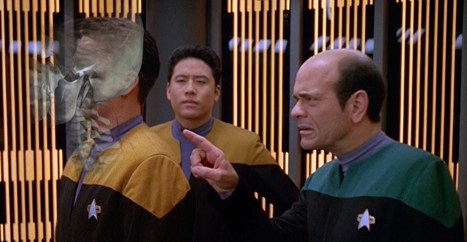
Field of Fire is an oddly nineties piece of television.

All television shows are inevitably a product of their time. This was particularly true of the twenty-odd-episode-a-season shows produced during the twentieth century, subject to the brutal churn of a weekly production schedule. The production team needed scripts, which meant that the writers needed ideas. Inevitably, those ideas were drawn from the wider culture around them. As a result, television is often an interesting lens through which culture might be examined, a projection of how a given society sees (or perhaps wishes to see) itself.

The noblest aim.

Star Trek: Enterprise was inescapably a product of the War on Terror, caught in the gravity of the attacks upon the World Trade Centre. Star Trek: Voyager was undeniably a child of the nineties, driven largely be a sense of listless anxiety in the shadow the millennium. While Star Trek: Deep Space Nine could never be entirely removed from its cultural context, it still stood apart. The writers tended to draw their themes from history, rather than from current affairs, creating a Star Trek show that seemed to exist beyond its cultural moment.

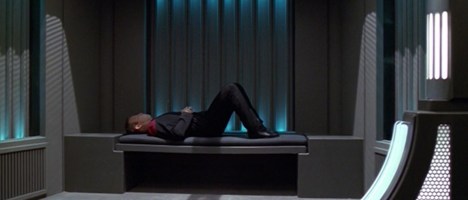
Of course, there are exceptions. Field of Fire is that most nineties of television episodes, the serial killer psychological thriller.

Highly illogical.

Continue reading

Star Trek: Deep Space Nine – The Emperor’s New Cloak (Review)

The Emperor’s New Cloak is a disaster.

To be fair, it is not a messy disaster. There is nothing particularly novel in how terrible The Emperor’s New Cloak actually is. Most of the awfulness is carried over from Through the Looking Glass and Shattered Mirror. The sharp decline in quality and merit of the mirror universe episodes since the concept’s reintroduction in Crossover has become a gentle slope. The Emperor’s New Cloak is unfunny and broadly homophobic nonsense, clumsily plotted and horribly paced. If it sets a lower bar for these mirror universe episodes, that bar is not appreciably lower.

Not quite having a blast…

The Emperor’s New Cloak is terrible in the same way that Prodigal Daughter and Field of Fire are terrible. It is as though Star Trek: Deep Space Nine has reached a point where its bad episodes are no longer surprising, simply uninspired. No audience member watching The Emperor’s New Cloak will wonder how any of these ideas made it to screen. There is none of the novelty that defined the horrors in episodes like Meridian, Let He Who Is Without Sin… or even Profit and Lace. There is just a creeping sense of fatigue.

In some ways, it makes sense that the most disappointing episodes of the seventh season should be affected by this feeling of exhaustion. The end is nigh, the production team have been working on the series for seven years. Even their bad jokes are no longer shocking, simply tired.

A dark moment for all involved.

Continue reading

Star Trek: Voyager – Gravity (Review)

Gravity is a powerful story, all the more effective for its relative simplicity.

Tuvok has been one of the most overlooked and ignored regular cast members on Star Trek: Voyager. The later seasons tend to neglect Harry Kim and Chakotay, but they had been given considerable focus in the earlier years of the show. Chakotay had been a major focus in The Cloud, State of Flux, Cathexis, Initiations, Tattoo, Manoeuvres and Basics, Part I. Kim had taken centre stage in Emanations, Prime Factors, Non Sequitur and The Thaw. In contrast, Tuvok remained relatively anonymous, more of a supporting player than a narrative focal point.

Vulcan on a ledge.

In hindsight, this appears a rather strange choice. Tuvok is the first full-blooded Vulcan character to appear as a regular on a Star Trek show. Spock is easily the most iconic character in the franchise, to the point that he would be the torchbearer for the JJ Abrams reboot and his family still haunts Star Trek: Discovery. As such, having a fully Vulcan character should have led to all manner of interesting stories. After all, Tuvok was introduced in Caretaker as a spy working undercover in the Maquis. There should have been a lot of material to mine in the set-up.

However, for most of the run of Voyager, Tuvok seemed cast in a supporting role. He was the investigator in episodes where the crew were falsely accused, as Paris was in Ex Post Facto or Torres was in Random Thoughts. He was a reliable sounding board for other characters, as with Kes in Cold Fire or Neelix in Rise or Seven of Nine in The Raven. He was even effectively employed as a mind-controlled monster in episodes like Cathexis and Repression. Tellingly, most of the handful of episodes focusing on Tuvok focus on events where he is not himself; Tuvix, Riddles.

Vulcan love slave.

This is a shame, as there is a lot of fertile ground to explore within Vulcan psychology. Logic is never as clean or simple as Spock made it sound. Existence is full of logical contradictions and inconsistencies. The two best Tuvok-centric episodes of Voyager tend to focus on these inconsistencies. Meld is an episode in which Tuvok asks questions for which there can be no answer, and in which his insistence that the universe is an ordered and logical structure pushes him to some very dark places. Gravity explores the long-standing myth that Vulcans are emotionless.

Gravity is a surprisingly influential episode of Voyager, an episode that explores the implications of an idea which the larger Star Trek franchise had taken for granted for more than thirty years. It is an episode that feels unique in the larger context of Voyager, one build as much around character as action. It is story about love and repression, one rooted very much in who Tuvok is. It might just be one of the best Vulcan-centric stories in the franchise.

Tuvok lightens up.

Continue reading

Star Trek: Voyager – Bride of Chaotica! (Review)

Bride of Chaotica! is an enjoyable mess.

As its title implies, Bride of Chaotica! is a celebration of nostalgic futurism. It is a culmination of a number of themes running through the series. Most obviously, this particular brand of retrofuturism has been a recurring gag since Night at the start of the fifth season, but it fits within a broader context. From the outset, Star Trek: Voyager has been engaged with a more nostalgic sci-fi aesthetic than Star Trek: The Next Generation or Star Trek: Deep Space Nine.

Bride of evil.

Voyager‘s retrofuturism has taken various forms; the old school “space western” tone established by Caretaker, the retro sci-fi trappings of episodes like Innocence or Rise, the monster mayhem of episodes like Phage or Macrocosm, the Cold War paranoia of Cathexis or In the Flesh, Tom Paris’ nostalgic holoprograms in Lifesigns or Vis á Vis, the abductees from the early twentieth century in The 37’s. However, perhaps the most basic is baked into the concept of the show. Voyager is literally a series about the desire to return to a safer and more familiar time.

In some ways, Bride of Chaotica! cements this nostalgia in the context of the larger Star Trek canon, embracing the anxiety that has become increasingly apparent in the years since the thirtieth anniversary. After all, the surrounding feature films all literalise the pull of the past. Star Trek: First Contact has Jean-Luc Picard literally journey back to twenty-first century Earth while revisiting his most iconic moment. Star Trek: Insurrection has the crew discover the fountain of youth. Star Trek: Nemesis confronts Picard with a younger clone of himself.

Radio Chaotica!

It is perhaps telling that Voyager was the moment at which the Star Trek franchise stopped pushing forward. During and after Voyager, the franchise would become increasingly backwards-looking. Star Trek: Enterprise would invite the audience to meet James T. Kirk’s childhood era, trying to recapture that old magic. JJ Abrams’ Star Trek reboot would focus on a young version of Kirk and Spock. Star Trek: Discovery will feature a central character who is something close to Spock’s sister. There is a conscious pull of nostalgia.

Perhaps the future was better yesterday.

Never too far afield.

Continue reading

Star Trek: Voyager – Latent Image (Review)

Latent Image is a powerful allegorical piece of Star Trek, a prime example of how Star Trek: Voyager could occasionally spin gold from its shift towards a more “archetypal Star Trek” template. It is a story that could easily have been told with Data on Star Trek: The Next Generation, for example.

At the same time, Latent Image is a story that touches on many of the core themes of Voyager, many of the show’s key recurring fixations and fascinations. It is an episode about the link between memory and identity, about the importance of preserving history rather than burying it; it touches upon both the metaphorical manipulation of history in stories like RememberDistant Origin and Living Witness and the literal manipulation of the past in stories like Future’s End, Part IFuture’s End, Part IIYear of Hell, Part I and Year of Hell, Part II.

Picture imperfect.

However, it filters that experience through Brannon Braga and Joe Menosky’s recurring fascination with themes of identity and self-definition. The writers have often used the artificial characters on Voyager to explore the malleability of self, how easily the sense of self might be eroded or decayed; the EMH grappled with this challenge in Projections and Darkling, while Seven wrestled with it in Infinite Regress. The artificial characters on Voyager frequently seemed on a verge of a nervous breakdown.

Latent Image is notable for wedding these two concepts together, for integrating these two concepts and exploring the manipulation of an individual’s history as the root of an identity crisis. What happens to the EMH in Latent Image is at once an extension of the dysfunction suggested in Projections and Darkling as well as a more intimate exploration of the cultural identity crises in episodes like RememberDistant Origin and Living Witness. Latent Image suggests that memory is the thread that ties identity together. Without that continuity of self, everything unravels.

A bone to pick with him.

As such, Latent Image exists in an interesting space. It is a story that works very well as a high-concept character study, focusing on the nature of the EMH has a computer programme. Although episodes like Pen Pals suggest that Starfleet has the power to remove memories from biological life forms, the plot of Latent Image could not work as well with a character like Kim or Paris. At the same time, it is a broader allegory about how important memories and experiences are in terms of defining who a person is, and how dealing with these memories defines a cultural identity.

Latent Image is a powerful and clever piece of television.

The camera never lies.

Continue reading

Star Trek: Deep Space Nine – Prodigal Daughter (Review)

Prodigal Daughter is an incredibly limp piece of television.

Prodigal Daughter plays more like a first season episode than a final season episode, the result of a creative process where the writing staff are still trying to figure out how best to approach major characters and even how best to structure individual episodes of the series. There is something distractingly amateurish about Prodigal Daughter, which seems to largely consist of one-shot guest characters standing around drab sets talking about things that happened off-screen. It is not so much bad as it is boring.

Painting a pretty picture.

To be fair, there are reasons for these problems. Ezri Dax was still a new character, and the production team were still getting to grips with her. Although Ezri had been integrated into the ensemble with relative ease, the writers had only given her a single character-focused episode in Afterimage. This was understandable, with everything else going on, but it meant that the character still had to find a unique voice. Beyond that, the structural problems with Prodigal Daughter were largely down to nightmarish disorganisation behind the scenes.

Of course, knowing this does not make it any easier to watch Prodigal Daughter.

Oh, brother!

Continue reading

Star Trek: Deep Space Nine – It’s Only a Paper Moon (Review)

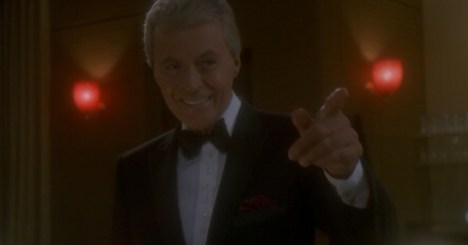
It’s Only a Paper Moon is a fantastic illustration of a lot of things that Star Trek: Deep Space Nine does consistently well.

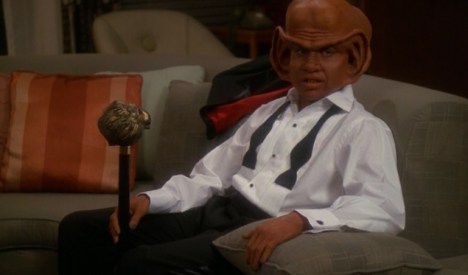
It is an episode that builds off events depicted in an earlier story, picking up with the character of Nog following the loss of his leg in The Siege of AR-558. In many ways, It’s Only a Paper Moon feels like a necessary part of that earlier adventure, dealing with the consequences of something truly horrific. It would have been cheap and crass to gloss over the enormity of what had happened to Nog. In The Siege of AR-558, the loss of Nog’s leg was a minor detail; one of many reminders of how war is hell. It’s Only a Paper Moon allows that story to play out in more depth.

“I’ll be seeing you…”

It’s Only a Paper Moon is also an episode that feels quite removed from what audiences expect from a Star Trek episode. The central story focuses on two supporting characters who exist outside the regular cast, trusting Nog and Vic Fontaine to carry a story on their own terms. It is a testament to how well-developed the world of Deep Space Nine has become, recalling the focus on Martok in Soldiers of the Empire or Once More Unto the Breach, Dukat in Indiscretion or Return to Grace and Garak in The Wire or Improbable Cause and The Die is Cast.

Unfolding primarily in a holographic recreation of sixties Las Vegas, It’s Only a Paper Moon is a very surreal and unusual episode of Deep Space Nine. However, it works perfectly in the context of Deep Space Nine.

A hard day’s Nog.

Continue reading

Star Trek: Voyager – Counterpoint (Review)

Counterpoint is a spectacular episode of Star Trek: Voyager, a highlight of the fifth season and of the seven season run in general.

Counterpoint is meticulously constructed, put together with a great deal of care and consideration. This is most obvious in the plotting and characterisation in the episode, in the way that the focus of the story remains constant while peeling back the layers on the characters involved. Too many Voyager episodes indulge in a contrived sequence of “… and then…” plotting, while Counterpoint is an episode that understands what it is about and is content to explore its ideas and its characters to their logical conclusions.

Playing it pitch perfect.

Counterpoint benefits from two superb central performances. Mark Harelik is one of the strongest one-shot guest stars to appear on Voyager, playing Kashyk as an endearingly ambiguous figure caught half way between a conventional romantic lead and a fascist thug. However, Counterpoint works best as a showcase for Kate Mulgrew as Kathryn Janeway. Mulgrew has always been one of the strongest members of Voyager‘s primary cast, but the production team always struggled to play to her strengths while building a consistent character.

Counterpoint is an episode that plays perfectly to the strengths of all involved, creating a symphony where all of the orchestra is playing both in key and in time with one another. At this point in the run, Voyager should be producing episodes like this with much greater consistency.

Near kiss.

Continue reading

Non-Review Review: Star Trek – Insurrection

“I think I’m having a mid-life crisis,” Riker tells Troi at one point in Star Trek: Insurrection, and it might be the most telling line in the film.

Insurrection is many things, perhaps too many things. However, it primarily feels like a meditation on what it means to grow old, focusing on the cast of Star Trek: The Next Generation. That first live-action Star Trek spin-off had revived the franchise as an on-going cultural concern, even launching a feature film franchise including Star Trek: Generations and Star Trek: First Contact, and spawning its own spin-offs including Star Trek: Voyager and Star Trek: Deep Space Nine.

A fist full of Data.

However, by the time that Insurrection arrived, The Next Generation was looking quite old. The Next Generation had launched more than a decade earlier, and had been off the air for almost five years. Although it had been a pop cultural behemoth, even its children (or its younger siblings) were starting to look a little long in the tooth. Deep Space Nine was in its final season, and Voyager was closer to its end than to its beginning. There was a creeping sense of fatigue and exhaustion.

In theory, this positions Insurrection quite well. After all, the original feature film franchise really came into its own when the characters found themselves forced to confront their own mortality. Star Trek II: The Wrath of Khan breathed new life into the franchise as it forced Kirk to come to terms with his old age, while Star Trek III: The Search for Spock indulged the sense of grown-ups behaving badly in a story that forced Kirk to throw aside his ship and his career in service of an old friend.

Picard’s hairpiece was fooling nobody.

Stories about age and mortality resonate, and so Insurrection has a fairly solid foundation from which to build. There is just one sizable problem. The cast and crew of The Next Generation have no intention of growing old, of wrestling with mortality, of confronting their age. Insurrection is fundamentally a story about rejecting this maturity and this sense of age, of refusing to accept that time takes its toll and denying that old age is best faced with solemn dignity and reflection.

Insurrection is a story about mamboing against the dying of the light.

A familiar dance.

Continue reading

Star Trek: Voyager – Thirty Days (Review)

Thirty Days is a fascinating misfire.

Thirty Days is build around a number of interesting ideas. In terms of character, there is the framing device that finds Tom Paris sentenced to spend one month in the brig after an act of crass insubordination, suggesting a relapse into the “bad boy” persona that was largely forgotten after Ex Post Facto, barring the occasional revival for episodes like Vis á Vis. It also hints at questions of discipline on the ship, something around which Star Trek: Voyager has skirted in the past in episodes like Prime Factors and Manoeuvres. There is a compelling story here, somewhere.

Watching Thirty Days can feel like…

In terms of science-fiction plot elements, Thirty Days features the first ocean planet in the history of the Star Trek franchise. That is interesting of itself. What wonders lurk within an ocean world? What would life look like had it never left the sea and set foot on land? There is something decidedly pulpy and magical about a planet that has no surface of which to speak, instead comprised of waves and tides. Even with the flimsiest of plots, this element alone should provide fodder for an exciting installment.

Unfortunately, Thirty Days fumbles both of these interesting elements, falling victim to a recurring issue with the plotting on Voyager. The pacing is awkward, the plot points are under-developed, the framing device is hackneyed. The script for Thirty Days seems far more concerned about hitting the forty-five minute mark than it does with using these elements to tell a compelling story. The result is a bit of a wash.

Water conservation.

Continue reading