• Following Us

  • Categories

  • Check out the Archives


  • Awards & Nominations

Star Trek: Deep Space Nine – When It Rains… (Review)

One of the interesting aspects of the final arc of Star Trek: Deep Space Nine is watching the series grapple with challenges that face a lot of later serialised television shows.

The massive ten-episode conclusion to Deep Space Nine is effectively equivalent to a full season of a highly serialised prestige television show like Game of Thrones, Westworld or The Leftovers. Of course, there are any number of obvious differences, from the need to structure episodes around commercial breaks or the dependency on clunky exposition or the fact that these ten episodes were following a production run of sixteen early episodes in the same production season.
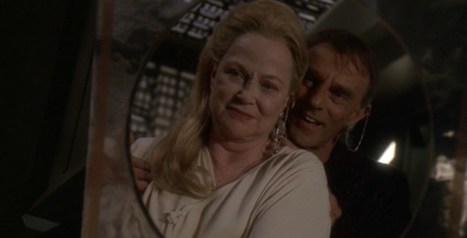
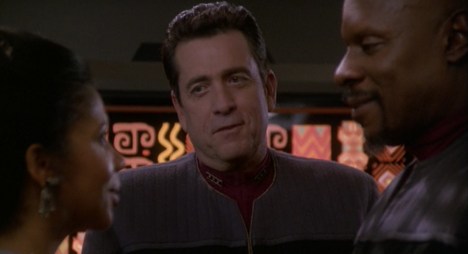
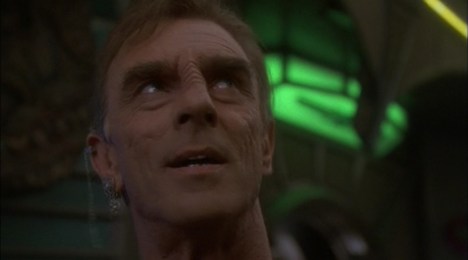
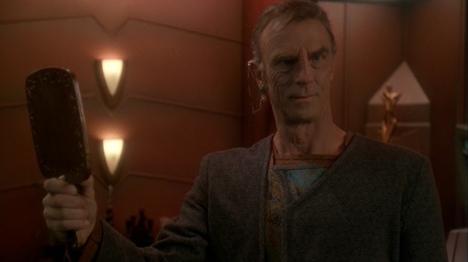
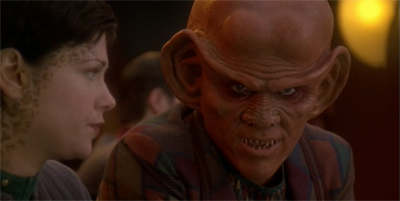
Dukat does not react well to criticism of his role in this epic ten-episode arc.

Nevertheless, these ten episodes grapple with a lot of the difficulties in mapping out a single extended story across a large number of episodes. Deep Space Nine had launched its six season with an impressive six-episode arc that hung together almost perfectly, give or take Sons and Daughters. However, there were unique challenges in attempting that same narrative trick with ten episodes at the end of a production season.

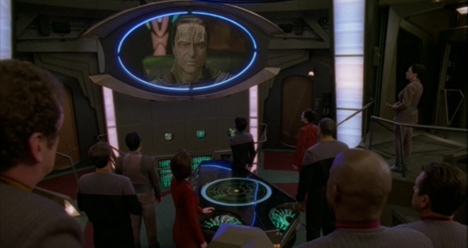
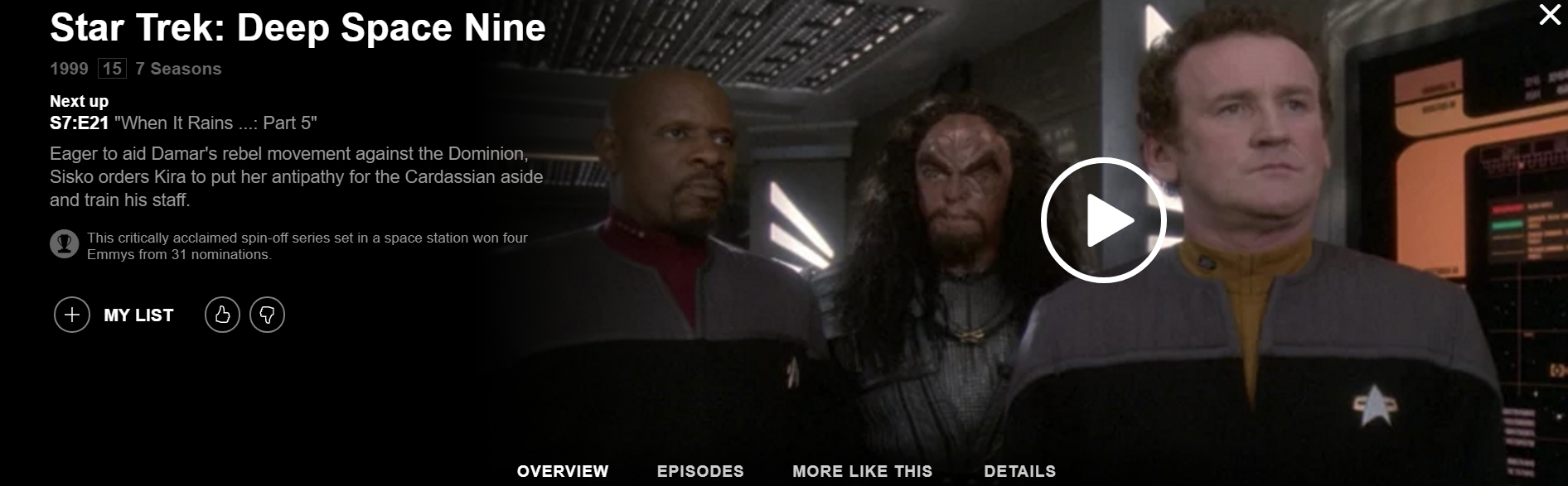
A lot of these problems are pacing related. As with a lot of serialised shows, these ten episodes occasionally struggle to give each episode a unique identity. Strange Bedfellows is an episode that seems stuck between the sets of dramatic reveals either side of it, the weddings and alliances of ‘Til Death Do Us Part or the terror and revelation of The Changing Face of Evil. There is certainly an element of that to When It Rains…, which seems to spend most of its runtime lining up two major plot threads for resolution in the superlative Tacking Into the Wind.
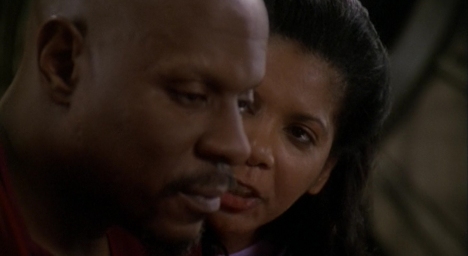
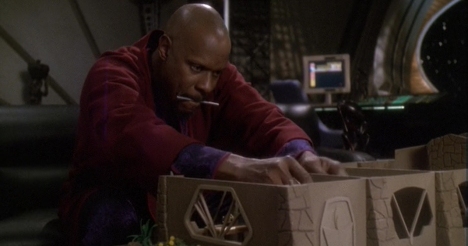
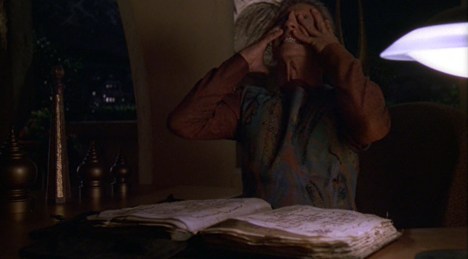
A tailor-made solution.

However, there is also a sense that certain plot and character threads in this sprawling ten episode arc have not been properly mapped out and paced, that the writers have failed to shrewdly allocate their narrative real estate. The writers had enough of an idea where they were going with this arc that they were able to seed most of the important threads leading up to What You Leave Behind with Penumbra. However, the individual story threads were not all equally paced. Some could be sustained for nine more episodes. Others fizzled after four or five.

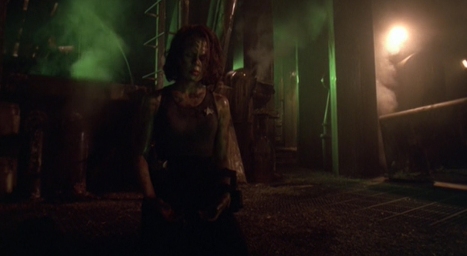
Not all of the narrative threads running through this extended arc of Deep Space Nine are equally impressive. Some of these story threads are clumsy and mistaken, running out of what little steam they had less than half-way through the extended run. So it is with the bizarre alliance between Dukat and Winn in service of the Pah-Wraiths.
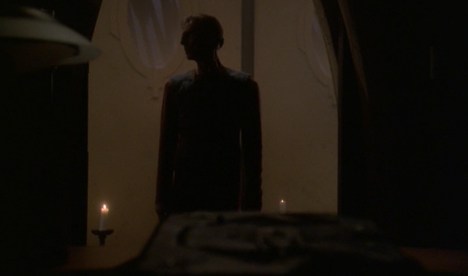
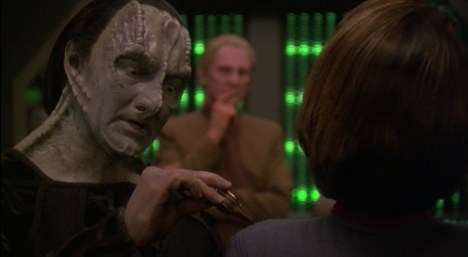
The darkness in men’s hearts.

Continue reading

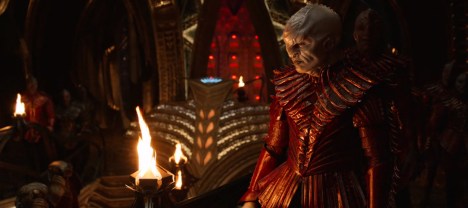
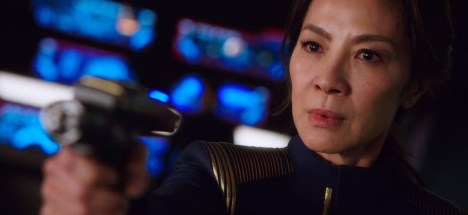
Star Trek: Discovery – Battle at the Binary Stars (Review)

In some ways, Star Trek: Discovery will always be overshadowed by what might have been.

It is not the first Star Trek series to face this particular hurdle. Both Star Trek: Voyager and Star Trek: Enterprise spent the majority of their runs in competition with phantom versions of themselves. Voyager was supposed to be a show about two rival crews, one a bunch of explorers and the other a group of terrorists, forced to work together when stranded alone on the other side of the galaxy. Enterprise was supposed to be a show about the building of the familiar Star Trek universe, a tale about how mankind got “from there to here”, to quote the theme music.

The great Star Trek Beyond.

Both series struggled to live up to that premise. Voyager abandoned any question of compromise and culture clash in Parallax, the very second episode of the series. For the rest of the show’s seven seasons, Captain Kathryn Janeway oversaw a fairly typical Starfleet crew on a fairly typical Star Trek mission, with rare nods to the original premise in episodes like Learning Curve, Alliances, Worst Case Scenario, Year of Hell, Part I and Year of Hell, Part II. Similarly, most of the first two seasons of Enterprise were stock Star Trek, even if the third and fourth seasons were a bit more ambitious.

In contrast, Discovery is competing against a slightly different shadow self. That shadow self appears in the opening credits of the show week after week, in the “created by” credit assigned to Bryan Fuller. Fuller departed early in the creative process of Discovery following disagreements with CBS, to the point that he identifies his most meaningful contributions to Discovery as Captain Philippa Georgiou and Commander Michael Burnham, one of whom is dead by the end of Battle at the Binary Stars.

No Khan do.

Indeed, Bryan Fuller’s contributions to Discovery really end with these two episodes. Fuller is credited on the script for The Vulcan Hello, along with producer Akiva Goldsman. Fuller is also credited with the story to Battle at the Binary Stars, even though the teleplay was written by replacement showrunners Gretchen J. Berg and Aaron Harberts. In some ways, then, it feels strangely appropriate that The Vulcan Hello and Battle at the Binary Stars serve as something of a self-contained prologue setting up the thirteen episodes that will follow.

The Vulcan Hello and Battle at the Binary Stars mark the end of Bryan Fuller’s short-lived Star Trek.

Empirical research.

Continue reading

Star Trek: Discovery – The Vulcan Hello (Review)

What does Star Trek look like in 2017?

Star Trek: Discovery was always going to have to reinvent the franchise. It exists twelve years removed from the end of Star Trek: Enterprise. That is a lifetime in pop culture; it is worth noting that Star Trek: The Next Generation was thirteen years removed from the end of Star Trek: The Animated Series. Resurrecting the franchise was always going to require innovation and reconceptualisation, and it is clear that any new interpretation of Star Trek would look as different from the Berman era as the Berman era did from the original series.

Navigating by the stars.

Still, that does not answer the question of what Star Trek looks like in 2017. In many ways, Discovery is an effort equivalent to The Next Generation, an attempt to return the franchise to television after some time as a relaunched movie franchise. The parallels all but suggest themselves; the chaos unfolding behind the scenes, the distinctly British character actor playing a senior officer with a much more continental surname, the use of the Star Trek brand to embrace a relatively unconventional distribution model.

Given all of this uncertainty, the vocal objections of a certain strain of fandom are almost reassuring, striking a consistent note at this most inconsistent of times. Star Trek fandom has always responded with trepidation to anything new or challenging, anything the pushes beyond the boundaries of expectations of what Star Trek can be. Fandom strenuously objected to the very concept of Star Trek II: The Wrath of Khan. Fandom dismissed The Next Generation. Fandom argued that Star Trek: Deep Space Nine was an affront to the very idea of the franchise.

Time is the fire in which we burn.

However, while all of this provides a framework through which Discovery might be understood, it comes no closer to answering that core question. What does Star Trek look like in 2017? Even the question itself comes loaded with all manner of ambiguities and uncertainties. Is the question being asked in terms of television production? Is the challenge being made in terms of political and social values? Is the inquiry posed in terms of continuity and legacy?

Discovery does not have the answer, at least not in The Vulcan Hello and Battle at the Binary Stars, but it is certainly asking the right questions.

The next phase.

Continue reading

Star Trek: Voyager – Someone to Watch Over Me (Review)

Someone to Watch Over Me is a decidedly atypical episode of Star Trek: Voyager.

The episode’s subplot, focusing on Neelix and a disorderly alien ambassador, harks back to the old diplomacy subplots of Star Trek and Star Trek: The Next Generation, when the crews would be asked to ferry ambassadors around only for terrible things to happen. There are any number of examples of that story template across the two earliest incarnations of the show; Journey to BabelElaan of Troyius, Is There in Truth No Beauty?Lonely Among UsLoud as a Whisper, SarekThe PriceMan of the PeopleData’s DayViolationsLiaisons.

The EMH rose to the occasion.

To be fair, Voyager has done a couple of these episodes before. There are a number of episodes in which the ship acts as a diplomatic courier shipping aliens from one destination to another or welcoming on board representatives of an alien culture; the subplot of Innocence comes to mind, as does the set-up of Remember. However, by and large, these diplomacy-driven subplots are a lot less frequent on Voyager than they were on the original Star Trek or The Next Generation. As such, the Neelix subplot feels very much like a throwback.

However, the primary plot of Someone to Watch Over Me feels very much like an episode of Star Trek: Deep Space Nine, an intimate romantic character study about an attraction between two individuals. Someone to Watch Over Me is very much an archetypal love story, one without the flavour of adventure or stakes defines other Star Trek romances like Captain’s Holiday or Counterpoint or Gravity. This is a low-stakes interpersonal attraction, very much in the style of Looking for Par’Mach In All the Wrong Places, His Way or Chrysalis.

A snap decision.

In fact, the basic plot of Someone to Watch Over Me is so archetypal that it can be traced back to number of classical inspirations. This is nothing new. The Star Trek franchise has long borrowed inspiration from various classics; Favourite Son and Bliss owe a great deal to The Odyssey and Moby Dick, for example. However, the choice of influences on Someone to Watch Over Me feels more like Deep Space Nine than Voyager; it draws from Pygmalion and its various adaptations, along with the early eighties comedy My Favourite Year.

The result is a decidedly strange blend of classic Star Trek storytelling that feels fresh and exciting in the context of Voyager. In many ways, Juggernaut was a showcase of Voyager‘s preference for blockbuster plot-driven storytelling. However, Someone to Watch Over Me is something much more compelling and intriguing. Someone to Watch Over Me is a character-driven episode of Voyager, and a very impressive and engaging one at that.

Putting the “ass” in ambassador.

Continue reading

Star Trek: Deep Space Nine – The Changing Face of Evil (Review)

The arrival of the Breen in the final stretch of Star Trek: Deep Space Nine pays off one of the longest recurring gags of the Michael Piller era.

The Breen are one of the most intriguing races in the larger Star Trek canon, first established as part of the mythos during the fourth season of Star Trek: The Next Generation. The Breen very assembled from a variety of little snippets of conversation over the next few years. The Loss established that the Breen were impervious to telepathy. Elogium implied that the Breen reproduced at a young age, and confirmed that they were known as a warlike species. They were suspects in the attack on the Vico in Hero Worship and on the Amargosa Observatory in Star Trek: Generations.

Things come apart.

The Breen would pop up time and again in dialogue, sketching out a bizarre culture. Their athletes were discussed in Interface. Their privateers were a threat dealt with off-screen in To the Death. Their nursery rhymes were a source of interest in For the Uniform. Their organic technology was mentioned in Scorpion, Part I. By the time that the Breen appeared on screen in Indiscretion, during the fourth season of Deep Space Nine, their status as an in-joke was confirmed. They were covered head-to-toe, dressed like Leia in Star Wars – Episode VI: The Return of the Jedi.

As such, the Breen are a rather strange choice to play such a crucial role in this late stage of the game, stepping into the Dominion War with only ten episodes left in Deep Space Nine. When they capture Ezri and Worf in Penumbra, their connection to the larger arc is unclear. Their plans to ally with the Dominion are only confirmed at the end of ‘Til Death Do Us Part. After a lot of teasing in Strange Bedfellows, it is The Changing Face of Evil that reveals the Breen to be something of a game-changer in the larger context of the Dominion War, easily retaking Chin’toka.

Battlefield Earth.

On paper, a lot of this is a transparent attempt on the part of the writers to move the story along. The Breen serve a number of clear narrative purposes, from escalating the stakes in the conflict between the Dominion and the Federation through to providing some more motivation for Damar’s betrayal of the Dominion. Tellingly, both of these threads pay off in The Changing Face of Evil, an episode that arrives at almost the half-way point in this sprawling galactic epic.

The incorporation of the Breen into the Dominion War is not particularly elegant. The introduction of a new alien species into the mix this late in the plot, with the clear intention of increasing the severity of the threat and to motivating the supporting cast to action, is a very clumsy piece of writing. However, Deep Space Nine just about manages to get away with it because the Breen don’t feel like a new alien species. Although they were never intended to serve this particularly purpose, they have been around long enough that they are part of the texture of the Star Trek universe.

For Cardassia.

Continue reading

Star Trek: Voyager – Juggernaut (Review)

Juggernaut is not a great episode of television.

The episode has any number of key problems. Most obviously, the episode illustrates how little the character of B’Elanna Torres has actually grown since Parallax, without even pausing to acknowledge everything that has happened in between in episodes like Extreme Risk. More than that, the episode’s core themes are undermined by an incredibly cynical conclusion that might work in the context of a larger character arc, but which doesn’t work when rooted in the series’ episodic approach to storytelling.

Calm under pressure.

However, in spite of all these fundamental flaws that hobble Juggernaut as a piece of television narrative, there is quite a lot to like here. This is very pointed a big “action” story told in blockbuster mode, evoking episodes like Timeless. It is all about broad strokes, ticking clocks and epic stakes. Juggernaut is fundamentally a runaway train story crossed with The Phantom of the Opera, which is almost perfectly within the show’s comfort zone. More than that, Juggernaut actually figures out how to do something vaguely interesting with the Malon before they disappear.

Juggernaut is a highly enjoyable episode of Star Trek: Voyager.

Here there be monsters…

Continue reading

Star Trek: Deep Space Nine – Strange Bedfellows (Review)

Three seems to be the magic number when it comes to long-form plotting in Berman era Star Trek.

Star Trek: The Next Generation arguably pulled off a three-consecutive-episodes arc with The Best of Both Worlds, Part I, The Best of Both Worlds, Part II and Family. Even the continuity-adverse Star Trek: Voyager managed something similar with Scorpion, Part I, Scorpion, Part II and The Gift. Star Trek: Enterprise tried a number of three-episode arcs in its final season, even if only The Forge, Awakening and Kir’Shara really worked; Borderland was a preamble to Cold Station 12 and The Augments, while The Aenar was a postscript to Babel One and United.

Super villain team-up.

Three episodes seems to work quite well for Star Trek: Deep Space Nine. The series’ second season premiere was the franchise’s first bona fides three-parter, The Homecoming, The Circle and The Siege. Even when it came to longer arcs, three consecutive episodes seemed be the limit; after Call to Arms, A Time to Stand and Rocks and Shoals, the arc opening the sixth season stumbled with Sons and Daughters before regaining its footing for Behind the Lines, Favour the Bold and Sacrifice of Angels.

As an aside, it also took three episodes for the alliance between the Dominion and Cardassia to properly integrate into the show’s mythology after the events of In Purgatory’s Shadow and By Inferno’s Light; the fifth season took a pause with Doctor Bashir, I Presume, A Simple Investigation and Business as Usual before beginning to unpack the consequences of that statusquo-shattering twist in Ties of Blood and Water.

Hang loose.

There are any number of reasons why three works so well. Maybe three episodes allow for that classic three-act structure, the iconic storytelling template. Perhaps the production team on Deep Space Nine tended to work in chunks of three scripts at a time, with two or three subsequent scripts in development by the time that any given script was finished; if this was the case, it would mean that the production team was ready to start fresh with the fourth script. Whatever the reason, it is a familiar pattern.

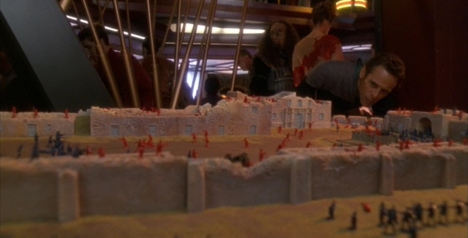
Although “the Final Chapter” is nominally a ten-episode arc, counting What You Leave Behind as two distinct episodes, the plot beats tend to flow in discernible three-episode chunks. Ezri’s mission to rescue Worf plays out over Penumbra, ‘Til Death Do Us Part and Strange Bedfellows. Gul Rusot is introduced in The Changing Face of Evil, is built up in When It Rains…, and meets his end in Tacking Into the Wind. Bashir discovers that Odo is sick in When It Rains…, figures out Section 31 is responsible in Tacking Into the Wind, and recovers the cure in Extreme Measures.

The window of opportunity is closing.

The opening salvo of this ten-episode arc was clearly intended as a three-part story. The original titles of the episodes were Penumbra, Umbra and Eclipse, suggesting an encroaching darkness that would cast a long shadow by the end of the third episode. Coincidentally or not, that would mark the end of the first third of the larger story arc. It suggests a very formal and careful structure, suggesting a three-act structure within the first act of a three-act structure. On paper, it is a very bold and ambitious piece of structuring from the Deep Space Nine writers.

However, the production struggle to maintain that structure. These ten episodes stumble when it comes to pacing and plotting. The weakest threads in this final run are those that feel either rushed or over-extended, which struggle to hit the right beats. Strange Bedfellows is an episode that struggles because it feels like its storythreads have either been stretched or compressed, the important events either pulled back into ‘Til Death to Us Part or pushed forward into The Changing Face of Evil. The result is an episode that feels stranded between bigger story beats.

No time for reflection.

Continue reading

Star Trek: Deep Space Nine – ‘Til Death Do Us Part (Review)

Perhaps more than any other Star Trek show, Star Trek: Deep Space Nine is an epic.

Sure, Star Trek: Voyager has more than a few characteristics of epic storytelling; it is a mythic journey, much like The Odyssey and The Iliad before it. In fact, several episodes of Voyager borrow quite heavily from those earliest of stories, with Favourite Son feature a planet for of sirens and Bliss finding the crew confronted with the deep space equivalent of lotus eaters. However, the storytelling on Voyager was always too small and too episodic to embrace the potential for a sprawling galactic epic.

Wedded bliss.

In contrast Deep Space Nine is a story with a lot of breadth. Of course, there are any number of isolated and standalone episodes within the seven-year run of Deep Space Nine, but there is also a strong sense that these one-hundred-and-seventy-plus episodes of television can be taken together and fashioned into a single cohesive narrative that runs from Emissary through to What You Leave Behind. There are undoubtedly bumps and inconsistencies along the way, strange shifts in direction and sharp left turns, but the series hangs together relatively well as a single narrative.

This is particularly true when it comes to the final ten episode of the series, which are very much intended to draw down the curtain on seven years of storytelling, while reinforcing the sense that this has truly been an epic narrative.

Feels like coming home…

Continue reading

Star Trek: Deep Space Nine – Penumbra (Review)

Penumbra represents the beginning of the end, kicking off the epic ten-episode conclusion to Star Trek: Deep Space Nine.

To be fair, Deep Space Nine had already embraced serialised storytelling, whether in the seeding of gradually-building plotlines or its long-term character development. The show was most serialised in the audacious six-episode arc that opened the sixth season; A Time to Stand, Rocks and Shoals, Sons and Daughters, Behind the Lines, Favour the Bold and Sacrifice of Angels. In some ways, the ten-episode closing arc is ultimately an extension of that basic idea. However, it is also something more complex.

When the moon is in the seventh house in the Kendra Province…

In some ways, this last narrative experiment would be the boldest creative decision of the entire seven year run. The production team had strained a little bit in structuring and pacing those six linked episodes; Sons and Daughters was notably the runt of the litter, telling a relatively standalone story about Worf while essentially repeating Kira’s character arc from Rocks and Shoals in a much less effective manner. As such, trying to tie ten hours of television together into a single cohesive narrative was a bold move. Then again, Deep Space Nine had never been short of ambition.

It is tempting to treat this ten-episode run as a single story, and it kinda is; Netflix labels the forty-five minute episodes as “Part 1”, “Part 2”, “Part 3”, “Part 4”, “Part 5”, “Part 6”, “Part 7” and “Part 8.” However, the run can also be broken down into smaller chunks. ‘Til Death Do Us Part and Strange Bedfellows were originally titled Umbra and Eclipse, suggesting a three-parter. In contrast, TV Guide listed the first four episodes in the run as a four-parter. When It Rains… and Tacking Into the Wind are definitely a two-parter. Extreme Measures is practically standalone.

Build a final arc.

Admittedly, the storytelling falters in places, as the production team’s reach occasionally exceeds their grasp. Some of these issues are outside the control of the production team, such as the budgetary concerns that hinder Extreme Measures. Some of these issues are entirely within the control of the production team, such as the pacing of the subplot with Winn and Dukat that leads to the most transparent stalling tactic in When It Rains…. Individual story choices are occasionally misguided, such as the emphasis on the Breen or the Pah-Wraiths.

Nevertheless, these ten episodes hang together surprisingly well. There is a sense of purpose and momentum running through these episodes that strengthens even the weaker hours. More than that, this ten-part saga includes some of the strongest episodes in the entire franchise, with episodes like When It Rains… and Tacking Into the Wind feeling like the culmination of more than nine years of storytelling across two different series. Though individual elements of this sprawling epic might miss the mark, the whole is greater than the sum of its parts.

The Dukat is of Bajor…

Continue reading

Trump Trek: How Star Trek: Voyager is Perfectly Trumpian Star Trek…

Star Trek has built up a fascinating pop culture mythology around itself. There is an interesting dissonance between that memory and the reality.

The fond memory of a thing is not the thing itself. It is a cliché to observe that the line “beam me up, Scotty” was never actually said on the original show, but many casual fans associate the phrase with the franchise. Even hardcore Star Trek fans tend to gloss over the historical record in favour of affectionate memory. Many fans remember the pointed anti-Vietnam rhetoric of A Taste of Armageddon, Errand of Mercy or The Trouble with Tribbles. Few remember the pro-Vietnam tone of Friday’s Child, The Apple or The Omega Glory.

There is a tendency to believe that Star Trek has always been progressive, that the franchise has always embraced tolerance and actively pursued diversity. However, the reality is often more complicated than that. This why certain sections of the fanbase seem to react in abject terror to concepts like “Trek Against Trump”, a campaign organised by Armin Shimerman to protest the racism and xenophobia espoused by the (then-) candidate Donald Trump. One would imagine that rejecting sexism, racism, white nationalism would be a no-brainer for fandom, but it was not.

Indeed, this reactionary strain of fandom has come up time and again in the context of Star Trek: Discovery. Certain vocal sections of the fan base have objected to the diversity of the primary cast, despite the fact that Star Trek: Deep Space Nine arguably had a much more diverse ensemble. The backlash has reached the point that the cast have had to actually give interviews that racism is a very bad thing and that the franchise is very much about tolerance and understanding. Similarly, the news that the series would be overtly political has rattled some cages in fandom.

In theory, these reactions should be shocking. The Star Trek franchise has carefully cultivated a reputation for liberalism and idealism. Indeed, the Federation is quite explicitly socialist, something hinted at in Star Trek IV: The Voyage Home and explicitly confirmed in Star Trek: First Contact. On a more fundamental level, the franchise is about people from different cultures and with different values coming together to work in common purpose. It seems reasonably fair to argue the franchise would disagree with concepts like “the Muslim Ban” or “the Transgender Service Ban.”

However, the truth is that there has always been a reactionary streak lurking within the franchise. And nowhere has that reactionary streak been stronger than in Star Trek: Voyager, bleeding over into the creation and first two seasons of Star Trek: Enterprise.

Continue reading