• Following Us

  • Categories

  • Check out the Archives


  • Awards & Nominations

Star Trek: Enterprise – Bounty (Review)

Next year, Star Trek is fifty years old. We have some special stuff planned for that, but – in the meantime – we’re reviewing all of Star Trek: Enterprise this year as something of a prequel to that anniversary. This April, we’re doing the second season. Check back daily for the latest review.

Just when it seemed like Star Trek: Enterprise was on a roll, it produces Bounty.

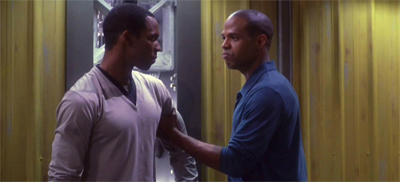
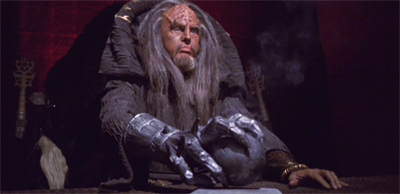
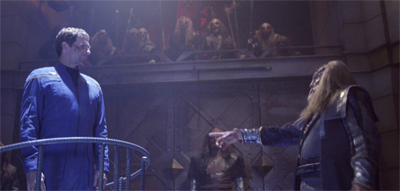
To be fair to writers Mike Sussman and Phyllis Strong, and showrunners Rick Berman and Brannon Braga, Bounty has all the makings of a network-mandated episodes. It is easy to see the stock plot elements manufactured from a checklist provided by the network. T’Pol in her underwear! Space battles! Klingons! The script also demonstrates a clear reluctance about some of these elements, as uncomfortable to be making Bounty as the viewers are to be watching it.

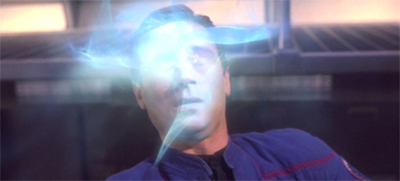
An enlightening experience?

An enlightening experience?

It is perhaps telling that Bounty was buried as the second half of a “double feature” with First Flight on initial broadcast. Not a feature-length adventure or a two-part episode, the scheduling of Bounty seems a little conspicuous, as if everyone involved is trying to get it out of the way as quickly and quietly as possible. Viewers watching UPN on 14th May 2003 would have tuned in for First Flight as usual. If they were lucky, they simply tuned out afterwards and returned to watch The Expanse a week later.

It is a much smoother transition from First Flight to The Expanse, but that does little to justify Bounty. The last stretch of the second season has generally done a good job of bidding farewell to a particular style of Star Trek. However, Bounty is an episode the embodies the worst tendencies of Enterprise. Sadly, those tendencies that may not actually be going anywhere.
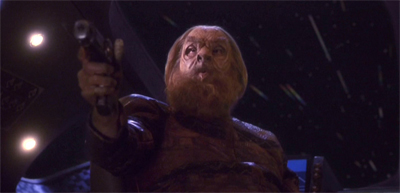
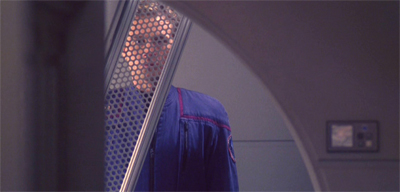
"You're gonna sit there, and like it."

“You’re gonna sit there, and like it.”

Continue reading

Star Trek: Enterprise – First Flight (Review)

Next year, Star Trek is fifty years old. We have some special stuff planned for that, but – in the meantime – we’re reviewing all of Star Trek: Enterprise this year as something of a prequel to that anniversary. This April, we’re doing the second season. Check back daily for the latest review.

First Flight is a prequel to a prequel.

First Flight unfolds before the events of Broken Bow, providing something of a belated origin story for Captain Jonathan Archer. The tail end of the second season feels like an odd place for such a story. The decision to air First Flight and Bounty as a double feature meant that First Flight premiered only a week before The Expanse, an episode that changed everything that fans thought they knew about Star Trek: Enterprise. Then again, perhaps this is the perfect place for an episode like this.

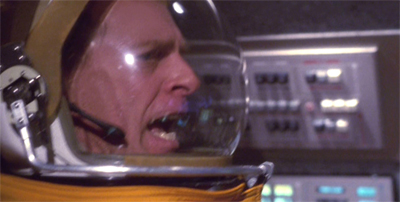
Ground Control to Commander Robinson... Ground Control to Commander Robinson...

Ground Control to Commander Robinson… Ground Control to Commander Robinson…

Much of the final stretch of the second season of Enterprise is introspective and reflective. The show seems aware that a big change is coming, and takes the opportunity of these last few episodes to look back on a classic model of Star Trek. Judgment puts Archer on trial; Cogenitor wonders whether old-fashioned Star Trek morality plays can still work in the twenty-first century; Regeneration finds the Borg lying among the (literal) wreckage of Star Trek: The Next Generation. First Flight opens with the death of Captain A.G. Robinson, a character we never met before.

More to the point, First Flight opens with the death of the man who was almost the captain of the Enterprise. On the cusp of a creative change in direction that effectively kills the show as it existed in the first two seasons, First Flight is pretty heavy on the symbolism.

... Take your protein pill and put your helmet on...

… Take your protein pill and put your helmet on…

Continue reading

Star Trek: Enterprise – Regeneration (Review)

Next year, Star Trek is fifty years old. We have some special stuff planned for that, but – in the meantime – we’re reviewing all of Star Trek: Enterprise this year as something of a prequel to that anniversary. This April, we’re doing the second season. Check back daily for the latest review.

It seems like a bit of an understatement to describe Regeneration as highly controversial.

The blu ray release of the second season of Star Trek: Enterprise includes two commentaries for the episode, a sure sign that there is a lot to talk about. On a track recorded in 2005, writers Mike Sussman and Phyllis Strong describe the episode as “infamous.” On a track recorded in 2013, John Billingsley describes how certain segments of fandom considered it a “jumping the shark” moment for the show. That last statement illustrates one of the perverse qualities of Star Trek fandom; one would assume that the viewers turned off by Regeneration would have already tuned out with Acquisition.

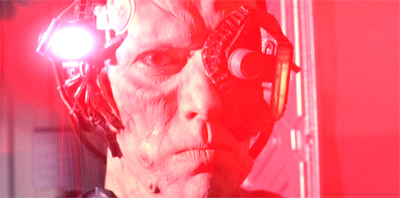
We are Borg.

We are Borg.

After all, the decision to bring back the Ferengi in Acquisition is hard to explain. Nobody was clamouring for more Ferengi episodes after Star Trek: Deep Space Nine had gone off the air. Outside of Deep Space Nine, the most enduring impression of the Ferengi was that they had begun their life as “villains that didn’t quite work” and bad quickly been transformed into “comic relief that didn’t quite work.” As such, it is hard to account for the decision to bend continuity in order to introduce the Ferengi into the first season of a prequel show designed to escape the baggage of the larger Star Trek franchise.

On the other hand, it made a great deal of sense to bring back the Borg. After all, the Borg were one of the few Star Trek aliens created after 1969 to make a genuine impression on popular culture. The Borg will never be as iconic as Klingons or Vulcans, but they will always be more iconic than Cardassians or Bajorans. They were also stars of the best-loved Star Trek movie starring the cast of Star Trek: The Next Generation. The Borg are a big deal; there is a reason that Star Trek: Voyager ran them into the ground.

"Assimilate this!"

“Assimilate this!”

It is no wonder that the Borg are frequently cited in discussions around the future of JJ Abrams’ Star Trek reboot. Asked if the creative team would consider bringing the Borg to the rebooted twenty-third century, Roberto Orci answered, “I think we would think about it.” Damon Lindelof was even blunter in his assessment, “You can’t talk about Trek and not talk about the Borg.” While they have undoubtedly been over-exposed and over-used since they first appeared in Q Who?, the Borg are the most distinctive and most successful addition to the Star Trek mythos outside the classic show.

While common sense and experience seemed to weigh against bringing back the Ferengi in Acquisition, it seems that continuity is the only thing holding the Borg back from making an appearance on Enterprise. That said, Sussman and Strong find a clever way around that issue, by remembering the suggestion in Broken Bow that Enterprise is as much a sequel to Star Trek: First Contact as a prequel to the rest of the Star Trek universe.

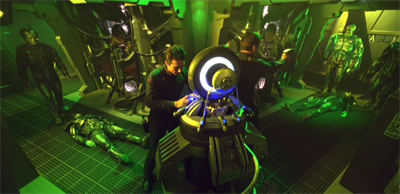
"Oh no, Cap'n, they've discovered the mood lightin' settin'."

“Oh no, Cap’n, they’ve discovered the mood lightin’ settin’.”

Continue reading

Star Trek: Enterprise – Cogenitor (Review)

Next year, Star Trek is fifty years old. We have some special stuff planned for that, but – in the meantime – we’re reviewing all of Star Trek: Enterprise this year as something of a prequel to that anniversary. This April, we’re doing the second season. Check back daily for the latest review.

Cogenitor is a brutally subversive gut-punch.

Coming towards the end of the second season, on the cusp of major changes to the way that Star Trek: Enterprise would be run, Cogenitor is structured as a piece of self-aware criticism of the moral methodology of the Star Trek franchise as a whole. For most of its runtime, Cogenitor plays as a stock Star Trek narrative. Confronting a perceived injustice in an alien culture he just met, Trip takes it upon himself to set things right – to make life better for an oppressed minority. His heart is in the right place; the narrative repeatedly assures us that his position is justified.

Guilt Trip.

Guilt Trip.

However, Trip’s solution to this moral dilemma is inadequate. Trip follows the standard Star Trek rule book for a situation like this – he does not cause a scene with the alien culture, instead respectfully empowering the oppressed individual by exposing them to the wonders of the universe so that they might change their world themselves. Trip exposes the eponymous cogenitor to humanist ideals and philosophy, offering his guest a new way of looking at the cosmos. It is sweet, touching and heartwarming.

Then it goes horribly wrong. Refusing to grant amnesty to the cogenitor, which had taken the name “Charles”, Enterprise warps off into the distance in search of new adventures and new opportunities. Any other episode of Enterprise would end there, but Cogenitor affords itself a four-minute coda which reveals the oft-overlooked consequences of this sort of casual meddling in the affairs of others. Through a combination of circumstances and decisions, Archer and Trip find that what should have been a triumphant humanist narrative became a tragedy.

A literal Star Trek.

A literal Star Trek.

Cogenitor feels like a criticism of the moral methodology of Star Trek; of the familiar episodic storytelling pattern that has our heroes warp away from complex situations after imposing their own morality on a culture they only just encountered. It is not too hard to imagine similar brutal twist endings or earlier Star Trek stories like The Hunted or Who Watches the Watchers? There is a sense that Cogenitor is making a none-too-subtle criticism of the assumptions that the Star Trek franchise has taken for granted over the years.

Cogenitor rejects the idea that fleeting engagement with other cultures can be sure to have the desired result. It is a point that feels particularly appropriate at the tale end of the second season of Enterprise, as the franchise was ready to make a (relatively) clean break from that kind of rigidly episodic storytelling. However, it also reflects an awareness of more nuanced and complicated political and social realities in the midst of the War on Terror. It would be nice to believe that societies can be “fixed” as easily as Kirk or Picard suggested, but the reality is decidedly more difficult.

The water polo ball is in Archer's court...

The water polo ball is in Archer’s court…

Continue reading

Star Trek: Enterprise – The Breach (Review)

Next year, Star Trek is fifty years old. We have some special stuff planned for that, but – in the meantime – we’re reviewing all of Star Trek: Enterprise this year as something of a prequel to that anniversary. This April, we’re doing the second season. Check back daily for the latest review.

One of the more interesting aspects of a heightened franchise like Star Trek is the way that invites particular members of staff to define their own voices. On most of the Star Trek shows, it is easy to distinguish the work of particular writers from one another. Ronald D. Moore likes militarism and world-building; Brannon Braga likes time travel and classic science-fiction. There are clear voices that can be distinguished from the choir on each of the shows, for better or for worse.

Although it enjoyed a considerably shorter run than the other Star Trek spin-offs, Star Trek: Enterprise is no exception.  The Breach is a script credited to writers Chris Black and John Shiban. The two had collaborated unofficially on Canamar, a script credited to Shiban alone. The two would work together again on First Flight towards the end of the season. It is certainly a partnership that had considerable potential, if not for Shiban’s departure at the end of the season.

What's up, Doc?

What’s up, Doc?

In many respects, The Breach feels like the product of those two voices. Xenophobia is a major theme of The Breach – as it was in Shiban’s other scripts for the season like Minefield, Dawn or Canamar. Like their last collaboration on Canamar and their future collaboration on First Flight, it seems The Breach presents a more balanced version of Archer than episodes like The Crossing or Horizon. This is a version of Archer who feels compelled to do the right thing, but without the same oppressive self-righteousness that drives his more awkward moments.

However, it seems like Chris Black provides The Breach with its very traditional and old-fashioned Star Trek aesthetic. A veteran of genre television with an understanding of the narrative conventions associated with the franchise, Black understands how Star Trek storytelling is supposed to work. The Breach is perhaps a little too formulaic and traditional in its storytelling, but it does demonstrate that – despite its best efforts – The Crossing had not completely buried a certain optimistic strain of Star Trek ethics.

Into darkness...

Into darkness…

Continue reading

Star Trek: Enterprise – Horizon (Review)

Next year, Star Trek is fifty years old. We have some special stuff planned for that, but – in the meantime – we’re reviewing all of Star Trek: Enterprise this year as something of a prequel to that anniversary. This April, we’re doing the second season. Check back daily for the latest review.

Horizon takes us backwards.

Early in the episode, the Enterprise is redirected to investigate a strange interstellar phenomenon. “This system’s almost thirty light years behind us,” Mayweather observes. Archer responds, “Admiral Forrest assures me it’s only a temporary detour.” This is largely what Horizon feels like, a journey back to the first season of Star Trek: Enterprise. Horizon is a deathly dull episode, but it would be more tolerable had it aired early in the first season. At least it is not as offensive as Unexpected or Terra Nova.

"A Travis episode? I'll be right there!"

“A Travis episode? I’ll be right there!”

There is something particularly regressive about Horizon, as if the episode is a relic of the show that Enterprise used to be. It focuses on human space exploration outside of Starfleet, as promised in episodes like Terra Nova or Fortunate Son. It gives the audience another glimpse into “boomer” life and even opens with Mayweather relaxing in “the sweet spot”, the first time that the audience has seen that location since Broken Bow. Even the plot feels like a retread of first season episodes – a strange hybrid of Fortunate Son and Silent Enemy.

The character beats are no better. Horizon struggles to construct a credible character-driven story for Mayweather. Unable to figure anything out, the show decides to saddle him with the same character arc that Hoshi repeated in episodes like Fight or Flight, Sleeping Dogs or Vox Sola. The problems are compounded by the script’s lack of trust in Anthony Montegomery to carry the himself, leading to an extended (and dull) first act and a padded (and dull) subplot. If Judgment made a sterling defense of Enterprise, Horizon is a damning argument for the prosecution.

Freight stuff...

Freight stuff…

Continue reading

Star Trek: Enterprise – Judgment (Review)

Next year, Star Trek is fifty years old. We have some special stuff planned for that, but – in the meantime – we’re reviewing all of Star Trek: Enterprise this year as something of a prequel to that anniversary. This April, we’re doing the second season. Check back daily for the latest review.

Judgment is the first episode of Star Trek to do something interesting with the Klingons since Tacking Into the Wind, almost four years earlier.

After all, it never seemed like Star Trek: Enterprise had any real idea what to do with the Klingons. The show had made use of Klingons in Broken Bow, Unexpected, Sleeping Dogs and Marauders – but none of these episodes seemed particularly interested in telling a story about Klingons. Enterprise seemed primarily interested in the Klingons as a connection to the franchise’s long and distinguished history. After all, Klingons are almost as iconic a part of Star Trek as Spock; working a few bumpy-headed warriors into your script was a nice way of acknowledging the Star Trek legacy.

Trial of the twenty-second century...

Trial of the twenty-second century…

Certainly, Enterprise was not interested in committing to the same Klingon world-building in which Star Trek: The Next Generation and Star Trek: Deep Space Nine had revelled. There are a lot of reasons for this. Over ten seasons, writer Ronald D. Moore had probably said just about everything that needed to be said about the Klingons; trying to say something new or interesting without his input was certainly daunting. More than that, Enterprise had committed itself quite firmly to episodic storytelling in its first two years; even the Andorians and Vulcans were still barely developed.

So David A. Goodman’s script for Judgment is ambitious, particularly in light of the spectacular failure of his (heavily re-written) work on Precious Cargo. Constructing an episode that might easily be misread as a rehash of Star Trek VI: The Undiscovered Country was a pretty bold choice, particularly given the problems that the show had endured while trying to construct an homage to Elaan of Troyius and The Perfect Mate. On paper, Judgment is an assignment that could easily explode spectacularly. It might not be as crazy a gambit as A Night in Sickbay, but it is a story with lofty objectives.

The court has spoken.

The court has spoken.

With so much of the second season feeling like it is running on auto-pilot, the energy and enthusiasm of Judgment is infectious. Singularity, Vanishing Point, Canamar and The Crossing felt like they were constructed using blueprints of what a Star Trek episode should look like. It is refreshing to watch an episode of Enterprise that seems genuinely excited to playing with these particular toys. In that sense, Judgment sets the mood for the final stretch of the season – despite duds like Horizon and Bounty, the final run of episodes feels like a band playing an encore for a show on the cusp of monumental change.

Although not facing the same threat of cancellation that loomed at the end of the third and fourth seasons, the second season of Enterprise feels like the last gasp of a particular model of Star Trek production, one no longer as viable as it once had been. Starting with Judgment, the show seems to acknowledge that things are going to have to change dramatically and soon; however, there is a clear attempt to bid this particular iteration of Star Trek a fond farewell. As such, any and all references to The Undiscovered Country feel entirely appropriate.

“Don’t wait for the translation! Answer me now!”

Continue reading

Star Trek: Enterprise – The Crossing (Review)

Next year, Star Trek is fifty years old. We have some special stuff planned for that, but – in the meantime – we’re reviewing all of Star Trek: Enterprise this year as something of a prequel to that anniversary. This April, we’re doing the second season. Check back daily for the latest review.

The Crossing represents a troubling return to form for the second season of Star Trek: Enterprise in a number of ways.

In terms of basic storytelling, the show is back at the point where it is simply throwing Star Trek plots into a blender and serving up a rather unappetising smoothy. The Crossing is packed with familiar Star Trek tropes – it is Return to Tomorrow by the way of Power Play through Cathexis. The idea of non-corporeal entities hijacking living bodies is not particularly novel, and The Crossing really has nothing new to offer in terms of that sort of story. There is no element of The Crossing as fun as Leonard Nimoy’s performance in Return to Tomorrow or the hostage crisis stakes of Power Play.

Here's Trip!

Here’s Trip!

However, even without the feeling of reheated leftovers, The Crossing is a very ugly little story. It reflects the reactionary post-9/11 politics of the show, the sense of isolationism and xenophobia that have become part of the fabric of Enterprise. The Crossing is essentially a fifties horror film repurposed as a post-9/11 cautionary tale about the dangers of trusting people who are not like you. It feels like a pretty solid indication of just how thoroughly Star Trek has lost its way. The decision to just externalise these anxieties in The Expanse is long overdue.

The fact that The Crossing is credited to the two showrunners driving Enterprise is quite worrying, particularly given that it serves to express an uncomfortable subtext running through the season.

Having a gas time...

Having a gas time…

Continue reading

Star Trek: Enterprise – Canamar (Review)

Next year, Star Trek is fifty years old. We have some special stuff planned for that, but – in the meantime – we’re reviewing all of Star Trek: Enterprise this year as something of a prequel to that anniversary. This April, we’re doing the second season. Check back daily for the latest review.

The story behind Canamar is much more interesting than the story told in Canamar.

On the surface, Canamar is quite simple – Star Trek does Con Air.” However, it had an interesting journey from original pitch to televised episode. Indeed, Canamar developed from David A. Goodman’s attempts to break out Judgment, trying to figure out what would happen to Archer after he had been found in Klingon court. Originally, the crew would have rescued Archer from a prison transport rather than Rura Penthe. However, producer Brannon Braga took such a liking to the “Archer on a prison transport” concept that he pulled it out of Judgment and assigned it to John Shiban to script.

"Have you seen Con Air?" "No." "Good. Then this'll all seem new to you."

“Have you seen Con Air?”
“No.”
“Good. Then this’ll all seem new to you.”

However, Braga also divorced Canamar completely from Judgment. Archer would no longer be a prisoner on a Klingon prison transport. Instead, he would find himself mistakenly arrested by an entirely new alien species a couple of episodes before he’d find himself arrested by a more recognised alien species. It feels somewhat redundant, with the first act of Canamar rushing through set-up of plot beats that would feel more organic and fluid if they came from an early episode explicitly designed to build to the idea of Archer on the prison transport.

Canamar is a prime example of just how out of touch Star Trek: Enterprise was with the television landscape, reinforcing the sense that the second season of the show was a holdover from some much earlier period of television production.

"It's the ship that made the Kessel Run in less than twelve parsecs. I've outrun Imperial starships."

“It’s the ship that made the Kessel Run in less than twelve parsecs. I’ve outrun Imperial starships.”

Continue reading

Star Trek: Enterprise – Future Tense (Review)

Next year, Star Trek is fifty years old. We have some special stuff planned for that, but – in the meantime – we’re reviewing all of Star Trek: Enterprise this year as something of a prequel to that anniversary. This April, we’re doing the second season. Check back daily for the latest review.

The Temporal Cold War arguably works better as a metaphor than a plot.

There is something quite compelling about the imagery of Star Trek‘s past and future doing battle within the confines of a troubled prequel, of outside forces meddling in a narrative, of the characters caught in the grip of forces they cannot understand. To expect the Temporal Cold War to make sense is to miss the point; to expect clear resolution is foolhardy. Instead of serving as a strong narrative thread running through Star Trek: Enterprise, it serves as a visual manifestation of the troubles haunting the show. It also serves as a very effective story backdrop.

Let's do the time warp again...

Let’s do the time warp again…

Future Tense has a pretty straightforward story. Archer and his crew discover a piece of floating space debris. They bring it aboard, discovering it is not what it appears to be. The Suliban show up, claiming salvage rights. The Tholians arrive, demanding the same. A chase ensues, as Archer tries to outrun the two alien species desperate to get their hands on the technology. Future Tense is a classic chase narrative, as multiple parties fight over what Hitchcock described as a “macguffin.” Little is revealed, nothing is proven, everything is resolved so neatly that it seems divine intervention is at work. Maybe it is.

And yest, despite – or perhaps because – of this narrative simplicity, Future Tense stands as a highlight of the troubled second season. Future Tense leaves almost every question about the Temporal Cold War unanswered, but it is a tight and efficient action adventure. Like Cold Front before it, it recognises that the Temporal Cold War is a story as much as a backdrop. The fact that it is mysterious and nonsensical and arbitrary make it all the more compelling. After all, that is how it must appear to Archer.

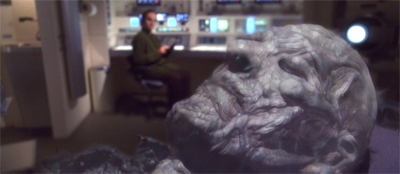
Alien bodies...

Alien bodies…

Continue reading