• Following Us

  • Categories

  • Check out the Archives


  • Awards & Nominations

Star Trek: Deep Space Nine – Distant Voices (Review)

This September and October, we’re taking a look at the jam-packed 1994 to 1995 season of Star Trek, including Star Trek: Deep Space Nine and Star Trek: Voyager. Check back daily for the latest review.

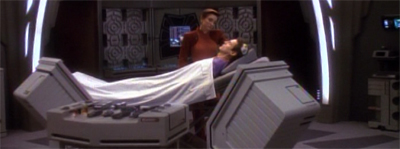
Poor Julian Bashir. Even at two-and-a-half seasons in Star Trek: Deep Space Nine, the character is still a blank slate. Distant Voices is a story that takes us inside the character’s head, but it winds up feeling very generic. It turns out that Bashir is afraid of getting old, as awkwardly pointed out in the opening scene. He also might have some self-esteem issues. For an episode that journeys into Bashir’s brain, Distant Voices is really pretty bland. There’s really not too much going on there.

Indeed, the most interesting thing about this glimpse inside Bashir’s mind is that it is so generic that it manages to avoid conflicting at all with the character-shattering revelation that Ronald D. Moore proposes in Doctor Bashir, I Presume. While it’s a nice piece of trivia, it’s hardly a compelling hook.

"So this is what a 100,000th episode party looks like..."

“So this is what a 100,000th episode party looks like…”

Continue reading

Star Trek: Deep Space Nine – Visionary (Review)

This September and October, we’re taking a look at the jam-packed 1994 to 1995 season of Star Trek, including Star Trek: Deep Space Nine and Star Trek: Voyager. Check back daily for the latest review.

Visionary confirms that “O’Brien must suffer” is to become an annual tradition on Star Trek: Deep Space Nine. The second season of the show had made a good start with episodes like Whispers and – to a lesser extent – Armageddon Game, but Visionary confirms that this will really be O’Brien’s niche in the ensemble from this point on. Visionary sees O’Brien randomly jumping forward through time, inevitably glimpsing some horrible tragedy that must be avoided. (Boy, it sure is lucky that he started jumping at this point, isn’t it?)

Visionary should feel contrived and convenient, hinging on a pretty flimsy plot hook. That said, the episode ultimately works quite well, even if it doesn’t stand out as a classic piece of Star Trek. Watching Visionary, there’s very much a sense that Visionary only really works as well as it does because Deep Space Nine has built up a larger mythology of characters and long-form plotting that can support what might otherwise be a fairly flimsy premise.

"Why the hell doesn't this ever happen to Julian?!"

“Why the hell doesn’t this ever happen to Julian?!”

Continue reading

Star Trek: Deep Space Nine (Malibu Comics) – Blood and Honour (Review)

The September and October, we’re taking a look at the jam-packed 1994 to 1995 season of Star Trek, including Star Trek: Deep Space Nine and Star Trek: Voyager. Check back daily for the latest review.

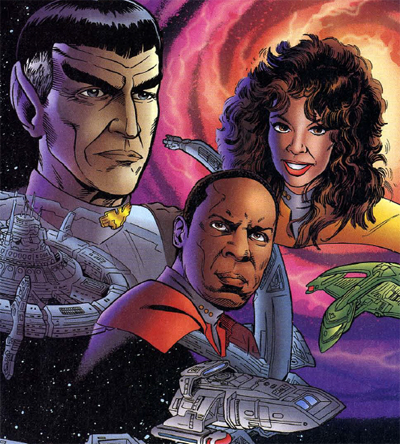
Whatever is to be done about the Romulans?

In space, all warriors are cold warriors...

In space, all warriors are cold warriors…

Continue reading

Star Trek: Deep Space Nine – Prophet Motive (Review)

This September and October, we’re taking a look at the jam-packed 1994 to 1995 season of Star Trek, including Star Trek: Deep Space Nine and Star Trek: Voyager. Check back daily for the latest review.

Now that Star Trek: Voyager is on the air, there’s a sense that Star Trek: Deep Space Nine can be more relaxed. The show was undeniably contrarian during the short period when it was the only Star Trek on the air, presenting a series of uncompromisingly cynical episodes to assure viewers that it would not be trying to fill the void left by Star Trek: The Next Generation. At the same time, there’s also a sense that show was acutely aware of it potentially wider audience watching during that window.

During that first half of the season, a new adversary was pushed to the fore, the show did a story about Klingons and featured three guest stars from The Next Generation – although not necessarily the guest stars anybody would have chosen. More than that, though, the show seemed to consciously avoid its more controversial types of episodes. Even by the show’s third year, it had become clear that certain “types” of episodes appeared a few times a year – a couple of “old favourites” for the writing team to fall back on while constructing a twenty-six episode season.

'Ear me out 'ere...

‘Ear me out ‘ere…

As such, it’s telling that the most divisive parts of any Deep Space Nine season were pushed into the second half of the season.  So Ira Steven Behr and Robert Hewitt Wolfe’s two Ferengi-centric scripts came after Voyager had premiered. Sure, Quark got to be the focus of the season’s third episode, House of Quark, but he shared that with the popular Klingons. The season’s two big Bajoran plot lines (Life Support and Shakaar) were positioned towards the end of the year.

Prophet Motive feels like the kind of Star Trek episode that could only be produced on Deep Space Nine as part of Ira Steven Behr’s unique vision for the show. It’s the kind of weird script that the show seemed to get away with by virtue of being “the other Star Trek on television.” That doesn’t mean that it’s particularly good, mind you, just that it’s distinctly a Deep Space Nine story.

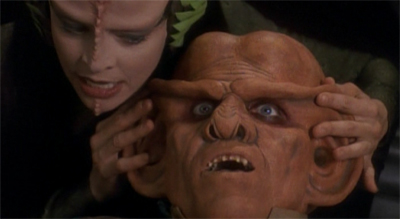
Quark is a by-the-book Ferengi...

Quark is a by-the-book Ferengi…

Continue reading

Star Trek: Deep Space Nine – The 34th Rule by Armin Shimerman & David R. George III (Review)

This September and October, we’re taking a look at the jam-packed 1994 to 1995 season of Star Trek, including Star Trek: Deep Space Nine and Star Trek: Voyager. Check back daily for the latest review.

The 34th Rule is a particularly notable piece of Star Trek fiction. It is the first Star Trek novel credited to a main cast member while their show was still on the air. Armin Shimerman, Eric A. Sitwell and David R. George III had pitched the idea for The 34th Rule as an episode of Star Trek: Deep Space Nine. When the producers were not interested in developing the idea, Shimerman and George decided to expand the idea out into a full-length novel. The 34th Rule was released during the seventh season of Deep Space Nine.

Shimerman was not the first actor to be credited on a Star Trek novel. William Shatner had already launched his own “Shatner-verse” series of novels following the “resurrection” of James Tiberius Kirk after his death in Star Trek: Generations. However, Shatner was pretty much done with the franchise at this point – having officially passed the torch to his successors as part of Generations. However, Shimerman was the first to publish a novel while the show was on the air.

The 34th Rule is a decidedly ambitious piece of work. It is clumsy in places, perhaps a little heavy-handed and on the nose. Nevertheless, it is a well-constructed and thoughtful Star Trek epic – one the feels in keeping with the mood of Deep Space Nine, even if it occasionally veers a little too far.

the34thrule

Continue reading

Star Trek: Deep Space Nine – Destiny (Review)

This September and October, we’re taking a look at the jam-packed 1994 to 1995 season of Star Trek, including Star Trek: Deep Space Nine and Star Trek: Voyager. Check back daily for the latest review.

The biggest problem with Destiny is that it doesn’t feel fully-formed. The show plays more like a series of vignettes than a single story. There are some nice character beats, and a sense that Star Trek: Deep Space Nine is an ensemble show, but Destiny meanders far too much. It seems like it wanders around without any singular purpose, any strong central point to tether it.

Is it about Sisko’s relation to the title of “Emissary”? Is about peace between Bajor and Cardassia? Is it about O’Brien and flirty Cardassians? Is it about Kira’s faith and her position on Deep Space Nine? Is it about end time prophecies?

It seems to be about all these things, but with no real commitment to any of them above the others. The end result is that it’s not about any of them particularly well.

Picture perfect...

Picture perfect…

Continue reading

Star Trek: Deep Space Nine – Heart of Stone (Review)

This September and October, we’re taking a look at the jam-packed 1994 to 1995 season of Star Trek, including Star Trek: Deep Space Nine and Star Trek: Voyager. Check back daily for the latest review.

Heart of Stone feels quite similar to Life Support. Once again, there’s a main plot that doesn’t involve Kira quite as much as it should. Once again, this is supplemented by a subplot involving Quark’s mischievous nephew, Nog. And yet – while still flawed in a number of ways – Heart of Stone works a lot better than Life Support did, primarily because it’s a lot more thoughtfully constructed. The lack of focus on Kira is explained as part of the plot; Nog isn’t holding down an unfunny comedy subplot, he’s getting some nice character development.

Heart of Stone is occasionally a little heavy-handed in its character beats, but it works well because it pitches its plot at the right level, focusing on the characters at the heart of these stories.

A rock and a hard place...

A rock and a hard place…

Continue reading

Star Trek: Deep Space Nine (Malibu Comics) – The Rules of Diplomacy (Review/Retrospective)

The September and October, we’re taking a look at the jam-packed 1994 to 1995 season of Star Trek, including Star Trek: Deep Space Nine and Star Trek: Voyager. Check back daily for the latest review.

One of the more interesting aspects of Star Trek: Deep Space Nine is the way that the cast actively involved themselves in the mythology of the show. Armin Shimerman originally pitched The 34th Rule as an episode of the show, along with Eric A. Sitwell and David R. George III. Andrew Robinson published A Stitch in Time, a novel based on notes he had been making about Garak during the production of the series. Even J.G. Hertzler co-wrote the Left Hand of Destiny duology.

Of course, this was not a unique occurrence. Walter Koenig had written an episode of Star Trek: The Animated Series, an issue of Marvel’s on-going Star Trek comic and even The Machiavellian Principle, a play performed at the Ultimate Fantasy convention. John DeLancie had co-written The Gift, a story published in DC’s Star Trek: The Next Generation comics. Ethan Phillips and Robert Picardo would lend their names to tie-in Star Trek: Voyager books.

However, it seems reasonable to observe that the supporting cast on Deep Space Nine were particularly interested in fleshing out and developing their characters. So it seems appropriate that Aron Eisenberg should co-write The Rules of Diplomacy, a special about Nog earning some credits before shipping off to Starfleet Academy.

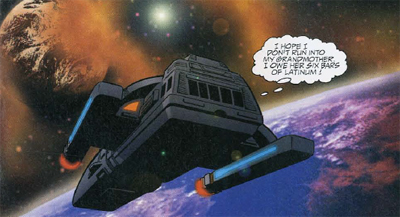
You can't go home again...

You can’t go home again…

Continue reading

Star Trek: Deep Space Nine – Life Support (Review)

This September and October, we’re taking a look at the jam-packed 1994 to 1995 season of Star Trek, including Star Trek: Deep Space Nine and Star Trek: Voyager. Check back daily for the latest review.

Life Support is the first episode of Star Trek: Deep Space Nine to air after Star Trek: Voyager went on the air. It’s amazing how quickly Deep Space Nine settled back into the role of “the other Star Trek show on television.” A lot of attention was focused on launching Voyager, with the show put in the awkward position of launching (and, in the years ahead, supporting) the new television network UPN. As a result, Voyager got a lot of press and a higher profile.

Deep Space Nine fell back into familiar routines. Life Support is far from an exceptional piece of Deep Space Nine. In fact, it’s a deeply flawed piece of television. However, it feels free of the identity crisis that dominated the first half of the third season. This is Deep Space Nine free of the expectations of being “the only Star Trek on television”, and allowed the freedom to just keep doing whatever it wants to do.

It doesn’t do any of the things that it wants to do particularly well, but it does them in its inimitable way.

Dead air...

Dead air…

Continue reading

Star Trek: Deep Space Nine – Prophecy & Change: The Orb of Opportunity by Michael A. Martin and Andy Mangels (Review/Retrospective)

The September and October, we’re taking a look at the jam-packed 1994 to 1995 season of Star Trek, including Star Trek: Deep Space Nine and Star Trek: Voyager. Check back daily for the latest review.

It is fun to imagine the negative space that exists between various episodes of Star Trek: Deep Space Nine. In its third season, the show was making nods towards serialisation, but there was never really a point where the series could not be broken down into reasonably well-defined episodic units. Even during the ten-hour series finalé, each of the constituent elements had its own narrative thrust and its own clear purpose. So it is fun sometimes to try to connect these threads together.

The ordering of episodes in a season of television is very interesting. It creates a fascinating connective tissue in the minds of fans. Although each episode is its own story, they come together to form something larger and more intriguing. On The X-Files, for example, placing Never Again directly after Leonard Betts changed the whole context of the episode. There are threads that do not necessarily exist within the individual episodes, but can be implied by the sequencing of the shows.

Placing Heart of Stone directly after Life Support is an interesting choice in several respects. It creates all sorts of interesting implications and developments, contradictions and possibilities. It is weird to have an episode about Odo’s attraction to Kira air directly after an episode focusing on the death of Kira’s long-term love interest; give her a week or two of space, guys. Similarly, it is strange to go from Nog’s characterisation in Life Support to his development in Heart of Stone.

The Orb of Opportunity is very clearly intended to bridge the gap between those two episodes, explaining how and why Nog developed in the way that he did.

ds9-prophecyandchange

Continue reading