• Following Us

  • Categories

  • Check out the Archives


  • Awards & Nominations

Star Trek: Deep Space Nine – Broken Link (Review)

This February and March (and a little bit of April), we’re taking a look at the 1995 to 1996 season of Star Trek, including Star Trek: Deep Space Nine and Star Trek: Voyager. Check back daily for the latest review.

What is perhaps most surprising about Broken Link is how quiet and subdued it all it.

The fourth season began with a bang, with the dissolution of the alliance between the Klingons and the Federation that had been established in Heart of Glory and dramatised in Star Trek VI: The Undiscovered Country. In fact, The Way of the Warrior featured the largest and most impressive combat sequence in the history of the Star Trek franchise to that point. Even allowing for The Sacrifice of Angels and What You Leave Behind, the fourth season premiere still ranks as one of the most elaborate set pieces in the franchise’s history.

Pray... for... Odo...

Pray… for… Odo…

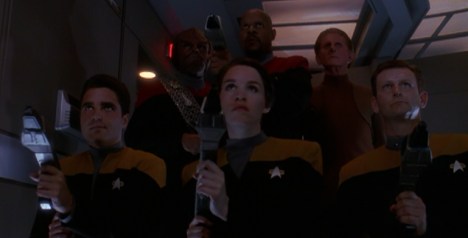
Broken Link consciously circles back to that. It features the first reappearance of Robert O’Reilly as Gowron since The Way of the Warrior. The episode makes it clear that the problems depicted in The Way of the Warrior are only worsening. There is no small suggestion that Gowron is hoping to turn the cold war between the Federation and the Klingon Empire into a shooting war. Broken Link is very much a show about taking the status quo that was established in The Way of the Warrior and ramping it up.

However, what is most striking about Broken Link is the manner in which it escalates the situation. Not a single weapon is discharged in Broken Link, which is the last season finalé of Star Trek: Deep Space Nine not to feature a combat sequence of some description. The actual plot of the episode is remarkably straightforward and linear, keenly focused on a single member of the ensemble rather while relegating politics into the background. Even in terms of the scripting of the episode, care is taken to slow the pace down and allow character-driven dialogue scenes.
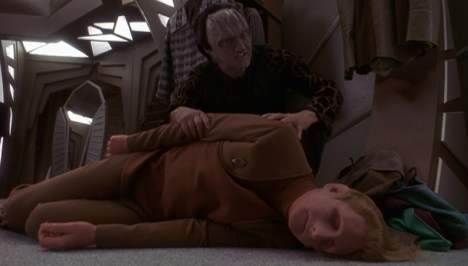
Oh no, Odo!

Oh no, Odo!

The result is a strangely intimate season finalé, one free of the bombast that comes with the season-bridging two-parters favoured by Star Trek: The Next Generation and Star Trek: Voyager. It is interesting to compare Broken Link to something like Basics, Part I, if only because the latter would never make room for Jadzia joking about being surrounded by “naked men” or Garak playing “Star Trek Cluedo” with Odo in sickbay. In fact, Broken Link is even relatively quiet by the standards of Deep Space Nine, lacking the galactic status quo shift of The Jem’Hadar or A Call to Arms.

As with a lot of the fourth season, there is a sense that the production team have made a point to learn from the third season: to improve upon what works and to fix what doesn’t. The Adversary was something of a happy accident at the end of the third season, a script thrown together at short notice when Paramount vetoed a season-ending cliffhanger that would be loosely adapted for Homefront and Paradise Lost. The slow character-centric tension of The Adversary was never intended to close the third season, but Broken Link realises that such an approach worked well.
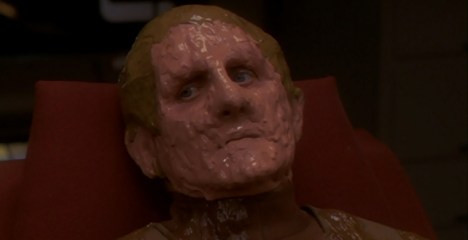
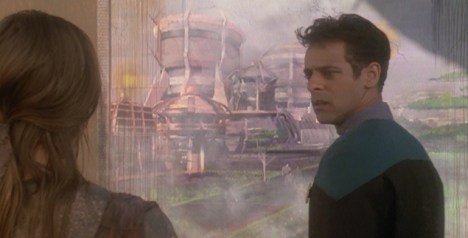
"Melting! Melting! Oh, what a world!"

“Melting! Melting! Oh, what a world!”

The result is an episode that feels incredibly comfortable in its own skin. Deep Space Nine is well aware of what it is, regardless of the direction and input that the studio offered the production team at the start of the fourth season. In fact, despite its somewhat relaxed pace and the space that it affords its character interactions, Broken Link is remarkably focused on what it wants to do. The closing line of the episode (and the season) is clever, consciously tying back the bold new direction of The Way of the Warrior back into the series’ own larger endgame.

In hindsight, Broken Link is something of a misleading title. Instead, it ties everything together.

Only a stone's throw away...

Only a stone’s throw away…

Continue reading

Star Trek: Deep Space Nine – Body Parts (Review)

This February and March (and a little bit of April), we’re taking a look at the 1995 to 1996 season of Star Trek, including Star Trek: Deep Space Nine and Star Trek: Voyager. Check back daily for the latest review.

Like The Quickening before it, Body Parts offers another glimpse at the humanism at the heart of Star Trek: Deep Space Nine.

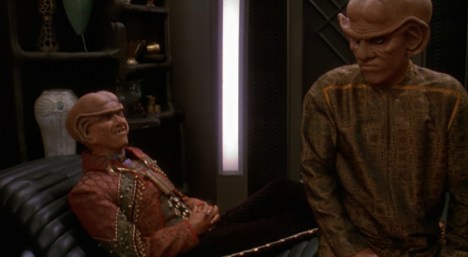
Body Parts plays into the broader themes of the fourth season. Zack Handlen effectively and memorably described Deep Space Nine as “Star Trek’s version of the Island of Misfit Toys.” In a way, that has been true since Emissary; the episode where the series got a bitter widower who wasn’t even a proper captain and a chief engineer who used to manage a transporter room on the flagship. Characters like Odo and Garak were always outcasts, while it never felt like the crew operating the station could claim to be the franchise’s “best and brightest.”

"Look, we're all exhausted after the season that's been..."

“Look, we’re all exhausted after the season that’s been…”

However, the fourth season really emphasises this aspect of the series. Worf joins the cast in The Way of the Warrior, and is promptly cut off from his own people. In Sons of Mogh, Worf is quickly cut off from his own brother. Kira brings Tora Ziyal to the station in Return to Grace, and she reflects on her isolation in For the Cause. Odo’s estrangement from his own people will be properly formalised in Broken Link, when he is cast into a wilderness between human and changeling. Body Parts simply puts Quark through his version of this arc.

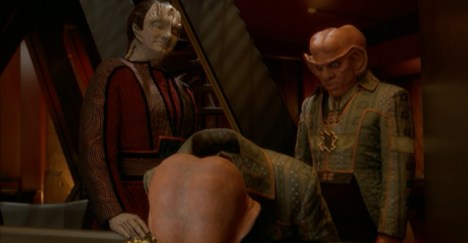
Body Parts is essentially a story about how Quark is no longer a proper Ferengi. He has been exposed to the values and ideals of the Federation, corrupted and changed through his time on Deep Space Nine. Although this winds up costing Quark a lot, the final scenes of Body Parts suggest that Quark has also benefited from his time on the station. Body Parts suggests that wandering out into the winder universe and exposing yourself to different cultures is inherently a good thing, even if it does generate tension.

Bearing the Brunt of his wrath...

Bearing the Brunt of his wrath…

Continue reading

Star Trek: Voyager – Basics, Part I (Review)

This February and March (and a little bit of April), we’re taking a look at the 1995 to 1996 season of Star Trek, including Star Trek: Deep Space Nine and Star Trek: Voyager. Check back daily for the latest review.

With Basics, Part I, the second season comes to an end.

In a very specific sense, of course. The production team decided to retain the strategy that they had employed during the show’s first season, adding an additional filming block on to the end of the season in order to film a bunch of episodes that would be broadcast at the start of the third broadcast season. At the end of the first season, four episodes were produced and held back – Projections, Elogium, Twisted, and The 37’s. As such, four second season episodes were produced after Basics, Part ISacred Ground, False Profits, Flashback and Basics, Part II.

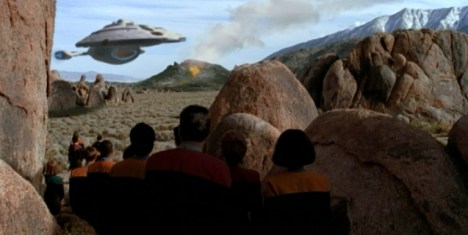
Heading home alone.

Heading home alone.

However, Basics, Part I marks the end of the show’s second broadcast season. It is very consciously designed as season finalé, something that the first season had struggled with by slotting Learning Curve into the broadcast slot. Basics, Part I also marks the beginning of the end for various threads running through the first two seasons of Star Trek: Voyager. It is the first part of the last Kazon story, the last Seska story, the last Lon Suder story, the last Star Trek television story written by Michael Piller.

It marks the beginning of the end of a troubled era for the show and for the larger franchise.

Hitchhiking in this part of space is very dangerous.

Hitchhiking in this part of space is very dangerous.

Continue reading

Star Trek: Deep Space Nine – The Quickening (Review)

This February and March (and a little bit of April), we’re taking a look at the 1995 to 1996 season of Star Trek, including Star Trek: Deep Space Nine and Star Trek: Voyager. Check back daily for the latest review.

Somehow, it happened. Star Trek: Deep Space Nine went from a show that could barely produce one good Bashir episode in a season to a series that could crank out three great Bashir episodes within the same production year.

The fourth season of Deep Space Nine is a fantastic season of television, even allowing for the episodes that don’t quite work (Sons of Mogh, Rules of Engagement) and those that fall completely apart (Shattered Mirror, The Muse). There any number of ways of measuring this success: the ease with which Worf has been integrated into the ensemble; the very high average quality of the individual episodes; the skill with which the production team navigated the introduction of the Klingon plot threads at the suggestion of the studio.

Paradise lost.

Paradise lost.

These are all perfect valid barometres of the season’s success. As is the most obvious indicator: the season is fun to watch and largely holds up on rewatch. However, the simple fact that Deep Space Nine could produce three great centring around Julian Bashir over the course of a single season speaks to how far the production team had come. After all, the studio had repeatedly asked the staff to write Bashir out of the show, convinced that fans were not responding to the station’s chief medical officer.

The Quickening is the third and final “good Bashir episode” of the fourth season, and it demonstrates just how important Bashir is to the fabric and framework of Deep Space Nine. Bashir represents Deep Space Nine‘s esoteric utopianism.

Bashir determination...

Bashir determination…

Continue reading

Star Trek: Voyager – Resolutions (Review)

This February and March (and a little bit of April), we’re taking a look at the 1995 to 1996 season of Star Trek, including Star Trek: Deep Space Nine and Star Trek: Voyager. Check back daily for the latest review.

So, shipping.

Times change surprisingly quickly. It is fair to say that Star Trek: Voyager emerged in a different world than the original Star Trek. However, it also emerged in a different world than Star Trek: The Next Generation. In a way, the show had acknowledged as much through its experiments with serialisation earlier in the second season. Michael Piller was trying to keep the franchise at the bleeding edge of contemporary television, realising that the medium was not the same as it had been when Jean-Luc Picard emerged at the end of the Reagan era.

Reach out...

Reach out…

Resolutions nods towards a different type of change in the way that television storytelling worked, particularly conversations about television storytelling. Although it could be argued that Star Trek helped to popularise the notion of romantically (or sexually) pairing off television characters through the practice of “slashing” Kirk and Spock, the notion of “shipping” had begun to enter the mainstream during the mid-nineties. The raw sexual chemistry between David Duchovny and Gillian Anderson on The X-Files played no small part.

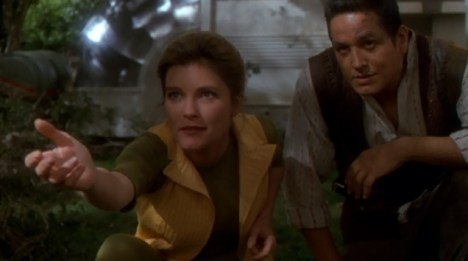
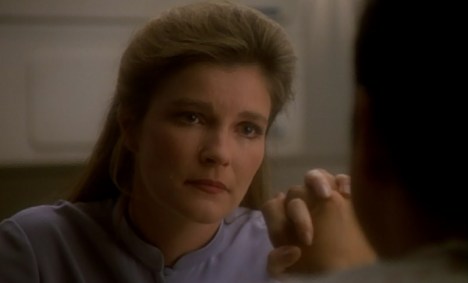
Resolutions is essentially about “shipping” Janeway and Chakotay.

... and touch somebody.

… and touch somebody.

Continue reading

Star Trek: Deep Space Nine – To the Death (Review)

This February and March (and a little bit of April), we’re taking a look at the 1995 to 1996 season of Star Trek, including Star Trek: Deep Space Nine and Star Trek: Voyager. Check back daily for the latest review.

To the Death continues the late fourth season shift in focus back towards elements unique to Star Trek: Deep Space Nine.

At the end of the third season, the production team found themselves receiving notes and input from the network, who wanted Deep Space Nine to go in a different direction. The writing staff on Deep Space Nine were willing to compromise, and took some of the network input on board. As a result, The Way of the Warrior added Worf to the cast and brought the Klingons back to the fore. However, it was clear that Deep Space Nine was not particularly interested in telling a long-term story about new hostilities between the Federation and the Klingons.

The Weyoun of the Warrior...

The Weyoun of the Warrior…

Over the course of the fourth season, the writing staff’s original plans and interests began to reassert themselves in an organic and logical manner. A story similar to Homefront and Paradise Lost had originally been planned to bridge the third and fourth seasons; instead, it was pushed back to almost half-way through the fourth seasons. The Bajoran religion was still the focus of Accession. Gul Dukat received a character arc in Indiscretion and Return to Grace. The Jem’Hadar got a focus episode in Hippocratic Oath. Ferengi politics popped up in Bar Association.

However, these aspects of the show really galvanise towards the end of the fourth season, with the production team really focusing on the elements that had been important during the third season and which would become even more important during the fifth season. For the Cause marked the return of the Maquis as a political player. Body Parts focused on Ferengi culture. However, three of the season’s final four episodes focus on the Dominion, working to reestablish the Dominion as the most credible of threats and the show’s primary antagonists.

Boy, does Sisko ever break out the welcome wagon...

Boy, does Sisko ever break out the welcome wagon…

Continue reading

Star Trek: Voyager – Tuvix (Review)

This February and March (and a little bit of April), we’re taking a look at the 1995 to 1996 season of Star Trek, including Star Trek: Deep Space Nine and Star Trek: Voyager. Check back daily for the latest review.

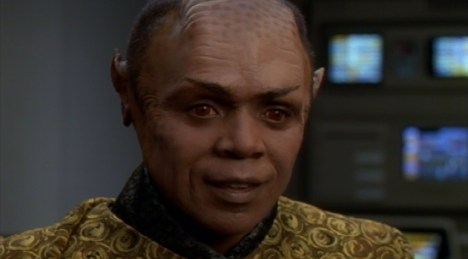
Tuvix is a controversial piece of Star Trek.

The episode tends to polarise fandom. In particular, the climax of the episode seems to divide fans firmly down the middle. When the fan site Trek Today marked the end of Star Trek: Voyager by staging a mock “Court Martial of Captain Kathryn Janeway”, it was argued that the events of Tuvix should have been included as evidence against her. It is no surprise that the episode generated such a strong response. Discussing the production of the episode, Tom Wright reflected, “The truth is that the higher ups of Star Trek knew that this would cause some controversy.”

"Neevok was never gonna cut it."

“Neevok was never gonna cut it.”

Of course it generates some controversy. This is the episode where Janeway elects to murder one crew member in order to resurrect two lost crew members. This is a story about how the title character is convenient for about forty-five minutes of screentime, only for the crew to quickly dispose of him as soon as the end credits beacon. Tuvix never really makes a convincing moral case for why the eponymous character has to die, beyond the fact that it conveniently resets the status quo.

Then again, perhaps that is reason enough.

Two for the price of one...

Two for the price of one…

Continue reading

Star Trek: Deep Space Nine – For the Cause (Review)

This February and March (and a little bit of April), we’re taking a look at the 1995 to 1996 season of Star Trek, including Star Trek: Deep Space Nine and Star Trek: Voyager. Check back daily for the latest review.

For the Cause essentially refocuses the fourth season of Star Trek: Deep Space Nine, rallying the season’s strength as the finalé approaches.

After a bunch of lackluster episodes, from Rules of Engagement through to Shattered Mirror and The Muse, the show finds its voice once again. For the Cause is not just a great episode of television, it is an episode uniquely tailored to this particular show. For the Cause would not work on any of the other for Star Trek shows, so precisely is it calibrated to what makes Deep Space Nine unique. It is a story about trust and betrayal, but also one that chips away at the romance of Starfleet and the Federation.

Pinning his colours to the mast...

Pinning his colours to the mast…

What is particularly interesting about the stretch of episodes running from here through to Broken Link is the sense that Deep Space Nine is getting back to basics. The fourth season is somewhat overshadowed by the addition of Worf to the cast and the emphasis placed on the Klingons in The Way of the Warrior. Although the production team do a great job working within the studio mandate, this shift in focus has meant that many more traditional elements of Deep Space Nine have been shunted into the background.

The final stretch of the fourth season finds the show returning to ideas that were threaded through earlier seasons and were shifted slightly out of focus with the return of the Klingons. For the Cause brings the Maquis back to the fore. To the Death, The Quickening and Broken Link focus on the Dominion threat. Body Parts returns to Ferengi politics. To be fair, the Maquis were the only element that totally faded from view over the fourth season, so it makes sense to return to them first.

A stunning betrayal...

A stunning betrayal…

Continue reading

Star Trek: Voyager – The Thaw (Review)

This February and March (and a little bit of April), we’re taking a look at the 1995 to 1996 season of Star Trek, including Star Trek: Deep Space Nine and Star Trek: Voyager. Check back daily for the latest review.

The Thaw is a visually striking piece of Star Trek.

The Thaw is among the most delightfully surreal and abstract episodes of Star Trek to be broadcast after October 1975. One of the more interesting aspects of Star Trek: Voyager is how consciously the show tries to return to the storytelling aesthetic of the original Star Trek show, at least in its early years. While the design aesthetics and characters might have been largely ported over from Star Trek: The Next Generation, the first few seasons of Voyager frequently feel like a conscious attempt to update sixties Star Trek tropes for the nineties.

In darkness dwells...

In darkness dwells…

This is obvious in a number of ways. Caretaker consciously tried to evoke the old “space western” aesthetic, to the point of featuring a Native American first officer and introducing the Kazon as horribly racist “primitive” stereotypes. Time and Again relished primary colour costuming for their suspiciously human-like aliens. These themes became more prominent in the second season, with the b-movie aesthetic of Threshold, the space horror of Persistence of Vision and Meld, and the reverse aging allegory of Innocence.

While Tuvix essentially offers a reverse twist on The Enemy Within, it is The Thaw that feels most obviously like a sixties episode trapped in ember. The allegorical storytelling, the abstract set design, the creepy campy tone. Voyager might be half-way across the galaxy, but it is never too far from the familiar.

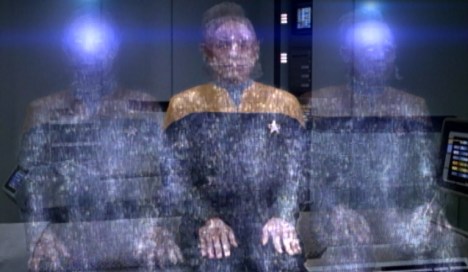
"We never bother to scream... ... when your mask came off."

“We never bother to scream…
… when your mask came off.”

Continue reading

Star Trek: Deep Space Nine – The Muse (Review)

This February and March, we’re taking a look at the 1995 to 1996 season of Star Trek, including Star Trek: Deep Space Nine and Star Trek: Voyager. Check back daily Tuesday through Friday for the latest review.

If Shattered Mirror represents the writing staff on Star Trek: Deep Space Nine trying to stave off late-season exhaustion by cutting loose with an extended Star Wars homage, then The Muse represents an altogether different response to the strain of the twenty-six episode season.

The Muse was a painful episode. It did not emerge fully-formed, with writer René Echevarria struggling to bring the story to screen. The result is a mess of an episode. The Muse is not a good episode of television, and is almost universally accepted as such. Afforded the opportunity to remove one episode from his Star Trek CV, director David Livingston suggested it was with obvious choice. “Which would I erase? Which was the one with Meg Foster? The Muse. That was not very good. In fact, that was not good.”

Blood on the page...

Blood on the page…

Continue reading