• Following Us

  • Categories

  • Check out the Archives


  • Awards & Nominations

New Podcast! The X-Cast – Season 2, Episode 8 (“One Breath”)

Just a quick link to another recent guest appearance over on The X-Cast, a great X-Files podcast run by the prolific Tony Black.

In my final appearance on the show’s second season, I had the pleasure of an extended conversation with Tony about One Breath. Readers of the blog will know that One Breath is (along with Never Again) one of my absolute favourite episodes of the show, so it was an honour and a privilege to be invited to talk about it on the show. We got to talk about all sorts of fun things, from Mister X’s grouchy demeanour to performative masculinity to just how carefully Walter Skinner sets up his stylish dead drops. Check it out the episode here, or click the link below.

podcast-onebreath

Continue reading

Star Trek: Deep Space Nine – Business as Usual (Review)

Business as Usual is, appropriately enough, a very typical Star Trek morality play.

It is a relatively rare example of Star Trek: Deep Space Nine engaging in the sort of pointed social commentary that many fans expect of the genre, the rather straightforward moral lesson couched in science-fiction trappings; The Devil in the Dark as a commentary on “the other”, A Taste of Armageddon as a condemnation of the Vietnam War, Let That Be Your Last Battlefield as a critique of racism in general. There are all but expected in a Star Trek show, but Deep Space Nine rarely plays them particularly straight.

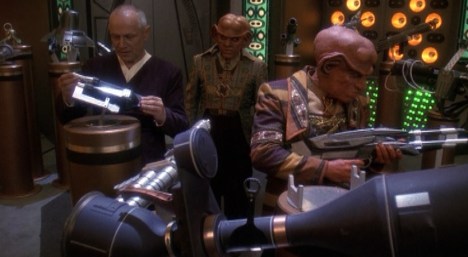
Disarming conversationalists...

Disarming conversationalists…

Deep Space Nine has told issue-driven stories before, with In the Hands of the Prophets serving to explore the gap between creationists and those who believe in evolution or Past Tense, Part I and Past Tense, Part II constructed as a direct commentary on Los Angeles’ plans to lock up their homeless population. However, the series tend to favour broader commentaries about grander themes. The show arguably as a timeless quality because it tends not to dwell too heavily upon specific ideas, instead meditating on particular themes like authority and conflict.

Indeed, Star Trek: Voyager is a lot more traditional in this respect. That writing staff has a clear fondness for the archetypal Star Trek morality play, constructing episodes as metaphors for contemporary issues; Remember explores Holocaust denial, Distant Origin deals with creationism, Displaced offers a reactionary take on immigration. Even non-issue-driven episodes like Darkling and Fair Trade make a point to stress the franchise’s utopian values in a manner much more overt than Deep Space Nine.

The hard sell.

The hard sell.

With that in mind, Business as Usual feels strangely old-fashioned. It is very much an episode of Deep Space Nine in terms of setting and character, in that no other Star Trek show would have a lead character knowingly and willingly become an arms dealer. However, it feels very much like an archetypal Star Trek show in that it is an episode about how the arms trade is implicitly immoral and horrific. It is a very worthwhile message, and in no way diminished by its obviousness, but it does feel surprisingly clear cut when compared to episodes like The Ship or Rapture.

Business as Usual is essentially a very conventional Star Trek story that is elevated by one of the best guest casts in the history of the franchise.

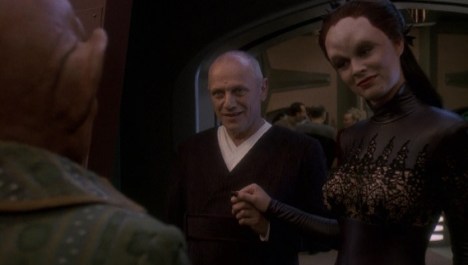
"No, Mister Quark, I expect you to buy!"

“No, Mister Quark, I expect you to buy!”

Continue reading

Star Trek: Deep Space Nine – A Simple Investigation (Review)

A Simple Investigation is a quiet little episode.

This is particularly true in the context of the crowded second half to the fifth season of Star Trek: Deep Space Nine. In Purgatory’s Shadow and By Inferno’s Light radically upended the status quo and set the fifth season on a march towards A Call to Arms. The threat of war looms large over the second half of the season, following the admission of Cardassia into the Dominion. There is a creeping sense of inevitability to episodes like Blaze of Glory and Soldiers of the Empire.

Strange bedfellows...

Strange bedfellows…

At the same time, Deep Space Nine takes a little while to adjust to that dramatic shift. The Dominion and Cardassia only come back into focus with Ties of Blood and Water, the episode that reintroduces Weyoun to the series. Still, episodes like Doctor Bashir, I Presume and Business as Usual have a sense of weight to them as they offer up high-stakes family drama and arms-dealing morality plays. In contrast, A Simple Investigation feels relatively low key. It is not an episode with profound consequences or shocking revelations.

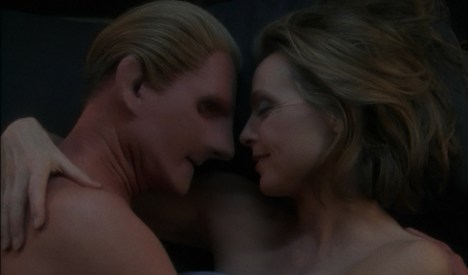
Instead, A Simple Investigation plays as a small-scale cyberpunk noir romance in which Odo falls head-over-heels in love with a guest star whom he will never see again. With all the chaos unfolding across the length and breadth of the fifth season, A Simple Investigation feels surprisingly… simple. The problems of these little people don’t amount to a hill of beans in this crazy world, but A Simple Investigation still takes the time to fixate upon them.

Star struck.

Star struck.

Continue reading

Star Trek: Voyager – Favourite Son (Review)

Favourite Son feels like the culmination of something that has been festering across the third season of Star Trek: Voyager.

The Star Trek franchise is generally regarded as progressive and forward-thinking. There is some debate to be had about whether this is an accurate summary of the franchise, given some of the creative decisions made over the course of its half-century run. However, there are times at which the franchise feels particularly liberal and points at which it feels particularly reactionary. A product of the mid-nineties, running through to the turn of the millennium, Voyager tends to feel very conservative in places.

This is a little bit what watching the episode feels like.

This is a little bit what watching the episode feels like.

In the second season, this reactionary tendency played out through the treatment of the Kazon in episodes like Initiations and Alliances. In the third season, with the Kazon long gone, it seems that Voyager has turned its reactionary gaze upon its female cast members. To be fair, the show’s first two seasons had any number of unfortunate creative decisions when it came to various female characters. Most notably, the decision to turn Seska into a baby-crazed maniac in Manoeuvres did not bode for the first female-led Star Trek series.

Nevertheless, a misogynist streak has manifested itself across the third season as a whole. In some cases, this has been relatively subtle; like the awkward insistence upon sexualising three-year-old Kes in the eyes of her two mentor figures in Warlord and Darkling. In other cases, this has been the entire point of the plot; like the decision to have Q try to sleep with the franchise’s first female lead and introduce his shrewish wife in The Q and the Grey or to introduce a psycho stalker in Alter Ego.

The original red wedding.

The original red wedding.

Other times, this sexist attitude has bubbled through the background of various episodes to the point that it builds to critical mass. Torres is victimised by her male colleagues over the course of three straight episodes, and none of them are held accountable; she is sexually assaulted by Vorik in Blood Fever, stunned by Chakotay in Unity, and tortured by the evil!EMH in Darkling. In each of those cases, the show seems to shrug off the violence committed by male characters against one of the show’s female leads.

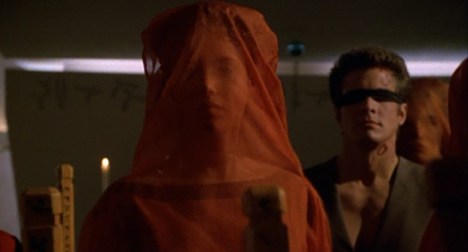
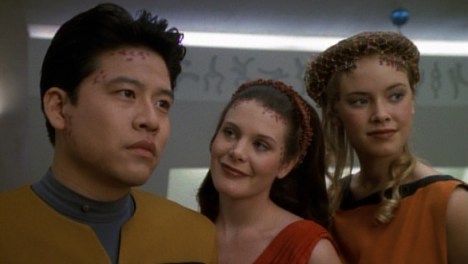
All of these elements come to the fore in Favourite Son, an episode that would have been painfully retrograde had it aired as part of the original series during the sixties. Favourite Son is that most uncomfortable myth dressed up in science-fiction drag, the tale of an island of beautiful women using their sexual prowess to lure men into their clutches to emasculate them. It is terrifying to think that this episode made it to air in the late nineties.

A beautiful dream.

A beautiful dream.

Continue reading

Star Trek: Voyager – Rise (Review)

Rise is in many ways a very typical episode of Star Trek: Voyager.

It is an episode that certainly has an interesting premise. For all its myriad flaws, Voyager tended to have a genuine interest in playing with science-fiction concepts. At its worst, this attitude manifested itself through the various “anomaly of the week” stories that followed a familiar pattern of the ship encounter some sort of strange phenomenon with predictable results. Often this phenomenon involved time travel or interstellar dust clouds, a trend that could be traced back to early episodes like Time and Again or The Cloud.

That crashing feeling.

That crashing feeling.

However, Voyager did occasionally use its interest in science-fiction storytelling to construct interesting stories. Deadlock might have set a damning precedent for the show, but it was compelling television. Blink of an Eye is a very clever little story. In true Star Trek fashion, Voyager would even use these science-fiction ideas to construct engaging allegories like the exploration of holocaust denial in Remember or the meditation on creationism in Distant Origin.

These concepts gave the series a sense of texture. They served to distinguish the show from its siblings. For example, Star Trek: Deep Space Nine was generally less interested in science-fiction high concepts than in characterisation and politics. When those sci-fi elements did show up, they were usually to torture O’Brien in episodes like Whispers, Visionary, Hard Time and Time’s Orphan. Of course, Deep Space Nine had sci-fi concept-driven stories like Playing God or One Little Ship, but they tended to stand out more from the series around them.

Up on the roof's the only place I know...

Up on the roof’s the only place I know…

Rise has a suitably high concept, a core idea that could easily have been lifted from the pages of the same pulp magazines that inspired The Cloud Minders. The episode is essentially a paranoid thriller unfolding within a confined space, but that confined space just happens to be a giant elevator that stretches from the surface of the planet into orbit. The premise is ridiculous, feeling like it was lifted from forties or fifties periodicals with giant insects and half-naked men on the cover. In other words, it feels of a piece with Innocence or The Thaw or Tuvix.

It is too much to argue that Rise has a brilliant concept, but it at least has an intriguing one. While it might be hard to use the basic elements of Rise to construct a classic, it should be relatively straightforward to construct a thrilling episode of television. Unfortunately, Rise simply does not work. More than that, Rise does not work for the most boring of reasons. As with a lot of Voyager, the episode is an interesting premise undercut by both a deeply flawed (and half-hearted) execution and the show’s own long-standing structural weaknesses. This happens all too often.

A dark moment for the series.

A dark moment for the series.

Continue reading

Star Trek: Deep Space Nine – Doctor Bashir, I Presume (Review)

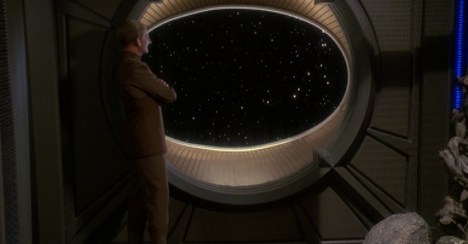
Doctor Bashir, I Presume is a strange little episode.

It directly follows In Purgatory’s Shadow and By Inferno’s Light, a two-part story in which it was revealed that Doctor Julian Bashir had been abducted by the Dominion at some point during the fifth season and replaced with a changeling infiltrator. Although the maths can be a little difficult to work out, it is suggested that Bashir was replaced by a changeling at some point before Rapture. With that in mind, it seems strange that the very next episode of Star Trek: Deep Space Nine should reveal that the recently returned Julian Bashir is himself an imposter.

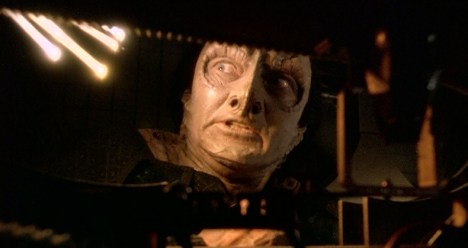
"Oh, shiny."

“Oh, shiny.”

However, even on its own terms, Doctor Bashir, I Presume is a very odd piece of television. The hook of the episode is a guest appearance from Robert Picardo as Lewis Zimmerman. Picardo is making a crossover appearance from Star Trek: Voyager where he played the EMH, who had also made an appearance in Star Trek: First Contact. Picardo is a fine dramatic actor, but the character is notable for being comic relief. Doctor Bashir, I Presume begins as a light-hearted quirky piece, turning sharply at the half-way point to become a gritty science-fiction family drama.

All of this is quite jarring. However, Doctor Bashir, I Presume works surprising well. A large part of that is down to how strange the episode is, often feeling like an intimate family drama about recrimination and disappointment set against the backdrop of a massive science-fiction franchise.

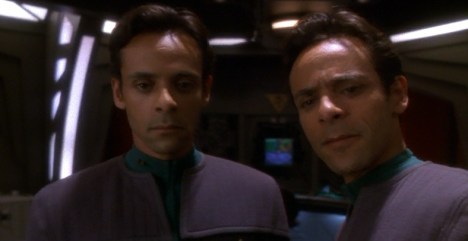
A selfie with himself.

A selfie with himself.

Continue reading

Star Trek: Voyager – Darkling (Review)

There is something to be said for the pulpier side of Star Trek: Voyager, the aspect of the show that plays like a cheesy sci-fi b-movie.

Brannon Braga is very much the driving force behind this aspect of the show, as evidenced by his scripts for the belated Cold War body-swapping horror of Cathexis or the psychological nightmare of Projections or the trashy psychedelic terror of Cold Fire or even the weird evolutionary anxieties of Threshold and Macrocosm. These sorts of episodes often feel like they belong in a late night movie slot reserved for forgotten horror flicks from the fifties and sixties. Of course, Braga is not alone in this; episodes like Meld and The Thaw also fit the pattern.

Blurred lines.

Blurred lines.

Of course, these episodes do not always hit the mark. Charitably, it could be argued that they land about half the time and misfire spectacularly about one third of the time. However, there is something strangely compelling about these episode. They feel distinct from what audiences expect from Star Trek. Even if they are arguably just an extension of late Star Trek: The Next Generation episodes like Sub Rosa or Genesis or Eye of the Beholder, they feel like something different from the show’s more conventional “let’s do archetypal Star Trek” plotting.

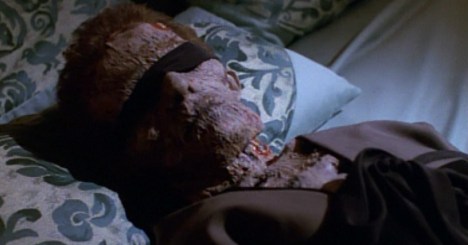
Darkling is an episode that doesn’t quite work, but which is oddly endearing in its dysfunction. It is a ridiculous central premise executed in a deeply flawed (and occasionally uncomfortable) manner. However, there is something weirdly compelling about wedding the show’s science-fiction premise to gothic horror through the fractured psyche of a computer program.

Patchy.

Patchy.

Continue reading

Star Trek: Deep Space Nine – By Inferno’s Light (Review)

In Purgatory’s Shadow and By Inferno’s Light represent a fantastic accomplishment for Star Trek: Deep Space Nine.

The two-parter demonstrates the care and skill that went into characterisation on the show. The later Star Trek series often struggled to define their core ensembles as effectively as this series defined its secondary players. Star Trek: Voyager often reduced its characters to cogs within a plot-driven machine, capable of whatever a given plot required from them at a given moment. The same was true of Star Trek: Enterprise, which spent most of its first two years slotting cookie-cutter characters into very conventional narratives.

"I, for one, welcome our new Dominion overlords."

“I, for one, welcome our new Dominion overlords.”

In contrast to Voyager and Enterprise, the bulk of plotting on Deep Space Nine seemed to flow from the characters themselves rather than forcing the characters to conform to the demands of the plot. All the big storytelling decisions on Deep Space Nine are rooted in the agency of the characters in question, to the point that the fate of the entire Alpha Quadrant seems to hinge upon the fragility of Gul Dukat’s ego. It is a very clever (and very ahead of its time) approach to plotting a science-fiction series, just one reason that Deep Space Nine has aged so well.

As a result, In Purgatory’s Shadow and By Inferno’s Light are both rooted in what the audience already knows about the characters populating Deep Space Nine. All the decisions that are taken feel very much in character, and in keeping with what the audience knows about these individuals. This only serves to make it all the more impressive that the two-parter so radically revises the show’s status quo.

Leave a light on.

Leave a light on.

Continue reading

Star Trek: Voyager – Unity (Review)

The autopsy of the Borg corpse is underway.

– Janeway about sums it up

If the third season of Star Trek: Voyager is about the show embracing its place in the shadow of Star Trek: The Next Generation, then it makes sense that the third season would bring the crew into conflict with the Borg. The first two seasons of Voyager had leaned rather heavily upon the mythology of The Next Generation, featuring guest appearances from Q and Riker in Death Wish or Barclay in Projections, not to mention a recurring Cardassian foe and enemies heavily influenced by The Next Generation era Klingons.

However, the first two seasons had made an effort to introduce new and exciting foes for Voyager, new recurring species to reflect that the ship was traveling through an unknown part of space. For all the show featured guest appearances from Romulans and Ferengi, the first two years at least tried to do their own thing. The Kazon might have been a questionable idea horribly executed, but at least they were a new species. The Vidiians were underutilised and remain one of the most fascinating recurring aliens in the entire franchise.
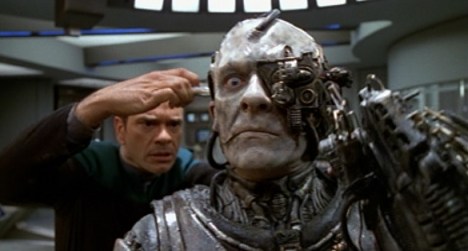
The brains of the operation.

The brains of the operation.

The third season only features a few token appearances of the recurring Delta Quadrant species. The Kazon disappear from the show after Basics, Part II. The Vidiians appear within a nightmarish time loop in Coda. A lost Talaxian pops up on a space station in Fair Trade. However, these aliens are no longer a recurring presence. There is an obvious vacancy that needs to be filled. Voyager needs a new recurring alien species. With that in mind, it is telling that the third season does not create a new alien menace like the Hirogen or the Malon.

The third season of Voyager decides that the Borg are to be the shows recurring adversaries. It makes a certain amount of sense. After all, the Borg are arguably the most iconic and effective aliens created by The Next Generation. They were a massive part of the spin-off really coming into its own with The Best of Both Worlds, Part I and The Best of Both Worlds, Part II. They were also a major part of the hugely successful feature film Star Trek: First Contact. There was definitely an appetite for more Borg stories. There always would be.

Corpsing...

Corpsing…

At the same time, the presence of the Borg feels very much like a concession or a surrender. This is Voyager effectively surrendering itself to becoming a pale imitation of The Next Generation, acknowledging that it will never create any alien species as memorable or as iconic as the Borg. That is not an unreasonable thing to accept. After all, Star Trek: Deep Space Nine did fantastic work with the Dominion, but that collection of alien species could never hope to have the same cultural penetration as the Borg.

Still, it is disheartening to see Voyager give up on itself so completely. Indeed, Unity is not even a particularly innovative Borg story, feeling very much like a retread of their last television story in Descent, Part I and Descent, Part II. This is a recurring problem for the third season of Voyager, which has spent a lot of time emulating various Next Generation episodes. However, there is also a sense that Voyager is not terrible at this imitation, even as it is lessened by it. Unity is a flawed episode, but an intriguing one.

Just what every Borg story needs! A Chakotay romance!

Just what every Borg story needs! A Chakotay romance!

Continue reading

New Podcast! The X-Cast – Season 2, Episode 6 (“Ascension”)

Previously on the X-Cast…

Just a quick link to another recent guest appearance over on The X-Cast, a great X-Files podcast run by the prolific Tony Black.

I got to return to the show to talk about the second part of the series’ (and the podcast’s) first two-part episode, Ascension. Wherein we discuss the unrelenting forward momentum of the second part of X-Files two-parters, the recurring sense that Krycek thinks all of this is just a little bit beneath him, and the joy of Roger Moore style stunt sequences. As ever, it was my pleasure to appear on the show, and Tony was as wonderful a host as ever. Check it out the episode here, or click the link below.

podcast-accension

Continue reading