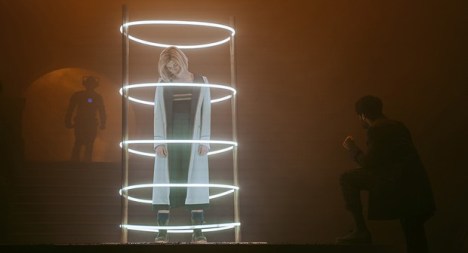
I published a new column at The Escapist yesterday. With the announcement that both Chris Chibnall and Jodie Whittaker would be leaving Doctor Who after this season and a string of specials, it seemed like a good opportunity to take a look back at their time on the show.
In particular, how this three-season stretch marks the first time since the revival that an actor’s interpretation of the Doctor has been left awaiting rehabilitation. Jodie Whittaker’s Thirteenth Doctor was a striking opportunity for the show, a talented actor in a bold reinvention. However, despite the combination of the actor’s enthusiasm and the audience’s goodwill, the show itself failed to deliver on her potential. This essentially places Whittaker in the same position as Colin Baker. The Thirteenth Doctor will have to look outside the show to find stories and characterisation worthy of the actor involved.
You can read the piece here, or click the picture below.
With The X-Cast moving on to coverage of the seventh season of The X-Files, and the episode Millennium fast approaching, it seemed like a good time to resurrect the Time is Now podcast. So I joined Kurt North to talk about the controversial episode.
Millennium is a very strange episode of television. It is designed to serve as a de facto series finale for Chris Carter’s Millennium while folding it into the mythology of The X-Files. However, it is an episode where two of the three credited writers have never worked on Millennium, and which builds to a climax of the mythology of Millennium which doesn’t really fit with anything that appeared on screen. However, it is also the episode that builds to the first on-screen kiss between Mulder and Scully, which creates an interesting tension in terms of the episode’s priorities.
You can listen to the episode here, or click the link below.
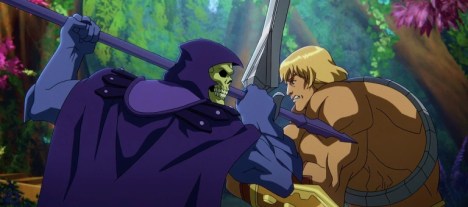
I published a new column at The Escapist today. The release of Masters of the Universe: Revelation generated some controversy last week, owing to a major twist at the end of the first episode that caught some fans entirely off-guard.
This is interesting, because it gets at one of the central tensions of modern fan culture, particularly the obsession with spoilers. Many fans are obsessively worried about having the film and television that they enjoy spoiled for them ahead of time, of having secrets revealed before release. However, that narrative doesn’t really fit with the outrage over Revelation, where it seems like many of those fans most vocally protesting the big twist at the end of the first episode seem frustrated that something like that development was preserved as a surprise for them and that it did catch them off-guard. So do fans really want to be surprised?
You can read the piece here, or click the picture below.
Scorsese’s biblical epic was one of the most controversial major studio releases of the late eighties, attracting death threats and protests for its portrayal of Jesus Christ. It formed the basis for Mulder’s journey in The Sixth Extinction II: Amor Fati, with the two-parter directly lifting several scenes from the film. It’s interesting to interrogate, in large part because – despite the influence of seventies cinema on The X-Files – it feels like the show’s only real point of intersection with one of the most influential filmmakers of the seventies.
You can listen to the episode here, or click the link below.
I published a new In the Frame piece at The Escapist this evening. With the release of Masters of the Universe: Revelation on Netflix this weekend, it seemed like a good opportunity to take a look at the larger franchise.
The He-Man franchise originated as a toy line from Mattel, obviously taking its cues from a host of contemporary pop culture like Conan the Barbarian and Star Wars. However, the franchise’s origins as a toy rather than a book or a feature film led to an interesting tensions. He-Man and the Masters of the Universe is a classic epic fantasy about the battle between good and evil, but it is a story without a predetermined origin or ending. Good may win individual battles against evil, but it will never triumph completely. As a result, He-Man presents the struggle of good against evil as eternal and unwinnable, but worth fighting.
You can read the piece here, or click the picture below.
I published a new In the Frame piece at The Escapist this evening. With Loki wrapping up its first season this week, it seemed like a good opportunity to take a look back at the show. In particular, how the season finale betrayed the show’s core themes and characters.
Loki is a story about many things, but it is primarily about power. It is about whether individuals have the power to determine the paths of their own lives. It is about who has the power to determine what stories get told and what they do with that power. It is also about how power intrinsically acts in its own best interests. There’s a lot of really interesting and biting stuff in Loki, which makes it slightly frustrating when the final makes a conscious choice to rob its characters of their agency, to reveal that this story doesn’t belong to them, and to argue that power must be centralised. In the end, Loki betrayed itself.
You can read the piece here, or click the picture below.
I published a new In the Frame piece at The Escapist this evening. The fifth season of Rick and Morty is currently airing, a the most recent episode has been greeted as a modern classic, so it seemed like a good time to take a look at what makes the show work.
Rick and Morty is a science-fiction comedy. Both comedy and science-fiction thrive off the dramatic principle of escalation, of extrapolating from one iteration of an idea to the next. What is so interesting about Rick and Morty is how the show adopts an exponential approach to that philosophy. The comedy and the stakes of Rick and Morty often derive from starting with a straightforward science-fiction concept and then doubling down on it repeatedly.
You can read the piece here, or click the picture below.
I published a new column at The Escapist today. Following the latest episode of Loki, it has become very clear that the show is an interesting American counterpoint to Doctor Who, specifically the version of Doctor Who overseen by showrunner Steven Moffat.
Loki carries over a lot of the imagery of Doctor Who, often with an interesting specificity – the purple world from Mindwarp, the fugitive pulled out of time to face trial for meddling with the timeline from The Mysterious Planet, the exploding moon from Kill the Moon, the former villain encountering different gendered versions of themselves from The Doctor Falls, the notion of “Volcano Day” from The Doctor Dances. It’s interesting to see such a major property drawing so directly from an eccentric British television show.
You can read the piece here, or click the picture below.
















 the m0vie blog