• Following Us

  • Categories

  • Check out the Archives


  • Awards & Nominations

Doctor Who: Last Christmas (Review)

There’s a horror movie called Alien? That’s really offensive. No wonder everyone keeps invading you.

Last Christmas is perhaps the most Moffat-esque Christmas Special of the Moffat era.

As such, it is an episode that will inevitably provoke a strong reaction, playing as it does to the writer’s strengths and interests in Doctor Who. As a show, Doctor Who has a long history of crashing genres into one another. One of the most endearing aspects of the show is the way that it can be a completely different show from week to week. One week, it is a western; the next, it is a horror film. One episode is a period adventure; another is a science-fiction comedy. Doctor Who is a show about a mad man in a box who crashes into random stories.
doctorwho-lastchristmas4

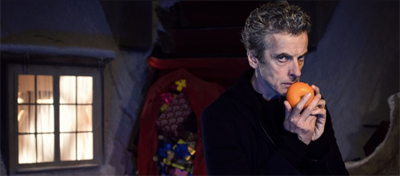
Last Christmas is quite overt about this. When Shona wakes up towards the end of the episode, we are treated to a glimpse of her “to do” list for Christmas Day, which happens to feature a variety of clear influences on the episode. Strangely, she plans to open her Christmas Day binge with a double-bill of Alien and The Thing From Another World, before taking a breather and returning for Miracle on 34th Street – you really do need a bit of space before properly digesting the truly heavy stuff. (She’s also marathoning the Hugo-winning Game of Thrones.)

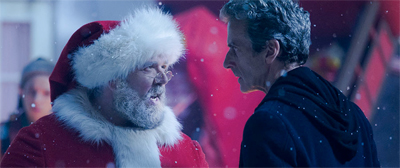
Last Christmas is a story that is incredibly (and almost cheekily) aware of its own fictionality. As with so much of Moffat’s Doctor Who, it is a story about stories. And dreams, which are really the same thing. “Time travel is always possible in dreams,” the Doctor observes, to borrow a quote from The Name of the Doctor. Dreams and stories.
doctorwho-lastchristmas Continue reading

Star Trek – The Immunity Syndrome (Review)

The first Star Trek pilot, The Cage, was produced in 1964. To celebrate its fiftieth anniversary, this December we are reviewing the second season of the original Star Trek show. You can check out our first season reviews here. Check back daily for the latest review.

The Immunity Syndrome is an underrated masterpiece, the first genuine classic overseen by producer John Meredyth Lucas.

It is bold, brilliant and more than a little bit weird. This is Star Trek as pure sixties science-fiction. It is a psychedelic ecological tale focused on mankind’s place in the larger universe. It doesn’t just pit the Enterprise against a giant space amoeba, it suggests that the universe itself is a singular gigantic organism, a complex system in which the Enterprise is just one part. The Immunity Syndrome is weird and wonderful, eerie and beautiful in equal measure. It is one of Star Trek‘s most effective encapsulations of the sixties.

Freak out!

Freak out!

Continue reading

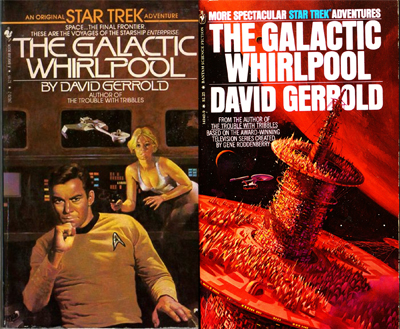
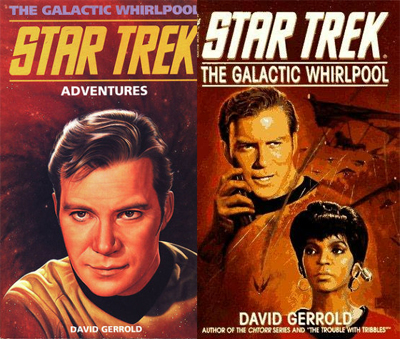
Star Trek – The Galactic Whirlpool by David Gerrold (Review)

The first Star Trek pilot, The Cage, was produced in 1964. To celebrate its fiftieth anniversary, this December we are reviewing the second season of the original Star Trek show. You can check out our first season reviews here. Check back daily for the latest review.

David Gerrold is one of the very few Star Trek writers to become an established science-fiction writer after his work on the television show.

Sure, writers like Ronald D. Moore and Brannon Braga have continued to work in genre television and film, but Gerrold is unique in that he has built up a reputation as a formidable science-fiction novelist. “By any reasonable definition David Gerrold is a major figure in science fiction,” the New York Times has argued. It seems hard to disagree. If Roddenberry had produced Star Trek a decade or so later, he may have been approaching David Gerrold the same way he approached Ray Bradbury or Theodore Sturgeon.

Gerrold joined the writing staff in the second season of Star Trek, following a number of failed pitches. The writer managed to sell The Trouble With Tribbles, which became one of the most iconic and memorable Star Trek episodes ever written. He was such a success that he was drafted in to punch up I, Mudd – the script going into production before The Trouble With Tribbles. Gerrold would hang around for the third season of the show and would become one of the defining voices on Star Trek: The Animated Series with D.C. Fontana.

galacticwhirlpool

Gerrold remained busy in the long gap before Star Trek: The Next Generation, writing a string of well-regarded one-off science fiction novels in the seventies; however, perhaps his best-known work in the interregnum was The War With the Chtorr, his series of novels documenting an alien invasion of Earth. When he fell out with Gene Roddenberry over the production of The Next Generation, Gerrold would launch his popular Star Wolf series – a bunch of novels adapted from a television pitch that feel very much like his vision of The Next Generation.

However, despite this success outside Star Trek, Gerrold remains quite attached to that massive shared universe. Indeed, he recently adapted his own infamously lost Next Generation script – Blood and Fire – for Star Trek: Phase II. However, this was not Gerrold’s first “non-televised” piece of Star Trek. The author was responsible for The Galactic Whirlpool, the fourteenth Bantam Star Trek novel published in 1980. The novel was published shortly before the license was handed over to Pocket Books, and is a remarkable accomplishment.

galacticwhirlpool2 Continue reading

Star Trek – Obsession (Review)

The first Star Trek pilot, The Cage, was produced in 1964. To celebrate its fiftieth anniversary, this December we are reviewing the second season of the original Star Trek show. You can check out our first season reviews here. Check back daily for the latest review.

The Star Trek franchise really does like Moby Dick, doesn’t it?

The show had done its first appropriation of Herman Melville’s iconic story of obsession and revenge earlier in the second season with The Doomsday Machine. In that episode, Commodore Decker sought to avenge the loss of his crew upon an unstoppable planet-killing machine. However, the basic formula quickly worked its way into the franchise’s blood. Obsession casts Kirk in the role of Ahab, albeit with a radically different ending and tone. After all, it is very cast Ahab as the heroic lead of a weekly television show.

"It's behind you!"

“It’s behind you!”

Star Trek II: The Wrath of Khan would return to Moby Dick for inspiration. Khan would even paraphrase from the book, without a hint of self-awareness or irony. After that point, it seemed like the franchise was more interested in mimicking the themes of The Wrath of Khan , which inevitably meant carrying over the themes of Moby Dick as well. Nevertheless, Star Trek: Voyager did its own variant of Moby Dick in Bliss and Star Trek: First Contact would reference the book directly.

Obsession is a competent if unspectacular episode, one that suffers from the fact that it has been done better and more compellingly in recent memory. However, given all the changes taking place behind the scenes, Obsession flows surprisingly well.

It really sucks to be a red shirt, eh?

It really sucks to be a red shirt, eh?

Continue reading

Star Trek: Alien Spotlight – Tribbles (Review)

The first Star Trek pilot, The Cage, was produced in 1964. To celebrate its fiftieth anniversary, this December we are reviewing the second season of the original Star Trek show. You can check out our first season reviews here. Check back daily for the latest review.

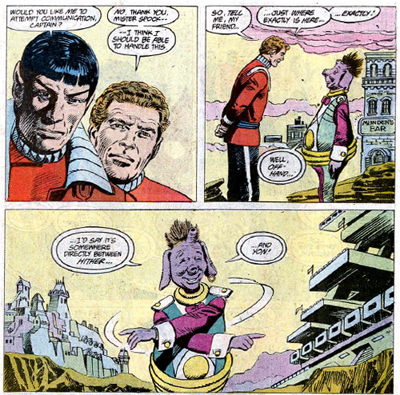
There is something delightfully gonzo about trying to write a comic book from the perspective of a bunch of Tribbles.

IDW’s Alien Spotlight series did not always work as well as it might, but the delightful done-in-one format of stand-alone stories told from the perspective of iconic Star Trek aliens allowed for a bit more versatility and flexibility than the line was normally afforded. Alien Spotlight: Cardassians was set after the end of Star Trek: Deep Space Nine. Alien Spotlight: Borg featured a delightfully clever logical paradox and a Borg invasion. Alien Spotlight: Klingons allowed Keith R.A. DeCandido to work his magic with the Klingons. Alien Spotlight: Romulans served as a springboard for John Byrne towards his Romulans saga.

You think you've got tribbles?

You think you’ve got tribbles?

There were more than a few disappointments along the way, but the Alien Spotlight series stands as one of the highlights of IDW’s Star Trek licensing. Alien Spotlight: Tribbles is a very odd piece of work. It is the kind of high-concept story that might feel like a gimmick and feels stretched over a single issue, let alone an arc. However, it is just silly enough that it works. Telling the story of a conflict between a bunch of Klingons and a human freighter crew through the eyes of the Tribbles is a fascinating idea.

While there is a sense that writer Stuart Moore occasionally has to stretch to get the story to where it needs to go, but Alien Spotlight: Tribbles is a delightfully charming (if perhaps a little too light) Star Trek diversion.

Laugh it up, fur ball...

Laugh it up, fur ball…

Continue reading

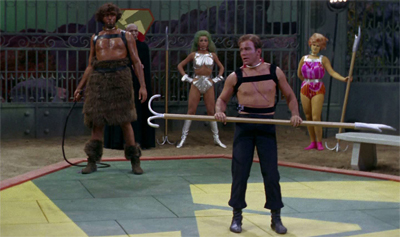
Star Trek – The Gamesters of Triskelion (Review)

The first Star Trek pilot, The Cage, was produced in 1964. To celebrate its fiftieth anniversary, this December we are reviewing the second season of the original Star Trek show. You can check out our first season reviews here. Check back daily for the latest review.

The Gamesters of Triskelion is not a great episode of Star Trek. Although filmed after Obsession, even if the production order lists it before that episode, The Gamesters of Triskelion feels like we’re watching producer John Meredyth Lucas finding his feet. It’s an episode that feels light and looks relatively cheap, formed from a collection of clichés that would already be familiar to Star Trek fans or fans of pulp science-fiction.

Perhaps the best thing that can be said about The Gamesters of Triskelion is that it has a decidedly pulpy charm to it. The entire episode looks like it was lifted from the cover to some trashy paperback, and the plot is recycled from stock science-fiction concepts and themes. While this isn’t enough to sustain an entire fifty minutes of television, it does allow the episode to feel a little distinctive and memorable… if not necessarily in a good way.

Shat happens...

Shat happens…

It is amazing how much of the franchise’s memorable iconography and imagery comes from weaker episodes of the classic Star Trek. It’s a testament to the show’s production design team, that could always find a way to make Star Trek look impressive, even on a tight budget and a short schedule. There’s also something enduring about the bizarre images that Star Trek could throw up on screen, even when the scripts were lacking; from space!Lincoln in The Savage Curtain to half-black/half-white racism in Let That Be Your Last Battlefield.

Of course, there are episodes that are both great and iconic at at the same time, like Mirror, Mirror. Still, rewatching the show, it is hard to believe just how much of the popular perception of Star Trek comes from episodes that are of… questionable quality. After all, The Gamesters of Triskelion seems to have made an impression. It seems to be a go-to reference for Matt Groening’s television shows.

Throwing a bit of stick about...

Throwing a bit of stick about…

Continue reading

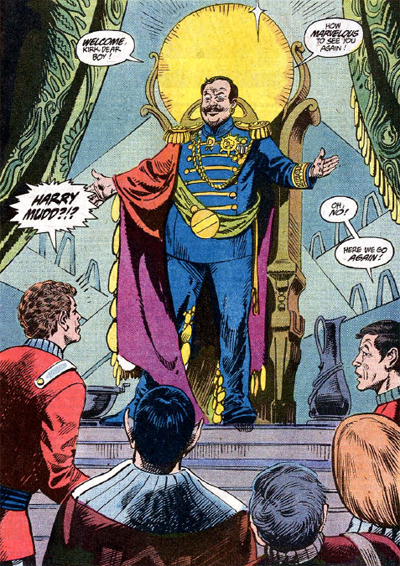
Star Trek (DC Comics, 1984) #39-40 – The Return of Mudd (Review)

The first Star Trek pilot, The Cage, was produced in 1964. To celebrate its fiftieth anniversary, this December we are reviewing the second season of the original Star Trek show. You can check out our first season reviews here. Check back daily for the latest review.

By its nature, Star Trek had very few recurring guest stars – outside of recurring extras and the supporting senior staff.

Star Trek was a prime-time science-fiction show in the sixties. As such, it was strongly episodic. More than that, it was a show that included its stated goal – “to explore strange new worlds” – in a narration over the opening credits. As such, the show did not tend to bring back too many recurring characters. Gene L. Coon had tried to introduce a recurring foil for Kirk in the second season, but Robert Justman had vetoed the reappearance of Kor in A Private Little War and Coon would depart before he could follow through on plans to make Koloth a recurring adversary.

Our man Mudd...

Our man Mudd…

Of course, this has not stopped Star Trek fans from seizing on various one-shot characters from the three seasons of the original Star Trek. Despite only appearing in Errand of Mercy, Kor has become a frequently recurring character in the Star Trek mythos. Gary Seven has spun off from Assignment: Earth into a string of novels and comics. Christopher Pike only appeared with Kirk in one single story, but there is a huge amount of literature dedicated to him. Still, this means that the elements which do recur are given a bit more weight.

Klingons, Romulans and Vulcans are a vital part of the Star Trek mythos. Khan Noonien Singh only appeared in Space Seed and Star Trek II: The Wrath of Khan, but his memory haunts the franchise to the point where he was revived for Star Trek Into Darkness. Harry Mudd has the distinction of being the only non-crewmember to recur within the original run of eighty episodes. So it is no surprise that Harry Mudd has become one of the most frequently recurring guest stars in the history of the franchise.

Kirk meets quirky...

Kirk meets quirky…

Continue reading

Star Trek – A Private Little War (Review)

The first Star Trek pilot, The Cage, was produced in 1964. To celebrate its fiftieth anniversary, this December we are reviewing the second season of the original Star Trek show. You can check out our first season reviews here. Check back daily for the latest review.

Star Trek is a pop culture relic of the sixties. It’s possible to see the decade reflected in just about every facet of the production. The show’s costume and set design speak to the decade, as do the series’ sexual politics. The Cold War colours a significant portion of the series, reflected in the Klingons and elsewhere. The Second World War is treated as the beginning of the future, while much emphasis is put on mankind’s expansion to the stars.

Even outside of these general parallels, there are episodes that speak to particular facets of the sixties. The Naked Time, This Side of Paradise and The Way to Eden all play with the idea of social liberation. The Ultimate Computer, Return of the Archons, The Apple and The Changeling all speak to concerns and insecurities about the rapid advance of technology and the people left behind. Journey to Babel touches on the gap felt between conservative parents and liberal children ready to embrace life’s possibilities.

Make war, not love...

Make war, not love…

And then there’s the Vietnam episodes. Shows like Errand of Mercy and A Taste of Armageddon reflect the conflict in a number of ways that were not possible in the scripted dramas of the time. However, A Private Little War is perhaps the definitive Vietnam episode. Part of this is due to the script and the production, which makes explicit reference to “the twentieth century brush wars on the Asian continent.” With the Klingons and the Federation meddling directly in the conflict on a small backwater planet, comparisons invite themselves.

However, there were factors at play outside the control of the production team. A Private Little War was produced in late 1967. It aired on February 2, 1968. However, North Vietnamese forces had launched the Tet Offensive only a few days earlier – the campaign would land through the end of March. The Tet Offensive would end with the North Vietnamese suffering heavier losses than the American or South Vietnamese forces, but the attacks would have a devastating affect on public opinion.

"Got your nose! And, soon, your planet!"

“Got your nose! And, soon, your planet!”

A Private Little War is placed terribly. It is a reluctant justification of the Vietnam War, presenting interference in a foreign war as a terrible (but necessary) burden weighing on Kirk’s conscience. The episode closes with Kirk committing to arm the natives, even if the show doesn’t have the courage of its conviction to follow the idea to its logical consequences. For all that Star Trek is described as a liberal and pacifistic vision of the future, A Private Little War endorses American interference in Vietnam.

The broadcast of A Private Little War only a couple of days following the turning point of the public perception of the war is an absolutely fascinating pop cultural synergy – a demonstration of how Star Trek was inevitably and inexorably of its time in a way that even a few months delay between filming and broadcast could change the context of the episode so dramatically.

I wouldn't look so happy with myself...

I wouldn’t look so happy with myself…

Continue reading

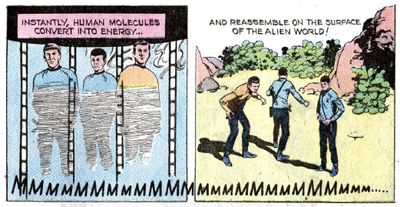
Star Trek (Gold Key) #61 – Operation Con Game (Review)

The first Star Trek pilot, The Cage, was produced in 1964. To celebrate its fiftieth anniversary, this December we are reviewing the second season of the original Star Trek show. You can check out our first season reviews here. Check back daily for the latest review.

The Gold Key comics came a long way, in the end.

The early issues were full of errors and contradictions – feeling like Star Trek as described across a crowded bar, the broad strokes present but the details never synching up. Those early comics – much like James Blish’s novelisations – suggest a missing link between Star Trek and fifties science-fiction. The earliest issues offered a glimpse of Star Trek through a prism. However, the comics grew more professional (and more familiar with their source material) as they went along.

Beam me down, Scotty...

Beam me down, Scotty…

Indeed, the series attracted a number of notable writers and artists, including Len Wein. Wein would go on to write for the franchise when DC procured the license in the mid-eighties. More than that, it was clear that the writers and artists had begun to watch the show. There were none of the early mistakes that come from working with publicity materials and without context. Although the earliest issue of the comics achieved infamy among Star Trek fans, the book ran for over a decade – stumbling a bit close to traditional Star Trek values as it went along, even if it never quite abandoned its more absurd tendencies.

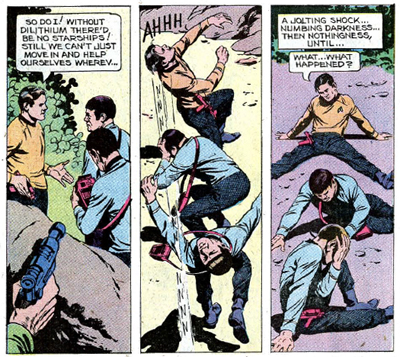
Operation Con Game is the last issue of Star Trek published by Gold Key, and serves as an example of how far the comics have come.

Disrupting that thought...

Disrupting that thought…

Continue reading

Star Trek – Journey to Babel (Review)

The first Star Trek pilot, The Cage, was produced in 1964. To celebrate its fiftieth anniversary, this December we are reviewing the second season of the original Star Trek show. You can check out our first season reviews here. Check back daily for the latest review.

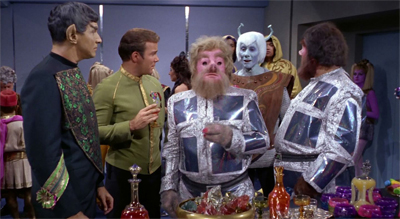
Journey to Babel is pretty influential, as episodes of Star Trek go. It is an episode that really cements idea of the Federation that came to be at the heart of the franchise, suggesting that the organisation really is a diverse intergalactic alliance of diverse alien species, rather than a union between Earth and Vulcan. More than that, the episode suggests that the individual members of the Federation might not exist in perfect harmony with one another, but may each operate with their own agenda and motivations.

However, what is really remarkable about Journey to Babel is how much of this unfolds in the background. All this world-building and -embellishing is very much a secondary concern for writer D.C. Fontana. Despite its scale and its scope, Journey to Babel is a decidedly personal story about a family in crisis. It works remarkably well, offering viewers a bit more insight into Spock as a character and where he came from.

Party on, Gav...

Party on, Gav…

Continue reading